Showing posts with label Christian Film-A-Thon 2014. Show all posts

Thursday, December 26, 2019

Kirk Cameron's Saving Christmas (2014) - A Celebration of Avarice


(The following content is reran from the 2018 Christmas marathon on Letterboxd, as originally seen here.)

Against every better instinct I have, I'm starting this review by playing nice. The basic theory underlining Kirk Cameron's arguments in Saving Christmas is not inherently flawed or condemnable. Across multiple narrated vignettes, Kirk argues against worries about the commercialization and secularization of Christmas by finding avenues to link activities and iconography commonly associated with the holiday back to Jesus. He's effectively saying one shouldn't lose heart in the validity of their faith when they see trappings of Santa Claus and mistletoe everywhere, as a good Christian will find ways of reaffirming their connection to God and Jesus in the everyday. If you place sufficient value on your spiritual life, the idea holds merit. Make your practice a personal matter, maintain a mindful attitude surrounding its tenants, and find strength through reflection on what you believe and why.

Thing about theories, though: they can only remain pure, untainted notions in perfect isolation. When Kirk Cameron puts this theory of argument into practice in Saving Christmas, he uses it to spin baffling nonsense about how Adam needed to put the forbidden fruit back on the Tree of Knowledge to get right with God, so Jesus going up on a wooden cross was a symbolic token to the same effect, thus turning all Christmas trees into unused crosses representing the salvation of mankind. He rambles on about how the historical Saint Nicholas punching a heretic at some ancient holy conference proves the current incarnation of Santa Claus is a crusader for the faith and some kind of badass warrior preacher. Christmas presents become the New Jerusalem, a somewhat interesting theological discussion about the relationship between Jesus' swaddling cloth and the Shroud of Turin becomes reason to not bemoan the lack of a nativity scene, and nutcrackers become Herod's baby-killing soldiers, now transformed into defenders of the holy way. To Kirk Cameron, finding the sacred in the secular seemingly means pulling up little bits and bobs of trivia from hagiography and apocryphal doctrine to justify not changing one's ways or attitudes in the slightest. The application falls just a tiny bit short of the theory.

Now, this is all VERY badly presented. Saving Christmas boats a bland visual style and an incredibly boring camera. We have to listen to Kirk Cameron put on his best William Shatner impression, stretching out every single monologue to three or four times its necessary length. He and his costars act by scrunching up their faces and wiggling from one weird expression to the next in a pantomime of what they think sudden enlightenment looks like. There are completely unnecessary digressions to Not Chris Rock doing his standup routine, a conspiracy theorist rambling on about Area 52 and poison in the hot cocoa, and a protracted breakdancing sequence towards the end set to the most repetitive sounding electronic dance hip-hop cover you could squeeze out of Angels We Have Heard on High. When the movie DOES deign to focus on its main conflict of Kirk talking to his brother in the car, the visual flairs it offers to keep the monologues interesting alternate between lazily floating through caves and Christmas tree lots, and scruffy-dirty-bearded-tavern-scripture-quoting-triphop-scored-Santa-beatdowns. It is two scenes from a real movie stretched out to forty minutes, with the remaining half-hour filled by inhuman attempts at comedy.

Still... it is not inherently loathsome. Horrendously executed, amateurishly argued, insulting on multiple levels, but not hateful like God's Not Dead. I INTENDED to go the tiniest bit easy on Kirk Cameron's Saving Christmas and give it one single, solitary star, as the smallest offer of mercy. "You're completely bugnuts, Kirk Cameron, and I don't agree with a single thing you've to say. Power to you to waste your money saying it in a movie, tho," sort of thing.

Then Kirk Cameron got to justifying conspicuous consumption and holiday avarice. Jesus IS the reason for the season, after all, and because Jesus took a material form when God sent him to earth, we should all celebrate his birth by spending and hoarding and glutting ourselves to excess. MORE materialism means MORE material stuff, and the MORE material stuff you have in your life, the MORE Jesus you have in your heart, or... something.

The rest of Kirk's arguments at least have either sufficient theological merit to get a pass in isolation, or are harmless enough to pass with a bewildered, "believe what you wanna believe, man..." This, though? This is straight up "the very things people claim run against the spirit of the holiday and Christ's fundamental teachings are actually virtues we should indulge in without restraint, because I did a little bit of wordplay." It is mindbogglingly misguided at best, willfully hard-hearted and selfish at worst. The whole idea retroactively strips the rest of the film's arguments of their scarce value, as it reveals the total lack of thought and introspection behind their conception. All we have here is a mouth set into a slab flesh, blathering away with the sole aim of vindicating its own capacity to speak and eat without shame.

Having seen all seven films, the question still remains: Why WERE there so many Christian films released in 2014? We know Kirk Cameron put out his film because Kirk Cameron is a crazy person who honestly thought telling non-believers their secular trappings are actually religious out one side of his mouth while telling the faithful they should abandon their morals and mindlessly feast would somehow earn him critical acclaim or substantial profit. But why did the world see the production and distribution of not only this many films, but the wide-release and heavier-than-average media coverage of the same? Is there any linking factor between the impetus to create Son of God, God's Not Dead, Noah, Heaven Is For Real, Left BehindExodus: Gods and Kings, and Kirk Cameron's Saving Christmas?

After many hours of consideration, internal debate, and fine-tuned analysis, I come to the conclusion 2014 saw the release of so many Christian films because multiple unrelated entities saw an opportunity to service/exploit a monied crowd whose opinions on the larger culture included a belief that they experience undue suppression in the media, and all happened to complete and circulate their products at around the same time. Some did this out of genuine belief, some did this to fulfill an artistic impulse, some wanted to turn a profit and nothing else, and some are Kirk Cameron. Either way, an abnormally wide-spread response to a potentially profitable business venture handily explains the whole phenomenon. Shocking revelations, I know. Kirk Cameron's the one who stopped talking in code and waffled on about how the liberals want Christmas to be more PC and keep Christians from practicing in public. Blame him for the blunt, cynical verdict here.

0.5/5

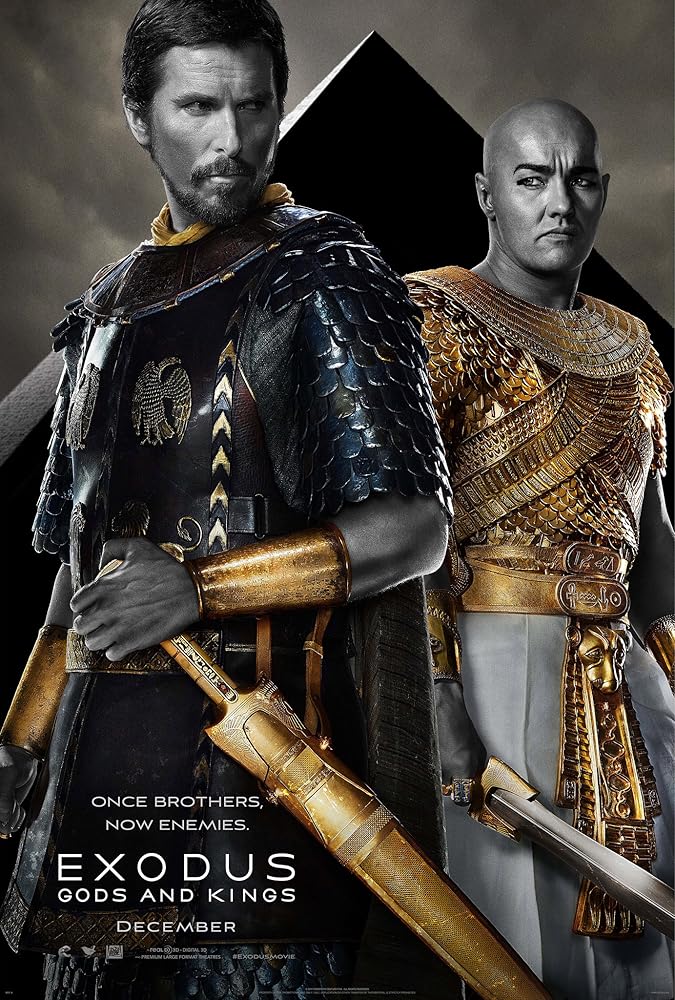
Exodus: Gods and Kings (2014) - A Reinterpretation of Scripture

(The following content is reran from the 2018 Christmas marathon on Letterboxd, as originally seen here.)

Why were there so many Christian films in 2014? In part, because Ridley Scott's adaptation of Moses' story hit theaters in early December. If we're to believe Scott's comments regarding the film's casting, had he bothered scouting for actors whose background remotely reflected those of characters and historical persons of Middle Eastern descent roughly 2000 BCE, we'd have gone down a film that year. Apparently, hiring actors whose skin is too dark or whose names are too foreign-sounding when making a film about the Exodus narrative means no studio will fork over a budget big enough to depict the Plagues or Parting the Red Sea properly. Whether the film was worth dousing Joel Edgerton, John Turturro, Aaron Paul, and others in varying degrees of brownface is a little bit up in the air, as the final product is a fairly mixed.

Giving a tiny bit of credence to Scott's financial justification for whitewashing and brownfacing his cast, the special effects during the big, spectacular Acts of God sequences are appropriately grandiose, and have an interesting bent to their execution. The film tries to find some natural means of explaining fantastical events, and so the plagues have initially sound justification for the Nile turning to blood, frequent swarms of destructive insects, and boils upon every Egyptian. Moses parting the Red Sea is treated as a potentially coincidental happening with only circumstantial ties to his own actions, which he must take advantage of as means of proving his connection to God to the doubting tribes. When it comes time for God's hand to become visible and explicit in its actions, the visuals gain a properly cinematic sheen, with a creeping shadow claiming each firstborn and the sea slowly collapsing back in on itself in a rushing tidal wave.

Exodus' new interpretation of Moses has some merit as well. It ditches the traditional role of shepherd and vessel of God in favor of a military man whose connection to the Lord may well be resultant from a traumatic head injury. There's a potentially neat dynamic around the midpoint, when Moses has returned to Egypt and determined to free his people through guerrilla warfare, intending to break Ramasses' will through attrition. As a concept, it makes some sense for a man brought up to lead armies to approach freedom from a fighting standpoint, and the film expands on this notion by contrasting it against God's proof that He can manage the same strategy far more effectively. I can see the intent, slowly nudging Moses out of his comfort zone and into the part of spiritual leader, and it might've worked!

But then we get into a major problem with Exodus: Gods and Kings: the storytelling and acting. Say what you will about Cecil B deMille as a director of crowds rather than actors; The Ten Commandments handily demonstrates how, with a lengthy enough running time and some talented players on hand, he could hammer a fully fleshed, comprehensive version of the material. Ridley Scott, working with still considerable two-and-a-half hours of screentime and actors of far greater standing than Charlton Heston, somehow cannot wrangle an ounce of humanity or relatability out of one of the quintessential religious stories about the power of faith and striving for freedom. He changes the script up far too frequently, giving Christian Bale and Joel Edgerton very little time to establish their characters as much beyond the same basic personalities in a slightly different situation before they overextend themselves or fade into the background. It's weird to think of a movie this long as feeling rushed, but it tries to cram in several additional scenarios for the rival brothers to work their way through in addition to the already shifting narrative of scripture, which makes odd moments like Edgerton's over-reliance on bellowing his lines to convey emotion, or the absolute stone-cold-stunner of, "From an economic standpoint alone, what you ask is problematic at best," stand out all the more.

Moses suffers the most here, as Scott's conception of a more secular prophet of the Jewish peoples comes off half-formed at best. The notion of moving him from commander of armies to rough-hewn freedom fighter to the Moses of Biblical understanding DOES have merit, but the film's eagerness to move from scenario to scenario means it never really slows down to examine Moses' psychology, or the deeper implications of his transformed state. A large portion of the middle stretch is taken up with Moses arguing with God in little circles about the morality of his actions without moving forwards. While his hollowed, resigned warning to Ramasses on the eve of the tenth plague and full confirmation of God's might has promise, it becomes a weirdly-shaped wrinkle when Moses' next big action involves triggering the parting of the seas with an act of doubt at God's presence. He awkwardly jolts from state to state depending on what the film deems necessary, and for all the hats he wears throughout the narrative, we ultimately see something less than the textual Moses.

When considering Biblical stories and characters, one needs to remember they rarely follow modern conventions of narrative structure or dynamic characters. The presentation on page frequently involves little more than "and then this happened, and so it was, and then this happened, and so it was, and then..." while the characters we're meant to learn from achieve their status as teachers by way of embodying an infallible moral righteousness. Introducing fallibility and uncertainty, then, is an easy way to make the old patriarchs and prophets more relatable, and examine their ideologies in greater detail. Taking Moses for an example, you have a man who knows exactly what he means to do the second God comes into his life, and hammers against the Pharaoh with unflinching certainty until he succeeds, only to turn the wrath of the Lord upon his own people when they fall short. Following the need to transform the character into something understandable and readable as an actual person in the moment, deMille kept the strong authority figure image, and whilst heavily emphasizing Moses' role as a lawmaker and Jesus-like figure, a good fit for mid-50s American culture.

Ridley Scott and Christian Bale's Moses does not only suffer from the story refusing to slow down long enough to examine him as a person - he sinks further because the film is naked about its intent to change him for profit. This Moses is not a man brought up to lead armies who later uses his experience to engage in a dragout war with his brother because it contrasts with any particular weightiness against his eventual turn to pure belief and subservience to God. He is a general-king because it enables to filmmakers to actionize the material, cram a few extra battle sequences in amidst the scenes of Biblical devastation, leverage the allure of a recently-departed Batman hanging around the studio. Action is not an inherent evil, and can be readily employed to underscore some greater point within the story, but Exodus' action scenes exist only to wow. Without proper interrogation of what this new strategically-minded, ready-to-doubt characterization means for Moses, the lurching nature of his character arc becomes more pronounced, and we end where we should have started.

They go and sideline the Golden Calf portion of the story, too, which is pretty much the most important part of Exodus if you're trying to give Moses a story about coming into conflict with God's divine wrath and learning to trust in His will instead of the strength in your own hands. There's fertile ground in a changed Moses suddenly turning against the very people he won over, the challenge of leading them to as pure a faith as his over forty years in the desert, and it's relegated to a single, far-away shot. That's how unwilling Gods and Kings is to engage with the implications of its alterations.

Initially, I felt three made for a fair rating. Ridley Scott at least provided some rather impressive vistas and battle sequences and visions of destruction on a mass scale. As I thought through the film more, though, I realized most of those visual effects-dependent scenes were either unnecessary attempts at actionization, or an inkling less impressive than equivalents in the deMille epic thanks to the (relative) ease of creating such shots in a computer compared against wranglings tens of thousands of cast and crew for similar effect. Though I do still find the Plagues and the Red Sea sequence both visually compelling and well-executed storytelling, I don't think the press of so many other visuals souring the more I contemplate them deserves too high a praise. Loop the brownface back into the discussion, and I'm more than happy to give Exodus: Gods and Kings my patented "there's some good things here, but man, the bad will weigh on your mind" rating.

Next time: The final installment of this impulsive Christmas series! Who all's ready for Kirk Cameron to celebrate the virtues of greed, gluttony, and conspicuous consumerism!

I'm not.

2.5/5

Tuesday, December 24, 2019

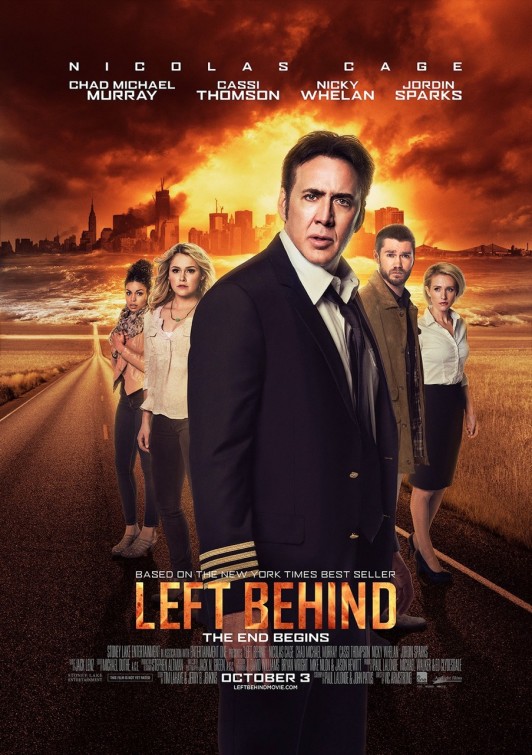
Left Behind (2014) - A Fanfic of the Apocalypse

(The following content is reran from the 2018 Christmas marathon on Letterboxd, as originally seen here.)

Why were there so many Christian movies in 2014? In part, because writer/producer Paul LaLonde finally raised sufficient funds to get a new adaptation of Tim LaHaye's sixteen-volume Left Behind series off the ground. A previous trilogy of films about the exploits of RAYFORD STEELE and BUCK WILLIAMS in the wake of the faithful's physical Rapturing to Heaven saw increasingly weak critical and financial success, and Kirk Cameron's continued slide into Evangelical nutjob-ery made his return impossible, so LaLonde instead snagged up a paycheck-desperate Nic Cage, a few vaguely recognizable character actors, and set about with his readaptation. Unlike his fellow Christian filmmakers, he didn't finish his movie in time for the lucrative Easter season, and evidently didn't feel like holding back for a month until Christmas, so the final product wound up dumped in early October and quickly forgotten.

Side note: In spite of a crowdfunding campaign for a sequel failing miserably, LaLonde has announced plans to adapt all sixteen books of the Left Behind series. Maybe he'll actually get around to filming something interesting on one of these future outings.

I'm incredibly disappointed in Left Behind. You hear the plot summary of the books and think to yourself, "Well, it might not sound GOOD, but they at least commit to spouting some absolute lunacy." Millions upon millions of good Christians bodily vanish in an instant, and the whole world instantly falls into rioting and chaos. A select number of survivors form the Tribulation Force to defend and convert the remaining unfaithful during seven years of hardship. There's conspiracies and redrawn national borders and armies of millions and a ceaseless war against the Antichrist against a backdrop of flame as the sun ejects half its matter onto the planet's ever-quaking surface. The whole thing's predicated on the notion all non-Christians need to hurry the hell up and get with the program lest they experience untold suffering for their staunch refusal to believe, but it's sort the sort of thriller where Russia can form a union with multiple European nations to simultaneously nuke Israel, only for God to vanish the nukes and plant them in the capital cities of the aggressors seconds before detonation. If the piled up nonsense still isn't tantalizing enough, I remind you this new adaptation has Nic Cage as a man whose faith is tested in the first hours after the Rapture. We have open invitation to completely lose our shit here.

Instead, it seems LaLonde and director Vic Armstrong decided the "try to act like we're normal people who believe normal things so the conversion message sells better" part of the job was more important than the "Lean into a full sixteen books of increasing fantasy insanity" aspect. A film starring a paycheck-cashing Cage and supporting actors in starring roles from a stuntman director never had much chance of achieving a great deal of depth, but relegating the action to Captain Steele's attempts to land his plane and nothing else smothers the film. With such a limited scope, all the movie has space for is characters with one-note personalities getting into arbitrary conversations/arguments in a confined space, while those whose book-counterparts are presumably more developed suffer through having to solve a conflict totally unrelated to their later apocalypse ministry. There are exactly three people who matter in this movie if my interpretation of the Wikipedia summaries for the books is correct, and their movement throughout the film can be easily boiled down to "is not a Christian" for 95% of the runtime, and "is a Christian" for the final 5%. That's not a heck of a lot to hang a "land the airplane" thriller on.

They could offer up SOMETHING here, but even if I set aside my disappointment at not seeing Nic Cage wage psychological warfare against the UN-leader Antichrist, there's nothing. The other passengers on their airplane occasionally set-up possibly interesting conflicts, like the pissing match between the Muslim and the little person, or the guy convinced everything is happening because aliens, or the woman who resorts to threatening everyone with a firearm after she becomes convinced they're all in on an act to steal her child. These situations are universally defused within two minutes of their introduction, and wrap back around to the same ol' "where did the other people go?" question without fail. Buck Williams is a total wash of a character, despite the half-hour prior to the Rapture taking its time to give him some connection to almost everyone onscrreen. Cage barely emotes as Steele, not even bothering with his trademark swaggering awkwardness, and favoring a bland, generically frustrated "ordinary man in a crisis" persona. Steele's daughter gets a lot of screentime wandering the post-Rapture world looking for her brother, which accomplishes nothing other than introducing a short cameo from another book character, and underscoring just how awful God is in this fictional world.

God seriously needs a better publicity guy. Throughout this review series, I keep mentioning how the Bible contains plenty of good messages and guidance for living one's life, so long as you read it critically and understand the cultural gaps between when it was written and the present day. However, across five films - four of which so far have served as not-so-covert attempts at converting nonbelievers - we've seen nothing but idle interventions, echoing silences, and a penchant for cruel torture, with this film representing the height of the final tendency. Were it not for Captain Steele's conversion in the last few minutes, I'd consider it a decidedly anti-religious film, what with all the focus on chaos and confusion and suffering as a result of his great gift to the world. I know and you know it's all MEANT as a time of hardship to sort out the worthy from the unworthy and grant the nonfaithful a final, true test of character before the End Times proper, but the movie never once mentions any of this. We're apparently supposed to watch all this destruction, see the devastation of parents who lost their children and good people deemed wicked sinners for a simple human failing, and think this a good and right part of God's plan because... well, because Nic Cage tells his passengers to pray before landing, I think.

It is, if nothing else, a spectacular self-own: You realize your source material has a little too much crazy religious fundamentalism to effectively work as propaganda, so you expunge everything but the inciting incident and "thrills" of trying to land a plane in a panic, only to also leave out all clarification for why the audience should take these developments as beatific, thus making the deity you worship look even crueler than his book-counterpart's relentless hammering upon the earth. Nothing works in Left Behind, unless you want to count the unintended comedic value in scenes like the bait-and-switch electric toothbrush, Nic Cage's last second attempts to avoid collision with a wholly-Raptured plane, or the sheer speed with which polite society descends into petty thieving and murder once there aren't any TRUE Christians left. I'm only giving it 1.5 stars because it does such a thorough job of scrubbing out the truly hateful parts of its ideology as to work against its own purposes, and argue the virtues of agnosticism. Nic Cage's performance barely rises above sleepwalking, so why bother?

Next time, Ridley Scott does some whitewashing, but still makes a real movie.

1.5/5

Monday, December 23, 2019

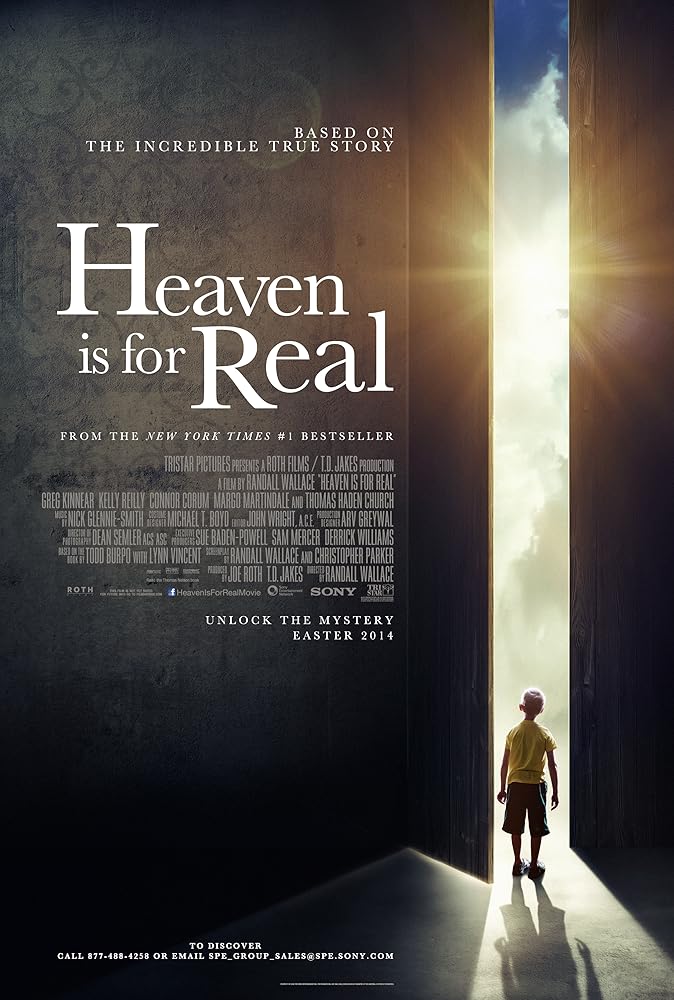
Heaven is For Real (2014) - An Exploitation of Innocence


(The following content is reran from the 2018 Christmas marathon on Letterboxd, as originally seen here.)

Why were there so many Christian films in 2014? In part, we can thank Todd Burpo, for deciding his lucratively successful Heaven Is For Real ministry venture simply couldn't make do with a successful tell-all book, press tours, and speaking appearances by his underaged son Colton, all recounting the boy's trip to heaven during an appendicitis surgery when he was three. In addition to all his other flush sources of income, Todd decided he needed to give his son his very own movie, directed by a real director, starring real actors, and distributed by a production company whose reality is questionable at best but leans towards interaction with this plane on good days. I won't bother with the question of whether the movie deserved to exist - while I'm normally inclined to say all artistic expression deserves a chance, Todd Burpo's entire career over these last fifteen years has rested upon the exploitation of a child who only just recently became a legal adult. He has no right to treat his son like a rarefied prop with which to entertain and inspire the masses, and he certainly should not predicate a kid's upbringing on being The Single Most Important Person On The Planet. It's terrible parenting to use your offspring for financial gain, and if there's an ounce of truth to anything he spews about heaven by manipulating Colton's story, I can't imagine any criteria through which he gains entry.

Shouldn't come as any great surprise, then, that Heaven Is For Real's biggest issues spring from the need to satisfy Todd's narrative. Carved away from the terrible real life circumstances leading to its creation, there's merit to the inciting incident and subsequent fallout as a story in its own right. A man of faith who wears many hats in his close-knit community suffers a series of medical and financial woes, culminating in the near-death of his toddler-aged son on the operating table. He soldiers on through the pain despite shaken beliefs, until his son claims to have left his body and seen the Lord God and Jesus. This spins into two interlinking issues, as the father is desperate for any reason to strengthen his beliefs again and begins treating his son like an authority figure instead of raising him, and the larger community bristles at the notion of their pastor moving from preaching useful metaphor to Biblical literalism. There's something interesting in the notion of laying a man so low and asking him to continue displaying the same level of strength and confidence he embodied before in the face of doubts and personal weakness. You could wrangle a decent ending out of such a story.

In fact, while watching, a superior version of this tale cropped up in my head. Basically, Todd realizes he's let his need to believe beyond a shadow of a doubt overwhelm his duty as parent and preacher, and potentially run the risk of damaging his son's development. The solution isn't to find irrefutable proof in Colton's statements and make the whole community come about to a new way of thinking, but rather to synthesize his two duties. He was neglectful towards Colton towards the start of the picture, after all, and the weakening of his passion for preaching correlates strongly to his increasing need for evidence. As a man of faith, he knows his scripture, and as a father, he knows his son. The two roles need not come into conflict with one another - the confidence and displays of strength he needs as a father can revitalize his sermons, and the depths of his faith can enable him to believe Colton's stories through his own lens of understanding without deferring the power in a father-son relationship to a child in hopes of greater understanding. Leave the actual truth of Colton's trip to heaven ambiguous, call for unity through common love of Jesus and the Bible's teachings, and there you have it. Got a fairly decent Christian film with a nice little "love your kids, don't obsess over details, be a pillar for the community" message in it.

Course, with the Burpo family so closely involved in this film's financing and production, such an alternate take is all but impossible. A story very loosely inspired by real events might fly with such a different interpretation, but with Todd Burpo and his ministry getting a say in the story, no dice. Because the film needs to end with Colton proving heaven exists and Todd resolving all his woes with said proof, the promising material becomes total naff. The movie only acknowledges Todd's immediate, eager transfer of control to Colton as weird insofar as his failing to find the RIGHT way to give Colton control to bring about the appropriate revelation. Those viewing his behavior as distressing or inappropriate are cast as simply doubting without reason or angry at God for not granting them special treatment. The question of literal scripture against metaphorical readings drops out of sight the moment Colton goes from describing general childlike interpretations of what he's heard in church to truth bombs beyond his understanding. Every conflict and character has to eventually run aground of the undeniable "truth" and come around to a singular point of view, and so the movie loses any impact its high-minded questions might've offered.

Any religious movie preaching a fundamentalist viewpoint is bound to be bad, but this isn't to say the final product is devoid of merit. The camerawork goes a fair ways towards keeping the film in the "bad but I can respect some elements" two star category, rather than the lower realms of actual hate the source and story deserve. Visually, Heaven Is For Real acquits itself well, thanks to Randal Wallace's direction of alternately storied/hacky cinematographer Dean Semler. The Nebraskan vistas and awe-inspiring glances to the sky have more of a gentler 80s Mad Max or contemporary Dances With Wolves feel than the same man's work on something like Peep Beep Meme Creep 2, and there are some interesting camera pushes here and there which feel like they belong in a better movie. There's a general folksy sense about this community and its people, one I rather like in spite of its total lack of authenticity when compared against the millionaire who minted his fortune by using his son. I can even find some merit in the way Greg Kinnear plays Todd's wide-eyed obsession opposite Connor Corum's innocent proclamations.

If you want a good idea of how Heaven Is For Real feels in a neatly-wrapped package, I think it's worth considering an early scene where Todd visits a psychologist concerning Colton's strange behavior. She dispenses some highly sensible avenues for diagnosis and treatment, only for Todd to effectively go "What if hlurgly blurgy bloo," which prompts her to suggest ESP as a more reasonable alternative. Todd then dismisses her profession, and refuses to consider his son as anything except a perfect source of knowledge who's causing HIM problems for the rest of the runtime. The movie as a whole also dovetails from something with the potential for constructive conversation into, "Well I can't understand it, so I'll just say something crazy and dig in my heels." Give more consideration to Colton's needs and experiences, acknowledge Todd's maladaptive reactions, do anything except fall back on an unexamined revitalization of faith. Anything's better than allowing a man who quite plainly views his son as a cashflow more than a person any measure of vindication.

Next time - Kirk Cameron's flamed out, so we're doing apocalypse fan-fiction with Nic Cage instead.

2/5

Sunday, December 22, 2019

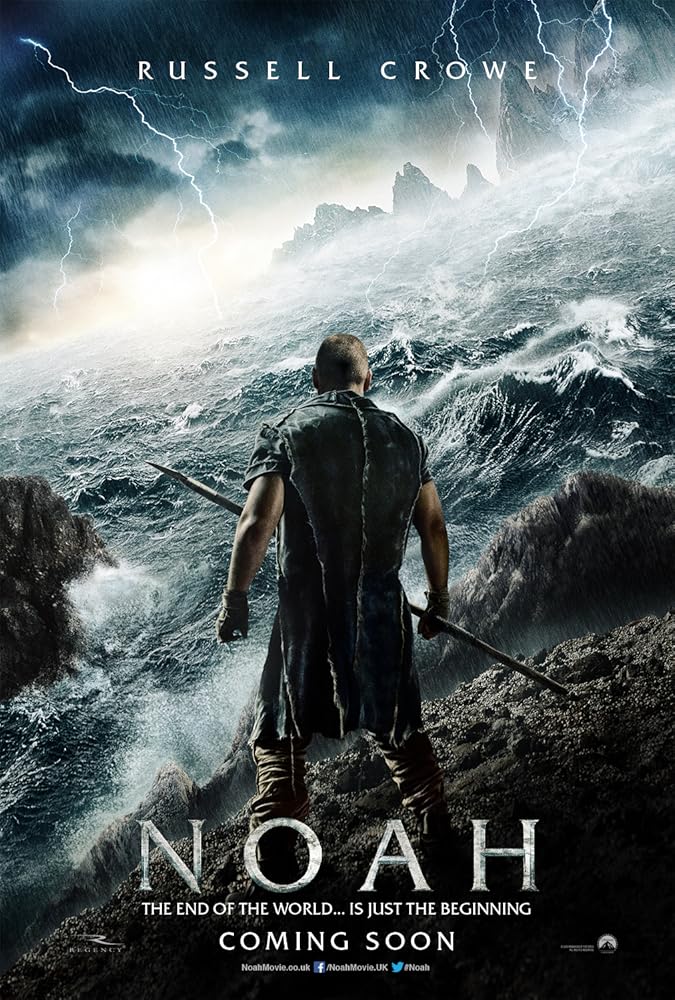
Noah (2014) - A Blockbuster From the Arthouse

(The following content is reran from the 2018 Christmas marathon on Letterboxd, as originally seen here.)

Why were there so many Christian films in 2014? In part, because Darren Aronofsky's fifteen year struggle to bring his vision of the Biblical Flood to the big screen finally bore fruit. A director whose work frequently involves characters pushing themselves to radical extremes, Aronofsky makes an interesting helm for the story of Noah, the patriarch who left all mankind to die beneath God's raging seas to preserve the sanctity of Creation. It's both a reversal and embrace of his usual ideas about the self and the masses, and it all comes packaged with a massive budget and expectations for big returns, courtesy of his success with The Wrestler and Black Swan. As the film proved a success critically and financially, and comes from the mind of a director with actual artistic ambitions, the only "did this movie need to exist" joke I can think to make involves slinging mud at mother! for trying a move into entirely symbolic territory and losing some of the power.

Aronofsky finds a far more even balance between metaphor and narrative this time around. Several passages of Noah creep into pure visual storytelling, and not just those involving the voice of God penetrating Noah's thoughts as a rapid series of powerful images. The reinterpretation of Watchers as victims of God's wrath and eventual precursors to the New Testament style of forgiveness-based salvation also lends way to interesting creature design and bits of worldbuilding to create a unique yet still Biblically-grounded setting. Noah's retelling of Genesis' opening passages through a flashing look at the Big Bang, planetary formation, and evolution that gives way to the key images of the Eden story helps underscore his character of a highly principled man trying to interpret his Creator's will through preset personal beliefs - a man who holds all he sees as dear, intruded upon by the sin of simply living, commanded to oversee its destruction. And then you have the contrast between a manmade apocalypse of fire, Enoch's vision in a time when the descendants of Cain ruled the land, and Noah's prophecy of devastation by water. Both presented as horrifying, especially when we see the survivors attempting to drown out the screams of thousands left to suffer and die on the mountaintops, but only one carries the divine promise of something after.

Compared to mother!, the metaphors at play here have a far clearer purpose, and relate more directly to characters who register as actual people. I've seen much critique of the decision to cast Noah as a figure who would murder his own grandchildren to ensure humanity's extinction, but I think it works very well within the film's parameters and Biblical cnaon. All the really hard parts leading up to the flood - interpreting his visions, constructing the ark, gathering the animals, defending it against invaders - are presented as grand undertakings, yet comparatively nothing compared to squatting in the dark for months on end with the knowledge of his supposed duty. In a twist on the usual Judeo-Christian narrative of prophets and chosen men passing God's tests by proving themselves willing to enact his will no matter the cost, Noah comes through this period in which nobody can dissuade him from the ultimate evil by looking into the face of a newborn child, and showing mercy. For once, the Creator wants to see his progeny spare a life, set aside the grim determination necessary to watch the whole world die, and mark the beginning of a new era with compassion rather than the murderous rage of Cain. Taking this route gives us Noah as a miracle worker and a mere man, prone to false beliefs and internal conflict as much as any other - a far stronger character than Jennifer Lawrence's being totally subsumed into her role as God's power of creation and destruction.

Other characters make for somewhat compelling cases, though unfortunately most suffer the opposite problem as mother!'s cast, and become mere pieces in the narrative. Ham's secretive relationship with Tubalcain aboard the ark has some interesting aspects of temptation and the sin of arrogance, which makes for a good extension of the earlier corruption of a "we make our own destiny" mindset. I'm also rather a fan of Og and the other Watchers, and their brief journey from distrustful, bitter souls to sacrificing warriors. Looking at the rest of Noah's family, though, they seem a little empty, and don't make much of an impact on the story. For all of Aronofsky's subtextual challenging of Noah's inherent righteousness as a patriarch, he doesn't really afford wife Naamah or adoptive daughter Ila a chance to interrogate his beliefs before the flood, or play a part in his turn to peace afterwards. They scream and cry to no avail with all the passion of archetypes and none of the unique embodying aspects of individual characters, and ultimately weaken the notion of the necessity of a balance between total fealty to the Creator and blazing one's own trail. Consequently, Tubalcain's temptations seem more unexamined and obviously evil, rendering him a conventional arrogant bad guy in the middle of a narrative calling for something more nuanced.

There's other things I could complain about, like how unnaturally well-groomed Shem and Ila look compared to the grimy naturalist aesthetic of their family, or the grand scope of the special effects straining against even a liberal $125 million budget and making some of the more "epic" scenes look awkward, but I think I've gotten the bulk of my analysis and valid critiques on paper. Aronofsky definitely does better work when he has something concrete and human to come back to rather than the excess of a pure passion project. While Noah is very much a personal story for him, the demands of a film designed as a blockbuster keep him focused on attaching his keen eye for visual symbolism and intense editing to a story about actual people. He didn't produce a masterstroke thanks to the neglect of other characters and the unfortunate shortstop of ideas right before pushing them to something truly complex and layered, but he did make possibly the best Bible movie of the lot for this project. I'm beyond glad we have a creator who wants to consider the Bible as sacred text AND inspiration for their own thumbprint. A whole seven films of blind lionization in a single month might drive me mad, so I'll gladly take intriguing and beautiful yet somewhat stilted.

Anyways, next time we're exploiting a child's close shave with death. That'll be fun.

3.5/5

Saturday, December 21, 2019

God's Not Dead (2014) - A Copypasta For The Fanatical


(The following content is reran from the 2018 Christmas marathon on Letterboxd, as originally seen here.)

Why were there so many Christian movies in 2014? In part, because Pure Flix Entertainment finally got around to releasing a picture filmed in 2012 to wide audiences to promote the work of the Alliance Defending Freedom, take advantage of the Easter season, and paper over the then-recent controversy regarding Phil Robertson's religious beliefs. Whether or not the film needed to exist is up for debate, as despite the numerous court cases cited during the credits, the film bears little resemblance to a body of legal battles regarding homophobic counselors and misapplied free speech zone rules, and instead draws most of its inspiration from a tired anti-liberal-education copypasta. Its original content scarcely relates to the central story, pushing an odious ideology about how nobody can do right in this world unless they act in God's name, with those who fail to comply suffering grievous punishment until they see the light. There's scant little to recommend here to anyone of any religious, agnostic, or atheistic persuasion, but I gave Son of God a fair shake, so this one gets the proper treatment too.

Keeping our eye on the fringes for a start, God's Not Dead has an incredible mean streak mile wide. Without any rhyme or reason behind the inclusion of many characters and their subplots beyond tangential blood connections to other characters lacking in purpose, I believe the best way to impress the film's failings in this arena is to simply rattle off the worst examples rapid fire. A fair warning: These are all The Worst.

A blogger whose only presented crimes are not believing in Jesus and disliking Duck Dynasty is diagnosed with cancer shortly after confronting Willie Robertson. Every time we see her, she's grown more miserable and destitute as her boyfriend dumps her because she's going to die and the reality of her own mortality hangs over her head with every passing hour. When she decides to confront the movie's headline act, the Newsboys, at the end of the film, they convince her that all will be well if she simply loves Jesus, which she does. Her ex-boyfriend is the brother of someone sorta related to the main story, and his whole thing is being the worst person in the world despite also being a man who played Superman. He visits his elderly mother, brags about how he escaped the devil, and gets a few Jesus truth bombs dropped on his head by the dementia-riddled woman before committing manslaughter. Elsewhere, a girl from a Muslim home tries to hide her conversion to Christianity, only for her little brother to walk in on her listening to sermons on her iPod in a scene framed as if she's pleasuring herself. Her father finds out, beats her, and throws her out of the house, leading the girl to a set of pastors who convert her to Christianity proper even though she already did so. Said pastors are constantly dealing with God breaking the sparkplug in their car, supposedly so they can help the townspeople through various crises of faith. For a while, they're at least somewhat likable in how goofy and endearing they act, right up until they choose to convert a man who's dying on the sidewalk instead of calling for an ambulance. They then say this preventable tragedy is a cause for celebration, and laugh.

It's a horrendously repetitive narrative structure. Whenever we need to spice up the slight main story, we cut to one of these other figures, who do their thing for a few minutes before jumping back to the copypasta. Set-up, suffering, Jesus is the answer/swordbearer, repeat. That everyone serves only as ciphers isn't much of a surprise, nor the emotional simplicity or vacuousness with which the film treats their problems, nor the lack of care for framing and shot composition in favor of getting points across as bluntly as possible. The film comes from an evangelical perspective, and evangelical Christianity is not well-known for its tendency to empathize with outside perspectives or deal with dissent in a forgiving manner. "You disobey Jesus and the wrath of God will fall on thine head" is the extent of their shtick when it comes to sinners and nonbelievers, so you get what's advertised on the marque pretty quick.

I was looking for a way to lead the above paragraph into something along the lines of, "What IS surprising, though, is the total lack of care shown towards the actual meat of the film," with some ramblings about lost opportunities or potential for a better film, but then I realized there's nothing surprising about a copypasta meant to rile up the excessively religious coming out awful when stuck on the big screen. Our nominally main story about a freshman philosophy student having to debate his overly contentious atheist professor on the existence of God indulges freely in all the tropes of the online tale: a teacher who disbelieves so hard he actively hates God, the prevailing notion of the lone Christian standing against a sea of nonbelievers, arguments for belief requiring edited scripture or turnabout logic to function, a remarkably quick turnaround from initial proposition to total conversion from everyone in the class, and a self-satisfied air about a supposedly watertight argument that wouldn't pass inspection at Noah's dock. One can have quite a lot of fun mocking the main character's phenomenal photoshop powers in the face of his lackluster debate skills, or Kevin Sorbo debasing himself by throwing tantrums to cut down the university-system's validity, or even the focus on a Chinese student who's instantly enamored with this Jesus person he's never heard of as a means of getting some model minority work in here. All bad, all wrongheaded, all laughable, but not surprising in the slightest.

If anything surprises whatsoever, it's just how deep the aforementioned mean streak runs. So much time is spent on the philosophy class debates, with the occasional cut to something good happening to an unrelated Christian or something bad happening to an unrelated atheist. There's perfect groundwork for the film to at least possess a coherent argumentative structure, a la "Here is why I am right, and here is a portion of a side story that further proves my righteousness." Win the debate, show how it applies to the "real world," spit on the stinky professor and watch a concert. Except the professor is the man who's hit by a car and forced to convert in his agonizing final moments. It's not enough to simply win the argument and provide a logical, scientific basis for believing in God; we must completely destroy the primary atheistic force in the narrative and render his contributions bunk. The nonbelievers are both wrong AND deserving of death, and the further addition of celebration at his passing through both dialogue and a massive concert playing around the hit-and-run tanks an already bad product to the depths of a half-star rating.

I do honestly intend to play fair with Christianity and religiosity wherever applicable with this holiday project. Sitting down for a Christmastime marathon and using it as an excuse to savage those whose beliefs don't match mine isn't much in the holiday spirit, and I'm genuinely curious to see what the unexpectedly numerous mainstream Christian cinematic offerings from 2014 look like when considered as a whole. In the case of God's Not Dead, though, the film's text and proud display of support from an officially-recognized hate group means I can only fight clean for so long. It wants to advance a mindset under which exactly one way of life is ever acceptable, and those who refuse to cooperate must face a holy purge, and it does so with a sprawling, unconnected mess of a plot without any concern for writing good characters or convincing dialogue. Anything that one might call decent here, like the occasional camerawork or the tiny chill I get toward the end of the title song (because any musical piece doing the whole "we're whispering the first part of the chorus but then we burst back into full bombastic swing" thing can elicit such a reaction regardless of poor or repetitive quality), simply compounds the issue by making something grounded in regressive, scornful attitudes seem attractive. To an extent, it's not even worth getting upset over, so ridiculous is its perfect embodiment of every negative evangelical stereotype...

...until the main character claims you can prove Darwin's "nature does not jump" claim wrong by compressing billions of years into a single day, pretending you didn't do so, and claiming most of the modern biosphere assumed its current form in a relatively brief period of time. Then I have to pause the movie and yell about why it is wrong for several minutes.

Least the next film here has someone competent in the director's chair! I'm looking forward to this adaptation of the part of mother! where Jennifer Lawrence tries to deal with a burst pipe.

0.5/5

Thursday, December 19, 2019

Son of God (2013) - A Biography For Believers

(The following content is reran from the 2018 Christmas marathon on Letterboxd, as originally seen here.)

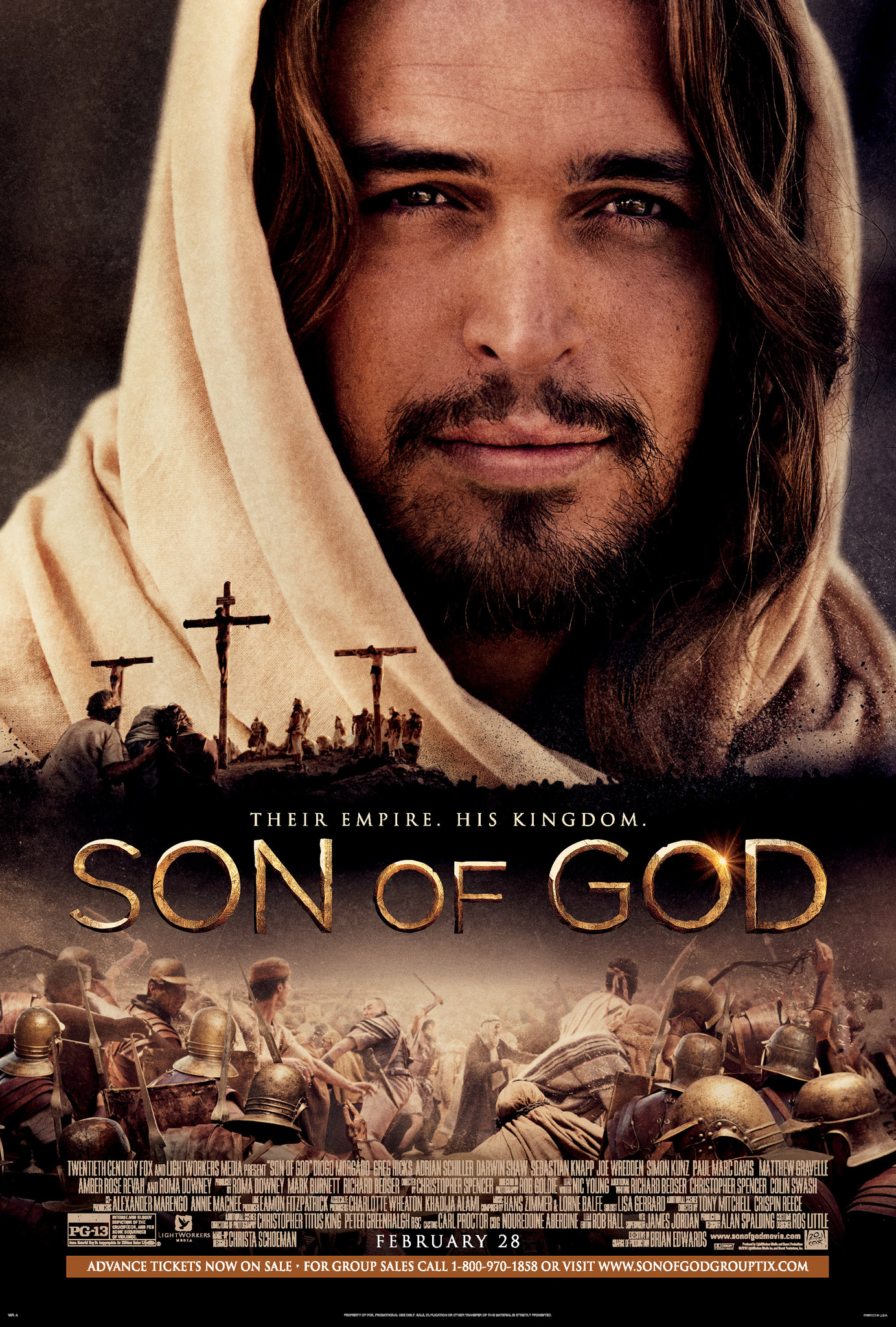
Why were there so many Christian movies in 2014? In part, we can thank Roma Downey and Mark Burnett of Lightworkers Media for deciding they needed to net some extra revenue from their 2013 History Channel miniseries The Bible, and releasing a cut down version of the four episodes concerning Jesus' life and deeds to theaters in late February. Whether or not the world needed this particular film to kick off the slate of seven to pierce the mainstream radar that year is a worthwhile question - the film leaves out many notable scenes from the Gospels and foregoes the series' narration, leaving behind a story already told free from character moments and unique stances on the Biblical narrative without proper transitions or context for what we're seeing. To the right eye, Son of God is pretty much useless as anything but an extension of the series' DVD sales (and, bizarrely, two redundant literary adaptations). We sat through all two hours and twenty minutes last night, though, so I feel obliged to treat it as a standalone work of adaptation, even bearing in mind the material was not designed to play this way.

On its own merits, Son of God isn't the worst thing in the world. I rather liked some of the little moments scattered about here and there, like introducing Jesus by half-submerging him in water as a means invoking his baptism and foreshadowing the later walking on water, or how Jesus' prayers in Gethsemane are cut against the pharisees and his disciples making their own calls to God. A few of the miracles have the basis of interesting techniques around them, such as Jesus feeding the 5000 by simply encouraging them to lift their baskets to the sky and bringing them down full of bread and fish, or the intense closeups marking Lazarus' resurrection. The guy playing Jesus mostly bases his performance on strong declarative readings of the famous sayings, which at least works well if you're only asking for a cliffnotes version of (most of) his famous deeds. It's not much, I'll confess. Having something nice to say about the film is still a welcome surprise, though.

Looking at the total scope, there's practically nothing here. While I mentioned the lack of important sequences like turning water to wine or the trial before Herod, I doubt this works well as compelling docudrama or fiction on its own merits. Son of God starts at the belief in Jesus' divinity and the importance of his ideals, and so resolves to spend its runtime presenting the necessary beats one after another without much flair. Jesus performs miracles and claims himself God's chosen son, confounds the local authorities with wise sayings beyond their comprehension, and astonishes his disciples most by claiming faith without sight is a grander thing than faith based on proof, in complete and total lockstep with what the Good Book says he did. His rage at the moneylenders in the Temple, his agony in the garden, his pain on the cross, they all come through without the slightest hint of the passion inherent to the story's very name. Jesus does what he does and is miraculous because Jesus does what he does and is miraculous in the Bible, and the movie thinks the tome so holy and worthy of reverence that it only deviates by omission, and never interprets or enhances.

I understand the reticence to do so. I'm no Biblical scholar or Christian - I came up in an agnostic household, my first exposure to the whole religion was a daycare teacher telling me I'd go to hell for not knowing what the Bible is, and that sort of soured me on the whole experiment for a while - but the tenants of the faith are familiar to me. If Jesus' story and the power inherent to him work best when you accept them unquestioningly, then to point to the Holy of Holies and claim something's wrong, that you can do it better, is akin to saying the new covenant between man and God has no power. Personal reinterpretation may be fine, depending on your sect, but in general one should strive to accept and internalize what's on the page, and never put out something defying the Word. If you're going to put the Bible on-screen, the best thing to do is to put it there as literally as possible, and stay out of its way.

Leaving aside the issue of trying to stage such a historical telling while casting actors whose ties to the Israeli homeland are almost nil, I don't think placing the holiness of the text above the personal connection does anyone any favors. Nothing is liable to supersede the original text, and a passionate reinterpretation designed for its time can have profound impact. After years of discounting the Bible and Christianity as institutions with good morals but not much modern value, watching Jesus Christ Superstar and seeing the story of Jesus in such a raw, emotional, humanizing manner on all levels got me interested in the continuing impact and validity of the story and its related tales for the very first time. That movie might scream 70s fashion and deliberately place itself both within and apart from the original setting by filming in on-location ruins, yet it is as alive and vibrant a tale as any I've seen. Judas and Caiaphas and Pilate all serve as barbing questions against the assumption of Jesus' divinity and good nature, and Jesus himself expresses open doubts as to the necessity of his project, only to be met with an abstract, inscrutable answer from God. The entire final half-hour demands an answer for why from Jesus again and again, and is only met with silence, and ultimately the confusion and anguish of the crucifixion.

And still, for all the silence, all the doubt, all the legitimate reasons to think Jesus only brought himself and those around him needless pain, the film ends on a shot of the cross silhouetted against the setting sun, a shepherd tending to his flock in the fields below, captured on film entirely by accident. If you want to distill the idea of believing without seeing, and so finding the Lord wherever you look into a single image, that's how you do it.

Son of God just has Jesus say as much before vanishing in a beam of light, because that's how the book did it, and so that's how we'll do it. It is so afraid to cast Jesus as anything except a man made of quotes and deeds, it robs him of whatever power a more heartfelt, artistic depiction might bring, and so fails as a recruitment tool.

It's a safe, easy, for-the-faithful only film, one which completely fails to understand the faithful need challenging and testing more than the non-believers. I cannot condemn it, for it does nothing condemnable save duplicate without skill or understanding. There exist far better depictions of this tale, far better stories inspired by it, far better shared connections from the heart of a moved believer to your own. Unfortunately, because we're looking at films designed to provoke, proselytize, and exploit those who have faith, we're not looking at many of those this Christmas season. I've got a surprise scheduled at the end to make sure this series is more than endless complaints about those who believe differently than I do expressing their religion wrong, but with what's coming up next on the docket...

Well, at least Son of God intends to preach the Word as it exists on the page.

2.5/5