Showing posts with label silents. Show all posts

Thursday, January 2, 2020

Limite (1931) - How would you feel if I told you she had leprosy?

Letterboxd Season Challenge 2019-2020!  Theme six, part one - a South American film!

(Chosen by me!)

A preface: Limite shall not receive a numerical rating at this review's conclusion.  Though claiming, "You watched this movie wrong!" is typically anathema to my perspectives as a critic and film fan alike, reviewing my own reactions as the film unfolded led me to believe I did exactly this.  Per the Walter Salles video essay accompanying the film on Criterion Channel as of this writing, director Mário Peixoto came from an artistic background steeped in poetry and the numerous experimental film movements across Europe in the 1920s before anything we might consider the typical narrative cinematic form.  His goals in creating Limite thus reflect this by placing emphasis on mood and movement far above any semblance of story in the manner of so many arthouse pictures, though it is not entirely a clean break.  To make a quick comparison against Tabu and the larger F.W. Murnau oeuvre, where Murnau would use a subjective camera and non-literal filmic techniques to suggest more spiritual passages or plunge his world into total otherness whilst still telling a story, Peixoto deploys what few narrative elements he has in complete subservience to the emotional thematic explorations on-screen.  Someone with more modern expectations of how films with narrative passages function might see these moments, and feel inclined to extrapolate narrative structural intent where there is none.

Or, put in simpler terms: the framing device with the boat threw me for a loop, because I thought it was going to be important to discern how each of the three silent, morose passengers came to be there, and spent more of the movie trying to puzzle out a beat-to-beat structure than appreciating the imagery and poetry Pexioto conjures.  Limite is an incredibly difficult movie to sit through with this mindset, as its many exploratory and experimental passages come to feel like lengthy distractions that drag longer than one would like.  Fortunately, I came to appreciate the film's actual intent further into the picture, but by the time I did so, I'd become fidgety and somewhat agitated, and so know I did not get the full and proper Limite experience.  Trying to assign a rating under these circumstances would lead to an unfair and uninformed numerical score, one which threatens to stand out more than anything I have to say.  So, on this understanding, I'll spend the rest of this review trying to communicate my analytical perspective on what Limite is an how it functions, and hopefully we'll get something more worthwhile from the exercise than me focusing on how I was, in a word, more bored than I'd've liked while watching.

So, that framing device.  After we see a woman gazing into the camera with rough, handcuffed hands round her neck, visions of a distant, tumultuous sea dancing before her eyes, we fade (as we do for numerous shots across the whole film) to a ramshackle rowboat with three people inside, a man and two women.  The man is perpetually bent over in contemplation, occasionally accepting something to eat or sharing a glance with his companions, but primarily affecting an air of one who wishes to never talk again.  The first woman, dressed in white, though occasionally animate and friendly, soon comes to turn her back against her fellow seabound captives, and stare out at the waves without showing the camera her face for most of the film.  The second woman, this one in black, lies on the boat's floor for much of the introduction, soon comes to sit next to the man in much the same pose, though she seems somewhat distressed by how the first woman will not make eye-contact.  Towards the end of the film, the man spies something in the distance and dives off the boat to chase after it, and following a montage of foamy waves breaking against the rocks and one another, we find the first woman clinging to a board from the capsized boat, with no sign of her companions, or any human life for miles around.

The above represents the entirety of what Limite communicates about its characters in the framing device.  Over the course of the first hour or so, we learn the man was a fisher who fell in love with another man's wife, the first woman was an escaped convict, and the second woman left a dissatisfactory marriage.  This, now, represents the entirety of what Limite will tell us about its characters, for their attempts to recollect their experiences clash directly against the film's theme.  Oftentimes when we follow them into their memories, we will trace their steps as they traverse long distances, only for the camera to get caught up in panning across a recently logged stretch of forest and have to jog back a few paces to find its subject crouched and weeping by a gate, or else wander away from their perspective entirety to focus on the wavering of a half-blown-away dandelion.  Our camera is happy to sit behind one subject as she stares into a lake that appears to be a sky, only to go whirling through the air the second her attention is the tiniest bit distracted, pulling alley-oops and loop-de-loops through the sky in a total desynchronization with her literal experience.  Sometimes it will track upwards into the pure white of sky and remain lost there for a good minute, or pan down across the blurred, radiant light from a white newspaper and white dress reflecting the midday sun, or float away from them to view the already striking fauna in the area through a negative filter that bathes all these sharp black objects in a white halo.

These people are not the camera's primary concern in Limite, and yet we always come back to them.  When we do stick around to see what's going on, we find their lives little more than turbulent chaos.  The man streaks through a field in agony, screaming out for someone as the camera rapidly zooms in on his face on the same cut again and again until he's tripping over the grassy hillside and can no longer remain upright.  One woman is glimpsed at a sewing machine, the camera lingering over extreme close-ups of her various tools, before a tight view of her scissor blades finds her sliding a finger across the entire edge, and then cuts to black.  The other spends quite a considerable time trudging along a dusty path, only to confront a man at the top of the stairs with a long, withering glower, before trudging back out to who knows where.  And even still, when the camera bothers with a human perspective, it will leave these characters behind in favor of repeatedly zooming on a fountain hole spitting water, staring up at a pair of might carved crosses, or resting on a train wheel's pivot as it begins to spin away from the station.  As a whole, the film only breaks from purely visual expression to communicate with language a total of two times - once when we glimpse a newspaper headline, and once when the man is told some particular information about the woman he's running an affair with that could only come through dialogue.

All of these sequences, sympathetic to the characters' lives or no, recognizably human or wholly nature-focused, are presented as memories.  Flashbacks.  We fades to and from them from within the rowboat, and when the characters are unable to strike up conversation, set about to paddling anywhere (as one of the woman fails to at one point), or do anything save sit and glower, they resolve to sit and glower and remember some more.  And it must be understood, these are not typical filmic flashbacks, for your typical film will render a memory much the same way it renders literal, immediate reality; maybe you'll get a hazy filter or a hint of an unreliable narrator to differentiate the two states, but on the whole the effect is the same.  With Limite, Pexioto seems determined to do nothing short of capture the entire experience of a memory.

You're a person if you're reading this, you know how it goes.  The way your brain catalogs and retrieves information is not based in pure 1:1 recollection of events as they happened, and a memory is not ONLY the events as you perceived them.  There's a complex tangle of associated emotions, wandering thoughts, trivial recollections, a sense of a wider life lived beyond the context of this one event.  The most unimportant little moments stand out, and you may well recall the sight of a half-naked dandelion head dancing in the breeze better than your passage down a dusty road on a difficult day, or feel as if your head went spinning off a cliffside and into oblivion as you contemplated the last few hours, or remember the world as nothing but the view of a blinding white sky as you experience profound agony.  From a cinematic perspective, it is incredibly difficult to capture a feeling so deep into the emotionally subjective as to leave behind any recognizable human experience, so the best way to capture this is by following impulse, and crafting images well beyond anything recognizably empathetic or human in the midst of what you present as a memory.

There's really no use in trying to understand the three characters trapped on the rowboat, as we see with the aforementioned final montage of waves.  Much as listening to someone else recollect their dream can be boring because you don't have all the associations necessary to really GET it, watching someone remember as a film acknowledges the full extent of sensory ties and wandering thoughts tied to a memory is a difficult, frustrating exercise.  You'll gleam feeling far more readily than logical sense, so Limite feels a sad, disgruntled, cornered experience that can tell you what emotional peaks marked these characters' final decision to get into a boat together, but never what events marked the journey beyond some broad sense of who they are and where they came from.  Because this is completely divorced from the larger life experiences required to really grok their perspective, you see the limits of perception and communication come into sharp focus as the film goes on.

Trying to directly transplant a memory - not the words one would use to describe it, or the images one would use to represent the actual event it draws upon, but the full, complicated, messy extent of a memory, lengthy connective tendrils and all - is practically impossible.  You'll sooner break the cuffs round your own neck that restrain you from communicating the whole, undiluted, compromise-free experience of your own life than get these three people except as emotional entities.  Which, ultimately, is the best we can do in daily life anyhow.

I'm aware I do something like this any time I come across a really old film missing any part of itself, and I'm aware it's not entirely fair to either old silents fortunate enough to receive a full restoration or the ones completely lost to time, as it implies a nobility in being incomplete, but I think one can best understand Limite through the single scene Pereira de Mello and later the Mário Peixoto Archives were not able to restore.  In the early going, as the quality of film degrades and increasingly obscures our view of proceedings, the man turns to the woman lying on the floor in the rowboat, and we cut to an intertitle indicating he helps her in some way.  This represents one of the very few times the boatbound characters interact with each other in any meaningful way, and it is entirely obfuscated by footage too damaged to restore.  It may seem odd to consider a fortuitous loss, until one remembers the film's opening and closing shots heavily imply the rowboat scenes too are a recollection of the woman with another's cuffs round her neck.  Her back was turned to these events, and so the single most recognizably human event in the whole framing device is lost to the ages, the one meaningful moment of face-to-face interaction obliterated by there not being a memory to draw upon.  Limits of memory, limits of celluloid, pretty much one and the same.

Through all this, I think it worth remembering that while I can draw all this analysis from Limite, it was still a frustrating film for me to watch, even as someone who normally deeply enjoys experimental and silent features.  To anyone and everyone who seeks this out, be it through Criterion or one of the film's numerous YouTube uploads, I'd recommend the following - do not watch it as you would another film.  Set aside notions of narrative satiation at the door, regardless of what appearances tell you during the framing device.  Simply come to experience the imagery, internalize the feelings, empathize best you can with this deliberately splintered, obtuse attempt to explore how we can never fully grasp where these people came from and where they are going.  It will play infinitely better with this perspective in mind, and perhaps even produce understanding greater than my own.  Something like this deserves consideration on its own level, and while I've done my best to approximate an appreciation grounded at this altitude, my immediate, in-the-moment experience did not properly reflect this.  Best I can do is provide a guidepost for you the reader, and hope to see with clearer eyes whenever I next watch.

Friday, November 22, 2019

The Phantom Carriage (1921) - Lord, please let my soul come to maturity before it is reaped.


Letterboxd Season Challenge 2019-2020!  Theme four, part three - a silent horror film!

(Chosen by John!)

The last time I reviewed The Phantom Carriage, much of my discussion centered on the film's most notable supernatural element, of the last poor soul to die at the strike of New Years' midnight condemned to drive Death's carriage over nights that last thousands of years until the clock's next year-marking strike. What I identified as "the real meat of the film" occupies a rather brief paragraph before I get back to meditating on personifications of death and the overall effect of dwelling in semi-darkness through the cinematic medium.  In my defense, I was just getting started with long-form reviewing at this point, and trying to spit out my reviews soon as I finished watching to boot.  On this rewatch, I think it good and right to give said meat some proper focus, and pick apart just what makes Victor Sjöström's yarn of a wretch redeemed at great cost tick along so well.

I find it notable how the film allows us to think of David as a real bastard before we truly know him.  The opening sequences focus on the bedbound Sister Edit, dying of tuberculosis and begging those around her to summon one David Holm to her side for one final meeting before her expiration.  Scenes of her attendants debating the wisdom of this decision follow, and lead into said attendants scouring the small Swedish village for some sign of this mysterious man whose presence a woman of the faith desires so greatly - but to no avail.  Dialogue hints towards David Holm deliberately dodging those who seek his presence, cuing us into his insensitivity towards those in pain and need.  We then shift focus to listen in on a drunkard regaling his friends with strange recollections of a deceased friends' beliefs about those who die at the year's final chime, presented visually through a series of stacked flashbacks.  While Georges' story about the Phantom Carriage is depicted with the film's first instance of double exposure visuals in a manner that imparts otherworldly, deathly seriousness, and Tore Svennberg's performance within David's flashback personifies a man hollowed with fear at the prospect of such a fate befalling anyone, Sjöström plays the man's pantomimed speaking on either side of the flashbacks with a silent, dismissive cackle, even as he speaks of Georges' passing in such a way as to condemn him to the fate he so feared.  It is only after we separately understand the concept of David Holm as someone who'd actively avoid a dying woman's request and this nameless man as one who laughs at misery and suffering, a good half-an-hour into the film, that we're informed they are one and the same, effectively doubling our disgust.

When Georges arrives as the driver of the Phantom Carriage to inform David of his fate for the next year and expound on how he came to this state, the way Sjöström chooses to present and cut the tale short further exemplifies how he characterizes David as a worm who deserves his fate.  Pastoral scenes of David as a happily married family man with two beautiful children last only a brief time before Georges enters the scene and tempts David into a life of disorderly drunken abandonment, but they speak to how deep this man's faults run, especially to a modern eye.  Much as these scenes were likely intended as a rail against alcoholism and the damaging effects it wreaks upon society (especially given the original Selma Lagerlöf novel's commissioned purpose as public education about tuberculosis), I see David's quick descent as emblemizing the true immaturity of his soul.  What kind of man would turn to such vicious, nasty behavior as deliberately destroying a kindly Salvation Army woman's hard work on repairing his coat with full knowledge of the infectious risk she took in doing so after but a few rounds at the bottle and a brief stint in jail, if not one who didn't truly appreciate what he has?  True, the loss of his family is a devastating blow, but we begin this stretch of film with a David who acts the regular family man, and end it with one willing to risk others' deaths just because he's feeling particularly mean this morning, separated by only a month or two at most.  ANY minor slip would've brought him to this state, and exposed his unfitness to do more than forlornly usher souls to the beyond.

Most interesting of all to me on this watch, I find it fascinating how Sjöström continues David's damnation through the final stretch, and yet still finds reason to bring about his redemption.  When Georges forces David's spirit to stand beside Sister Edit's bed, and listen to her recollections about his life since she knew him, it paints a picture of a soul only a few shades removed from a true moral blackness.  In these passages, David deliberately coughs on people in the hopes his consumption will finish them off, professes a profound hatred for all joy in life, hunts his wife all across Sweden to the point of driving her to illness and exhaustion, reunites with her under false pretenses, deliberately risks infecting his children, and pulls what would become known in sixty years' time as A Jack Torrance with an axe - the only thing saving him from total irredeemablity is his unwillingness to take a swing at his wife once free.  Worst of all, the infection David earlier passed to Edit claims her life towards the picture's end, robbing the world of a truly selfless soul, one who looked on a wretch like David and saw someone deserving kindness and love and sacrifice, and pursued these beliefs to no avail beyond their respective deaths and the increased suffering of all who knew him.  There is practically no reason to want this man to do anything except suffer for the millennia that will pass before he must hand the carriage's reins over to another unfortunate bastard.

And yet he is redeemed.  When David Holm catches sight of his wife, in utter poverty, preparing poison to kill her children and take her own life to end their suffering, he is overcome with such agony at Georges' powerlessness over the living that he is granted a reprieve.  He wakes in the graveyard where he expired, rushes home, saves his wife, and convinces her of his true desire to reform, uttering the above-quoted prayer as the film's final word.  To my eye, David has Sister Edit's selfless kindness to thank for his salvation.  In life, her actions were met only with vindictive destruction and hateful rhetoric, which poisoned her and sank David further into his vagabond life of depravity.  In death, however, as David watches his life over again at Georges' side, seeing his cruelty with eyes free from its blinding effects, what stands out most is how far Edit went in the name of trying to help, even on so little a matter as patching the holes in his coat.  It is the sight of someone truly pure giving her all to the very end and no avail that makes David cower on the floor in an attempt to hide from the horror of his own life throughout the film's latter half, and it is the knowledge of how his living sins will continue to consume and rend apart all he held dear well past his death that gives rise to divine intervention, enabling David to truly repent, and earn a second chance at spiritual maturation before his final time of dying.

He does not deserve this.  He cost the world far, far too much in life, and stands as such a heartless, spineless bastard, I can't blame myself from nearly two years back for thinking Sjöström should've leaned into the abyss and denied David any salvation.  But at the same time, seeing a hopeless sinner realize the full implications and effects behind his careless actions and come to a second chance through purest anguish is the whole point of The Phantom Carriage.  The scenario's horror lies with its connotations beyond all else, its staying power with the impossibility of its conclusion.  Sister Edit's suffering and untimely death only possess a silver lining if we allow for the man she thought savable to the bitter end to be saved and grow beyond what he once was.  If, and only if the worst amongst us are treated as if they can one day become better is Death's terrible sting lessened, and only then does the empty void beneath the hood possess and deserve a human face.  S'a very Christian message, and one I'm happy to go along with for the sake of emotional wholeness.

4/5

Sunday, November 17, 2019

The Bat (1926) - I've stood by you through Socialism, Theosophism and Rheumatism; but I draw the line at Spookism!


Letterboxd Season Challenge 2019-2020!  Theme four, part two - a silent horror film!

(Chosen by Jackie!)

Might as well start off by noting the most notable thing about The Bat as a media franchise: in his 1989 autobiography Batman and Me, Bob Kane named Roland West's 1930 sound remake of this silent comedy-mystery as a major influence on his most famous creation, Batman.  This would count for something more if it weren't for Bob Kane's major contributions to the Batman mythos beginning and ending with the idea for a guy named Batman.  Considering Kane and his estate spent a good collective seventy-seven years bilking Bill Finger of any and all creative credit on published materials, despite Finger coming up with (among other things), Batman's actual costume, the Batcave, the Batmobile, Robin, Commissioner Gordon, the Joker, Catwoman, many of Batman's villains who hail from the 1940s, and the actual stories and dialogue from the vast majority of Batman stories published during the Golden and early Silver Ages, I do not think it matters much that Mary Roberst Rinehart's 1920 Broadway smash hit eventually played before Kane's eyes as a filmic adaptation when considering the overall Batman legacy.  There's a few tiny elements in common here to make the tenuous connection a little more believable, such as the presence of a circular light with a bat silhouette in the middle, or the bat-shaped calling cards the titular villain leaves behind, but in the main, naming The Bat as a major influence on Batman's creation only gives credence and credit to a man who stole more than enough both during and after his time on this earth.  Someone let me know when a Bill Finger biography mentions this play or either film; then we can start talking.

Anyhow, as a film, 1926's The Bat proves a difficult watch.  Looking over the Wikipedia synopsis for the play, there are mentions of where exactly the act breaks go, and I can see how moments within the film are meant to function as such, yet the pace West adopts to keep things lively makes matters muddled and difficult to follow.  On paper, the tale involves the criminal mastermind known only as the Bat holing up in an old manor where an elderly woman, her youthful niece, and their live-in maid have recently taken residence, joined in short order by a mysterious new gardener, a doctor representing a bank which was robbed under suspicious circumstances, two detectives hired to chase down the bank robber and the Bat respectively, and a late-arriving roughed-up man who nobody can identify.  You set them lose on the understanding that any one of them could be the Bat, and you've the ingredients for a nice spooky run-around.  In practice, there are so many characters with so many hidden agendas, introduced at a pace which does not slow down for or discriminate between act structures, and treated as a single massive pack whose individual members don't much matter so often as to leave one completely lost.  Try as I did, I could not keep track of the plot's twists and turns and double-backs, and eventually asked the room if anyone knew what was going on, to which I received a collective, "No."

It's at least nice to know understanding the mystery is only one component involved to enjoy The Bat.  The other, pertaining to the film's miniature comedic routines, makes a nice time.  If I don't know quite what's going on or why the characters are doing what they're doing, I'm at least guaranteed to enjoy whatever's happening on-screen at any given point.  West cuts between footage and title cards at a rate which I assume is meant to duplicate the dialectic rhythms of the stage play, and finds more success than usual in the attempt.  I'm personally a fan of maid Lizzie's comedic hysterics and how overall extra she gets when faced with the slightest amount of stress.  Characters moving through the manor in a big ol' huddle leads to some decent comedic scenarios here and there, particularly when they all go swinging from the rooftops.  One of the detectives, who looks to me for all the world like Roscoe Arbuckle, gets into a little game of turn-around over a gun on a table with the mystery man while the latter's tied up, and that clicks along nicely.  Connect the gags of comedy the gags of horror, and The Bat also has some nice beats along those lines, such as the moment when the villain corners the niece in a hidden room and we finally get to see his realistic chioptera mask in detail, or the way West frequently narrows the camera's focus to just the diagonal slice of a stairwell to heighten tension.  He's a little incoherent on the big picture, but I'm having myself a decent experience.

I cannot call The Bat a particularly good movie.  Not when the reveal of whodunnit comes at the close, we all spend a few minutes discussing what happened amongst ourselves, and then I look up the plot summary on Wikipedia and find the four of us misunderstood what happened entirely.  West's film does not make the play's plot easy to follow, what with the way it hastily introduces multiple characters at a rapid clip and treats the routines the scenario makes possible as more important than the overarching structure or point of the piece.  With said routines, be they comedic or intended as frightening, serving to draw out a small smile or appreciative nod multiple times throughout, the negative impact of his plotting and character work is dampened to an extent.  It's likely not the best way to experience Rineheart's work between her original novel The Circle Staircase, the stage production, West's sound remake, and the 1959 redo with Vincent Price.  Could easily be wrong on that count - I've not experienced any of the others, so maybe The Bat as a property doesn't hold any appeal for me and this IS the best of all possible versions - but I'd imagine at least ONE of these is still funny while also making it substantially easier to follow who's who and what's going on.

(Gotta love how we just absolutely mangle the Bat's leg during the climax while elderly Miss Ogden casually goes about her crocheting.)

2.5/5

Sunday, November 3, 2019

Häxan (1922) - We no longer sit in churches staring terrified at frescoes of devils.

Letterboxd Season Challenge 2019-2020!  Theme four, part one - a silent horror film!

(Chosen by me!)

There's some debate to be had over whether traditionally-defined progenitor of the documentary film, Nanook of the North, fully deserves the title.  After all, director Robert J Flaherty did not strive to capture the Inuit people as they lived at the time of production, but rather hired several actors of Inuit descent to play out the customs of their past like they constituted the entirety of Inuit culture.  Realities were ignored, narratives invented, details blurred, and overall the production is thought of as presenting a false impression of what "Eskimo" life was really like, based on American cultural assumptions of the day.  One does not come here to bury Flaherty and his entire historic footprint, though, regardless of how backwards his views and methods were, to the point of falsifying his star's name and cause of death two years after release to make his work seem more "authentic."  Much as Nanook of the North lacks true authenticity, one can still find the shape of things to come over the next century in its restagings - many of the practices on-screen were real Inuit traditions and skillsets, and in retrospect there's a certain truth to the falsehoods, if one useful for documenting the director's biases rather than the lives of those in frame.  It's far more docufiction than pure documentary, and its usefulness has shifted radically with the times, but a documentary it is all the same.

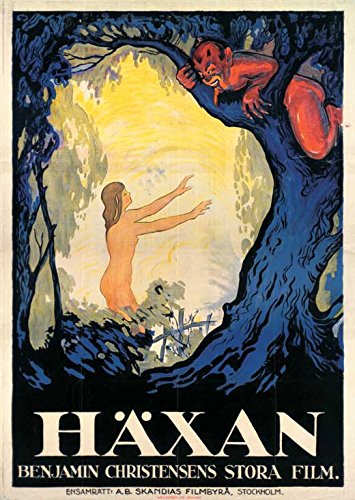
We encounter a similar issue of classification when discussing Benjamin Christensen's 1922 experiment, Häxan, retroactively subtitled Witchcraft Through the Ages for a 1968 American release.  On first blush, it seems very much in what we'd call the documentary mold, though perhaps closer to recorded lecture than anything traditionally filmic, what with the ongoing discussion of sources to be found in your playbill and the presence of a pointer guiding the eye through woodcarvings and mechanical depictions of hell.  The tone is academic, the focus on understanding how medieval scholars and priests understood the world to function.  Even when the camera shifts to presenting a filmed scene of a witch's hut in centuries past, the setting seems plausible, and the witch more an old, knowledgeable woman trusted by her younger fellows in the village as a source for miracle remedies with appropriately magical-sounding ingredients.  Shortly after this, however, Christensen's intertitle narration asserts that belief in the devil reached such heights as to make Satan a physical reality, and he pops up as Lucifer himself from behind a monk's bookstand.  We're off to the races, and won't make contact with more sensible reality for a good hour.

If Christensen's film veered into the fantastical and never returned, I'd feel no qualms about its classification.  The introduction is academic and informative, yes, but once you start watching witches fly through the night and kiss the devil's ass and eat stews of toads and unchristened children with the same eye of scholarly interest, you're more than likely exploiting safety and comfort communicated by the opening tone to scare the audience.  Let's all watch as Satan brings his faithful to a palace in the sky of wealth and delights they can never touch, tempts young maidens to wander nude through the night air from their window, and drive a convent of nuns to madness with the merest hint of his presence.  It's all realized with sets and costumes reminiscent of 15th century woodcarvings and manuscript doodles, and it's transgressive as hell for the time of release.  Just hunker on down for a bit of witchcraft-based horrors from the best a Swedish film studio's money could buy in the early 1920s.  Should be keen, yeah?

The issue becomes muddied when we consider how Häxan ends.  We return to reality for a brief consideration of torture devices and how we as a modern audience might react if forced to endure their infernal pains, dive back in for the aforementioned mad nuns passage, and then catch our heads for a final segment interrogating possible explanations for witchcraft in the past.  To Christensen's mind, much of the abnormal behavior cited as proof of allegiance to Satan can be explained as symptoms of hysteria in its various forms (or somatic symptom disorder, in the more up-to-date scientific vernacular).  Coupled with prejudiced and fearful attitudes towards anyone deemed a social outsider, or too temptuous to the faithful, or just plain not liked by a strong authority figure, a mental disorder could handily explain the vast majority of witch trials conducted by inquisitions across Europe over the centuries.  Witches, Christensen asserts, were never real, yet despite advancements in medical understanding of the mind and greater societal tolerance towards those with potentially frightening differences, the attitudes which fueled a fear of witches persist today.  After all, only the wealthy are afforded the full care of a fully-staffed clinic - the poor must endure and suffer in over-packed madhouses, and when you get down to it, what is forced, indefinite incarceration in an asylum but a more drawn-out form of burning at the stake?

Strong argument.  Resonant mindset.  Surprisingly comprehensive call for tolerance from something made nearly a whole century ago.  Applicable to discussions about how to handle mental illness in the modern day.  Damned strange case to make after indulging in images that treat witchcraft as real and immediate and vicarious as anything else in the picture.

It is here we encounter a difficulty in classifying Häxan, for it is possessed of a dual mindset.  In the one, witchcraft is as fake and ludicrous a notion as Earth at the center of a cosmos presided over by a physically tangible God, and has no place in modern times save as a specter of ills past; in the other, witchcraft is decidedly more solid and effective a cinematic reality than the unmoving images from manuscripts centuries old, and the very director calling magic and the supernatural a sham is free to run about in full devil costume, churning his butter and waggling his tongue into the camera all the way.  Christensen never acknowledges the disparity, casually showing an old woman driven to false confession by continued torture before presenting her wild inventions in a manner that suggests genuine vicarity.  From the way the film moves across subject to subject, witchcraft's existence only really depends on the needs of the moment.  The film is open to presenting beliefs born of ignorance and prejudice as just that, or presenting them like Flaherty would his Inuit subjects hunting with handheld harpoons, as the only conceivable reality.  There exists contradiction between these two modes, and it would seem to strain even the definition of docufiction to include Häxan amongst its ranks.

To solve this, I suggest we consider the film's roughly middle portion, the only passage to last across more than one of its seven segmented Parts.  The depiction of a witch trial from initial accusation to death of the last far-flung victim is as much fiction merely informed by historical research as anything else in the film, and its characters more indebted to the traditions of theatrical melodrama than a modern understanding of historical reenactment (or at least good historical reenactment - looking your way A&E), but it also makes the strongest argument for treating Häxan as a documentary of its own sort.  Amidst scenes chronicling false confessions as if they were undeniable truths, we find the inquisitors engaged in psychological torment of their charges better suited to chilling the blood than any naked moonlit dance or newborn sacrifice, or even the suggestions of instruments at torture in later sections.  They play false friend to trick a woman into confessing she may have heard of how to perform one tiny, inconsequential piece of magic at some point in her life; they drag a woman's family before her to guilt her over how they'll suffer when she's gone; they find inconsistencies in the stories as told and feel a tiny pang of empathy for those they torment, and go to their leader for an explanation of how this is REALLY the result of some magic spell or bewitchment upon their hearts.  We find, in short, the true monsters of the movie, the men who must hold directly contradictory views in their minds to assuage their guilt and carry out the destruction of several entire families to burn out witches they know probably do not exist, and yet must exist, because why else are they bringing about such suffering in the name of God?

Consider again how Christensen asserts these attitudes persist to the modern day.  We, like the priests and scholars of 15th century Europe, consider ourselves learned, better informed about the mysteries of the universe and the depths of the human mind than any before our time.  And like the priests, he posits our advancements do not preclude cruelty towards the disadvantaged, the oppressed, and the othered.  In order for this to be so, a similar form of doublethink must occur in our time, be it willful ignorance of the world's sufferings, or a distant self-justification that those who suffer in such a manner must deserve it in some way, or a personal self-justification of our own righteousness when we engage in such.  Per Christensen, a belief in witchcraft and the devil must persist to the present, in its own insidious way.  No longer in the literalized form of thinking suspicious persons as literally in league with the devil (for most of us), but in attitudes that say we are enlightened to the ways of the world and the plight of our fellows, yet allows them to burn by no fault of their own all the same.  This film is, in effect, a documentary of a mindset.

For Christensen's film to reflect this doublethink in its construction is, I should think, for Christensen to acknowledge his own shortcomings as an academic and documentarian addressing this issue.  On one level, to discuss witchcraft and the inquisitions directed at witches, one must treat the fantastical and real as matters of equal interest, particularly in a visual medium like film, where simply saying "This is what they believed witches did" is not the most effective means of communicating the idea.  On another, talking about the intellectual and moral inferiority of persons past invites one to derision by future viewers and critics, as Christensen's use of the medical term hysteria does in a time when said word has passed into common vernacular as a derogatory phrase.  Playing into the necessarily contradictory views in this manner insulates Häxan to an extent, ensures its ideas can remain evergreen.  After all, my notions about what constitutes a progressive, informed viewpoint will one day too seem hopelessly ignorant and backwards.  There are doubtlessly areas in my life where I turn a blind eye to suffering and justify it as necessary and right, as there are for all.  I, too, believe in witches after a fashion - it's just the way these things go.

We'd all do well to try and remove the bewitching of our own doing, treat those in our own lives better, and call for our governments to do the same, especially where the mentally ill are concerned.

4.5/5