Showing posts with label fantasy. Show all posts

Saturday, March 28, 2020

The Wizard of Oz (1939) - What makes the muskrat guard his musk?


It's the Letterboxd Season Challenge!  Theme nine, part two - a film named a 20th century milestone in cinematography by the American Society of Cinematographers!

(Chosen by John!)

Fellas, fellets, all in-between, let me tell y'all somethin' - it's tough out there sometimes.  Some weeks you wind up emotionally exhausting yourself for multiple days over a lot of trivial here and there, and just don't have it in you to go through the usual motions, like writing out a detailed review for one of the greatest films ever made, even if it's one you personally love to pieces across every aspect.  I've burned myself out well and good here, but I'm still looking to provide y'all with at least a little decent content at a pace of once a week anyhow.  Fortunately, since we're looking at The Wizard of Oz, I've already got a review in my back pocket from when I first watched it at a TCM Live event in January of last year for another challenge!

Having reread my work and slept on it, I still largely agree with what I wrote, and feel I don't have any lengthy new insight a scant year later anyhow.  As such, after a few brief bullet pointed thoughts that'll probably flit between stray observations and jokes, I'll present you with my full review of Dorothy's adventures, and see you on the flipside for when we start the cinéma vérité leg of this journey with High School.  Hope you lot have a decent time staving off the coronavirus, and just remember what Charles Manson said about reruns on Family Guy: "If I haven't seen it, it's new to me!"


  • We can all agree the ASC likely chose this film as one of the 20th century's great achievements in cinematography due to its stunning, popularizing use of Technicolor to make audiences believe in the Land of Oz like no cinematic fantasyland prior.  I'll definitely agree with this, but think it worth noting how Harold Rosson's camerawork goes the extra mile to sell Oz and its tangibility in much the same way his work on the titular musical number from Singin' in the Rain.  The sets on the MGM lot are quite obviously sets, with visibly painted walls and plainly fake plants and all the trappings of reality achieved via paint and wood and fabric, yet the camera tracks a course through these spaces in such a way as to make them feel all the more vast and expansive than they already are.  It'll pan through Munchkinland or seamlessly take us through multiple sets to create the impression of a longer Yellow  Brick Road or position the character skipping towards a flat horizon, and by this movement and emphasis on space make it all feel as if it really does go on forever.  Regardless of how obvious the seams are, your brain honestly believes this is how Oz should be because the camera is so free to explore and convince you there's forever more to be seen.
  • I only briefly mention her below, and I haven't much to add others haven't noted in the preceding century, but Margaret Hamilton's performance as the Wicked Witch of the West really is one of the all-time greats, huh?  The cackle, the hunched, stalking movement, the obvious sense of enjoyment and frustration with every action, the energized presence of an actress who'd reprise the role many times over across the next fifty years out of simple love for the part.  Imagine anyone else doing half so well.  I can't.
  • There's so much to unpack from the line, "Only bad witches are evil," that the world needed to craft an entire multimedia empire with one of the most popular live stageshows ever produced at the center just to explore all the implications.
  • You'd think the Tin Man would be a terrible choice for putting out a fire, considering how oily he is at all times.
  • I've said it before and I'll say it again - I earnestly believe films with this style and approach to effectswork, not just the hoary old "We should ditch CGI and go back to practical effects!" argument, but a total embrace of taking the conventions of stage plays and giving them the best polish studio money can buy can still have a place in the modern cinematic landscape.  Please, anyone, I beg you, give me more soundstage reality productions, they're too glorious and dear to my heart to believe audiences wouldn't respond well anymore.
  • Much as it is fun to joke about movies and throw up a cynical affect at times, I really can't be insincere about this film.  Although I didn't note it in the review below, at the time I told Adept how the Munchkin Land sequence felt distinctly of its time and difficult to appreciate on its own terms, and how the Cowardly Lion's "King of the Forest" song felt like weird filler to keep the film moving rather than a fully realized work on its own terms.  These were my only complaints after my first watch, and on a second I cannot possibly imagine what I was talking about.  They're both delightful segments in a film bursting with delight and charm and whimsy and life, and I can only think I meant they felt the least of a work where everything is at the top of its game and endlessly timeless.  I watched both with the biggest of smiles alongside everything else this time, and as such feel no qualms about bumping what was initially a 4.5 star review up to a perfect 5.  It's just... so terribly good, I haven't words, aside from what I'm about to repeat.
So!

***

To dive right into the heart of the matter, The Wizard of Oz succeeded as a piece of family fantasy entertainment and entrenched itself as THE definitive vision for fantasies in live action until George Lucas upended the game some forty years later entirely because it fails to deliver its moral. Owing to the producers fearing audiences were too sophisticated to believe in Oz as a real place one might escape to, the film ends with the revelation that Dorothy merely dreamt the land of scarecrows and tin men and lions and witches, the parts of her closest allies and greatest enemy having been played by people from her average, everyday life. To give the producers some credit (as if their role in overseeing one of the greatest achievements in factory filmmaking wasn't already credit enough), it's a good decision, as it helps emphasize and transform the book's original standard fantasy adventure ending of "It's so good to be home again" into the more basally resonant, ever-iconic "There's no place like home!" which is a solid moral for a children's story. The visual stylings include little touches emphasizing the idea of comings and goings, and Dorothy's departure from Oz becomes a strong bittersweet moment when we realize the spirit of these lovable characters lives on in their real world counterparts, if not the exact forms we grew to adore.

But it is an utter failure nonetheless. The Wizard of Oz boasts larger than life, blisteringly colorful reality by way of a soundstage fantasy, the sort where you can't help but believe this is EXACTLY the way the Land of Oz should look, even if you can pinpoint the spot where set dressing turns into painted wall at all times. It has some of turn-of-the-century's most beloved children's literary characters realized through still-technically-impressive makeup and soft, charming performances from up-and-comers and vaudeville staples alike. It moves at a great clip, has little touches of comedy at every turn (I was just... so glad to hear the reactions of people who've obviously loved this film for decades and still get the fullest enjoyment out of it in the theater today), and a sentimental approach to every aspect of the production so strong that you can easily forget how brutal studio work could get eighty years back. It has the "If I Only Had A..." songs, and "Ding-Dong the Witch Is Dead!", and "We're Off To See the Wizard", and "Somewhere Over the Rainbow", for chrissake.

You can't make a movie with "Somewhere Over the Rainbow" and not have people believe it. Bringing a fantasy world to life and then telling your audience they should really be grateful for their warm bed and loved ones is always a hard sell, because you simply cannot spend so much money making the fantasy world look the way it does and expect home to look even half so attractive. In the case of Oz, Mervin LeRoy and Victor Flemming and the veritable army of MGM staffers responsible for this world did such a good job making its scenery and inhabitants feel real and immediate, the decision to deny their reality at the end comes across as little more than an attempt to avoid stepping on the toes of a far more conservative America.

Thank God the film fails. If it were to sell you on the notion of Oz as a nice fantasy, but ultimately less preferable than life on the Kansas farm, it would require a far inferior Oz. Perhaps a less menacing Wicked Witch, or a less lush Munchkin Land, or a less joyous Emerald City, or - heaven forbid! - a less endearing Cowardly Lion. Something would have to go wrong for Kansas to ring true as the best of all worlds, and then where would we be? In a time where the film doesn't continue to birth homages and inspirations for how to make the impossible believable? When its themes didn't resonate so powerfully in the wakes of both the Great Depression on original release and World War II on rerelease as to serve as a comforting delight for children the world over? When audiences would ever want to do anything but hug the Cowardly Lion and never leave him behind because he's perfect just the way he is?

No, it's better that The Wizard of Oz fails to convince the audience of a healthier moral. Such pure, unbridled fantasy took near-inhuman levels of personal sacrifice and compromise to bring to the screen. We almost saw a classic encapsulation of the studio system in its prime and the American willingness to accept flying monkeys and fraudulent wizards changed into something totally unrecognizable a million times over in the development process. A film like this is, after its own fashion, a miracle, and should a miracle stumble over its words while trying to instruct us on loving our home more than a land over the rainbow, then why not take advantage of its failure to communicate and live there for a while? Happy little bluebirds fly - why, then, oh why can't we?

5/5

Saturday, February 1, 2020

A collection of FUCK YOU, IT'S JANUARY reviews

A smattering of terrible dump month release reviews written over this last month on letterboxd!

***
Stephen Sommers should've probably taken a few more passes at the screenplay for Deep Rising before he started shooting. There's a solid hook to the premise, with Treat Williams' smuggler captain carrying a group of trigger-happy mercenaries to God knows where in the middle of the ocean, only to discover they've filled his ship with armed torpedoes and chartered a course to an abandoned cruise ship. That things aren't at all what the mercs expected, what with the proliferation of smashed up rooms and digested skeletal remains throughout the liner, gives us a pretty good line into the movie. Could serve as a workable mystery to keep tensions high until we're ready for the monsters, except his movie is structured so we're constantly cutting between the smuggler boat and the cruise ship before the disaster. I understand the impulse to play with both during the first act, considering the larger boat's owner is somewhat important to the mercs' place in the movie and we need to introduce Recognizable Actress Who'll Sell Tickets Famke Janssen early on, but doing so makes it harder for the movie to grab an audience. We know where we're going and how we're gonna collide, so a large portion of the film becomes a waiting game for the plot to hurry up and let the characters figure what we already know.

It also harms the character dynamics, which weren't particularly strong to start. I suspect the production intended to coast on Harrison Ford's charisma before he turned 'em down, and so Treat Williams is largely affecting his best Ford impression to middling effect. He'd still serve if he had a good, long stretch to exercise a dynamic with his fellow crewmembers and butt heads with the mercs in interesting ways, though. Unfortunately, because we've simply gotta spend so much time on the cruise ship before it sinks, the time we have aboard the smuggler ship is halved, and Williams only has the briefest amount of time to establish a back-and-forth with Wes Studi's merc captain before they're on the liner, and people start dying. Aside from him, there's only Kevin J O'Conner around, who's too deep in snively comic relief mode to impress a relationship with his captain or the men antagonizing him, and Una Damon as first mate, who gets killed to make way for Janssen as our lead. Considering Janssen's character is entirely superfluous if you cut the mystery-ruining early scenes, has little chemistry with Williams (much less time to IMPLY a romance before they're face-smearing one another), and just not giving it her best, it feels we left a potentially more interesting character to die in favor of a conventional dangling love interest.

Our writing woes just spill out from there. Once we start killing characters it happens at an alarming clip that removes a lot of potential for interaction. Losing out on the potential mystery/thriller aspect undercuts what impact the second act revelations could've had. Even with the improvements I've suggested, the nature of the conflict basically leaves us with nothing to DO character-wise in the third act save escape the boat, which takes the form of very simple tasks being complicated by sudden bursts of busywork. All throughout, conflict and tension are generated more by characters suddenly acting needlessly aggressive rather than drawing on a dynamic built naturally through exchanges and events. The movie's even so committed to insisting Anthony Heald's boat owner is the more interesting presence, it kills Studi early in favor of having Heald act the selfish psychopath for the finale. There are bad screenwriting decisions spilled all over this movie, the cast aren't really charming enough to distract from said issues, and it's all incredibly frustrating, because I can see how some tweaks to this one early structural element might've capped these poor impulses and resulted in a stronger final product.

I go with a 2.5 rating rather than the 2 stars my discussion here implies on the merit of the film functioning fairly as an action-horror in the watching. The Ottoia-derived monster's just a massive blob of CG nothing when we see it in full, but the tentacles look fairly menacing on their own or in a pack, and have some damned good effects work for the time and budget. If you take the deaths as less scary moments and more a game of Who's Gonna Get It Next, there's a few solid whacks throughout. Treat Williams, though working an entirely thankless job with so many Star Wars references I'm not at all surprised Ford refused his participation, manages some charismatic presence through a part that doesn't really realize he's protagonist till halfway through. And like... it's a monumentally stupid part of this movie, but I do think the whole setpiece with Williams and Janssen zipping around the flooded corridors of the sinking ship on a jetski, trying to build up enough speed to ramp out while blasting tentacles and obstacles with a shotgun is a good bit've fun. I'd play that part of the Deep Rising video game, it's got a neat two-player mechanic - one of you drives and hits fire, the other has to pump and reload and aim the shotgun over the other player's shoulder.

You can see the rot settling in Stephen Sommers' brain watching Deep Rising. The same inability to write or direct meaningful character interplay, structure a screenplay without a lot've ancillary bullshit stapled on, or deploy special effects without obviously using them as spackle to hide cracks in his scenario. All things that would fester and dig their roots deeper until he went all-out with Van Helsing and just broke the movie. Here, they're a hindrance, but he gets a little something out've the enterprise all the same. Like I say, if he'd taken another week to edit the script and narrow in on the potential for a mysterious situation where the main character learns what's going on alongside the audience and has a stronger rivalry with the dangerous men he's smuggling, he might've had something wholly passable. The near-misses are always more disappointing than the total misfires, even when they're still enjoyable at their own level.

2.5/5

Monday, December 23, 2019

Mixed Nutcrackers: The Nutcracker and the Four Realms (2018)


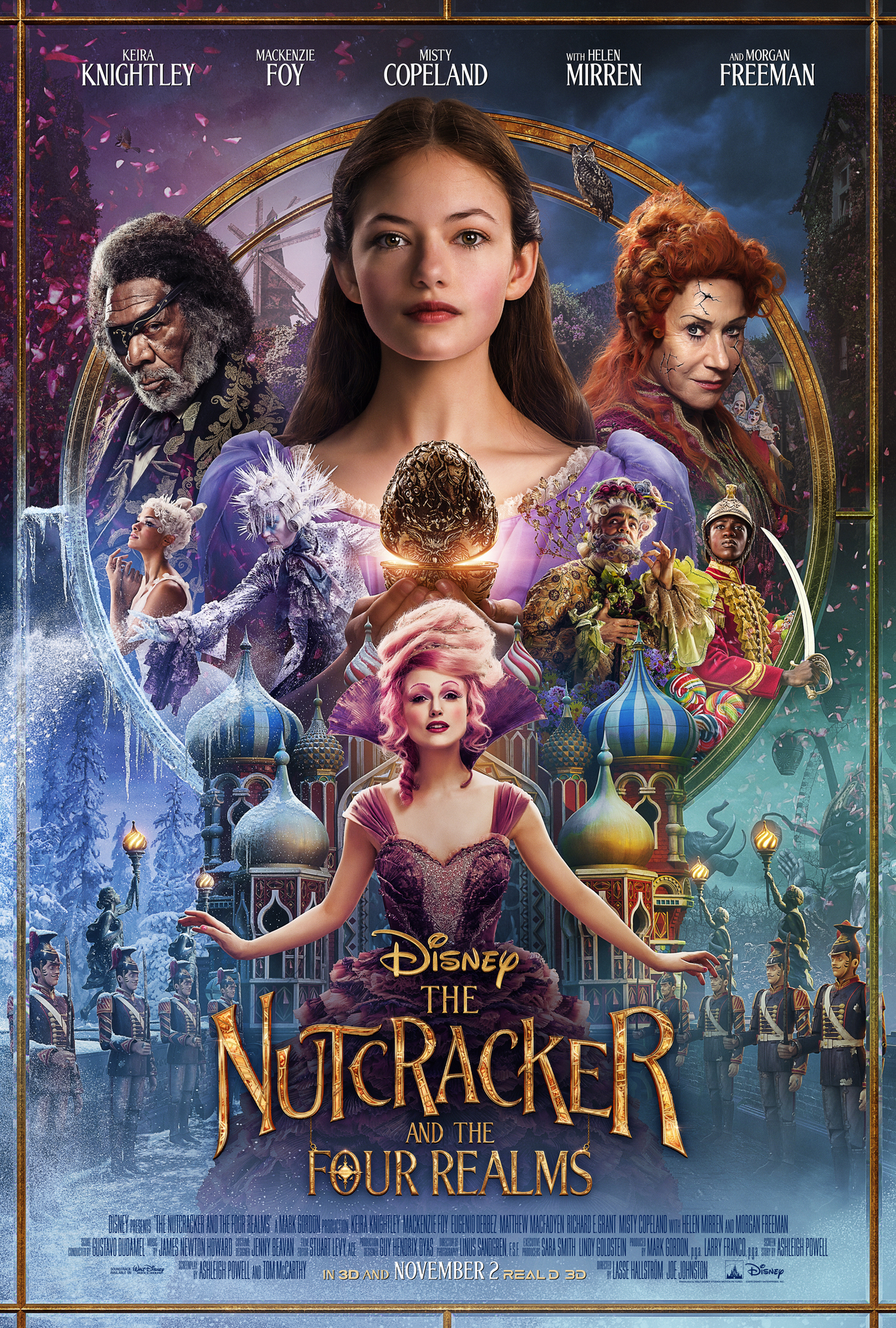
Over the last month, I've spent quite considerable hunks of time puzzling over why The Nutcracker and the Four Realms exists.  The reasons are quiet obvious and take little time to figure, of course - Disney intersected with Tchaikovsky's work very briefly when they adapted his Nutcracker Suite for a segment in Fantasia, Disney's been on a streak of remaking various classics of theirs both major and minor alike, and 2018's Star Wars offering targeted the traditional May release window rather than their new Christmas block, so turning out a big-budget Nutcracker film like they've been proprietors and overseers of the beloved property all this time works for a holiday market thing.  They don't even have to buy a whole studio to get the rights like they'll have to if they ever want to make coin off The Wizard of Oz, they've just gotta pretend that their all-encompassing dominance over childhood nostalgic properties has a transference effect across anything and everything in the public domain with the tiniest connection to Disney, and voila!  It even makes sense why it is the way it is, for Tim Burton's vile take on Alice in Wonderland made over one billion dollars worldwide, Kenneth Branagh's better Cinderella did respectable business for its budget, and overconfidence in the Disney offices keeps bad ideas afloat even after, say, Alice Through the Looking Glass turned out a financial disappointment.  You've a license to print money with recognizable properties done up in action-fantasy regalia, so away we go, 130 million dollar budget, gonna be a grand ol' time, woo!

My questions were more philosophical in nature.  Why are we here, at this point on the board?  Must it continue on like this?  Is there any conceivable creative spark behind the greenlighting and production of this film, or is it truly just an idea whose final form doesn't matter so long as someone can check off a little box on a list of Good Ideas What Will Make A Billion Dollars?  The answer to all of these questions is yes, without fail, but I wonder all the same.  The trailer and related marketing materials, though over-designed to such a degree as to embody a wonkily admirable aesthetic all their own, simply looked so boilerplate and uninspired in what they implied, it seemed the only reason any of the Nutcracker stuff showed its face was for the purpose of having a little more reason to use the Sugar Plum Fairy dance and Waltz of the Flowers on the soundtrack than normal in a Christmas movie.  And is that really what anyone wants to make a movie about?

Not asking whether the audience wants to SEE it or not, no, I'm curious about the folks who've gotta write and act in and design and direct this stupid thing.  Is this how you wish to spend your twilight years, Morgan Freeman?  Is this how you foresaw your first big mainstream exposure coalescing, Jayden Fowora-Knight?  How exactly did you get here, Lasse Hallström?  Were the ABBA music videos and What's Eating Gilbert Grape and all those dog movies not enough?  Must you architect something with no soul?

Whatever the reasons (for I'll never know), The Nutcracker and the Four Realms exists, and it's about exactly what its trailers make it out as.  New take on Clara Stahlbaum going through a magical adventure in her Godfather Drosselmeyer's house, except instead of a small skirmish between toys and mice with a semi-sweet kinda romance as the main pull, it's this big to do about a locked mechanical egg without a key gifted by her dead mother and a fantasy kingdom the elder Stahlbaum created from crude inert matter with multiple realms based on a few dances from the Tchaikovsky ballet, and wouldn't you just know it the whole thing's gone to hell in a handbasket with a mysterious arch villainand frightening circus imagery and need for a strong warrior queen to march forth and save us all as prophecy foretold and aaaaaaaaaaagh.  Pretty lookin' but vapid to the extreme, and lacking in any real identity of its own - in addition to all the bog-standard "Classic fairytale kingdom from your childhood is a little more Game of Thrones now" trappings, they've pinched bits and bobs from Alice, Oz, Narnia, and Disney's newer animated canon entries with shameless liberty.  The whole concept's a glass-molded, sugar-coated diorama piece, endlessly reflective of its counterparts an tasting of nothing in particular, a bad bedrock for any story to rest upon.

Somehow, with such an easy formula as, "Exposit, adventure, twist, conclude" to follow as inherited from all the other fantasy imitators its imitating, The Nutcracker and the Four Realms manages to back itself into a corner with some impressively bad character writing.  Clara, as played by Mackenzie Foy (who shall remain largely blameless, for not doing anything with the following is probably nobler than making a futile effort), has an alright if simple set of traits at the movie's start: she's clever and into tinkering with machines, she's upset about her mom's death, doesn't want to socialize in the way expected of her societal station, and clashes with her father over how to deal with the grief, retreating into her mechanics as he does his stuffiness.  With the whole thing regarding her mysterious locked egg that no amount of tinkering can open without the key, there's the basis for a bit of self-discovery and growth via the medium of an adventure in bootleg Middle-Earth cum Narnia.  Too bad for us, though, soon as she follows a string into the Four Realms, she becomes little more than an audience surrogate.  All sense of individual personality gets wiped away so she's free to marvel at the pretty sights and wonder at the new characters and feel sad when we're supposed to feel sad and get invested when we're supposed to get invested.  Lacking much identity of her own for a goddamned half-hour effectively distances one from her, and primes you less to fall under this world's magical spell, and more notices how it's so concerned with crunching exposition that it only spares about ten seconds total to show you three of the four realms from the title.

(Seriously, they're probably the best designed locations in the film, and we get a single shot of each.  Rest of the movie's in a comparatively empty - and probably easier to render - golden palace and various sparse dead woods.)

So, follow me on this one, please, I'm about to do a Thing.  Clara has learnt all about the ins and outs of the Four Realms, the supposed dangers posed by Mother Ginger in the disgraced Fourth Realm, and how her mother used a giant machine called The Engine to bring the whole fantasy kingdom to life, effectively making her heir to God's throne in this land.  The three good regents need The Engine to build an army to stand against Mother Ginger or else face extermination, but woe of woes! it's broken!  Now Clara, showing signs of life and personality for the first time in ages, perks up and suggests she might be able to tinker with the machine and solve the problem, because she's really good with machines and finally has someplace where her talents will be appreciated!  But no, we don't actually need her skills or anything unique about her - we need her mother's key, the same key that opens her mechanical egg.  Off a-marching we a-go, having a grand old time running about the Fourth Realm, getting attacked by mice, creeped out by clowns, just sorta doing whatever action-y thing comes to mind to tick off time because this little key hunt is all we have for a second act... long story short, Clara gets the key, opens the egg, and nothing.  She's devastated, because her mother left a note saying everything she needed was right inside the egg, and there's nothing, so clearly there's nothing important or special about her.

Gee gosh willikers, wouldn't you know it, we get back to the palace, turn on the Engine, and the Sugar Plum Fairy's really the villain for reasons that don't matter and I don't really care about.  Point being, she throws Clara in the tower dungeon and plans to destroy the whole Four Realms or something, and Clara?  Clara starts getting ideas in her head.  Clara starts thinking she has to reach deep down inside, find an inner strength she never knew she had, trust in her knowledge of the laws of mechanics, use them to escape and figure out a way to save the day.  She enacts a great escape with lots of verve and daring-do!  She spirits her way back into the throne room, where her mother's Engine is spurting out unstoppable tin soldiers!  And in a grand act of self-actualization, she sneaks up to the machine, and... uses her tinkering skills to shut it down and stop the Sugar Plum Fairy.  Turns out what she needed to do was exactly what she thought she needed to do at the start of the second act, just with an arbitrary march to kill her self-confidence and a little alone time to figure out something about herself she already knew.

That's not a character arc.  That's a character ten-yard penalty.  "Achieved self-actualization too soon, ten yards back, first down."

I don't know.  What else'd'y'want from me here?  The Nutcracker's a complete non-entity with no personality and even less reason for being singled out as important in the movie's shaky lore, the backstory and whole dramatic situation relies on implications from Morgan Freeman and flashbacks to Clara's mother which communicate a wholly different backstory than the one Sugar Plum's heel-turn is predicated on through monologue, and its ten steps backwards ten steps forwards story has nothing to say at the end of the day beyond "Keep visiting your childhood imaginary kingdom, or it'll all burn to ash because you weren't good enough to not grow up!"  I liked the Mouse King's reimagining as a mouse golem comprised of thousands of mice, though far more as a concept than for how he looks or anything he does, some portions of the expository ballet are rather pretty in both physical movement and the practical effects around the dancers, and the soulless tin soldiers are fairly, appropriately creepy.  I'm rather upset at how they only play a few snatches of the final dance piece on a tinny little music box before swapping over to the more "dramatic" sounding Waltz of the Flowers for the real final dance and - does it matter?

Do my further critiques and weak, minor praises have any purpose?  It's not fundamentally broken like the Tom and Jerry outing, and it doesn't fall as far into eye-popping, misguided arrogance as 3D, but unlike those works, I cannot think of how to improve this.  If I intuited some better means of handling Clara's arc (read: making it an arc in the first place), devised a better use of our first act time than uselessly oggling empty spectacles whilst hiding away the ACTUAL production design achievements behind weird editing choices, strained and labored and sweated to scrub out the uncomfortable "child God fantasies must last forever!" implications, it wouldn't be for anything.  The base idea of "The Nutcracker but we're Lord of the Rings and Narnia now" is bad and nonfunctional of itself, and my absolute best suggestion, being "Use a different concept," requires eradicating the movie entire down to its bones to keep suggesting anything better.  Uniquely-shaped failure to write a coherent story for its heroine marks the most remarkable thing about The Nutcracker and the Four Realms, and I'm half-inclined to say we shouldn't imagine a better movie in its place, because a muck-up like this is too rare and special to deny.  Why continue spilling digital ink on a work I've declared poorly conceived from start to finish, and cannot accept the obvious answers over the whys of its existence for how much they shake my faith in an inherently good universe?

Movie's bad.  Don't go watching it.  Check out Nutcracker Fantasy and the 1973 Nutcracker short instead.  They're far more charming, creative, better designed, and free on YouTube as of this writing to boot.  Hell, watch the Barbie movie, it at least does more with its golem character and out-and-back narrative structure.

2/5

Sunday, December 22, 2019

Noah (2014) - A Blockbuster From the Arthouse

(The following content is reran from the 2018 Christmas marathon on Letterboxd, as originally seen here.)

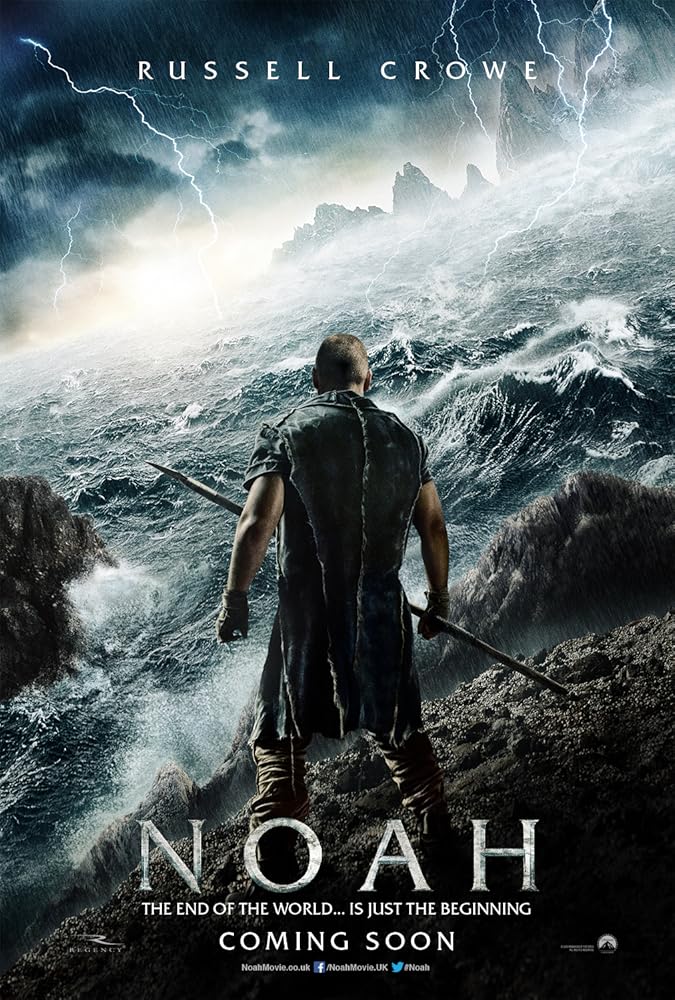
Why were there so many Christian films in 2014? In part, because Darren Aronofsky's fifteen year struggle to bring his vision of the Biblical Flood to the big screen finally bore fruit. A director whose work frequently involves characters pushing themselves to radical extremes, Aronofsky makes an interesting helm for the story of Noah, the patriarch who left all mankind to die beneath God's raging seas to preserve the sanctity of Creation. It's both a reversal and embrace of his usual ideas about the self and the masses, and it all comes packaged with a massive budget and expectations for big returns, courtesy of his success with The Wrestler and Black Swan. As the film proved a success critically and financially, and comes from the mind of a director with actual artistic ambitions, the only "did this movie need to exist" joke I can think to make involves slinging mud at mother! for trying a move into entirely symbolic territory and losing some of the power.

Aronofsky finds a far more even balance between metaphor and narrative this time around. Several passages of Noah creep into pure visual storytelling, and not just those involving the voice of God penetrating Noah's thoughts as a rapid series of powerful images. The reinterpretation of Watchers as victims of God's wrath and eventual precursors to the New Testament style of forgiveness-based salvation also lends way to interesting creature design and bits of worldbuilding to create a unique yet still Biblically-grounded setting. Noah's retelling of Genesis' opening passages through a flashing look at the Big Bang, planetary formation, and evolution that gives way to the key images of the Eden story helps underscore his character of a highly principled man trying to interpret his Creator's will through preset personal beliefs - a man who holds all he sees as dear, intruded upon by the sin of simply living, commanded to oversee its destruction. And then you have the contrast between a manmade apocalypse of fire, Enoch's vision in a time when the descendants of Cain ruled the land, and Noah's prophecy of devastation by water. Both presented as horrifying, especially when we see the survivors attempting to drown out the screams of thousands left to suffer and die on the mountaintops, but only one carries the divine promise of something after.

Compared to mother!, the metaphors at play here have a far clearer purpose, and relate more directly to characters who register as actual people. I've seen much critique of the decision to cast Noah as a figure who would murder his own grandchildren to ensure humanity's extinction, but I think it works very well within the film's parameters and Biblical cnaon. All the really hard parts leading up to the flood - interpreting his visions, constructing the ark, gathering the animals, defending it against invaders - are presented as grand undertakings, yet comparatively nothing compared to squatting in the dark for months on end with the knowledge of his supposed duty. In a twist on the usual Judeo-Christian narrative of prophets and chosen men passing God's tests by proving themselves willing to enact his will no matter the cost, Noah comes through this period in which nobody can dissuade him from the ultimate evil by looking into the face of a newborn child, and showing mercy. For once, the Creator wants to see his progeny spare a life, set aside the grim determination necessary to watch the whole world die, and mark the beginning of a new era with compassion rather than the murderous rage of Cain. Taking this route gives us Noah as a miracle worker and a mere man, prone to false beliefs and internal conflict as much as any other - a far stronger character than Jennifer Lawrence's being totally subsumed into her role as God's power of creation and destruction.

Other characters make for somewhat compelling cases, though unfortunately most suffer the opposite problem as mother!'s cast, and become mere pieces in the narrative. Ham's secretive relationship with Tubalcain aboard the ark has some interesting aspects of temptation and the sin of arrogance, which makes for a good extension of the earlier corruption of a "we make our own destiny" mindset. I'm also rather a fan of Og and the other Watchers, and their brief journey from distrustful, bitter souls to sacrificing warriors. Looking at the rest of Noah's family, though, they seem a little empty, and don't make much of an impact on the story. For all of Aronofsky's subtextual challenging of Noah's inherent righteousness as a patriarch, he doesn't really afford wife Naamah or adoptive daughter Ila a chance to interrogate his beliefs before the flood, or play a part in his turn to peace afterwards. They scream and cry to no avail with all the passion of archetypes and none of the unique embodying aspects of individual characters, and ultimately weaken the notion of the necessity of a balance between total fealty to the Creator and blazing one's own trail. Consequently, Tubalcain's temptations seem more unexamined and obviously evil, rendering him a conventional arrogant bad guy in the middle of a narrative calling for something more nuanced.

There's other things I could complain about, like how unnaturally well-groomed Shem and Ila look compared to the grimy naturalist aesthetic of their family, or the grand scope of the special effects straining against even a liberal $125 million budget and making some of the more "epic" scenes look awkward, but I think I've gotten the bulk of my analysis and valid critiques on paper. Aronofsky definitely does better work when he has something concrete and human to come back to rather than the excess of a pure passion project. While Noah is very much a personal story for him, the demands of a film designed as a blockbuster keep him focused on attaching his keen eye for visual symbolism and intense editing to a story about actual people. He didn't produce a masterstroke thanks to the neglect of other characters and the unfortunate shortstop of ideas right before pushing them to something truly complex and layered, but he did make possibly the best Bible movie of the lot for this project. I'm beyond glad we have a creator who wants to consider the Bible as sacred text AND inspiration for their own thumbprint. A whole seven films of blind lionization in a single month might drive me mad, so I'll gladly take intriguing and beautiful yet somewhat stilted.

Anyways, next time we're exploiting a child's close shave with death. That'll be fun.

3.5/5

Saturday, December 21, 2019

Mixed Nutcrackers - The Nutcracker in 3D (2010)


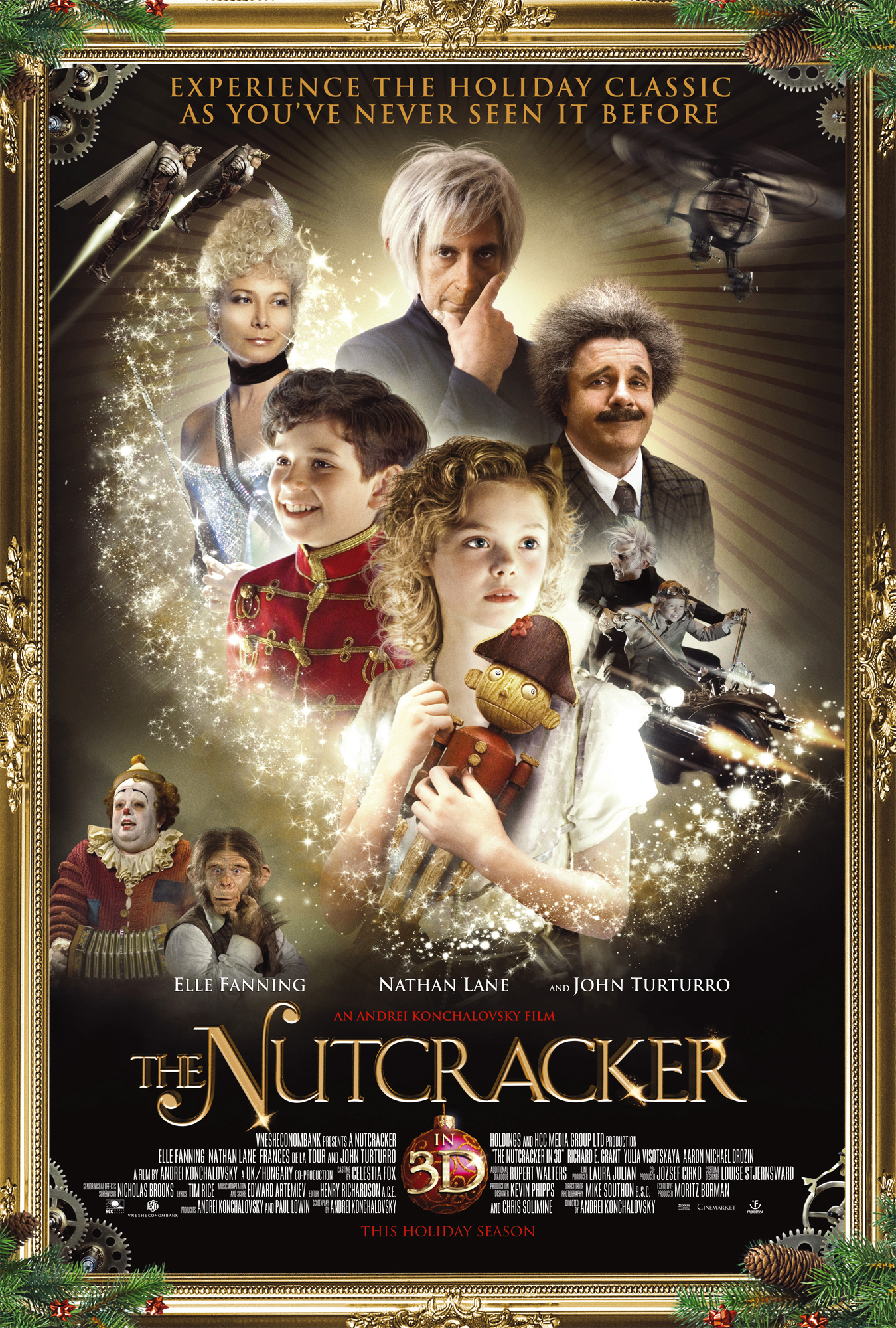
Goodness, but ambition sure can go wrong, can't it?  Andrei Konchalovsky reportedly sat on and tinkered with the idea for what ultimately became The Nutcracker in 3D (alternately The Nutcracker: The Untold Story) for a solid twenty years, long after he became a frequent film fest circuit contender, and in which time he continued to direct, write, and produce a wide variety of films across multiple genres.  This here was his passion project, a grand fantasy epic built upon little by little whenever he had time, finally realized after two decades' gestation with a budget of $90 million, well in excess of anything he'd directed since Tango and Cash.  Grand ideas given grand stage and a (relatively) lavish pocketbook, enough to justify playing with musical elements, massive soundstages, scores of extras, a wholly CG character or two, and the best 3D effects money could buy.  One might, perhaps, observe how "the best 3D effects money could buy" in the year prior to its ultimate 2010 release came from a film costing this project's budget three times over, and that the base material was shelved since 2007, and start to understand what went wrong.

Hubris is our watchword for today.  Hubris in thinking a production so plainly bloated by B-name theater actors' salaries and enormous soundstages could afford a little skimpiness on the effects budget, and so crafting a final product where flying effects and CG characters render as vaguely floating a few feet above the film rather than anywhere inside it.  Hubris in Tim Rice deciding his lyrical compositions for the musical numbers would not use Tchaikovsky's ballet pieces as a base and follow their lead with a complimentary rhythm, but rather be designed for singing along to every not, regardless of whether or not the resultant cadence sounds anywhere close to a natural register.  Hubris in believing many side characters so plainly charming on the face of it that we needn't see them between their too-brief introduction and an end-of-second-act crisis wherein they display none of their personality quirks again in favor of generic fantasy action platitudes.  Hubris in thinking spending the entire second act wholly detatched from the fantasy world and spinning our wheels on some domestic drama the film clearly doesn't care for is at all an acceptable way to stay within our budget when it really kills the pacing dead and causes many following beats to feel redundant.

Hubris with regards to the rats, oh my GOD, the rats.  I can only assume Konchalovsky and his contributors thought as far as, "Well other films use a little Third Reich imagery as shorthand for the bad guys, we can as well," and then trotted out said justification every time they wanted to add a little more.  The rats march around in full-blown SS uniforms, round up innocent people from the street, throw them into concentration camps, operate massive ovens designed to burn those they scapegoat as ruining the world, and talk up the eventual birth of a glorious rat masterrace and a Rat Empire which will last for one thousand years.  All right there, on the surface, no necessary distancing whatsoever, plain and simple Nazi stuff.  Let's not also forget, they still have rodent faces, rodent faces which look very much like Nazi propaganda caricatures of Jewish people besides, and most talk with heavy Italian/Brooklyn accents.  And listen, listen - while I am the world's foremost advocate for scaring kids through children's movies, the effects on John Turturro's face when his Rat King gets upset and he morph-roars into a monstrous rat face are all too much, all too distressing, and deployed all too frequently for how much I don't like looking at it.  Also, their arrival into the movie evokes 9/11 imagery, and Turturro electrocutes a pet shark at one point, for no reason other than making this whole thing more off-kilter and distressing.

Looking at The Nutcracker in 3D with a proper critical eye, though, trying to see beyond all the odd, excessive, easily-identifiable bad creative decisions, and figure out what really went wrong, I think the briefly mentioned structural problems drag the movie more than any of the Nazi rat stuff.  Don't get me wrong, unless we perform corrective surgery on the film, wholly remove all the Nazi motifs, and find literally any other thematic costuming as a replacement, it will always have that millstone round its neck, but figuring out the structural problems could help a lot.  You can get away with quite a bit if a story plays as familiar or resonant in the broad strokes, making your idiosyncrasies read as "Alright, go off but I'm with you" instead of "What in God's good name are you DOING?"  Bad as the Nazi rats, the child acting, and the effects compositing are, The Nutcracker in 3D's greatest weakness lies in how it flaunts conventional story structure in favor of a protracted second act in the real world, with all hints of the fantastical banished to the margins.  To illustrate my point, allow me to propose as potential alternative layout for the film, in which we only change the order and focus of events with minor eliminations to improve flow.

The first act, with Mary meeting the Nutcracker, exploring the expanded living room, and learning about the curse the Rat Queen placed upon him can play exactly as they do in the movie, except we move the introduction of the Nutcracker's three living doll friends over to the start of act 2, and place more focus on the developing relationship between the two.  Rather than spending the second act in the real world, Mary, the cured real boy Nutcracker Prince, and the doll companions spend their time trying to infiltrate the Rat Kingdom and overthrow the Rat King for good, only for the Rat King to discover them, kidnap the retransformed Nutcracker, and banish Mary and the dolls back to the real world.  THEN we can play out a shorter, tighter focused version of act 2's runaround as a start-of-act-3 crisis,and proceed with the movie's third act as is, only with better defined supporting characters and a stronger relationship between Mary and the Nutcracker. Compare this to how little screentime the two share in the film as-is, and how much of the back half of the second act is dedicated to rerunning the first act's set-up with new stakes while assuming we've any reason to invest, and the problem should be plain.  Spending so much time insisting Mary stay separated from the Nutcracker and the Rat Kingdom only serves to kill the film's capacity to engage an audience; a structure more in-line with traditional children's fantasy epics would help the piece flow, get us deeper into the weirder elements, and at least acclimatize us to the stranger elements in addition to strengthening the character work.

Or, as an alternate proposal, how about we keep the film's structure as is, weirdly lengthy return to reality and all, except we shift around our thematic focus instead?  Exact same movie up to the thirty-minute mark, except Mary's attempt to lift the Rat Queen's curse doesn't work, because for all the enchanting, fantastical sights around her, she doesn't really believe in what she's seeing just yet.  The sudden return to mundane reality thusly hits her harder, and her father's attempts to shake those silly dreams for her head has a tangible impact on her.  That whole meandering musical number where Uncle Albert sings about a magic pebble her father had as a boy connects more directly to Mary's story, and when the Nutcracker returns to bring Mary and her brother Max back for another try at liberation, she only goes reluctantly, and only invests fully for the third act because the Rat King kidnaps Max.  You can then run the third act as a simultaneous "Rescue my brother" narrative and a "I have to actually care and believe in all those childlike things like imagination and dreams" story, to boost up the effect when Mary finally lifts the curse and claims she never wants to leave this new home.  Just one change to one plot point and a shift in the main character's attitude, and you can make this odd structure work a little better.

I'm personally more into the first proposal than the second, for the first allows the film to indulge in its weird attempts at spectacle more openly than the second, which probably requires turning down the bombast to sell the audience on Mary's refusal to truly believe until the climax.  Either way, they both show how The Nutcracker in 3D didn't necessarily have to break so badly as it does.  There's so much "This is MY passion project, and we're doing it the way I like!" running through every aspect of the production, I've a hard time believing you could wrangle a wholly good or appealing story from the wreck, especially if we're really honestly truly married to doing Rat Nazis and not spending a proportionate amount of money on our effects.  With a different structure though, regardless of if it's more traditional or more suited to supporting a thematic idea, we might've seen a respectable if heavily flawed, too indulgent work that communicates something and delivers a mildly enjoyable experience.  It is broken and misconceived, but the foundations could've supported SOMETHING, rather than the haphazard mess we got.  Which, all told, is better than the total, doomed-from-the-start failure of the Tom and Jerry Nutcracker film.

(Let me tell you, it was REALLY distracting hearing Moaning Myrtle's voice coming from the Nutcracker's mouth the entire film.)

2/5

Sunday, December 15, 2019

Mixed Nutcrackers - Barbie in The Nutcracker (2001)


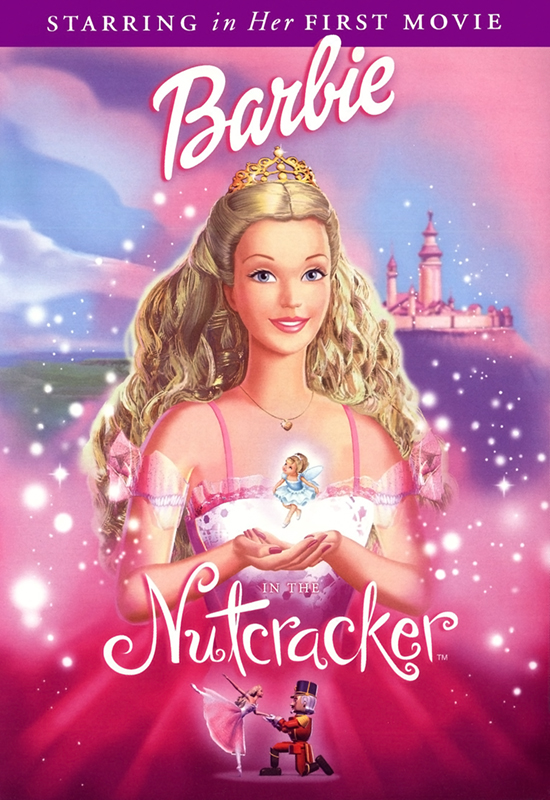
Fun fact: this marathon was originally conceived as an All-Barbie December, on the simple basis that Christmastime is a time for tormenting friends, and nothing could possibly equal the torment of promising a Nutcracker marathon, only to dovetail into a long collection of samey Barbie films with no warning.  Only trouble is, if we DID run an All-Barbie December, I'd have to watch all of those same Barbie films myself - and, even worse, WRITE about them.  Such a joke could not possibly sustain itself across a whole month and still produce good writing, so the series was quickly converted to a Nutcracker-a-thon, and here we are today.  You can still count Barbie as the centerpiece of the series, the crown jewel from whence all other films featured sprang forth, and a perfect embodiment of why we're doing Nutcracker stuff instead of Barbie stuff.  Because let me tell y'all right here right now, I do NOT have a lot to say about this one.

Not like I didn't have a lot to say about The Motion Picture, gosh no.  Go back and read the review, I had plenty to say, just no clue how to format it into a coherent, paragraph-based piece.  Barbie in the Nutcracker challenges because it is plainly aimed at the youngest audience yet, roundabouts the four-to-six demographic, and much as the joke reviews on Letterboxd insisting this has an ending to rival Mulholland Drive in complexity and confusion, something ready-made to stop holding appeal once you enter second grade does not offer many avenues for critique.  The simplicity leaves fewer dimensions to pick at, the purity of purpose makes slagging too hard bad sport, and the lack of nostalgia in my case in particular means I cannot articulate what makes it tick for someone who saw it at just the right age in the way someone born round the same time as myself but with a Barbie obsession in their past.  So, seeing as I do still have a few concrete points to walk across, we won't rely on bullet pointing, but we will theme by paragraph, and take some time to poke Barbie in the Nutcracker's merits as an adaptation of The Nutcracker/TheNutcracker and the Mouse King, its merits as a piece of animation, its merits as a piece of children's entertainment, and how it is effected by its status as part of the Barbie brand.  Should work out just fine; let's go.

As I've noted when discussing the various ballet-oriented adaptations, The Nutcracker has an inborn problem of dropping any semblance of narrative in the back-half in favor of pure dance, and even ETA Hoffmann's original story loses its slack once Marie and the Nutcracker Prince enter the Land of Sweets.  This requires any story-focused works to find some means of tinkering the material to suit its own needs, and we've seen a few differing approaches - Nutcracker Fantasy was more inspired by ideas from the story and crafted its own narrative from near-whole cloth, The Nutcracker Prince added more supporting characters and a bit of extra drama during the final movements, and the various ballets have the benefit of about half-a-dozen scripted dances for fodder.  Barbie, for her part, sticks to the basic rhythms of a young woman receiving presents on Christmas eve, becoming delighted by a nutcracker, and having a strange dream of a war between mice and toys, with a few minor alterations.  Her Aunt Elizabeth functionally replaces now-Grandfather Drosselmeyer as gifter and One Atop The Clock, there's no party or other toy soldiers because character models are expensive, and she doesn't wake from her dream once she drives away the Mouse King with her slipper.  This last marks the film's major departure, for once it's done with the literary source's first half inside fifteen minutes, it sets aside the rest of its remaining hour for a story of light high fantasy.

This basically works as a creative choice, because it decouples the movie from novella and ballet, and largely enables it to run its own little Christmas-themed thing.  Changing the Sugarplum Fairy to a Sugarplum Princess is a weird little bit of probably-necessary marketing tampering, but making her a McGuffin that Barbie, the Nutcracker, and a few hangers-on must seek out to free a fantasy kingdom from the Mouse King's iron clutch gives a fine excuse to keep introducing new concepts, constantly move forward without flagging in one spot for too long, and introduce a few little bits and bobs of its own.  I certainly didn't expect the Barbie Nutcracker movie to feature a massive rock golem chase or a talking bat sidekick, yet they're here all the same and functioning quite nicely.  Considering the way it all looks, Mattel could've easily taken the same assets and put out a token PC game with the same story.  That courtyard in the climax seems purpose-built as a boss arena, so why not?

With regards to looks... well, it's no great shake, but was there any chance otherwise?  Round 2001, only Pixar and Dreamworks had humanoid animation anywhere close to workable, and Pixar's whole "It's more believable and endearing because they're toys" idea with Toy Story also had a greater budget, more talented artists, far more detailed environments, a stronger lighting rig, and stylized characters who aren't confined by the semi-realistic proportions and sculpting of the Barbie line.  They tried, God bless 'em they tried, but there's a stiff lack of flair to the movements and the models are way too lacking in detail to read as anything except cheap.  Attempts at animating special effects like fairies dancing through the air as they fly look more like someone messing around with the drag-and-drop tool, and the little amount of dancing present seems heavily limited by what the models could do regardless of them using mo-cap.  The lighting effects are the biggest failure, as any attempt to do something creative gives the characters this weird fuzzy halo effect that ruins any illusion of them standing in their environment, while simpler set-ups make them look like the plastic they are.  All in all exactly what you'd expect from a direct-to-video 3D animation project of this time, but I still have to give props for the effort.  The animators at Mainframe and Mattel Entertainment could've easily lit the whole thing uniformly and made no swings at more complex animations they didn't have the budget or experience to handle.  Their failures speak more to willingness to experiment than lack of ability (though don't get me wrong, the execution lacks something fierce at times - that cloudy beachside scene is just the pits).

(Plus, they recognized their inability to fully model every outdoor environment, so several of them utilize digital mattes on the skyboxes and render a few more complex panoramic scenes as fully 2D paintings, which actually caught me off-guard at one point.  I was just about ready to mock the film for not knowing what the heck a Perspective is when they arrive at a magical castle, only for it to fall down because it's a cardboard fake planted by the bad guys, which just so happens to look identical to the style used on the flat backgrounds.  They got me good there!)

I think the whole thing holds together as a cartoon for really young kids pretty well.  Fun little out-and-back adventure type narrative with just enough daring-do to keep the boys engaged while remaining soft enough for the girls, if we are to think in terms of a Mattel-executive circa turn of the millennium.  As regular readers know, I'm perpetually gung-ho for a little bit've scary imagery bound to frighten small ones a little in any product, and the Mouse King's predilection for casually turning his minions and subjects to statuary checks that box quite nicely.  We had quite a lot of fun joking about how the dialogue-driven portions of the climax are effectively Mattel discoursing on the need for consent from the governed for an effective system of government, which satisfies the whole "Gotta have something for the parents!" aspect in a manner beyond the usual crude humor.  And really, while I'm baffled by the large percentage of reviews from supposedly full-grown adults that seem to genuinely have a hard time understanding the ending (Dream real; nothing more, nothing less), the whole thing with Barbie turning out to be the Sugarplum Princess and Prince Eric being real outside the dream probably does work as a series of effective twists for anyone of the right age.  Thumbs up from me on this metric.

If there is a real weakness I can dig at here without feeling bad for going after something made for very small children with the same vigor I do more mature films or animators in circumstances unfriendly to more polished work, I think the film's position as part of the Barbie brand harms it most.  The whole thing is framed as Barbie telling a story to her... I think sister, as a means of helping her gain confidence during her ballet lessons, and the fact that main character Clara is more Barbie as Clara than a person herself leaves the film unable to pursue its ideas to the fullest.  Other characters claim Clara is a strong, brave, confident person whose presence keeps the party together and gives the Nutcracker the strength to outmatch the Mouse King, but Barbie can't do anything we might interpret as off-brand, so these qualities only come through because the characters say so.  Otherwise she's just moving from place to place and setting up more important conversations, which limits its ability to impart any positive message to its audience.  The whole thing with "Barbie was a beautiful princess all along and lives happily ever after!" comes through on a "I'm four and don't know what stories or dialogue are" level far clearer than "Barbie becomes a beautiful princess because she's a capable person who uses her inner strength to earn her happy ending" aspect.  Not to mention, ending on a scene of Barbie and her sister dancing a variation on the Sugarplum Fairy piece with step-to-step perfection kinda undercuts Barbie as a positive big sister rolemodel by having her teach it perfectly the first time with no need for anything beyond telling a story.  At least the sister struggling a little but doing better than she did at the start would've made it stronger.

Yeah, I know I'm giving way, way more credence and critique to a Barbie film than it probably merits, but one has to at least try and treat all films equally if we want everyone across all ages and outlooks to have good movies made for them.  Far, far easier to do so for a children's film than something made for members of another racial identity or sexual orientation, given we've all got some variation on that childhood experience, and I think Barbie in the Nutcracker deserves a little effort anyhow.  One can tell the crew put forth their level best for the circumstances, and while it's not great or even to my personal standards of wholly good (that lighting really kills it for me), it does what it wants to do well, and also allows Tim Curry a chance to go whole ham on the digital scenery.  Nobel goals fulfilled adequately.  Bout all one can ask for and be happy with when dealing with Barbie, I'd say, least till they had the idea for Life in the Dreamhouse and got meta with it.

(Here's some fun trivia for you - the Nutcracker's VA, Kirby Morrow, served as Goku in Ocean Group's dub of Dragon Ball Z from episode 160 onwards, while Ian James Corlett (Captain Candy) served as Goku in Saban's initial dub of the anime, and Peter Kelamis (Primm the Bat) replaced him in the Saban dub before serving in the same capacity in the Westwood dub.  Got three Gokus up in here.  Neat!)

3/5

Thursday, December 12, 2019

Mixed Nutcrackers - The Nutcracker (1993)


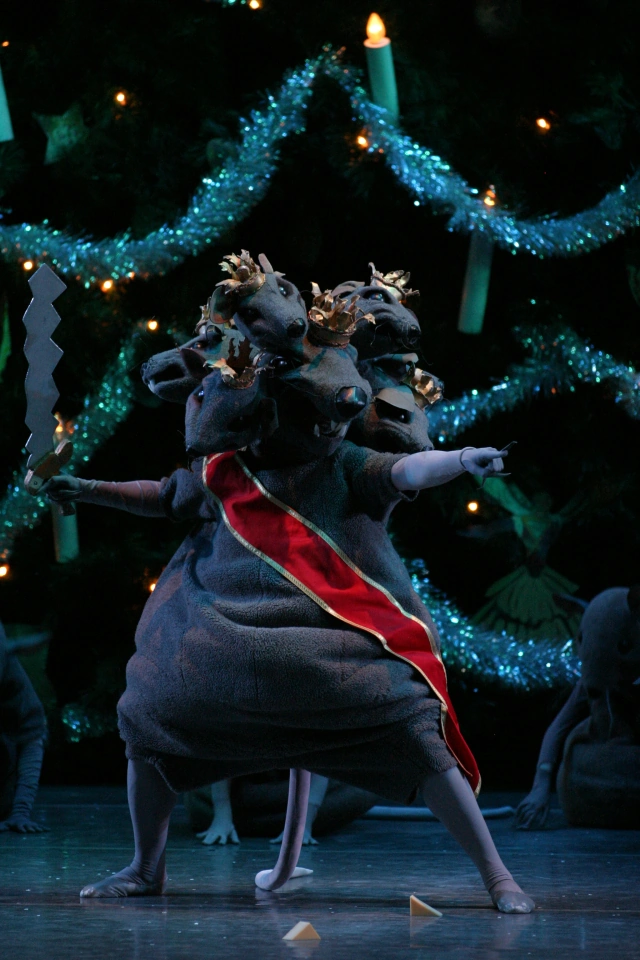
SEVEN HEADS ALERT!  SEVEN HEADS ALERT!  I REPEAT, THE MOUSE KING SHOWS UP IN 1993'S THE NUTCRACKER, AND HE HAS THE FULL, PROPER SEVEN HEADS.  THREE MOLDED COPIES OF THE CENTRAL HEADPIECE JUTTING OUT FROM BOTH SIDES, YOU COUNT 'EM UP, YOU'VE GOT ONE TWO THREE FOUR FIVE SIX SEVEN FULL HEADS!  HE AIN'T IN IT MUCH,  BUT HE MATCHES THE PROPER COUNT, AND HE'S GOT THE SAME DELIGHTFULLY ROUNDED, BAGGY BODY SUIT AS THE REST OF THE MOUSE SOLDIERS.  FIVE OUTTA FIVE.  TEN OUTTA TEN.  BEST MOVIE OF THE YEAR ALL YEARS.


Ahem.

So, this take on The Nutcracker is a bit of an odd beast.  Despite an alternate title naming it after George Balanchine's famous, life-giving and fame-bringing 1954 version of the ballet and despite drawing extensively from Peter Martin's then-present rendition, the film's overall construction gives one the impression it only exists because Kit Culkin couldn't negotiate satisfactory terms for payments on Home Alone 3, and rushed a film version of a Christmastime ballet into production so his son would have a starring role in a holiday film for the winter '93 season.  Macaulay Culkin is quite a bit more prominent than other Nutcrackers and their princely counterparts, entering the story alongside Drosselmeyer and getting teased as a potential romantic interest for Marie during the children's dancing scenes at the Christmas party.  He's got a substantial number of close-ups compared to the other major players, which reveal how Kit evidently instructed Macaulay to not move a single solitary facial muscle during the entire production, and consequently makes it seem weird the child actor so well known for his expressiveness in the Home Alone movies is playing it so dead-eyed.  Some of that might come from how Kit very obviously didn't drop a single cent on ballet lessons for Macaulay, who is asked to perform the Nutcracker Prince's dancing recap of his battle against the Mouse King (notably deleted from The Motion Picture), and does so by awkwardly shuffling in place, occasionally flourishing his arms a tiny bit, and overall looking like he does not want to be here.  Much as Tchaikovsky's ballet has the leads' absence throughout the second act baked into its traditional form, Culkin's presence makes the issue all the more head-scratching, for the constant focus on his person throughout the first act gives way to he and Clara simply sitting on the sidelines watching the cultural and candy dances with very few close-ups, and not even performing the play's final dance.  Y'all paid for The Kid What Did Home Alone In This Other Christmas Thing, now thrill as he embodies none of the traits you liked from that movie, and then gets benched so the real dancers can dance.

Course, the real dancers here aren't quite equal to those from the Bolshoi Company or the Pacific Northwest Ballet.  Lacking in technical knowhow about ballet and dance in general though I am, exposure to their filmed productions tells me there's something oddly simple about the performances here.  The group pieces are all fairly fine to my eye, big crowds in motion always having some positive effect on me regardless of technical execution, and their costumes are pretty and eye-catching all-round, so a large group in matching outfits of this type is going to work for me.  Problems arise with the solo or paired dancers, whose movements seem rather slow and restricted - the ballerina playing the Sugarplum Fairy seems especially simple and sluggish during her highlight numbers by comparison.  I have to wonder how much of these underwhelming dances are the result of my spoiling by viewing world-class performers and no one else immediately prior to this viewing, how much comes from a lack of vim and vigor during this particular production, and how much blame one can lay upon director Emile Ardolino.  I've not seen Dirty Dancing, but its reputation as one of the great dance movies led me to expect better staging and camerawork.  Where the Bolshoi production has the excuse of being a filmed live performance, and The Motion Picture works a few tricks to ease into its theatrical staging, Ardolino presents the film as 80% head-on filming of obvious stagebound sets, and renders his rare close-ups or alternate angles disappointing in effect thanks to a lack of acting from anyone onstage.  I singled out Culkin for his lifelessness due to his prominent treatment, but pretty much everyone here lacks an awareness that the camera might find them interesting at a distance any closer than fifty feet.  Such simple performances might work when viewed as live theater (not ever Nutcracker staging needs to bring the house down and strain the performers past their limits) or even filmed theater, but with the bare-minimum effort at treating this film like a movie in hand, the unimpressive footwork and static camera should make it a bit of a slog to watch.

Connie thought so, and I see where she's coming from... yet I found myself far more engaged by this production than the Bolshoi version or The Motion Picture.  I cannot call this film better than either, as despite some pretty backdrops and outfits (and those INCREDIBLE mice, ho boy!), its production design doesn't quite match the former's creativity or the latter's richness, and both contain what seem to me far better dancing.  Kevin Kline's perfunctory narration should seem insulting, and does little to help once one realizes how well the same information is communicated without words even here, and there's just simply not much here I might call exemplary.  Charming to an extent, visually pleasant, containing a mouse king with the proper seven heads as God intended, yes, but not great.  And again, here I am with a film I think lesser compared to The Motion Picture that kept me alive and awake far better.  I'm inclined to say some of it comes down to growing familiarity with both the general form and this particular show, and having multiple different points of comparison against which to actively go, "It's interesting how they're handling the cultural dances this time, and the different placement on the Sugarplum Fairy's dance has an odd effect on the flow, and what are the limited cinematic flourishes doing for the film compared to the others when they'll sometimes take the form of a slow flashback to events we saw five minutes ago, and and and?"  It's probably not so much this film having anything particularly special to stimulate my brain, as it is me having poisoned my brain with so much Nutcracker content in the past few weeks as to find the act of comparing and contrasting different versions more rewarding than I did when watching The Motion Picture a week back.  Call it engagement by way of being a fucking nerd.

Harshness aside, this staging of The Nutcracker probably simply made an ill-fit for the cinematic form.  Drawing on Connie's after-film musings again, I'd agree many of the flaws I've highlighted wouldn't stand out so prominently on the stage, considering the lack of a camera to underline the lack of emotive acting and its own inability to dance in time would remove the pressure to live up as a piece filmmaking, and the longer-standing tradition of live ballet productions compared to versioned film as film would remove the impulse to compare it to productions more specifically geared to take advantage of the medium.  In this particular mode, however?  S'fine.  Fun to poke fun at how wooden Culkin's dad made the thing by shoe-horning his famous son in, enjoyable to watch when the bodies are in motion, and happily free from the pedophilic subtext present in the ballet - or, for that matter, the textual text present in The Motion Picture.  This last really helps me find a positive spin on the film at the end of the day.  Drosselmeyer may become a bit of a dead-end character if he's not constantly present throughout the dream sequences, but if the alternative is a consciously creepy rendition orchestrating the dances in the Land of Sweets as a means of stealing young Clara's hand away from her ideal fantasy boyfriend, then LET'S play schmaltzy, cutesy child romance with no godfather in sight.  Please.

3/5

10/5 for the Mouse King

Monday, December 9, 2019

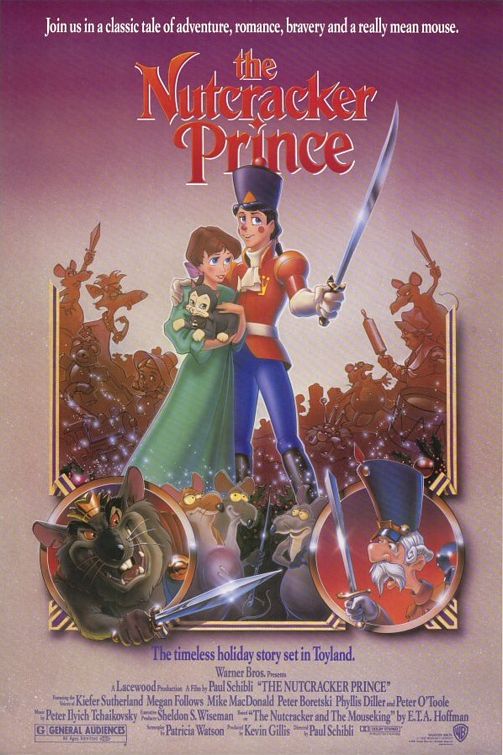
Mixed Nutcrackers - The Nutcracker Prince (1990)


Here's somethin' interesting for you - whilst watching the credits to The Nutcracker Prince last night, I noticed how a substantial portion round the middle was dedicated to "opaquers."  The term's alien to me and doesn't make its description obvious on first look, so I spent a little while Googling it, trying to find some reference to the profession of opaquing as it pertains to the film or animation industry.  My efforts were for naught, and the only reference I found to opaquing beyond dictionary definitions for "making something opaque" came from the imdb credits page for this very film.  It seems really strange for a film to have 168 artists credited for a single job I can't find any reference to online, especially when every other credit pertaining to people who designed, laid out, animated, photographed, and cut the film totaled to 176 persons, a mere eight more for every other part of making the drawings move than whatever an opaquer does.  What's going down here?  What secrets do you hide, O The Nutcracker Prince?

I've a working theory on this, and I'd love to hear any information proving it wrong, because it speaks to some unfortunate business practices if it's right.  Of those 168 opaquers, 37 are credited in a special section for Opeongo High School, Ontario-located home to graduate Kevin Gills.  Gills served as The Nutcracker Prince's screenwriter and sole credited producer, and quite a large portion of the non-celebrity voice cast were drawn from acting contributors to his cartoon The Raccoons.  It's also worth noting how, despite the film's listings noting production by Lacewood Productions, the animation credits here name Hinton Animation Studios, a studio which fell to crippling debts mid-production and was reconstituted into Lacewood prior to release.  All this, in combination with the "opaquers" coming just after the the xerographers and matching department people, leads me to believe "opaquer" is a deliberately twisted term for "colorist," one not covered under union protections, and so an easy way for a producer operating on a tight budget to cut a few costs on his film.  Why pay a few professional colorists at scale when you can farm the operation out to a whole bunch've people for very little money, and still not pay as much as if you'd hired any union-backed folks?  You can even get a little work from the high school and not pay a dime!

Now, as I mention, this is largely speculation.  I confess I don't know too much about how many workers it typically takes to get the colors done on an animated film compared to the other departments, and it's possible the use of high schoolers could come down to Gills paying his dues and offering his old school a program for teens to get a little experience in the professional filmmaking world for school credit.  There's easily a non-sinister interpretation of events if you look for it.  However, I'm not too inclined to believe it sight unseen over thinking the practice unethical, as there are still oddities in the credits like assigning a single artist to produce the backgrounds for a solid fifteen minute chunk of film where the other background artists would only need paint roughly five-and-a-half minutes assuming roughly even distribution, or the downright odd aversion to the word "colorist" when character designers are followed immediately by "character colour design."  Something don't quite add up here to my eye, and I'd love to hear from anyone more in the know about these things than me, because I'm really quite baffled.  Is "opaquer" a common job title up in Canadian production houses, or have I really found a weird cost-cutting measure?

As one might guess from the three paragraphs focused on accreditation more than anything in the film, The Nutcracker Prince gives one reason to think it made on the cheap.  It's not particularly egregious about any of these, and looks quite nice in places for what they had, but you can TELL they weren't exactly throwing around money to spare during production.  A few of the more impressive, fluid pieces of animation get reused in the same context wholesale, faster movements trend towards choppiness and lower detail compared to the norm, and numerous actions that seem best suited to smooth execution across a single shot are broken into their individual components across multiple edits and focused on as complete actions in their own right, completely killing any illusion of naturalness.  What's more, the aforementioned fifteen-minute chunk of the film with its own background artist is so thanks to a shift in the artstyle towards something far simpler and cartoonier, which effectively means the more complex, Disney-inspired animation only requires 50 minutes finished work rather than 65.  Fine as it appears in places, including some rather impressive on-screen transformations and big gestures given the clear crunch, the crunch is still clear, and marks the film as one produced under tight conditions.

Much as I'm inclined to note its low-budget, I don't much hold this against the film.  As I keep stressing, the designs work for what they are with one or two little stand-outs (primarily the Mouse King, who looks nicely frazzled and burly), the backgrounds have a good gentle quality about them, and some of the animations had me impressed at what they could pull off on not a lot've money.  The big art style shift actually works to the film's favor in my mind, as the character designs shared across both styles read better with the thinner lines, lighter colors, and slightly lesser detailing.  Its embrace of a zanier, late 50s sketchy-mod-look-embracing Looney Tunes aesthetic also helps the film's louder, slapstickier elements feel more natural, and leaves a satisfying sensation in the mind once it's all over and done with.  I very much enjoy the dedication to showcasing sequences sure to frighten small children in the audience, as when the Mouse King is stalking Clara with a fatal wound in his chest while all the animate dolls revert back to wood and plush.  We might not have artistic triumphs here, but the artistic moderate accomplishments get the idea across on their own level all the same.

Heck, with regards to the plot and story, I appreciate how much The Nutcracker Prince draws from ETA Hoffmann.  It's pretty much the same plot points in largely the same order, with details like Clara bargaining with the Mouse King after his supposed initial defeat and the passage through the Land of Sweets left intact.  We're even free from a creepy Drosselmeyer again, which I think will only be possible through these animated adaptations - the instinct to move FAR away from "what if an eight-year old's sexual awakening by way of her godfather's tricky machinations" is absolutely the right instinct.  Where the film REALLY falls down comes with its confidence in the material.  Paul Schibli and Kevin Gillis have, if not a time-tested classic, at least a well-worn, simple template on their hands, and no good reason to tack on additional details or rearrange the structure, but they do all the same.  For example, just as Nutcracker Fantasy's Tchaikovsky quotations were rather sparse and token, here the snippets from the ballet's score come far too frequently, and are overly front-loaded.  Recognizable melody follows Christmastime staple with little time for the score to cool its heels, and before we're past fifteen minutes we've used practically everything the general public might know, thus leaving the rest little to pull out for something fresh, beyond an admitedly clever use of the final waltz across multiple emotional tones.  There's too much eagerness to prove we're doing The Nutcracker, which leaves the film a bit sonically lacking as it goes on.

When considering their lack of confidence in the novella's story and structure, the problems multiply.  The battle against the Mouse King's forces and the journey into the Land of Sweets now requires the presence of multiple new doll characters to provide further slapstick comedy and exposition about the nature of the fantasy world and its kingdom, which mark a transparent grab for inattentive children's eyes.  They're not particularly enjoyable or dignified parts, especially not Peter O'Toole's elderly, bumbling toy general, who I feel earnestly sorry he ever had to voice for any reason.  Parts must've not been very good at the time.

Our biggest issue, though, comes with the exact placement of The Hard Nut flashback segment, the prior discussed 15-minute artstyle shift.  Rather than coming between the two battles between Nutcracker and Mouse King, it is positioned at the fifteen-minute mark during the opening Christmas party, and concludes at the half-hour mark, leaving the following forty-five minutes to work through the book's first and third acts back to back.  This speaks to a distinct lack of trust in the young audience to go along with the magic of toys and mice fighting without a full explanation for why there are magic toys and talking mice that don't get along beforehand, and sets bad precedent for the film to come.  Positioning such wild silliness gives the rest of the film justification to play its comedy broad and loud even when it doesn't match the more Disney-esque artwork, and leaves us with the odd problem of characters showing up to establish their gimmick and subsequently reappearing to bring it to conclusion in the space of five minutes.  Placing the flashback where it naturally sits in Hoffmann's work, as effectively the middle act, would not only break up the action and hopefully dissuade the surrounding film from going as broad as it does, but maintain the sense of wonder and magic around that first battle, perhaps hooking an unattentive audience better than "here's some exposition but it's really silly" does.

This constitutes a LOT more words than I anticipated spilling over a minor forgotten piece of 90s children's animation based on The Nutcracker, so I feel a little bad gritting my teeth and giving it the lower rating between the two I teased in my head for most of the day.  After all, despite some shrillness in the comedy and sloppiness in the animation shouldn't entirely overwhelm a solid if unremarkable overall production.  Poor construction and lack of faith are poor construction and lack of faith, however, and I've my suspicions that the same team working under the same circumstances would've produced a stronger film if they'd stuck to what they had and didn't feel the need to, for want of a better phrase, dumb it down by tweaking the order of events and adding more trendy elements for their day.  The gentler aspects of the original story are what spoke to me most, and something trying for an early prototype version of 90s eye-rolling and purposeful tone breaking just can't get all the way over the pass line in my house.  Plus, y'know, much as one shouldn't let behind-the-scenes stuff effect their viewing unless it's concrete and doing active harm to someone, I really can't shake the notion that they weren't paying their colorists a living wage during production, and that's just shitty if it's the case.  Please, please tell me I'm off-base on this.

(It's really all down to the Mouse King - a crooked tail and a hair-trigger temper do NOT compensate for one lousy head.)

2.5/5

Tuesday, December 3, 2019

Mixed Nutcrackers - Nutcracker Fantasy (1979)


Much as I'd like to preemptively declare Sanrio's Nutcracker Fantasy the weirdest film we'll watch for this marathon, I shan't do so.  It's far too early for any statement so definitive, particularly when I've watched the trailer to Nutcracker and the Four Realms multiple times over the past week in a vain attempt to understand how and why it happened.  This said, today's film does make a fairly convincing case for the title, being a stop-motion animated work that rejiggers pieces of the ETA Hoffman story into a wholly new form inspired by The Wizard of Oz and Alice's Adventures in Wonderland, with animation courtesy of several Rankin/Bass overseas animators.  Per imdb's cast and crew page, those who worked on this film weren't CREDITED for much on their American televised work - director and editor Takeo Nakamura only has Santa Claus Is Comin' To Town listed as an animator, while puppet producer Sadao Miyamoto worked on Frosty the Snowman as an uncredited animator, Tadahito Mochinaga served as puppet technician and cinematographer on Mad Monster Party and animation supervisor on Rudolph the Red-Nosed Reindeer, and puppet designer Ichirô Komuro went on to serve as production supervisor on several of the company's 80s productions.  Only four major names I can find amongst the credited crew in total, but considering how lax most visual presentations were about giving due credit to everyone who worked on a project beyond department heads (especially where foreign workers were concerned), and considering it shot at Mochinaga's own MOM Production studio same as the Rankin/Bass specials, I have to imagine there was more behind-the-camera experience with the form and style than one can ascertain from the on-screen accreditation.

Without the budgetary and time limitations of producing for an American televised holiday market, and with the eye and money of a booming Sanrio (backed by five years of Hello Kitty sales) on their side, Nakamura and crew show what this style of stop-motion can really do with Nutcracker Fantasy.  Sets are substantially larger and more detailed than in the familiar Christmas specials, with the lovingly dressed, two-story foyer of Clara's home and the Mouse Queen's sprawling lair standing out as particularly impressive examples.  Large crowds of characters are not only possible at a greater frequency than in Rankin/Bass' productions, they also boast a wide assortment of unique character designs, rarely resorting to mothballed old props or copycat clones.  When sets of characters with the same appearance do show up, it's justified by the presence of armies of mice and wind-up soldiers, spiced up by the addition of odd-looking generals, and more than compensated for by staging a lively, multi-plane battle with several layers of action across the horizontal and vertical plane both.  The camera's also far more lively than one typically sees with this style, crawling through the dolls and transitioning across interesting composite editing effects.  Special effects too benefit from the loftier breathing room, with far more intricate and lively integration of sparkling lights and specialized sets for trick camera moves, well beyond the overlaid gauze and animated snowflakes of Rankin/Bass' work.  I have to wonder how much Sanrio's aesthetic needs and demand for quality, or else the animators' decade-long experience with the style influenced the production, for Mad Monster Party was also produced for a theatrical release, and still suffers from the same limitations as its televised counterparts.

As an adaptation of The Nutcracker, Nutcracker Fantasy is actually a pretty fascinating reworking.  In as succinct a manner as I can manage: they've taken Godfather Drosselmeyer's story about how the Nutcracker came to be with the Mouse Queen and the cursed princess and the hard-to-crack nut, transplanted it into something inspired by the looks of the Land of Sweets without the candy themeing but with the large assortment of foreign dignitaries, expanded the conflict with an ongoing war reminiscent of the opening movement's mice/toys battle, and presented it all as a maybe dream/maybe reality situation, which nicely encapsulates every important element of Hoffmann's story.  It takes far more cues from medieval fantasy and lost girls stories, given how Clara's part for much of the story is to stand on the sidelines listening and worrying, but it's quite a clever way to rope in so much detail that's otherwise dropped from the ballet.  Some portions seem drawn from the ballet, as when the foreign wisemen are clamoring over one another to propose solutions in a manner reminiscent of their dances (just with far, FAR more nations and... ethnicities, shall we say, represented).  There's even a nod to the astronomer from Drosselmeyer's story, through the Queen of Time, whose mystical, heavenly figure of sagely advice is achieved through traditional ningyō jōruri rather than stop-motion.  S'all very neat to behold, and coupled with the aesthetics of the piece, it manages to give the film its own identity while paying clear homage to its progenitor, which mark good qualities for an adaptation.

When the film plays with its own material, it's not always quite so charming.  The beginning takes several minutes to establish a sinister Rag Man figure who seems like he'll play a major role, yet drops clean out've the narrative once the Nutcracker portions begin.  I'd suspect his loss has something to do with the English dub (the only one easily available, unfortunately) chopping out about ten minutes of footage, including two live-action dance segments, though I cannot find any substantial information on the differences.  More probably common to both versions is the court of foreign wisemen, which turns entirely on lazy stereotype humor, and mostly gets past my hackles for its clear demonstration of how varied the puppet design is in this film, as well as containing both a joke about Stalin's five year plan AND an offhand reference to Der Fuehrer's Face, both of which threw me for a loop.  The film's attempts to give Clara something to do in the climax mostly center on her wandering through a magic forest and meeting several symbolic original figures who lack much of what makes the Queen of Time interesting to watch and consider.  Most they have going being voiced by Christopher Lee, with one seeing him attempt a rather bad Irish accent.  It really must be said, while it's admirable to try and exercise Clara's emotional intelligence during this stretch, prior to the effort she has nothing to do but stand around waiting for the plot to move on, rendering her an undynamic protagonist in love with the soldier-turned-Nutcracker Franz because he looks handsome and heroic.  And, well...

I say the story's weaker when it's striking out into its own concepts, when I should really say it's at the weakest when it pulls in the one thing I'd never have imagined we'd pull from the Hoffmann story.  The reasoning behind the Mouse Queen's ire, I get snipping it out.  Clara not throwing her slipper to distract her an afford the Nutcracker a win, weird considering the ballet keeps this and makes it a more decisive action than in the story, but whatever, the sequence plays out fine on its own.  Making the secret to cracking the nut and breaking the Mouse Queen's power a pearl sword rather than someone's teeth, I guess I'm fine with it despite lessening the importance of Franz becoming a Nutcracker - these puppets don't exactly have articulate jaws.  But having Clara awake from her dream, meet her visitor Fritz, find him identical to Franz, and get married to him despite a doubtless decade-or-more age gap betwixt them?  Hoy.  Bad enough an implication when it's the 1810s and marital customs were far different than now.  Even accounting for this film's still-40 year age and differences in Japanese culture, it's still a bit of a Thing to take the story beyond a young girl's self-flattering dream world and into "They actually literally got married in real life and went to live in her fantasy kingdom, which is real, forever."  Gets one chewing one's cheek lining in discomfort, and makes some of the wholesomeness drain out've the story, not at all helped by how Clara's undying love as the only thing that can save the Nutcracker from his transformed state dropping into the story a few minutes prior with a "We've been trying to tell you this was the case all along!" line, despite this very much not being the case.  You were trying to tell her the kingdom of toys and ethnic stereotypes needed saving from a two-headed mutant mouse monster so your newfound beloved could marry someone else entirely.  Don't try to sell me a story you weren't telling in the final minutes, even if I'm in your target audience, and especially don't heavily imply a marriage between child and teenager at best, child and adult at worst.

There's other problems with Nutcracker Fantasy, mostly pertaining to the English dub - the voice acting is serviceable at best, the inclusion of Tchaikovsky snippets token, the American musical numbers not really to the standard of what their contemporaries were producing, which don't do much for me anyhow.  Taking it all into account and looking for the right ribbon with which to it it in a bow, though, I think an ultimately positive assessment is in order.  The spectacle of seeing Rankin/Bass' particular take on stop-motion design and animation given greater cinematic flair and polish than I've ever seen leaves a big impression, and the way it remixes The Nutcracker and the Mouse King into its own mini-fantasy war plot whilst homaging the source material leaves me with charm aplenty to overcome the less than stellar original material.  Just the simple fact of the Queen of Time's live puppetry amidst this collection of invisibly maneuvered figures is a memorable and impressive enough testament to the creativity on display here to get me over the "why are we implying child marriage?" hurdle.  A strong start to the holiday programming proper, and one I hope at least one non-Fantasia film can surpass before the month's out.

(Points for giving at least one mouse monarch multiple heads.  We'll see if anyone managed the full seven.)

3.5/5

Friday, November 22, 2019

The Phantom Carriage (1921) - Lord, please let my soul come to maturity before it is reaped.


Letterboxd Season Challenge 2019-2020!  Theme four, part three - a silent horror film!

(Chosen by John!)

The last time I reviewed The Phantom Carriage, much of my discussion centered on the film's most notable supernatural element, of the last poor soul to die at the strike of New Years' midnight condemned to drive Death's carriage over nights that last thousands of years until the clock's next year-marking strike. What I identified as "the real meat of the film" occupies a rather brief paragraph before I get back to meditating on personifications of death and the overall effect of dwelling in semi-darkness through the cinematic medium.  In my defense, I was just getting started with long-form reviewing at this point, and trying to spit out my reviews soon as I finished watching to boot.  On this rewatch, I think it good and right to give said meat some proper focus, and pick apart just what makes Victor Sjöström's yarn of a wretch redeemed at great cost tick along so well.

I find it notable how the film allows us to think of David as a real bastard before we truly know him.  The opening sequences focus on the bedbound Sister Edit, dying of tuberculosis and begging those around her to summon one David Holm to her side for one final meeting before her expiration.  Scenes of her attendants debating the wisdom of this decision follow, and lead into said attendants scouring the small Swedish village for some sign of this mysterious man whose presence a woman of the faith desires so greatly - but to no avail.  Dialogue hints towards David Holm deliberately dodging those who seek his presence, cuing us into his insensitivity towards those in pain and need.  We then shift focus to listen in on a drunkard regaling his friends with strange recollections of a deceased friends' beliefs about those who die at the year's final chime, presented visually through a series of stacked flashbacks.  While Georges' story about the Phantom Carriage is depicted with the film's first instance of double exposure visuals in a manner that imparts otherworldly, deathly seriousness, and Tore Svennberg's performance within David's flashback personifies a man hollowed with fear at the prospect of such a fate befalling anyone, Sjöström plays the man's pantomimed speaking on either side of the flashbacks with a silent, dismissive cackle, even as he speaks of Georges' passing in such a way as to condemn him to the fate he so feared.  It is only after we separately understand the concept of David Holm as someone who'd actively avoid a dying woman's request and this nameless man as one who laughs at misery and suffering, a good half-an-hour into the film, that we're informed they are one and the same, effectively doubling our disgust.

When Georges arrives as the driver of the Phantom Carriage to inform David of his fate for the next year and expound on how he came to this state, the way Sjöström chooses to present and cut the tale short further exemplifies how he characterizes David as a worm who deserves his fate.  Pastoral scenes of David as a happily married family man with two beautiful children last only a brief time before Georges enters the scene and tempts David into a life of disorderly drunken abandonment, but they speak to how deep this man's faults run, especially to a modern eye.  Much as these scenes were likely intended as a rail against alcoholism and the damaging effects it wreaks upon society (especially given the original Selma Lagerlöf novel's commissioned purpose as public education about tuberculosis), I see David's quick descent as emblemizing the true immaturity of his soul.  What kind of man would turn to such vicious, nasty behavior as deliberately destroying a kindly Salvation Army woman's hard work on repairing his coat with full knowledge of the infectious risk she took in doing so after but a few rounds at the bottle and a brief stint in jail, if not one who didn't truly appreciate what he has?  True, the loss of his family is a devastating blow, but we begin this stretch of film with a David who acts the regular family man, and end it with one willing to risk others' deaths just because he's feeling particularly mean this morning, separated by only a month or two at most.  ANY minor slip would've brought him to this state, and exposed his unfitness to do more than forlornly usher souls to the beyond.

Most interesting of all to me on this watch, I find it fascinating how Sjöström continues David's damnation through the final stretch, and yet still finds reason to bring about his redemption.  When Georges forces David's spirit to stand beside Sister Edit's bed, and listen to her recollections about his life since she knew him, it paints a picture of a soul only a few shades removed from a true moral blackness.  In these passages, David deliberately coughs on people in the hopes his consumption will finish them off, professes a profound hatred for all joy in life, hunts his wife all across Sweden to the point of driving her to illness and exhaustion, reunites with her under false pretenses, deliberately risks infecting his children, and pulls what would become known in sixty years' time as A Jack Torrance with an axe - the only thing saving him from total irredeemablity is his unwillingness to take a swing at his wife once free.  Worst of all, the infection David earlier passed to Edit claims her life towards the picture's end, robbing the world of a truly selfless soul, one who looked on a wretch like David and saw someone deserving kindness and love and sacrifice, and pursued these beliefs to no avail beyond their respective deaths and the increased suffering of all who knew him.  There is practically no reason to want this man to do anything except suffer for the millennia that will pass before he must hand the carriage's reins over to another unfortunate bastard.

And yet he is redeemed.  When David Holm catches sight of his wife, in utter poverty, preparing poison to kill her children and take her own life to end their suffering, he is overcome with such agony at Georges' powerlessness over the living that he is granted a reprieve.  He wakes in the graveyard where he expired, rushes home, saves his wife, and convinces her of his true desire to reform, uttering the above-quoted prayer as the film's final word.  To my eye, David has Sister Edit's selfless kindness to thank for his salvation.  In life, her actions were met only with vindictive destruction and hateful rhetoric, which poisoned her and sank David further into his vagabond life of depravity.  In death, however, as David watches his life over again at Georges' side, seeing his cruelty with eyes free from its blinding effects, what stands out most is how far Edit went in the name of trying to help, even on so little a matter as patching the holes in his coat.  It is the sight of someone truly pure giving her all to the very end and no avail that makes David cower on the floor in an attempt to hide from the horror of his own life throughout the film's latter half, and it is the knowledge of how his living sins will continue to consume and rend apart all he held dear well past his death that gives rise to divine intervention, enabling David to truly repent, and earn a second chance at spiritual maturation before his final time of dying.

He does not deserve this.  He cost the world far, far too much in life, and stands as such a heartless, spineless bastard, I can't blame myself from nearly two years back for thinking Sjöström should've leaned into the abyss and denied David any salvation.  But at the same time, seeing a hopeless sinner realize the full implications and effects behind his careless actions and come to a second chance through purest anguish is the whole point of The Phantom Carriage.  The scenario's horror lies with its connotations beyond all else, its staying power with the impossibility of its conclusion.  Sister Edit's suffering and untimely death only possess a silver lining if we allow for the man she thought savable to the bitter end to be saved and grow beyond what he once was.  If, and only if the worst amongst us are treated as if they can one day become better is Death's terrible sting lessened, and only then does the empty void beneath the hood possess and deserve a human face.  S'a very Christian message, and one I'm happy to go along with for the sake of emotional wholeness.

4/5