Showing posts with label comic bookery. Show all posts

Sunday, October 13, 2019

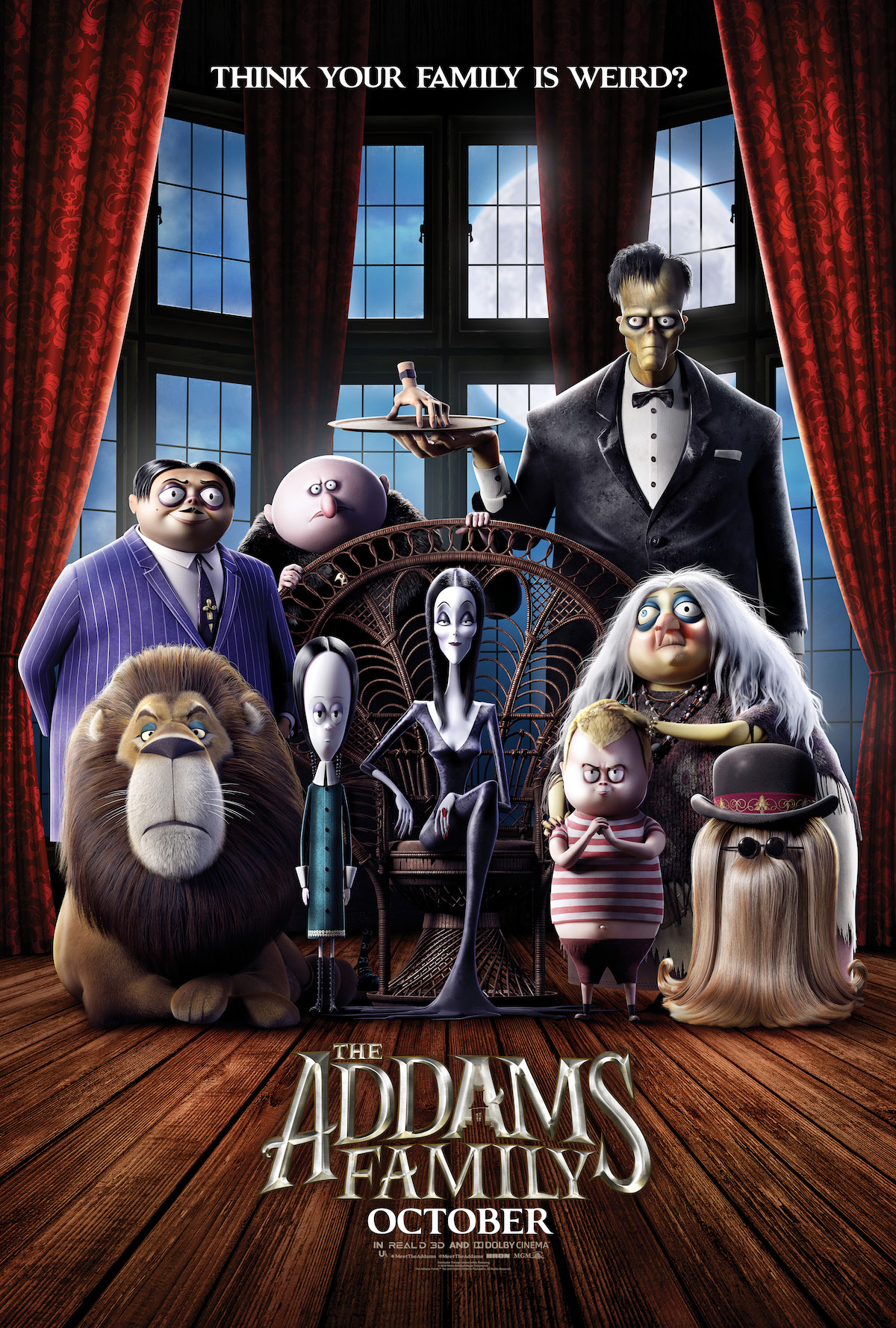
The Addams Family (2019) - You rang?


Conceptually, the new Addams Family is a touch confused.  Per the lengthy pre-credits introduction sequence, this latest take on Charles Addams' classic characters are a bunch who very much mind the fact that polite "normal" society views and persecutes them as freaks, and are ecstatic to discover a creepy old manor in perfect line with their sensibilities.  Quite a lot of one major subplot involves Morticia and Gomez agonizing over keeping Wednesday safe from the outside world, and the climax turns on first a need for one family member to shield the rest from an angry mob, then on the whole clan learning the meaning of tolerance.  I'd feel somewhat hesitant to decry this as a betrayal of the franchise's core appeal - this being how for as creepy, kooky, mysterious, and spooky the Addams' are otherwise, they're far better at maintaining the wholesome, healthy ideal of a nuclear family than the more conventionally regular people around them - except for the way the film frequently demonstrates an understanding of this same appeal.  Depending on the scene, the Addams Family are wracked with the same inability to functionally communicate with and love one another as the rest of the world and fear discovery/destruction, or act exactly like their traditional selves, blithely unaware of how or why others would ever view them as different, exactly in tune with one another.  It's definitely odd to go from Morticia failing to deal with Wednesday's emergent rebellious attitudes or Gomez pushing Pugsley to work a tradition the same way he did, to the family unit ticking like clockwork to unintentionally freak out a nosy neighbor.

Matters aren't helped by how the film's vision of normalcy is itself decidedly skewed.  The villain, Margaux Needler, a designer home flipper, seems a pretty decent foil to the family in the mold of the villains they faced in the 90s films, with a few added doses of more obvious "conformity is bad" commentary slathered on so the younger kids can get it without trying.  Issue is, the same impulses that make her so obvious a foil on the surface also drive the writers to make her a far more conventional, active villain, which leads to... weird choices.  Choices like the same film that's trying to make general social intolerance to difference scary deciding to have its villain artificially engineer any and all hate towards the Addams' via social media.  Choices like bringing the intolerant villain round to the heroes' side without any idea how to do this, so she just goes from full-scale meltdown over her failure to blissful acceptance after some off-screen romancing from Uncle Fester.  Normal as a concept basically has to adopt two contrary versions of itself, the default state of the world by natural order and something forced on others by control-freaks, in much the same way the family's dynamic flip-flops from its classic form to more conventional dysfunction and back again.  It all reeks of a production with multiple differing visions, and no real compromise on how to make it a cohesive whole.

On the somewhat positive side, the individual characters as realized by their voice actors slot into their roles quite nicely.  Pugsley in particular feels like a big improvement over other incarnations of the character, having an actual personality and arc to play through compared to his usual state of Wednesday's chew toy.  He's still a little heavily reliant on the "little tyrant boy obsessed with explosives" archetype common to pretty much all forms of kooky family media, Finn Wolfward's performance occasionally trends towards generic in ways the other cast members don't, and I'm still not entirely convinced the idea of Gomez feeling ashamed over his son's interest in explosives over swords isn't against the franchise's general spirit... but it leads to some sweet moments in the finale, allows Pugsley a chance to shine, and gives the family's most cipher-like character some good definition, so I take the good I see here over the bad.  Oscar Isaac and Charlize Theron don't bring much to their characters Raul Julia and Anjelica Huston didn't already put there, though they feel right for the parts, and ChloĆ« Grace Moretz has the right sort of deadpan to make her more rebellious take on Wednesday play well.  Nick Kroll as Uncle Fester... look, he's in basically the right vocal neighborhood registry of a Jackie Coogan imitation, but there's something about how gargly he sounds at times and the implications of the character as a class-A pervert that turns me off the performance.

As per always, Lurch and Thing remain my personal favorites.  Perhaps my love for characters with minimal dialogue and no major part to play in the plot says something about the film's quality.  I'm still out here loving Lurch living his best life, even as he's mostly here to provide musical gags.  I adore him all the same.

I wasn't expecting much out of this film, and sure enough I didn't get too much.  Between its inconsistent characterization for the family, weird insistence that the Addams' of all families need to learn tolerance and acceptance of difference, and somewhat slow pace (it feels like we spend an hour setting up all the conflicts going down throughout the film, then toss out half and rush through what remains - there's a few teased-out lines regarding Morticia getting in over her head that never go anywhere, for example), it's definitely a prime candidate for a studio product existing for the sake of its own existence above any driven need to tell a story.  Knowing as I do, however, how the Addams Family can be far duller and far more inappropriately disturbing (yes, even for them) as per the wretched 1977 Halloween special, I can't really say this is TOO bad.  Confused, low-energy, and not so classically Addams as to properly earn the admittedly fun replication of the 60s series' intro before the credits, yes, but not awful.  Not intolerable, or ruinous, or a blight on the cinematic landscape, or whatever some more hyperbolic reviewers are claiming.  Definitely a good time for the kids, though probably destined to become less a beloved nostalgic classic than "the HELL was I thinking liking this so much?" when they grow up.  It exists, won't make much money, and will pass from memory before you know it - why should I do much more to it than point out what I think is wrong, note what it gets right, and go, "Eh, y'know, if it's your thing, why not?"

(They slot a Young Frankenstein reference AND an Invasion of the Body Snatchers reference right next to each other.  It's weird.)

2.5/5

Sunday, October 6, 2019

Joker (2019) - The worst part about having a mental illness is people expect you to behave as if you don't.


(Goin' full spoiler mode for a film that's still in theaters, so turn back if you aren't down for that.)

Right.  Let's have ourselves a talk about the quote in the title.  It's been in the trailers, gone viral as part of the marketing, gotten propped up as one of the big iconic capital-T Things from the movie alongside Joaquin Phoenix crying as he stretches his mouth into a fake smile and Phoenix smash-step dancing on the stairs.  And it has been... interesting for me.  Because I've said that quote before.  Paraphrased or verbatim, I've hit low points where all I want to do is lash and rant and hurt whoever's listening, and said that it's so goddamned frustrating having to go through my day under the expectation I'll act all normal when inside I'm getting angrier and angrier at myself and everyone around me.  "Yeah, me," I'll say, "it really does suck not being allowed to go round unloading all your damage on other folks whenever you want to, and getting called out when you decide to anyways out of the blue."  It is a Bad Thought, one of the repeating lines that comes up when my mental state hits its worst point, and one of those things I constantly promise myself I'll never unload with again before whoopsy-daisy!  Turns out we're right back here.

Hasn't exactly been one of those situations where it's this major trigger every time I see it - despite my problems, I'm generally collected enough to not deal with that problem, though I understand plenty others do and wish them the best in coping and overcoming.  It's more a strange situation because there's been all this talk about how Joker will get audiences inside the famous supervillain's head, make them see the world as he does, make us sympathize with the mad clown.  And it all sounds a lot of marketing guff reinforced by folks on the internet who're more than happy to repeat marketing guff if it's guff written to appeal to their sensibilities.  Until there's that thing I say when I'm having problems. My self-pitying, self-justifying line, which functions so well as a means of hurting others by implying they're doing something wrong by not tolerating my overly-aggressive nonsense, and hurting myself by explicitly stating the out-of-control, undercutting, unstable mindset is the healthy one.  That... sure is one hell of a Thing to have at the forefront of a marketing campaign.

And y'know, cliched and close to incel sadboi talk as it may sound, in watching Joker, there's an awful lot've Things in Joaquin Phoenix's performance I recognize from my own struggles with mental problems.  The tendency towards performative behavior when feeling cornered.  The attempts to sound decisive and harshly-spoken made ridiculous by storming off into a glass door or some other such unaware pratfall.  The struggle to break out of your own headspace and properly connect with folks.  The fantasizing - so much of the fantasizing.  Placing yourself in situations where you know you'd otherwise recede into the background or bomb if put on the spot, and imagining how you'd effortlessly breeze through it and get all the veneration and positive reinforcement you'd ever like.  And then when you can't idly dream anymore and come back to reality and find things aren't so good as you'd like, tearing everything out of a small space, crawling in, and not coming out for hours on end.  I've definitely done that last one more than a few times myself.

It should be noted, my life doesn't suck the same way Arthur Fleck's does.  I'm not dangling over a pit of economic ruin in a city on the verge of social revolt with an equally-ill mother to take care of and a need for multiple medications that the state pulls away once social programs get the axe.  Things are, in spite of how I feel many hours of the day, generally fine.  But Joker is out here smartly working the fears that things might be this way one day, or worse, how they might be so right now.  It's rote to say a film plays with your sense of reality, yet this film's right up front with how it does this, inviting you into Arthur's head to see how readily he detaches from reality early on, and evoking the same sudden shifts to the world acting flattering towards him at multiple points to slyly indicate when he has a break.  Most of the time, these breaks come when his situation is deteriorating, and while moments like his realizing the woman he's been courting never spoke to him beyond their initial meeting are obvious, other bits like the yuppies he murders taunting him or the city reflecting his self-image in the adoption of clown masks as a means of performance take longer to resolve themselves as real or not, if they do at all.  For the record, while I unfortunately had to give up a theory that the clown masks were all in his head (the third act doesn't really work as a narrative if you hold to it), I'm still nursing a notion that the guys he kills on the subway didn't actually do much to him, given the oddity of their singing Send in the Clowns before beating the shit out've him in the same way the street punks do at the beginning.

It could all be wrong, is what I'm saying.  Life could seem good, and the things you hold dear could all be inventions of perception to make yourself feel better.  S'a terrifying thought, and one I frequently have when down in a really dark place.  Cinematically, it's an easy place to explore, and would make a fine film on its own merits.  Where I think Joker goes right, where I think it earns the accolades it has claimed in this last month, and where I think it dodges the traps inherent to a story about how your reality isn't true and the world really wants to just beat you down, is in its refusal to validate.

Phoenix is key here.  He spends so much of the film chasing after some notion he's more important than he feels, be it a career in stand-up, a place as Thomas Wayne's son, or someone who can hold a lasting relationship.  When all lead to dead-ends, and he is left with this hollow, hating feeling inside, he breaks, and turns fully performative.  He's more dynamic in his movements, playful in his speaking, clever in his speech, more the image of a man treating the world as something to kick back against.  That fantasy of going out there, making a grand statement, and blowing your brains out for all the world to see (another one I get at times) constitutes his whole plan for the third act, and his every action is played as if however the world reacts, he'll take it as validation.  Yet the film does not reinforce, nor does it condone, because it treats his actions as disturbing, shocking, and vile as they are.  This man has killed people to make himself feel better, taken advantage of the big shot he's always wanted to enact a small-screen suicide, found a way to control his inappropriate laughter by deliberately, forcefully laughing at the horrific acts he perpetrates.  Each and every action is an act, and it is act to get attention, to feel important, to raise a middle finger at the world and tell it all to piss off.

And it is wrong.  The film treats it as wrong.  Phoenix's performance indicates he is wrong.  The whole big fantasy of becoming an important person, and what does it involves?  Breaking down on air, violently oscilating between performative and self-pityingly angry, blowing a man's brains out, and becoming the cult leader of an aimless, needlessly violent movement based in destruction as an ideology.  Big whoop, buddy.  Your dream's everyone's nightmare.  MY dream's everyone's nightmare.  That's why I push it down and try to get better.  And the thought that there might come a day when I can't push it down, because I can't control it or because the wrong stimuli come along or because I can't get the help or support I need any longer is terrifying.  And that's the big success of Joker - taking all those what if fears of living with a mental illness, playing them out to their logical conclusion, and condemning the result.  This is wrong, because the end result is the JOKER.  This is his world, this is what I get if those impulses are acted on - a nightmare world where the veneration  I want only comes from people who might want to serve a goddamned supervillain.

Now, if I've any big issue with Joker, it's in how it adheres to the whole supervillain thing.  Namely, at the climax, as Arthur's story is reaching its climax, we cut over to one of the rioters chasing a rich couple out of a movie theater, and gunning down Bruce Wayne's parents.  The camera stays with the little boy for a little too long for my tastes.  If it were incidental, a sharp punctuation note in the midst of all the chaos he's needlessly inspired, I might be good with it.  As stands, this feels like a far worse attempt to tie Batman and the Joker's origins to one another than the Tim Burton Batman film.  At least there, the connection was more casual, a nice third act twist to make the stakes more personal in the way a thousand other action films have.  Here, we've a film whose writing and star performance work their asses off to show how this is all the result of a man disintegrating and taking every little thing as an opportunity to scream at the world about how unfair it all is and work his damage out on everyone who crosses his path, and how none of it is right or justified regardless of how he feels... and then throws a little "And this was all the start of a great franchise rivalry!" note in right as it ends.  It's far, FAR too close to making his actions seem righteous and exciting rather than hellish and terminal.  A story like this, this sort of sympathetic but still firm and moral look at the Joker, should not end with Batman's creation.

I should dive out, back into healthier waters.  This has been a lot more soul-baring exercise than proper review, even though a lot with regards to the film's editing, sound design, other performances, and general visual feel deserve praise.  Just for a quick little example, it's smart in the way it brings in the Taxi Driver and King of Comedy homages, as they mostly play into Arthur's runaway, self-destructive myth making, and function as means of showing how he's taking the wrong path more than making him look cool in a shallow way.  But I've gotten dark here, and possibly implied some things about myself in finding a mirror in this movie that I really don't intend.  I just want to say, in spite of how much of my worst thoughts I find in this movie, how much I feel the fear of giving up and doing whatever and taking even the most horrific things as a means of feeling great, I am OK.  I wouldn't appreciate Joker quite so much if I wasn't OK.  In much the same way Psycho is a scary but enjoyable way of watching a mentally ill person wrench the movie's narrative away from its original track and refuse to let it go with each plunge of the knife, Joker is a terrifying look at all my intrusive thoughts and imagined scenarios.  It's a good way to see that all actualized with a palpably horrified reaction to what it all means if brought to a conclusion, and then lean back, self-reflect, and say "Let's not go there.  Let's be healthy."  Hopefully it stays this way, and we don't see it all blown to bits by Phoenix coming back to fight Batman as a more standard take on the character.

(Last note: Todd Phillips has been talking a lot of nonsense in interviews of late, all this stuff about how comedy is dead because the leftists and SJWs are out to cancel all comedians, and how he's trying to smuggle a REAL movie into the world of comic book fluff.  I very much disagree with his perspectives, and will be quite disappointed if further thinking on this film turns up that ideology in his construction.  It still works quite well for me, though, and I can't find reason to condemn his comments in the same way I condemn other directors for endangering/abusing cast and crew, so y'know... fuck what he thinks.  Movie's still good.)

4/5