Showing posts with label TV stuff. Show all posts

Thursday, December 19, 2019

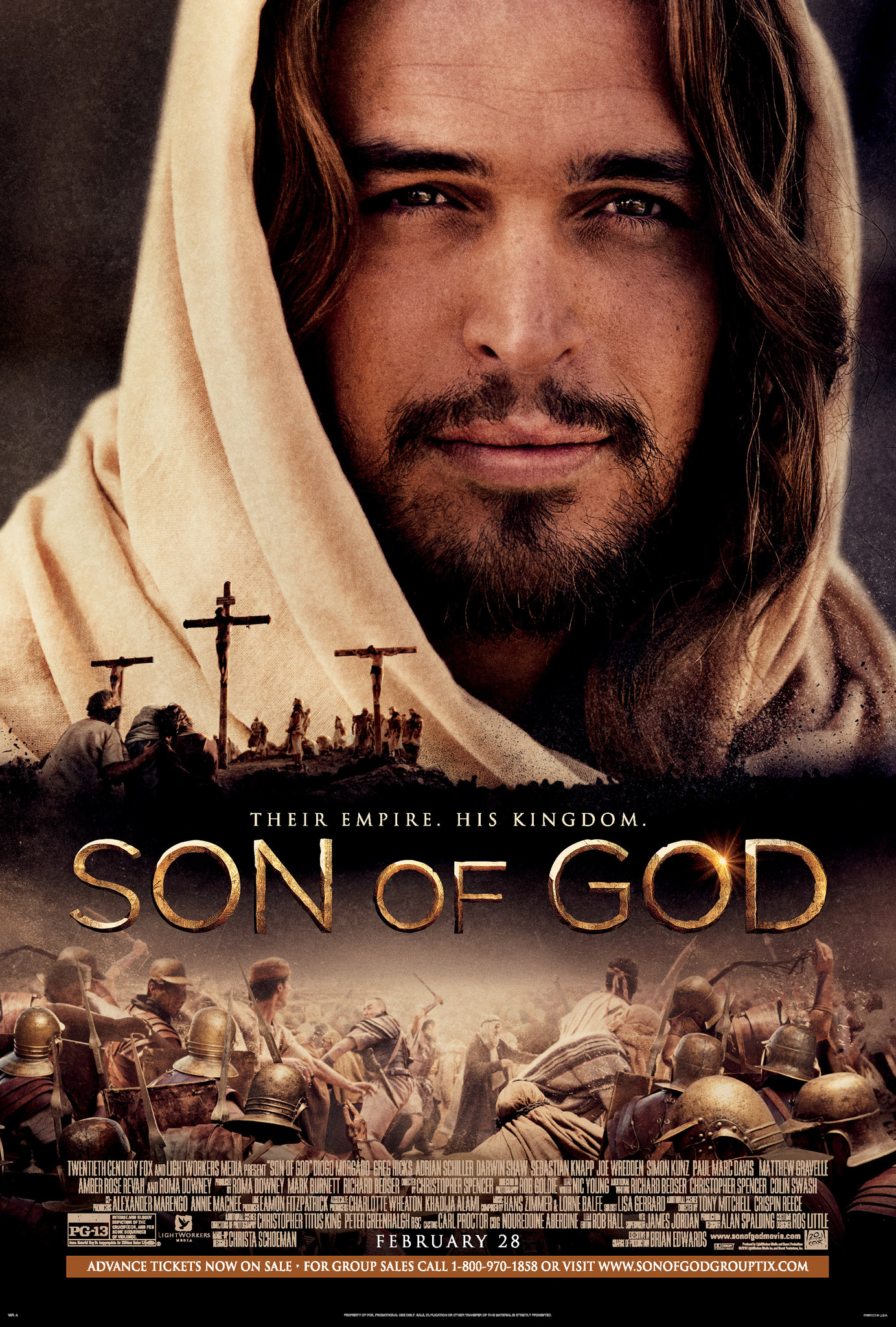
Son of God (2013) - A Biography For Believers

(The following content is reran from the 2018 Christmas marathon on Letterboxd, as originally seen here.)

Why were there so many Christian movies in 2014? In part, we can thank Roma Downey and Mark Burnett of Lightworkers Media for deciding they needed to net some extra revenue from their 2013 History Channel miniseries The Bible, and releasing a cut down version of the four episodes concerning Jesus' life and deeds to theaters in late February. Whether or not the world needed this particular film to kick off the slate of seven to pierce the mainstream radar that year is a worthwhile question - the film leaves out many notable scenes from the Gospels and foregoes the series' narration, leaving behind a story already told free from character moments and unique stances on the Biblical narrative without proper transitions or context for what we're seeing. To the right eye, Son of God is pretty much useless as anything but an extension of the series' DVD sales (and, bizarrely, two redundant literary adaptations). We sat through all two hours and twenty minutes last night, though, so I feel obliged to treat it as a standalone work of adaptation, even bearing in mind the material was not designed to play this way.

On its own merits, Son of God isn't the worst thing in the world. I rather liked some of the little moments scattered about here and there, like introducing Jesus by half-submerging him in water as a means invoking his baptism and foreshadowing the later walking on water, or how Jesus' prayers in Gethsemane are cut against the pharisees and his disciples making their own calls to God. A few of the miracles have the basis of interesting techniques around them, such as Jesus feeding the 5000 by simply encouraging them to lift their baskets to the sky and bringing them down full of bread and fish, or the intense closeups marking Lazarus' resurrection. The guy playing Jesus mostly bases his performance on strong declarative readings of the famous sayings, which at least works well if you're only asking for a cliffnotes version of (most of) his famous deeds. It's not much, I'll confess. Having something nice to say about the film is still a welcome surprise, though.

Looking at the total scope, there's practically nothing here. While I mentioned the lack of important sequences like turning water to wine or the trial before Herod, I doubt this works well as compelling docudrama or fiction on its own merits. Son of God starts at the belief in Jesus' divinity and the importance of his ideals, and so resolves to spend its runtime presenting the necessary beats one after another without much flair. Jesus performs miracles and claims himself God's chosen son, confounds the local authorities with wise sayings beyond their comprehension, and astonishes his disciples most by claiming faith without sight is a grander thing than faith based on proof, in complete and total lockstep with what the Good Book says he did. His rage at the moneylenders in the Temple, his agony in the garden, his pain on the cross, they all come through without the slightest hint of the passion inherent to the story's very name. Jesus does what he does and is miraculous because Jesus does what he does and is miraculous in the Bible, and the movie thinks the tome so holy and worthy of reverence that it only deviates by omission, and never interprets or enhances.

I understand the reticence to do so. I'm no Biblical scholar or Christian - I came up in an agnostic household, my first exposure to the whole religion was a daycare teacher telling me I'd go to hell for not knowing what the Bible is, and that sort of soured me on the whole experiment for a while - but the tenants of the faith are familiar to me. If Jesus' story and the power inherent to him work best when you accept them unquestioningly, then to point to the Holy of Holies and claim something's wrong, that you can do it better, is akin to saying the new covenant between man and God has no power. Personal reinterpretation may be fine, depending on your sect, but in general one should strive to accept and internalize what's on the page, and never put out something defying the Word. If you're going to put the Bible on-screen, the best thing to do is to put it there as literally as possible, and stay out of its way.

Leaving aside the issue of trying to stage such a historical telling while casting actors whose ties to the Israeli homeland are almost nil, I don't think placing the holiness of the text above the personal connection does anyone any favors. Nothing is liable to supersede the original text, and a passionate reinterpretation designed for its time can have profound impact. After years of discounting the Bible and Christianity as institutions with good morals but not much modern value, watching Jesus Christ Superstar and seeing the story of Jesus in such a raw, emotional, humanizing manner on all levels got me interested in the continuing impact and validity of the story and its related tales for the very first time. That movie might scream 70s fashion and deliberately place itself both within and apart from the original setting by filming in on-location ruins, yet it is as alive and vibrant a tale as any I've seen. Judas and Caiaphas and Pilate all serve as barbing questions against the assumption of Jesus' divinity and good nature, and Jesus himself expresses open doubts as to the necessity of his project, only to be met with an abstract, inscrutable answer from God. The entire final half-hour demands an answer for why from Jesus again and again, and is only met with silence, and ultimately the confusion and anguish of the crucifixion.

And still, for all the silence, all the doubt, all the legitimate reasons to think Jesus only brought himself and those around him needless pain, the film ends on a shot of the cross silhouetted against the setting sun, a shepherd tending to his flock in the fields below, captured on film entirely by accident. If you want to distill the idea of believing without seeing, and so finding the Lord wherever you look into a single image, that's how you do it.

Son of God just has Jesus say as much before vanishing in a beam of light, because that's how the book did it, and so that's how we'll do it. It is so afraid to cast Jesus as anything except a man made of quotes and deeds, it robs him of whatever power a more heartfelt, artistic depiction might bring, and so fails as a recruitment tool.

It's a safe, easy, for-the-faithful only film, one which completely fails to understand the faithful need challenging and testing more than the non-believers. I cannot condemn it, for it does nothing condemnable save duplicate without skill or understanding. There exist far better depictions of this tale, far better stories inspired by it, far better shared connections from the heart of a moved believer to your own. Unfortunately, because we're looking at films designed to provoke, proselytize, and exploit those who have faith, we're not looking at many of those this Christmas season. I've got a surprise scheduled at the end to make sure this series is more than endless complaints about those who believe differently than I do expressing their religion wrong, but with what's coming up next on the docket...

Well, at least Son of God intends to preach the Word as it exists on the page.

2.5/5

Wednesday, October 30, 2019

Over the Garden Wall (2014) - If dreams can't come true, then why not pretend?


Full offense meant towards every other special we watched for this marathon, but Over the Garden Wall captures the spirit of Halloween far better than any of them.  There's a tendency to look on the holiday as merely its surface-level elements, with the candy and the dressing up and the pumpkins and the gentle attempts at spookery.  In fairness to them and many other Halloween specials, there's nothing inherently wrong with celebrating Halloween as a time of haunts and creeps at play and little else - it's wonderful we still reserve any amount of time for reveling in mischief and fear, and some truly great art has come from fully embracing the modern aesthetic, like The Nightmare Before Christmas.  Halloween isn't just the modern practices and signifiers, though.  There's a salient connection to an older way of life, an older system of beliefs, a link to times when it was believed certain nights blurred the line between this world and the other.  Viewed through a modern context, you've not only a blurring between reality and supernatural, but also modern customs and bygone means of celebration.  We've gone through quite a few iterations of how to observe Halloween and the sense of controlled fear in general, and this holiday marks a good time to revive them more than most.

Amongst its multitude of virtues, Over the Garden Wall's greatest strength as a piece of Halloween media rests on just how many autumnal and horror-adjacent ideas it evokes to pitched-perfection across a mere ten quarter-hour installments.  Episodes can vary in focus from exploring the confines of a seemingly infinite manor seeking out a ghost in the spirit of old dark house movies, gentle schoolhouse dramas mixed with Scooby-Doo and Benny Hill sensibilities, harvest festivals directly informed by the aesthetic of gay nineties fall-themed postcards, or 80s teen dramedies.  Quite a few episodes even make room for direct homages to Fleischer's creepier Betty Boop/Cab Calloway cartoons  There's dozens of artistic influences on display throughout the series, all unified by a gentle modernized take on the classic fairy tale set-up of children wandering the woods seeking a way home.  As all-encompassing revelry in imagery and tropes of Halloweens and harvests past as you could want, it ensures there's a special, particularly resonant moment for all audiences without sacrificing its own particular feel.  Chasing a predesignated, boxed-in style to slap over everything simply can't achieve the same warm, cozy effect of merging multiple sources to create a vibe all your own.

It's good the series' artistic style is so dedicated to forging its own path whilst wearing its influences on its sleeve, for doing so is ideally reflective of the show's overall storytelling goals.  I don't speak casually when I call this a modernized fairy tale; it's way more than just the sense of light whimsy meant by that evocation.  The Unknown as a setting is reflective of both Wirt's self-serious teenaged poetic mythologizing and Greg's younger freeform train of thought approach to the world, a dark, never-ending wood where practically anything can and will happen, and children must watch where they step at every turn lest they stumble into a strange inhabitant.  It's every bit the perfect stretch of land in which to abandon a Hansel and Gretel or Little Red Riding Hood, and leave them to learn a harsh lesson about never straying from the path, or always listening to their elders, or never trusting strangers.  Over the Garden Wall avoids such overt moralizing - while dangers do lurk betwixt the edelwoods and deceptive forces do crouch in the dark, the vast majority of residents and travelers are merely people living their lives, and trusting supposedly obvious warning signs based on initial appearances often leads to more trouble than being kind and adaptive would otherwise.  There's little need for Wirt and Greg to listen to a powerful authority figure or suffer greatly for their transgressions to learn their lessons.  What they bring into the woods is enough to see them through, if they know how to use it.

A firm rejection of regressive, conservative views on childrearing will always earn applause from me, but what makes this show so special is how beautifully structured it is towards the goal of communicating that idea.  How it will dedicate entire episodes to the old "you meet in an inn" set-up to explore the pros and cons of identifying oneself by a societal role, or sly repeat concepts from previous episodes in a new context to throw the viewer off-guard and foreshadow the characters' descent into despair when the same outcome produces vastly different results.  How dedicated it is to finding a minute or two for development and honest conversation amidst whatever ten-minute slice of fun we're currently engaged in, often with direct relation to the game's unfolding.  How gentle and consistent it is in revealing non-hostility of frightening entities in order to reinforce the sense of confidently conducting yourself and looking beyond first impressions for kindness rather than deception.  How when it does reveal the genuine, immediate danger in the forest, it takes the form of unilateral, unflexible thinking patterns, mixes that with the original conception of a fairy for a fresh take on Der Erlkönig, and then simultaneously freshens it further and ties it closer to healthier old sensibilities by making the secret to victory acceptance of a different, adaptable worldview.  On all levels I can conceive, Over the Garden Wall tries and succeeds at evoking the old to create and enliven the new, and it does all this with the added benefit of gorgeous art, charming characters, and alternately humorous and genuinely frightening moments.

This is what the children need.  Fairy tales for the new age.  Decidedly modern sensibilities used to explore and understand and grow beyond past attitudes.  Something crafted with the total spirit of Halloween in mind, something that can understand the original impulses behind its celebration and find ways of thematically educating them about its nature and assuaging their own self-doubts, and finding room for new forms of surface-level fun besides.  Over the Garden Wall is the kind of program which can play with a cat in a great big jack-o-lantern themed maypole raising the dead to new life in pumpkin costumes for a grand harvest dance amidst pastoral New English fields of wheat, and still make time for incorporating candy and costumes into its aesthetic.  It's the complete package for Halloween viewing, and a lovely watch with friends.  Odds are you've already seen it and don't need my glowing praise atop the thousands of other write-ups online, but I'm still thankful for the chance to watch it as the capper to this series.

Hey, thanks!  It works for the November holiday too!

5/5

Friday, October 25, 2019

Halloweentown (1998) - See you in the afterlife!


Depending on how you contextualize the matter, the Disney Channel film Halloweentown is either a standard tween drama about asserting your independence with a thin layer of watered-down spooky imagery slathered on top, or a standard kitchen sink fantasy family romp with a thin layer of watered-down tween drama sprinkled about.  Neither characterization does the production any favors, implying nothing particularly special about the base story while making the flavoring sound unappealing and insufficient.  Although you'd have to press me fairly hard to get me confessing I feel any different than this, I think it about as fair to have a go at Halloweentown for what it is as I do for all the films highlighted in this marathon - which is to say, not fair in the slightest.  Why take the movie to task for trying to give kids a safe, enjoyable entrypoint into spoopy material and SLIGHTLY more complicated family dynamics than they'd be otherwise used to when its legacy as a nostalgic classic indicates it landed just right with its target audience?  There's more than plenty failures inherent to the film's construction to use as fuel for a nice coal-raking beyond its conception, after all!

I more than understand the limitations imposed on a project of this nature.  Child labor laws dictate children can't work outside certain hours, so location shoots need to take place during the day and night scenes can't take advantage of natural dark.  Filming permits are expensive, as are props and costumes, and the challenges of set dressing grow exponentially when trying to transform a real location.  Interiors, though less logistically challenging, still constitute a real expense, and the overall company bottom line will come out healthier if old sets are recycled with minimal changes.  Costumes and special effects eat into a budget like nobody's business; cheaper alternatives to the cutting edge and a lack of make-up or prosthetics on the leads make an acceptable cost cutting measure.  And we mustn't forget how all of this is done on a TV budget, with a TV production cycle, and a particular target date to hit due to the holiday theming of the picture.  Movies are stupid hard to make, and the people behind them deserve no grief for the multiple reasonable compromises necessary to turn in a project on time and in budget.

From an end-viewer's experience, though, it's still hard to lose the feeling of Halloweentown as a disappointing setting.  A magical world full of all the monsters and creatures and beings you associate with All Hallow's Eve, realized as a tiny town square with minimal set dressing beyond the big stone jack-o-lantern prop.  The interiors we visit could readily double for homes and ice cream parlors and saunas (???) in any Disney Channel production save the inhabitants, who wander about in costuming ranging from passable to obviously inflexible latex.  Exterior shots not only rarely leave the tight confines of the town square, they rarely leave one side of the street.  Everything about this wondrous fantasy land wherein main character Marnie Cromwell's dreams of becoming a witch feels tiny, dingy, and uninspired, hardly what you want from a children's film trying to sell the magic of a town where it's Halloween every day.  I put no blame on the crew or schedule masters for doing their best under doubtlessly cramped, underfunded circumstances, but I do put blame on director Duwayne Dunham for not allocating screen resources better.  When compared against the potential of the setting to capture the eye through the whole runtime, I hardly think the puppetry needed to animate a skeleton taxi driver for a handful of scenes a worthwhile choice.

Mark you, for much Halloweentown, I can only tell what the town looks like by squinting at the frame's margins.  For reasons I cannot comprehend, practically every dialogue sequence is shot in extreme close-up, with characters' faces completely dominating the picture.  Not a medium or wide in sight any time people are talking, regardless of whether the location or action around them would benefit from a slightly pulled-back lens.  It's as if the whole movie was shot with the camera parked inches from the actors' faces, which makes for quite the miracle when considering how even the youngest child actor only occasionally acknowledges its presence.  Staying so needlessly, uncomfortably close makes the already fairly charmless town feel even more drab and uninviting, because the unexciting image of not-so-great child actors badly emoting as they half-scream through their lines lingers in the brain far more readily than that of a supposedly wondrous setting.  At the very least, it's preferable to be pressed up against the kid characters' faces, seeing as they're not half so creepy as Robing Thomas' damn-near pedophilic Kalabar getting up in our business.  He's thankfully not in this much, though his scenery chewing delivery towards the end is also afforded no flattery by the overly close camera.

With regards to those kids, I could certainly do with less of them.  Not regarding the snarky, self-satisfied dialogue, something endemic to practically all family friendly children's media in the 90s.  Not regarding Kimberly J Brown's Marnie, who's only bland and uninteresting in the mold of pretty much all protagonists of this nature.  Certainly not with regards to Emily Roeske's Sophie, an actually endearing presence in the film and one I wish had more to do than repeat the same three lines of dialogue over and over again when the scene's not totally focused on her, even if it's just doing some more unique cute things.  With regards to Joey Zimmerman as Dylan, the smug, brainy, "rational" brat brother of the bunch.  Him being eight years my senior and fully grown nowadays, I feel no qualms in stating I absolutely cannot stand the kid - not the way he's written, not the way he's dressed, not the way he delivers his lines, not the immaturity he inspires in anyone who responds to him, not the basic conception of his character as a skeptic who has to actively call out everything around him as fake before adopting a forced cheery "everything's obviously a dream so I'll roll with it, you freak dream people" attitude, none of it.  He's a prominent presence throughout the whole film, getting at least one grating line per scene, and the screenplay's idea of allowing him development is to grant him magic powers and then immediately slide back into the same viewpoint as always.  The whole "believe in yourself and love your family and you can do anything" message is fair and fine for a film of this nature, but it stands on shaky ground when the person two inches to the left of the main character going through all this self-improvement journey stuff is talking smack at it every step of the way and seemingly learns nothing by the time the last frame fades.  He's awful, and I actively wish he wasn't in the movie, particularly because he reminds me of myself at his age, and I don't think any child needs exposure to that blither.

Halloweentown probably ain't worth all this, as I mentioned up top, much as it's plainly a cheapie attempt to cash in on Tim Burton providing Disney a marketable name and concept in The Nightmare Before Christmas.  It's a Disney Channel movie from two decades ago, fer chrissake.  All the stuff I've mentioned is bad, but not "all those paragraphs what I wrote up there" bad, and on the whole it's an inoffensive runaround without anything special to its name.  Fact of the matter is, there's Homestuck nonsense going today, I get nice and riled up by the thought of Andre Hustle continuing to desecrate the corpse of something that WAS special and meaningful to me, I need a punching bag which doesn't come with painful memories of past fights and undue emotional turmoil, and Halloweentown makes the perfect target.  So take that, you nothing of a Disney Channel movie.  Bear the brunt of my negative energy, so I might feel better while watching and analyzing Van Gogh tonight.

There are multiple elements at play here to indicate the separate dimension Halloweentown exists within is actually hell, and I don't feel kind enough to the film to think of alternate interpretations for any of them.  Benny the skeleton cab driver is slowly roasting for the sins he committed in life, and he probably deserves it.

2.5/5

Sunday, October 20, 2019

The Worst Witch (1986) - HAS ANYBODY SEEN MY TAMBOURINE?


(Warning: I have never read any of The Worst Witch books.  Everything I claim about them comes from a two-hour dive across wikis, fan communities, and Goodreads reviews after watching last night.  Please excuse any inaccuracies.)

I shan't categorically claim a book so simple and episodic as The Worst Witch has natural difficulties making the jump from page to screen - to my understanding, both later TV series based on the series have found greater success, which indicates Jill Murphy's tale of Mildred Hubble struggling through her first term at Miss Cackle's Academy for Young Witches has greater potential for live-action translation.  It is probably more accurate to claim a mixture of hewing so closely to the structure of a book with perhaps half-a-dozen major incidents and bringing the same to life on a fairly low budget does nobody any favors.  1986's The Worst Witch has to fill a scant seventy minutes (less counting opening and closing credits) with an even scanter handful of notable events, and call it a day.  You can handily do this in the pages of a book with barely 100 pages, large-print, and multiple full-page illustrations aimed for the sensibilities of first or second graders.  Imagination and empathy for the main character takes over quickly to fill in any gaps, and a "and then this happened, and then this, and then this, and then that," structure fits either the child who only reads one chapter at a time or the child who tears through the whole book in a single sitting.  A low-stakes, high-fun spin through the life of a girl who can't do anything right in a fantastical setting is a great idea for a young reader's book.

For a film... well, you can see the director and crew straining for ways to make it all work.  Some choices meet their mark by inventing clever little new incidents to serve as glue between the major incidents, such as the game of Terror Tag or a brief bit of comedy with the Headmistress' (I assume) Chicago-dwelling niece.  Nice, kid-friendly expansions on what you'd expect from the setting and story, as are the moments of conversation between the children during lull-periods.  At other, more crucial turns, though, the film opts to take major incidents like Mildred accidentally turning her rival into a pig, and draws them out with guff-laden dialogue for quite a long while, longer than I could imagine myself standing at an age more appropriate for relating to this story.  Elsewhere, attempts to appeal to an older audience fall completely flat, whether they be the multiple segments showing the evil witches plotting their dastardly scheme to little more effect than their sudden appearance towards the book's end, or recasting the stuffy, elderly Chief Magician as a vamping Tim Curry, whom literally every other member of the cast is in love with for some reason.  Anything with these two threads is padding of the highest order - and speaking of their padding...

At least one of the songs is tolerable.  I think it's more a problem with delivery on Growing Up Isn't Easy and Agatha's Song, as the singers are pretty shrill and off-pitch, and I could see myself going with their bouncy rhythm if they featured a better performer.  They still irritate the ears a touch, unfortunately.  As to Tim Curry, his song features some awful non-sequitur lines even for something aiming at silly, very basic rhymes, an awkward halting rhythm backed by badly tuned synths, and Tim Curry wavering back and forth with no indication he knows what he's doing.  And it is probably the best part of the special thanks to how hard Tim Curry goes for it on the vocals, coupled with Craig Price's off-the-wall editing and effects.  If there were an award for Most Editing, Price deserves it for his work on Anything Can Happen On Halloween every year all years.  It's a neck and neck battle between Tim Curry and Charlotte Rae for whose musical number is the most transparent time waster, but much as I love Tim Curry's and have the entire thing imprinted on my brain after discovering it on YouTube years ago, I have to hand him the title.  His goes on way longer and completely warps the film's tone to cram itself in there.

Much as decisions to expand the story with wheel-spinning and weird underaged Tim Curry-crushes and long musical numbers harm The Worst Witch's potential, I think the biggest problem introduced in bringing it from page to screen involves the tone of how Mildred is treated.  Watching this without the implicit understanding that as a young reader invited to think of myself in Mildred's place thanks to the degree of non-specificity the written word affords, working through all the times when Mildred is called out, teased, put upon, straight-up bullied, and badgered by her fellow students and teachers alike for what look like terribly minor infractions just makes one feel bad.  The adults in her life engage in the exact same name-calling and positive punishment as the other children, to the point where the one adult in the school who's supposed to be on her side, the headmistress, out and out calls her the worst witch to her face multiple times.  It's a miserable thing to see, compounded by hints that this magical society otherwise operates on "Do things how you please just so long as you're witchy about it!" I GET Mildred being punished for messing up a potion, but let her ride her broom and carry her kitten however she damn well pleases, you monsters.  Carrying a cat in a satchel is just as witchy as having it sit on the tail.  With how pointed and direct these baseless attacks on her  person play, and how little the excessive lengthening and padding blunt the effect, the story still feels more joyless than I suspect it should, even for one about a little girl who feels like she can't do anything right.  I more want to hug Mildred and tell her it'll be OK than watch her continue on through this battery.

So, important thing to note again as we finish up: While I can't sit down and point to my own experiences with Murphy's books as a means of illustrating my points, I am somewhat inclined to treat the series with a softer hand.  This film reportedly disappointed Murphy on release, and while I could handily join thousands of others in digging through the Harry Potter similarities, I also understand how, with eyes clear from the nostalgia in my own, the first film in that franchise suffers from much the same issues as I identify here, just with a stronger throughline and a FAR higher budget.  If I can apply "this thing works far better on ink and paper, where a child reader can engage in self-protagonist-replacement easier" in a film I identify as a childhood favorite, I can say this weaker effort shouldn't cast any bad light on its source material.  Besides, in much the same way I adore Sorcerer's Stone in spite of the problems, I know there's plenty people who love this special for the same reason I love the first filmic entry in MY magical school series - they saw it as kids, have strong memories associated with its iconography, and no real reason to be bothered by the padding or strange means of depicting conflict as a result.  I wouldn't want them to besmirch my love for the film, so I won't besmirch anyone else's here.  There's issues issues aplenty, but I can understand why others like it, and don't think it much right to call this bad beyond its failure to engage me as an adult.

Besides.  Just... lookit this.  It's incredible.


3/5

Monday, October 14, 2019

A Disney Halloween (1983) - *Horrifying Michael Eisner noises*

Related image

My original intention for this introduction went something to the effect of, "You see what I mean? The third film in the Made For Halloween marathon is just a collection of clips from old Disney shorts and features, something I slotted in as a fun extra entry alongside Over the Garden Wall. There's really no way I can get a coherent review out of THIS!" Work an exasperated tone for mild humor, get into a quick little bullet-pointed summary of anything I found notable, call it a day on the shortest write-up in the series. Simple enough. Unfortunately, two factors got in the way of my plans. Firstly, I could not for the life of me find the originally planned special, Disney's Halloween Treat from 1982, anywhere online. The closest approximation, a fan-made reedit, is a janky, ill-flowing mess that fails to feel like anything beyond its station. So, we went with 1983's A Disney Halloween instead, which uses reordered segments from Halloween Treat, follows them with footage from 1977's Disney's Greatest Villains special, then finishes off with two mostly intact cartoons more directly related to Halloween-y topics.

Second, and far bigger a problem, comes from my browsing the Letterboxd review pages for these specials. What should I find there, but a review by user No-Personality that matches my usual standards for length and personal depth, for a program I honestly thought couldn't sustain any extended discussion. Not only for A Disney Halloween, but for Halloween Treat and the later DTV Monster Hits, with comparative notes across all three. Clearly, the bar on how much I have to try in reviewing these clip shows has been raised! Ergo, while I won't make an effort at totally matching what they've got beyond the link there (my own history with these specials begins and ends with "I think I may've seen one on TV when I was six or seven, even though I know they stopped airing with any regularity before I was born," and I'm not nearly big enough a Disney fan to provide meaningful or interesting commentary on anything here), I can at least expand my bullet-pointing idea out to discussing the special's whole structure, rather than just what jumps out at me most immediately. I care bout you folks, all six of you who regularly click on this space through twitter and facebook.
So!


  • Goofy has slain Michael Eisner's alternate universe double, and fashioned his corpse into a meat suit. This is the second most horrifying thing in the entire special, right behind having to look at Michael Eisner.
  • I'm fairly convinced Ted Turner's colorization process was such a big deal during the 1980s not due to fears he'd irrecoverably damage classic black-and-white films with his insistence on needless/gainless modernization, but rather because efforts to colorize old movies before turner looked like Cozilla or the attempts at adding splashes of color to The Skeleton Dance here. It's weak, weak stuff, to the point the colors only stay inside the decades-old celluloid lines on the very last shot before we cut to more montage footage of the shorts within. Nobody needed this. 
  • Starting with the Night on Bald Mountain sequence from Fantasia makes for a stronger opening than Halloween Treat's Mad Madam Mim wizard's duel, I should think. Can't exactly speak to this with any certainty, as we didn't watch Treat, though I can say the summoning of ghastly spirits by the hand of a great demonic figure is a better tone-setter than Fun With TF Fetish. At the very least, if Mim has to stay towards the special's front despite Hans Conrad having a full ranting speech dedicated to her from a few years back, it makes more sense for her to follow Chernabog rather than the other way's round.
  • I wouldn't say The Old Mill makes a PERFECT Halloween-specific short for showcase when Disney made so many other more overtly spooky tales (no Mad Doctor, huh?). It's still an absolute 5/5 short, remarkably complex and artistic for the first film to feature Disney's multipane camera, and much of its charm and thrills pull through even the fuzzy resolution of the archive copy we watched. Glad to have it here, regardless of the expense to Pluto's Sweater and Mickey's Parrot. 
  • Donald Duck how many floors do you have in your home. 
  • Pink Elephants on Parade is a better song than Hephalumps and Woozles, and boasts stronger, more creative animation. Not the fairest comparative in the world, given the drastically different economic situations at Disney both on the macro scale of the studio operating at full strength before WWII really cut into their pocket books vs something originally intended as a stand-alone short during the relatively fallow 60s, and the micro scale of Winnie the Pooh stuff aiming for a gentler tone than anything in Dumbo. I can't help but think it disappointing they went with what I'd think of the lesser of two similar options, particularly since they kept the naked dancing fire spirits from the Fantasia sequence. 
  • OK, in this A Disney Halloween rendition of the special, I can understand cutting Pluto's Judgement Day in with a few other Pluto shorts to create a little thing about Pluto being tormented by cat devils in hell for chasing and bothering cats all day long. They've added in a segment from one of their 1950s TV shows about the history of cats and witchcraft, and moved up the Siamese cats segment from Lady and the Tramp to create an extended block of cat-related content. Makes sense, cats are a big part of Halloween iconography, and the whole "people used to be superstitious about black cats so ooooh, spooky!" thing makes a better bridge into Racism than slotting Si and Am in with Cruella de Ville and the Evil Queen like Treat did. However, Treat is the one that cobbled these Pluto cartoons together, and I can't figure out why no matter how hard I try. Pluto's Judgement is already structured around Pluto tormenting a bunch of cats and then getting his comeuppance in a dream - did we need to showcase Figarro so much that we slotted one of his Pluto shorts in here? I can just see some station manager storming around the office bellowing, "MORE CATS! GOTTA HAVE MORE CATS! CATS PLUS CATS EQUALS HALLOWEEN!" as the editing team scrambles through the archives and pulls out Puss Cafe of all things for their Halloween special. 
  • I love Hans Conried, as should we all. Terrific self-satisfied sneer of a voice, incredible screen-presence, one of the many reasons everyone should give The 5000 Fingers of Dr. T a watch sometimes, all-round great gentleman of stage and airwaves. Much a hassle as it was arranging to watch the longer special in spite of multiple sleep schedules, listening to him bemoan the lack of respect afforded to villains as the Magic Mirror is a total delight, and the biggest reason to watch this special. And of course he chooses the bad guy with whom he shares a voice for the first in his highlight reel, just an extra little touch to really sell it. 
  • Limited though they were by the restraints of what the '77 special contained, and much as Edgar is one of the elements in The Aristocats I wholeheartedly love, I'm sad we don't get any Cruella de Ville in here. There's nothing much Halloween-y about her (or many of the villains, come to think of it, beyond convincing children they make fantastic costumes for the following night), but they had a full segment for her in the original, and the already brief montage of Lady Tremaine, herself, and the Queen of Hearts was cut down to five-second flashes. I'm sure there was something they could've done with Hal Douglas to keep her in, if only for her song. 
  • The Maleficent segment was mostly an occasion for complaining about how dumb 2014's Maleficent was, and how badly it treated the fairies. 
  • I get finishing on Lonesome Ghosts and Trick or Treat. They're explicitly Halloween-focused shorts, they featured Huey, Dewey, and Louie in the opening song without giving them any real time in treat, and these two are practically the only shorts in the whole thing to run for close their originally intended length... but Treat ended with the Headless Horseman song and chase from Ichabod and Mr. Toad, and I can't help but bemoan its loss alongside everyone else who's done any kind of in-depth discussion of these specials. Go trick 'r' treating all you like, just don't deny me Bing Crosby singing the best song in any Disney animated film. Yes, I know I can just look it up on YouTube after. Yes, I absolutely did so, both before we watched, after we watched, and again a few times at work today. No, I shan't stop complaining, nor can you make me stop. 
No rating this time, as there's nothing much TO rate. Some stuff's from shorts/films I consider brilliant, others are from films I don't care for but feel somewhat warm towards due to the highlighted elements, others I'd never seen before tonight and found fine, and some are Racism. Call it a 4/5 if you like, though it's just not anything I'd think ratable in any event. Fortunately, the back half of this little marathon boasts films with no such problem across the board, so we can get back to non-bullet-pointed business as usual in short order.

Thursday, October 10, 2019

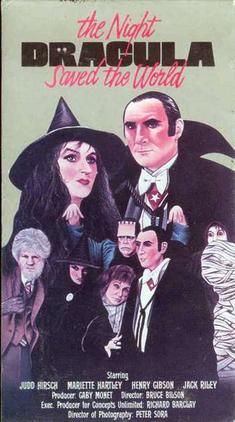
The Halloween That Almost Wasn't (1979) - It's one of those days I wish I was dead! And stayed dead!


Y'wanna hear some neat trivium?  This here 1979 Halloween special from ABC was in competition for a few Emmy Awards!  Even went and won one!  Course, there's a little bit of weirdness going on - between 1968 and 1972, and again from 1977 to 1982, the Emmys split the category for Outstanding Achievement in Children's Programming into two categories, one for the outstanding achievement in general handed to the producers, and one for outstanding individual achievements, awarded to higlighted cast and crew.  The latter category is rather interesting to look through, as it allowed craftspeople and actors who wouldn't normally get a shake (due to children's programming only hosting the one category for producers in the years before and after) a chance to have their work honored.  From what Wikipedia shows in their tables for the category, it didn't work out every time, as the award was juried and required one nominee to receive 50% of the ballots to justify a win, which often meant nobody earned any honors.  There were even a few years where the category judges only nominated two people, and the jury still couldn't come to a 50% consensus.  Imagine having only two options and somehow not achieving a majority consensus in either direction.

Anyhow, The Halloween That Almost Wasn't was pretty well set to win the individual achievement category in 1980, as it had three contributors nominated, compared to Sesame Street in Puerto Rico's two.  Arthur Ginsberg was nominated for his editing, Mariette Hartley for her performance as the Witch, and Bob O'Bradovich for his makeup, which won the award.  I wish I could speak more to Ozzie Alfonso's direction and Nat Mongioi's art direction on the Sesame Street primetime special, but unfortunately nobody has it anywhere, save an upload of the first episode containing segments that aired over the following week.  S'in pretty poor quality anyhow, so I'm not sure I could much judge it none too well.  Something tells me I might feel just a touch biased towards wanting to say one of the two deserved the award sight unseen, since O'Bradovich's winning make-up is... what it is, and it feels more right to say a piece of programming from Sesame Street in its prime is more deserving of accolades than something comparatively lighter and fluffier.

Also wish I could give Sesame Street the same consideration for the overall Outstanding Achievement in Children's Programming category; however, balked as I am there, I CAN give such consideration to the winner, Benji at Work.  Of the two programs I can judge, I think it fair to say Benji's little documentary was more deserving of the win.  It has some weaknesses in how it keeps up some dishonesty around the realities of Benji's life, as it feels a little weird how they constantly insist on calling the female Benjean a he to maintain the illusion, even as Mr Rogers was more than comfortable showing children the faces and processes behind other beloved fictional institutions.  On balance, though, it's a nice enough look into how Frank Inn worked with his animals and collaborated with filmmakers to get the hero dog acting so well.  Regardless of how the film they're documenting turned out (quite the stinker, as I understand), the special makes a fair mix of entertainment and education for children, and has an endless parade of shots showing Benjean acting like a cute pupper.  The thing's got my approval, even as I could personally do without Adam Rich as host.

S'more trivium for you!  The actor playing...

...oh right, we're supposed to be reviewing The Halloween That Almost Wasn't.  Truth be told, I've been dodging around doing so.  Applying my usual standards for critique here just doesn't seem fair or proper.  It's a light piece of children's entertainment from 40 years ago, and while I can certainly identify flaws aplenty with its concept and execution, ragging on it like something produced with any higher ambitions than keeping kids entertained with silly puns and goofy costumes for half an hour seems in bad sport.  Still, this is a review site, and I did put it on the list with the intention of providing some semblance of a discussion, so... why not?  Just a little critique, in bullet points.

-Without Judd Hirsch, I'd probably tear into this program quite a bit more.  He's quite plainly having a very good time playing Dracula, leaning into the character's pompous attitude and flustered reactions to his fellow monsters having gone soft and/or unionizing.  The jokes and pratfalls he's running through may be juvenile for even his audience, but they're functional enough and earn laughs - though I must admit, my laughing at a Young Frankenstein reference comes entirely from the thirty-second "did he really just..." process that followed rather than any real cleverness.  Honestly, if I had to choose an actor to nominate for their performance from this, he'd be they.

-This said, Mariette Hartley doesn't deliver a half-bad performance as the Witch.  The writing on her is a bit shaky, oscillating between "I want to break Halloween because you don't respect me enough or share your controlling interest with an equal business partner" and "I want to break Halloween because people think I'm ugly and mean, and I don't want to be that anymore," with neither taking over long enough to get a clear picture of the intent beyond "Witch bad, gotta stop her."  As such, her sharp-tongued, smarmy Brooklyner approach to the character gives it an appreciable, endearing quality where the writing lets her down.  She has a sweet scene with a little girl who loves witches towards the end, so y'know... it works out to something good enough to praise.

-The other monsters are drastically underserved by the structure.  The Wolfman and Frankenstein's Monster at least get highlighted entrances and a few one-liners when Dracula chews them out for giving into corporate marketing deals.  Zoltar the Zombie King and the Mummy are barely afforded time for Igor to speak their names on arrival before they shuffle out of frame, and for the rest of the picture they're only allowed to stand around looking kinda bored without delivering any dialogue.  And for as much as the first two monsters get to do during their introduction, they too fall into the background as part of the indistinct crowd behind Dracula as he and the Witch spar it out.  I think the writing team only had one good joke for the Creature, the one about how his feet aren't his, and didn't know how to make the other undead monsters work without repeating the concept of detachable body parts.  The Mummy gets to pratfall at one points, but it's slow and awkward and does nothing for me, so that's a bust.

-I can appreciate the suburban family watching TV as the news comes in that Halloween may be cancelled forever if Dracula can't get his act together, insofar as they're a semi-absurd element of blissfully modern stuff intruding on what's supposed to be an evocation of Gothic Eastern European stylings.  They don't come back into it past the introductory scenes until the ending, and I think it would've helped the special feel a little more cohesive if there'd been a beat of Dracula or Igor or someone realizing they need a different tact to get the Witch back on their side.  At very least, the dad should've come back in with his children, just so we could get some more good ol' gum-flappin', square-lookin' all-American 70s sitcom dad goodness.

-The ending of this movie is probably why disco is dead.  John noted that it works on some level, since undead monsters probably only listen to dead music.  I don't know if I agree, but it seemed an interesting enough observation to share.

-Rating films gets tricky sometimes, as the definite number attached to a review is so easy to take for the total opinion when it's more a general barometer for where I am on work, with the lengthier passage serving to fill in details.  I'm going with a 2.5 for The Halloween That Almost Wasn't, which is normally one of my bad scores, typically dolled out to films I find sink juuuuuust below the barrier of quality to be called good.  Again, though, I think it highly unfair to treat this slight lil' thing as a full effort with all that implies - yet I also can't exactly say its problems don't bother me or prevent me from having as good a time as I'd like, children's show or not.  To this end, I'm keeping the 2.5 rating, but additionally noting how it's a 2.5 that could very easily transform into a 3 if I'm feeling the tiniest bit more generous at some point.

So, like I was saying, one more fun little bit of trivia here.  The actor playing Frankenstein's Monster here, John Schuck, went on to play Herman Munster in the late 80s Munsters revival series, The Munsters Today.  If that ain't enough neat connections to other noted light horror-adjacent TV, consider how Igor's actor, Henry Gibson, voiced a character for the 1973 Munsters animated telefilm, The Mini-Munsters.  Or, my personal favorite of the connections, Wolfman actor Jack Riley played Gomez on the Addams Family Fun House variety hour, which I STILL want to see for the purposes of tormenting friends.

Writing about old, idle-watching TV ain't my strength, and the next entry in this year's Halloween marathon is gonna test my ability to pull together a coherent piece even more.  Fun!

2.5/5

Saturday, October 5, 2019

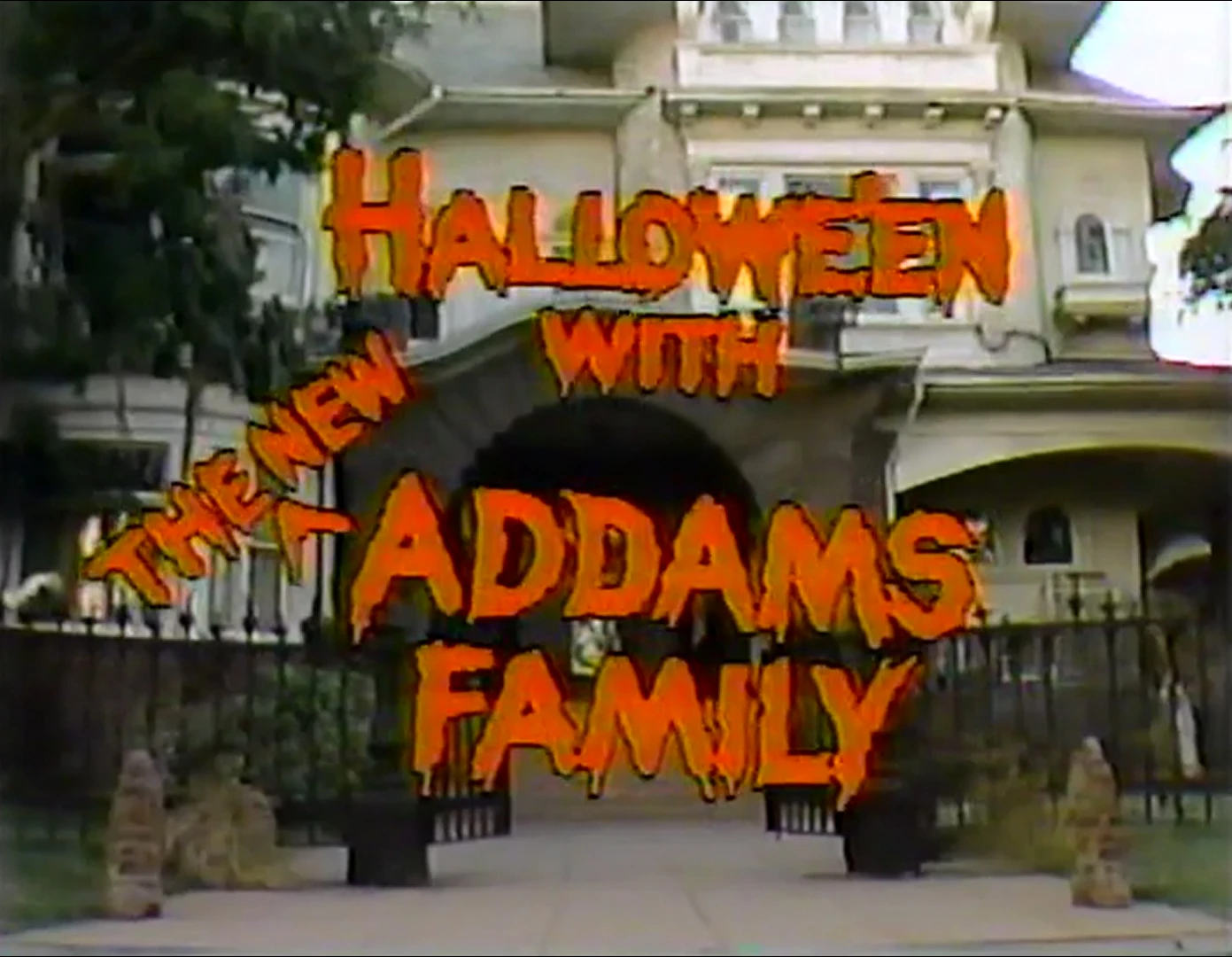
Halloween with the New Addams Family (1977) - 'Tish! That's French! 'Tish! That's French! 'Tish! That's French! 'Tish! That's French! 'Tish! That's...


I ask of you, what is the best way to celebrate the blessed month of Halloween filmically?  Runthrough of a popular slasher franchise?  Binging on old Universal horror entries?  Exploring silent horrors of the 20s, going abroad for some foreign horror flicks you've never scoped, wallowing in the misery of some modern torture porn feature?  Over on Letterboxd, there's a whole October-long challenge called Hooptober, dedicated to encouraging the userbase broaden their experience with the ol' spooks and seek out some scary movies they've never seen before.  Me, though?  I prefer to keep things small.  Got too many challenges going on otherwise to dedicate a whole month to just the spooky stuff.  Slip in something breezy and easy between it all, for some nice evening viewing with friends.  Casual, homey viewing!

In practice, this translates out to watching a bunch of old made-for-television Halloween movies with friends on the expectation that we will all suffer, because I am a horrible person.

Is it fair for me to bag on Halloween with the New Addams Family for its low-budget production values and poor writing, which scans like occasional Munsters contributor George Tibbles wrote it in a mad rush one afternoon before shooting?  TV wasn't exactly home to many prestigious names back in the 70s, in those days before premium channels and cinematic trend-chasing dominated the airwaves.  Surely this was far more acceptable in its own time?  Too bad for this special, I got the itch to check out an episode of the original series right afterwards, and let me tell you, this thing has no excuses.  Halloween, Addams Style, a second-season episode of the original run, boasts a far more appealing visual style between the denser set dressing on the house, the smarter use of screen space in framing the actors, and the far cleaner, crisper look the black-and-white footage gives everything.  It sees the same actors delivering jokes in much the same spirit with far more aplomb, nailing the timing and making even old comedy staples like "We need the jawbone of an ass" "Well don't look at me!" feel charming and enjoyable.  Things HAPPEN - I can't stress this one enough, it runs a third of the time as the special, yet it keeps finding new, dynamic things for the family to do, and milks all the potential of "A neighbor tells Wednesday witches don't exist, so her parents hold a seance to contact a dead relative while Lurch and Grandmama try to either find a witch at this time of night or fake one" in a good twenty minutes.  They've even got a fun bit about bobbing for apples on a giant seesaw.  The whole thing makes good comfort watching, and speaks to the energy and dynamics that made the series such a crowd favorite for decades to come.

Comparatively, Halloween with the New Addams Family has none of this.  The switch to color taping doesn't do the far more barren manor any favors, and the camera is frequently placed wherever it's quickest and cheapest to get the shot, which further highlights how drab and empty everything looks.  Eleven years away from the characters did the adult cast no favors, and while they all have their individual vibes down, the timing's just all wrong.  I can't put much blame on them in this respect, though, as the jokes are incredibly repetitious and poorly written, and apparently directed to be read the same way on each loop - I lost track of how many times they wrung Gomez and his brother going wild over Morticia speaking French with no variation on the gag around two dozen, and dully accepted the next fifty or so.  This is when the special's writing actual jokes, and not making already tired, hacky references to Star Wars and Life cereal commercials.  And as to what's actually going on...

There's just no excuse.  We're on television, where you're liable to lose the audience if the pacing flags too much.  It takes the length of an entire episode of the original show and then some before the whole Addams clan is assembled once more, and it's to practically no effect.  All the adults are around from the word go, and before we can introduce grown-up Wednesday and Pugsley as they arrive home for a family Halloween party, we get bogged down in following an ill-defined spy wandering through the house getting freaked out.  Make no mistake, "normal stranger comes to the Addams' house and gets freaked out" was a standard plot for the old series, but they rarely ran the idea for twenty minutes straight with but three jokes to spread around.  Once the actual party gets underway, it's much more of the same, just in different configurations.  Gomez gets kidnapped, plays morse code on his piccolo, gets rescued by Wednesday and Cousin Itt while remaining none the wiser.  Bad guys stomp their feet and tear their hair in frustration before trying the same plan again.  More, more, always more repetitions of "Tish!  That's French!" to the point where I wanna die!  And the weirdness... oh, the weirdness!

Not GOOD weirdness, mark you.  Not ADDAMS weirdness.  Short-sighted TV writing weirdness.  Going in, I was not expecting so much of the special to revolve around Gomez feeling insecure in his marriage and suspecting his brother and a masked doppleganger of cucking his wife, but it's the direction they took, and we all have to deal with it through each unfunny moment.  There are, for reason I could not begin to explain, two large, burly, near-naked muscle men roaming the Addams manor throughout the second half.  I'm pretty sure they're hired tough guys for the antagonists, but why they all had to look like BIG JIM SLADE simply eludes me.  It's all sexualized and borderline raunchy in a way that feels alien to the tone we're otherwise shooting for, and yet it takes up so, SO much of the special's runtime.  Anytime something like this crops up, it's like taking a sledgehammer straight to the face, and with as many instances to sex-driven jealousy or oiled-up musclemen you get here, there's not much recognizable as a face left by the end.

If you'll permit me an indulgence, I simply must ramble about the odd little thing which bothers me most: Gomez and Morticia have birthed two new children between the original series and this special, and their names are Wednesday Jr and Pugsley Jr.  For some reason, THIS bothers me far more than the uncomfortable marital troubles or the out-of-place bodybuilders, likely because it is so easily explained with faulty real life reasoning.  We want the family dynamic from the original series to remain the same and we want the whole original cast back for the reunion, but the actors for Wednesday and Pugsley are grown-up and wouldn't be living at home anymore, so we'll get them back and have two NEW children for the parents to raise!  Fine idea, except when you remember that Wednesday and Pugsley would still be living at home when their new siblings were born, and yet Gomez and Morticia looked at their latest progeny and thought to themselves "Same names."  Maybe you could have some fun with that weirdness, make jokes about an Addams tradition of creating identical twins no matter the cost, except they don't display even this level of creativity.  The new children are just THERE - they never deliver any jokes, they're never the subject of jokes, they don't figure into any comedic scenario, and they vanish from the film entirely once the party starts.  Write 'em out!  They're dead weight!  They're not funny!  Somebody show some sign they put effort into this!

(Important to note, however: Everything with Thing and Lurch is golden.  I support them in all their endeavors, and am glad they both find meaningful romance in this special, even if Lurch has his cruelly ripped away.)

As one might guess, Halloween with the New Addams family leaves me with very little material to write about.  The poor quality is clearly the result of a director, writer, and production team who only wanted to spin the wheels for a good hour in the hopes of getting picked up for a new series, and so it is bad in obvious, uninteresting ways.  Lazily written and badly told jokes, a cast without much spark behind their eyes, lifeless filming, plodding plotting, tedious re-dos of the same material.  Unless I want to write a lengthy diatribe on the exact psychosexual reasons all the "Oh no, my wife is screwing another man who looks just like me!" comedy is so deeply uncomfortable, I can't do much except rant and pick nits at this thing. There's a reason it hasn't seen an official release since the days of VHS.  At least we had an excuse to watch an episode of the original series, which I highly recommend over this.

(Absolute worst thing about this special?  Those near-silent, weakass snaps during the theme song.  Get a proper sound designer, you absolute animals.)

1.5/5