Showing posts with label adventure. Show all posts

Saturday, December 21, 2019

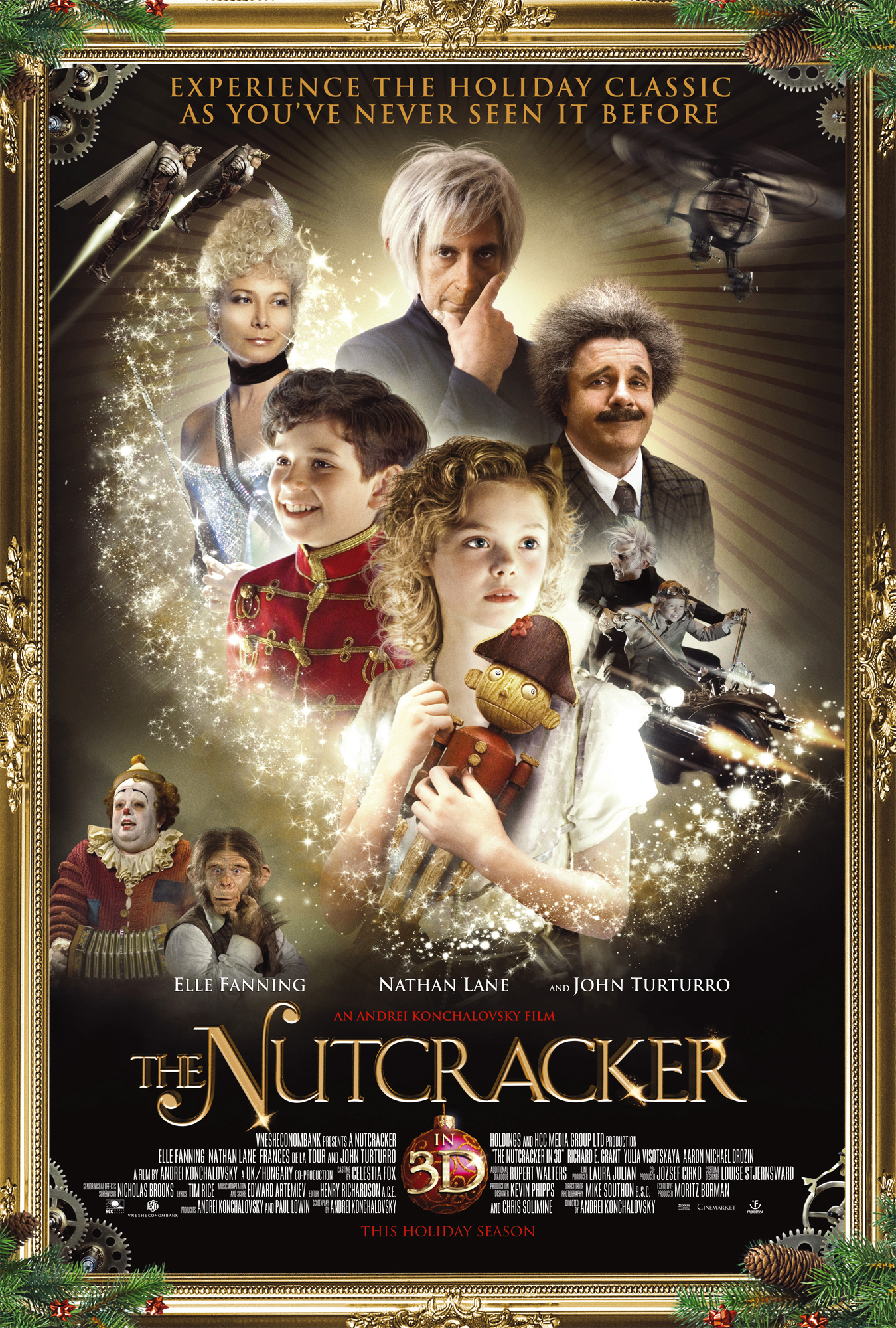
Mixed Nutcrackers - The Nutcracker in 3D (2010)


Goodness, but ambition sure can go wrong, can't it?  Andrei Konchalovsky reportedly sat on and tinkered with the idea for what ultimately became The Nutcracker in 3D (alternately The Nutcracker: The Untold Story) for a solid twenty years, long after he became a frequent film fest circuit contender, and in which time he continued to direct, write, and produce a wide variety of films across multiple genres.  This here was his passion project, a grand fantasy epic built upon little by little whenever he had time, finally realized after two decades' gestation with a budget of $90 million, well in excess of anything he'd directed since Tango and Cash.  Grand ideas given grand stage and a (relatively) lavish pocketbook, enough to justify playing with musical elements, massive soundstages, scores of extras, a wholly CG character or two, and the best 3D effects money could buy.  One might, perhaps, observe how "the best 3D effects money could buy" in the year prior to its ultimate 2010 release came from a film costing this project's budget three times over, and that the base material was shelved since 2007, and start to understand what went wrong.

Hubris is our watchword for today.  Hubris in thinking a production so plainly bloated by B-name theater actors' salaries and enormous soundstages could afford a little skimpiness on the effects budget, and so crafting a final product where flying effects and CG characters render as vaguely floating a few feet above the film rather than anywhere inside it.  Hubris in Tim Rice deciding his lyrical compositions for the musical numbers would not use Tchaikovsky's ballet pieces as a base and follow their lead with a complimentary rhythm, but rather be designed for singing along to every not, regardless of whether or not the resultant cadence sounds anywhere close to a natural register.  Hubris in believing many side characters so plainly charming on the face of it that we needn't see them between their too-brief introduction and an end-of-second-act crisis wherein they display none of their personality quirks again in favor of generic fantasy action platitudes.  Hubris in thinking spending the entire second act wholly detatched from the fantasy world and spinning our wheels on some domestic drama the film clearly doesn't care for is at all an acceptable way to stay within our budget when it really kills the pacing dead and causes many following beats to feel redundant.

Hubris with regards to the rats, oh my GOD, the rats.  I can only assume Konchalovsky and his contributors thought as far as, "Well other films use a little Third Reich imagery as shorthand for the bad guys, we can as well," and then trotted out said justification every time they wanted to add a little more.  The rats march around in full-blown SS uniforms, round up innocent people from the street, throw them into concentration camps, operate massive ovens designed to burn those they scapegoat as ruining the world, and talk up the eventual birth of a glorious rat masterrace and a Rat Empire which will last for one thousand years.  All right there, on the surface, no necessary distancing whatsoever, plain and simple Nazi stuff.  Let's not also forget, they still have rodent faces, rodent faces which look very much like Nazi propaganda caricatures of Jewish people besides, and most talk with heavy Italian/Brooklyn accents.  And listen, listen - while I am the world's foremost advocate for scaring kids through children's movies, the effects on John Turturro's face when his Rat King gets upset and he morph-roars into a monstrous rat face are all too much, all too distressing, and deployed all too frequently for how much I don't like looking at it.  Also, their arrival into the movie evokes 9/11 imagery, and Turturro electrocutes a pet shark at one point, for no reason other than making this whole thing more off-kilter and distressing.

Looking at The Nutcracker in 3D with a proper critical eye, though, trying to see beyond all the odd, excessive, easily-identifiable bad creative decisions, and figure out what really went wrong, I think the briefly mentioned structural problems drag the movie more than any of the Nazi rat stuff.  Don't get me wrong, unless we perform corrective surgery on the film, wholly remove all the Nazi motifs, and find literally any other thematic costuming as a replacement, it will always have that millstone round its neck, but figuring out the structural problems could help a lot.  You can get away with quite a bit if a story plays as familiar or resonant in the broad strokes, making your idiosyncrasies read as "Alright, go off but I'm with you" instead of "What in God's good name are you DOING?"  Bad as the Nazi rats, the child acting, and the effects compositing are, The Nutcracker in 3D's greatest weakness lies in how it flaunts conventional story structure in favor of a protracted second act in the real world, with all hints of the fantastical banished to the margins.  To illustrate my point, allow me to propose as potential alternative layout for the film, in which we only change the order and focus of events with minor eliminations to improve flow.

The first act, with Mary meeting the Nutcracker, exploring the expanded living room, and learning about the curse the Rat Queen placed upon him can play exactly as they do in the movie, except we move the introduction of the Nutcracker's three living doll friends over to the start of act 2, and place more focus on the developing relationship between the two.  Rather than spending the second act in the real world, Mary, the cured real boy Nutcracker Prince, and the doll companions spend their time trying to infiltrate the Rat Kingdom and overthrow the Rat King for good, only for the Rat King to discover them, kidnap the retransformed Nutcracker, and banish Mary and the dolls back to the real world.  THEN we can play out a shorter, tighter focused version of act 2's runaround as a start-of-act-3 crisis,and proceed with the movie's third act as is, only with better defined supporting characters and a stronger relationship between Mary and the Nutcracker. Compare this to how little screentime the two share in the film as-is, and how much of the back half of the second act is dedicated to rerunning the first act's set-up with new stakes while assuming we've any reason to invest, and the problem should be plain.  Spending so much time insisting Mary stay separated from the Nutcracker and the Rat Kingdom only serves to kill the film's capacity to engage an audience; a structure more in-line with traditional children's fantasy epics would help the piece flow, get us deeper into the weirder elements, and at least acclimatize us to the stranger elements in addition to strengthening the character work.

Or, as an alternate proposal, how about we keep the film's structure as is, weirdly lengthy return to reality and all, except we shift around our thematic focus instead?  Exact same movie up to the thirty-minute mark, except Mary's attempt to lift the Rat Queen's curse doesn't work, because for all the enchanting, fantastical sights around her, she doesn't really believe in what she's seeing just yet.  The sudden return to mundane reality thusly hits her harder, and her father's attempts to shake those silly dreams for her head has a tangible impact on her.  That whole meandering musical number where Uncle Albert sings about a magic pebble her father had as a boy connects more directly to Mary's story, and when the Nutcracker returns to bring Mary and her brother Max back for another try at liberation, she only goes reluctantly, and only invests fully for the third act because the Rat King kidnaps Max.  You can then run the third act as a simultaneous "Rescue my brother" narrative and a "I have to actually care and believe in all those childlike things like imagination and dreams" story, to boost up the effect when Mary finally lifts the curse and claims she never wants to leave this new home.  Just one change to one plot point and a shift in the main character's attitude, and you can make this odd structure work a little better.

I'm personally more into the first proposal than the second, for the first allows the film to indulge in its weird attempts at spectacle more openly than the second, which probably requires turning down the bombast to sell the audience on Mary's refusal to truly believe until the climax.  Either way, they both show how The Nutcracker in 3D didn't necessarily have to break so badly as it does.  There's so much "This is MY passion project, and we're doing it the way I like!" running through every aspect of the production, I've a hard time believing you could wrangle a wholly good or appealing story from the wreck, especially if we're really honestly truly married to doing Rat Nazis and not spending a proportionate amount of money on our effects.  With a different structure though, regardless of if it's more traditional or more suited to supporting a thematic idea, we might've seen a respectable if heavily flawed, too indulgent work that communicates something and delivers a mildly enjoyable experience.  It is broken and misconceived, but the foundations could've supported SOMETHING, rather than the haphazard mess we got.  Which, all told, is better than the total, doomed-from-the-start failure of the Tom and Jerry Nutcracker film.

(Let me tell you, it was REALLY distracting hearing Moaning Myrtle's voice coming from the Nutcracker's mouth the entire film.)

2/5

Wednesday, October 9, 2019

Tabu: A Story of the South Seas (1931) - Always driven on by fear... fear of the avenging tabu...

Tabu: A Story of the South Seas (1931)

Letterboxd Season Challenge 2019-2020! Theme three, part one - a film chosen by Cahiers du Cinéma as one of the 100 essential to an ideal library!

(Chosen by me!)

The story is simple: The young man Matahi lives on the island of Bora Bora, wiling away his days amidst the springs and waterfalls with lover Reri.  The chief of all tribes across the island chain has selected Reri as the new honored virgin, paragon of all virtue amongst their people, and so declared her tabu.  With Matahi unwilling to accept this declaration and Reri devastated by the loss of a normal life, the two steal away through a stormy night to a nearby French colony, where they try to establish a new home.  Unfortunately, the old warrior Hitu is on their trail, determined to enforce the custom of the tabu, while societal forces beyond the young couple's control seemingly conspire to bring the dreaded curse down upon their heads.  Fill in key details, and you've a classic story of youth defying tradition, and learning how you can't outrun the consequences of your actions.

In Tabu: A Story of the South Seas, the details are filled by none other than F.W. Murnau (with influence from early documentarian Robert J. Flaherty), and so the yarn communicates a powerful strain of those old world sentiments through a modern medium.  Having grown weary with the American studio system after his previous sound pictures bombed, Murnau fled to Tahiti for a year to make a movie his way, in the silent tradition.  Though his partnership with Flaherty fell apart thanks to a disagreement in style and technical troubles in the shoot's first days, the opportunity to return to the format in which he made his clearest mark did wonders for this, his tragically final film.  And not just a return to the silent tradition - the early cooperation with Flaherty and the subsequent shift to a more ethnographic approach, the employment of purely native newcomers for cast and crew, and the opportunity to experiment with his free-floating, subjective camera along new dimensions all help push Tabu to feel like a director doing whatever's necessary to draw just the right qualities from his material.  Just as the cinematic verve of Nosferatu's self-moving shadows and dissolving bodies added to the film's sense of a centuries-old horror, so too do the fresh filmmaking angles here help Tabu play as a millennia-old tale with strong ties to the modern day.

You take the three elements I highlighted, and you get something like the boat-bound scenes, wherein we watch the simple act of real seafarers organizing a party to meet an inbound sailboat, for the simple sake of watching what it looks like when actual mariners from this part of the world engage in such an activity.  It's enough to see them perform these actions, and enjoy the narrative twist of Matahi's little brother calling him back to the mainland at the worst time possible, but Murnau adds that key something extra by placing the camera directly on the bows and sterns.  While I'm certain they were well secured (this ain't no Evil Dead running around with the camera on a plank of wood recklessness), and while we've seen cameras placed in dangerous positions many times over the years, one really has to appreciate the danger involved at this time and place in strapping a valuable piece of equipment to a pitching wooden vessel just to authenticate the shot.  Even when not putting his most necessary tool at risk, Murnau is right in there with the characters, allowing the lives, habits,and ceremonies of the tribespeople dominate the first chapter of Paradise, which is far more about spearfishing and ceremonial message reading and traditional dance than it is plot.  When we transition into Paradise Lost, the ethnographic elements fall away a touch, yet the sense of living a true life never goes away, regardless of how much story intrudes.  After all, we're still with the same folks, and even the colonialist supporting cast hail from the region.

This, I think, demonstrates Murnau's strengths as a storyteller, and the happy accident of losing Flaherty's more overtly observational (if still well-known manipulative) tendencies.  Through most scenes of the natives living and performing, Matahi and Reri are still communicating their despondency over the situation, and play out a nice little teen drama of self-pity and anti-traditionalism without uttering a single word.  Though the choice to go dialogue free isn't as extreme here as in Murnau's earlier The Last Laugh - we're treated to plenty intertitles in the form of in-story letters, which I suppose is a necessary evil when trying to fully expound on some of the concepts around mandated virginity and imperialistic intersections with local values - it sure as hell works in the young couple's favor.  Both because their actors rise to the occasion and give no indication they've never done this before, and because it again allows Murnau to play about with cinematic techniques to great effect.  Consider the way the old warrior Hitu haunts Reri's waking eyes in every doorway, or how Matahi gets completely lost in how the colonists enable him to put on an even wilder party than those back home from seemingly the good of their hearts, only to discover later than money and debts exist.  Where the thoughts and feelings of the local ship captain and outpost master are communicated through his diary, Matahi and Reri remain purely visual actors through expression and cinematic form.

And really, when it all comes to a head, it marks the themes about societal taboos and the strange power they exert over youth draws on all this to such interesting effect.  I especially like the scene of Matahi's troubled dream: it's the most expressionist piece in the picture, and ties together the tribe's tabu of sullying the sacred virgin with the colonists' taboo of defaulting on your debts, by way of a third forbidden practice.  Being backed against the wall, ignorant of Hitu's imminent arrival yet fully conscious of what will happen if he can't pay his bills, Matahi dreams of overlapping images, the debtor morphing into an off-limits patch of sea, where we push in through several fades to the sandy bed and the great pearls within, the largest of which grows to fill the screen before transforming back into a satisfied debtor.  In effect, if Matahi can breech just one more tabu, he thinks himself set for life - the twin sharks of Hitu and the literal sharks guarding the pearls never once crossing his mind.  It's a lovely sequence, and, in cooperation with how Reri's attitude towards her position changes from one of despair before she flees to one of ceaseless guilt and fear afterwards, makes clear the film's position.  Even if there's no mystical force chasing down those who cross an invisible line in the sand, the sense of shame and need to continue crossing lines to stay ahead of the consequences get the job done just the same.  Matahi's equally doomed by Reri's failing convictions and his decision to leave her alone to go on a risky pearl dive to save their hides as he is by Hitu's final dreaded appearance.

Now, there's places I don't think Tabu entirely works, and feels more a product of its time than an old story captured on film.  Chiefly, while the accompanying score is cleverly integrated with musical cues that respond directly to the action on-screen and generally contributes to high engagement with the material, it also seems too Western in conception, too much like a Hollywood studio band blaring a marching tune of "FEEL THIS!  FEEL THAT!" over Murnau and the locals' more effective filmic and acting choices.  It's just a little bit too much imposition from the emerging American tradition to fully gel.  One of those cases where something's good on the face and endears itself well to the crowd, but doesn't quite belong amidst the other choices.

I can't and won't say the score sinks the movie, though.  It's too perfectly sharp and clear a portrait of life and tradition in Tahiti at the time through the eyes of a great expressionist mind as tempered a naturalist for "this music doesn't sound quite right for what we're doing" to even dent the hull too much.  I mean, one can handily tell we're talking about a great work of art when one considers how its message boils down to "youthful rebellion cannot hope to overcome the societal forces puppeteer their lives, be it virginal traditions or colonialist capitalism," and I like it this much.  Me, Mr Let The Youth Run Wild And Get The Hell Out Of Their Way.  The image of Matahi struggling to keep his head above the waves as the full force of all his poor decisions and boundary crossings weigh down upon his tiring arms is too potent for me to say otherwise.

The world really did lose Murnau too soon.  S'a damned shame Chaplin got to bow out of silents on his own terms with City Lights in the same year, while Muranu died and didn't have a choice in the matter.  RIP to him, even nearly 90 years on.

4.5/5

Wednesday, October 2, 2019

Nausicaä of the Valley of the Wind (1984) - It's so beautiful... hard to believe these spores could kill me...


Letterboxd Season Challenge 2019-2020!  Theme one, part two: a favorite film from one of the past hosts!

(Chosen by Jackie!)

A few months back, while reviewing Dune, I noted how adapting the complex world of Arrakis from Frank Herbert's novels to the big screen seemed a nigh-impossible task for any direction, thanks in part to how much of the setting's appeal lies within the unique, functioning ecology Herbert created and how it impacts the characters' journey.  The limits of a two-hour narrative feature do not seem the friendliest place for exploring an ecosystem in any kind of detail if we're to also tell a tale of great political intrigue.  Certainly, on first impression, the same issue seems liable to plague Nausicaä of the Valley of the Wind - though adapted from Hayao Miyazaki's manga of the same name by the man himself, it is only adapted from the first sixteen chapters of a fifty-nine chapter series, before Miyazaki introduced the true depth of the Sea of Decay's place in the world's larger story.  What's more, those initial sixteen chapters still played host to a dense plot about infighting, survival, and the nature of war, and Miyazaki himself had only helmed a single animated feature prior to this point, one set in someone else's preestablished universe.  One considers all this in a vacuum, and has to wonder exactly how you can make a film that turns on as tricky a subject as ecology work so well?

The answer firstly lies in the same place one finds the key to all Miyazaki films: love and appreciation.  Any time we follow Princess Nausicaä into the Sea of Decay, whether it's on an expedition for materials to assist her people in the Valley of the Wind, scrambling for survival in the aftermath of a surprise aerial attack, or racing through the canopy to prevent some great disaster, the film takes its time to impress on us the beauty of this deadly place.  The gorgeously detailed renders from multiple background artists and Fantastic Planet-esque animation on the enormous Ohmu bugs help it play to the eye viscerally, all ethereally light blues and greens gently mingling with each other before the breach of vivid reds and pinks, or soft white glows, or an enormous mass of nearly-black green overwhelming the screen.  Experientially, though, we also have Nausicaä herself to guide us, as her evident experience with this harsh landscape cuts through its threats at every turn and makes us appreciate the underlying pulse of life.  Her windwhistle for taming angered bugs, her careful manner of step that can still become overwhelmed by excitement, her refusal to succumb to fear where quick-witted planning would serve better; her every move when enveloped in this place that could otherwise kill her within minutes shows someone who respects and lives with their environment, no matter how hostile.  It is the same tender loving care Miyazaki puts towards the familiar pastoral landscapes of My Neighbor Totoro or the bulky biplanes of Porco Rosso, applied to a deadly landscape of his own invention, and it makes the whole scene of ink and paper breathe with undeniable life.

With the audience accepting of and appreciative towards this strange new world just from the way the film is paced and animated, Miyazaki has ample room to impress his next trick for communicating the setting's ecology: a plot directly revolving around our place within the ecosystem.  "Place" is a fitting word for how the film views humanity's role here, for the whole conflict around a technologically-superior nation seeking to revive a Great God Warrior and reclaim the world entire for mankind predicates its wrongness on the damage of might and fire wielded with too liberal a love for their usage.  As the situation degenerates, with Nausicaa losing her father and becoming lost below the Sea's floor, and her people contend with an encroachment of spores in addition to their militaristic occupiers, it becomes clear that each worsening development comes down to a reflection of the old world's sins: a love of power, a lust for conquest, an impassioned flurry of violence, an inability to stop and think before acting.  The film's harshest development, of Nausicaä dooming her secret garden of healthy plants from the Sea of Decay in a fit of rage and despair, passes with little bombast compared to the burning of an infected forest or the revival of the rotting Warrior, but it most clearly shows the dangers of giving into our worst tendencies and refusing to live with the world as it is.

Under the film's philosophy, we both matter more than anything, and do not matter at all.  The world guarantees us no place within its boundaries if we do not work to maintain it, and the same system that naturally birthed us can easily naturally render us extinct.  We can only thrive on our own terms and with the land if we take the time to appreciate what we have, live within our means, understand how the world works and what we must do to keep it healthy alongside ourselves.  Attempts to overwhelm with superior strength will only lead to a backlash, and the loss of everything we have.  There is the great danger of the Ohmu overrunning the land and costing the Valley people their very lives, yet there is still the minor tragedy of Nausicaä destroying her secret garden, in her almost denying everything she has learned about how these lifeforms work in favor of deepening her misery.  The greatest calamity of all, on a macro and micro scale, comes with embracing fire for any reason because you hate the weathering of wind and water upon your hands.  To refuse a nurturing role and to adopt the role of destroyer are equal evils, for they suggest we can live above or beyond the world, not within it.

Fortunately, the course of Nausicaä's journey allows her time to reflect on the empathetic failings of those she admired through dreams, a chance to meet and understand someone who initially considered her an enemy, and the unique opportunity to view the near-crystalline truth of the Sea of Decay's purifying processes.  It takes time to deepen her convictions towards pacifism, and forces her into situations where only a total commitment to nonviolence and a full understanding of what's truly necessary can win the day.  She must use all her strength to stop an instinctive infant Ohmu from drowning itself in poison, assert her will without raising her fist, sacrifice herself to halt catastrophe, all to impart a singular message: the world must turn on its own terms.  The Sea of Decay is a system that has evolved to cleanse the earth and defend itself against those who would poison it again.  Though toxic to humans, survival in the face of this toxicity is a testament to our endurance and ability to live with the land, to take without excess and guard what's our own.  To take the final image of the film, a new seedling sprouting from Nausicaä's abandoned gas mask in the petrified forest beneath the Sea, we can understand that with time, a life lived as Nausicaä believes it is best lived will lead to a healed world, a far healthier world than if those who want dominance now clench their fists round its expanse and die to bleeding poisons.  It will take time, and it will not always be friendly to us, but when has it ever been so for any other species in the world's history?

I don't think Nausicaä is quite as impactful as it could potentially be - coming so early in Miyazaki's cycle and running on a far tighter budget than future Ghibli productions, you can see the places where their smaller touches haven't quite taken hold.  Side characters feel a little flatter and play closer to anime stock characters of the day, animation techniques like the Ohmu's segmented sliding fall away when not absolutely necessary, the story gets lost in a bog of political intrigue with villains who don't slide close enough to either outright evil or understandable motives.  It's a foundational text for everything that came after, and it shows in the margins.  Even still, considering all future Miyazaki films have expanded on this foundation to magical effect, the raw, elemental version of all he does still resonates profoundly all the same - a few less effective pieces here and there can't take away from a fantastically written protagonist, lovely landscapes, the joy of animated flight, or that all important ecology.  This last is not incredibly detailed compared to that of Arrakis, or even the same Sea of Decay from the manga, but it is functional and vital to the story and themes in a way few other imagined cinematic settings are.  How did Miyazaki make a world so dependent on an ecological understanding work on the big screen?  By focusing less on the particulars, and more on making it someplace the audience can touch, understand, and reflect through onto their own lives.  An ecology of emotion, in effect.

Denis Villeneuve, I hope you're taking notes.

4.5/5