Showing posts with label drama. Show all posts

Saturday, May 23, 2020

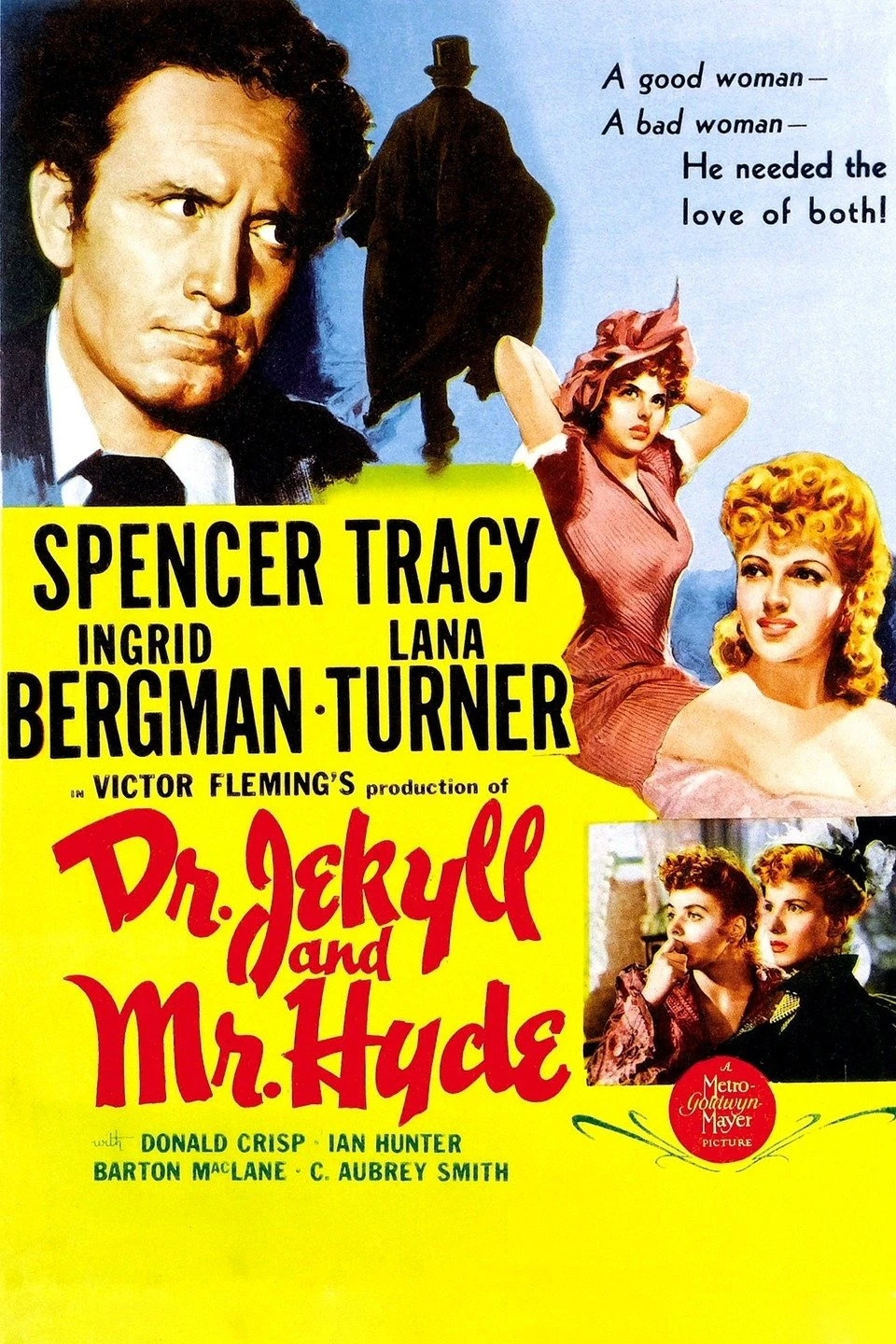
Dr. Jekyll and Mr. Hyde (1941) - Dream that they've all turned into white mice and crawled into an eternal pumpkin!


It's the Letterboxd Season Challenge!  Theme twelve, part one - a film starring Ingrid Bergman!

(Chosen by me!)

It takes a bit've time to settle in with Spencer Tracy and Ingrid Bergman in the parts of Dr. Jekyll and Ivy the barmaid respectively, primarily owing to the accents.  Neither is turning in a bad performance throughout the first act of Victor Flemming's remake of an adaptation of a stageplay based on the Robert Louis Stevenson novella, far from it as Tracy brings his usual hard-mouthed moral pillar with a gentler side to his performance of the good doctor with a disturbing preoccupation over evil, and Bergman makes her part as a would-be rape victim turned slinky temptress to her savior come alive with just how thirsty she plays the role.  As set-up for the film's later dive into a crueler relationship once Jekyll takes his serum and unleashes Mr. Hyde, their flirtations come across well enough... but the accents are still quite a lot to accept.  Tracy a little less so, seeing as American-accented leads in American productions set in Britain is a fairly common practice, and he strikes a compelling enough figure by simply being Spencer Tracy to make the lack of an effort to put on anything remotely posh easy to filter.  Bergman, however, is only two years out from learning to speak English for her part in Selznick's remake of Intermezzo, and trying her damndest to strangle her natural Swedish accent into a lower-class Irish brogue.  Heaven help her, it's not happening - she slips back into her usual mode with great frequency, and her constant seizing onto dialect snippings like "ain't" or replacing "my" with "me" do little except sound odd coming from someone whose screenpresence was otherwise so refined.  S'a thing you have to sit with and learn to accept across the nearly two-hour runtime, cause it never gets better no matter how hard she tries.

I focus so much on the accenting issues in this first paragraph because I think it's necessary to note the film has some uphill territory to cover before detailing how I believe it traverses the terrain like completely flat ground throughout the second act.  Once Jekyll unleashes Hyde and goes out for a night on the town, Dr. Jekyll and Mr. Hyde settles into its true intentions, and produces a second act worth praise all on its own terms.  Not at all what you'd expect with Hyde storming about foggy ol' London Town causing a ruckus in bars and making himself a disreputable member of the community (though the act's opening scenes do give you some've that, if incredibly toned down), the film is most interested in exploring how Hyde acts as a manipulative hand behind Ivy's back to cost her a job, isolate her from her friends, and push as far into depicting their abusive relationship as the Hays Code would allow.  Bergman stands as the focus character for this half-hour stretch, and weird accent or no she's doing a fantastic job of portraying an abuse victim in what feels like a realistic manner.  True, you still get the histrionics that can be recut as Fay Wray-style screams for the trailer, but her response to Tracy's mocking runaround conversations and mind games as he pushes her into giving him what he wants are excellent, doing her best to keep her composure against someone who's obviously harmed and violated her many times over even as he's dead in her face and she's on the verge of breaking entirely.  Scenes set apart from Hyde see her putting on a brave face for friends and tip-toeing around anything she thinks might earn her another assault, suddenly recoiling into a ball of defensive excuses when she can't hide the scars.  On Tracy's end, his Hyde certainly isn't a stunning physical or behavioral transformation compared to some of the more lauded actors to fill the part, yet I think him playing it as merely a crueler, disheveled Jekyll rather than a completely split personality opens the film to further exploration of whether or not his postulations regarding good and evil in the human soul are as accurate or bifurcated as he believes.

Fact, let's talk Jekyll/Hyde theory for a moment before digging further into the film.  Per Jekyll's outline in an early dinner scene, those aspects he calls good and evil are inherit to all, expressed not in totality one way or the other, but intermingling at all times, a little of each depending on the circumstance.  To isolate one from the other, express the evil in a man as a wholly different person from the good-facing side, should follow into the good living with a clear conscience and no impulse to do wrong.  Locked away from one another, one might even eradicate the evil altogether by giving it no outlet, no infusion of serum to bring its full force to bear on the physical world.  Course, as we know from Stevenson's novella, Jekyll cannot be considered a righteous innocent if he indulges Hyde's expression at all, for Hyde is of him, a man born of thoughts and impulses within his own brain, and if the two are to draw on knowledge and memories of the other and mutually regard their back-half as a figure worthy of disgust, then they must know what their mirrored self does and why.  Jekyll might safely say, "It was Hyde who did all those horrible things, Hyde, not Jekyll," yet he alone is responsible for drinking the formula that gives Hyde flesh, just as Hyde is responsible for taking the same to hide behind the guise of Jekyll.  Whatever Hyde does is an exercise of what Jekyll wants to do, and in denying Hyde reflects on him and continually indulging his evil side another night's escapades, Dr. Jekyll's supposedly pure half a soul becomes stained with every drop of blood Mr. Hyde sheds.  If, say, Dr. Jekyll were to continually unleash Mr. Hyde in the name of venting his frustrations over not being able to marry his fiance due to her father's concerns, and allows Hyde to torture and rape an innocent woman because it leaves him feeling better, then it's not really good and evil he's separated: it's presentable and unpresentable, only called by another, morally simplified name.

So!  All this in mind, why on earth does Dr. Jekyll and Mr. Hyde ask us to sympathize with Jekyll during the third act?  Despite all the work it puts towards locking our sympathies squarely in Ingrid Bergman's corner, once her scene of pleading with Tracy to save her from the insidious Hyde is over, the film takes a turn towards Hyde coming into prominence without the serum, has him murder Ivy, and spends the remaining half hour fretting over how poor innocent Jekyll has lost control over his totally separate evil side.  It's terribly incongruous, dedicating so much time and effort towards depicting an abusive relationship full of manipulation and heavily implied rape as something horrifying, postulating on how the rapist is not a separate person but the inherent desires of a front-facing "good" man, and then escalating to murder our most sympathetic character before acting like the murdering rapist is somehow still deserving our pity.  Worth noting, I think, the picture doesn't get into Jekyll's perspective during the second act at all, so we're left with a bland reassurance of his goodness without any attempt to explore why he unleashed Jekyll so many times, which can only lead to the worst assumptions about his person.  The whole thing plainly doesn't work, as the story only functions if you throw away everything we've been told about how the Jekyll/Hyde dynamic works here and believe Jekyll a tragic protagonist because he's the protagonist and so should be counted as tragically struck low.  What's more, in refusing to examine the why behind Jekyll's actions or condemn him for it, an entire ACT's worth of material I think excellently executed suddenly feels like a cheap, exploitative depiction of the exact same subject matter, because all Ingrid Bergman's suffering comes to is a quick murder and hand-wringing over how oh, how totally innocent is the man who allowed this atrocity!  Such a powerful depiction of abuse and rape denied a point beyond "Isn't it all so horrifying" does not gain from the absence; it only subtracts, and lessens, and yes, cheapens the whole thing by making it a commodity for entertainment rather than a serious issue.

I do so hate it when lazy storytelling taints an otherwise good aspect in a film with the taste of sand and ash.  I hate it doubly so when it's a film with such beautiful views of a reproduced Victorian London shrouded in fog and enclosed spaces darkened by the presence of a single man, a film with good performances across the board and chilling music and some rather nice if not standout effects sequences for the transition from Jekyll to Hyde and back.  Going with a zeroed-in focus on Hyde as a rapist to one victim has massive potential for a character study into the presumptuous nature of Jekyll and men of his like, but without a point beyond "Don't ya feel sorry for him?" all this good work adds up to a bad film.  The post-film conversation with Connie last night ranged for quite a while longer than usual as we debated whether the film deserved 3 stars for its technical and performative aspects, or 2.5 for its thematic failings.  While I argued in favor of the former for a time, after listening to Connie's perspective and considering it in view of my own history of assessing well-made films with major themeing flaws, I think the lower rating is only right and consistent.  If you're gonna do Jekyll and Hyde and expect the audience to stand with Jekyll at the end, either run with Hyde as a more typical force of mayhem and standard crime, or don't even try if you mean to go so hard on the magnifying-glass look at abuse.  "Man willingly unleashes his devils and terrorizes a woman until he ultimately murders her" and "Man never did anything wrong, pure cinnamon roll, etc" do not jive at all.

(The fades employed to transition between the two aspects are pretty impressive technically when you consider how well each successive shot matches to the next, especially given how many subtle little movements Tracy makes that somehow flow near-seamlessly from one to the next, but the part where they try to focus on his eyes by rendering them as a separate strip over the rest of the picture falls apart the second you notice a horizontal stripe of his head bouncing around independent the rest.)

2.5/5

Saturday, May 9, 2020

The Fits (2015) - Must we choose to be slaves to gravity?


It's the Letterboxd Season Challenge!  Theme eleven, part two - a film distributed by Oscilloscope Laboratories!

(Chosen by Jackie!)

.。*゚+.*.。It's exorcising personal demons time*゚..。*゚+


I've discussed my difficulties participating in middle school and high school sports here a few times before.  Primarily as they pertained to the social aspects, bad interactions with my mental issues and hazing and bullying and the like. The actual running wasn't too easy either, tho, and I don't mean in the sense that pumping your arms and legs hard as possible for miles on end is physically taxing even when you're used to doing so day in and day out.  The part where you feel like you belong to a team, use the energy of those around you to better your performance and feed back into the loop with your own contributions was demanding for someone inclined to hole up inside their own head and define themselves as apart rather than within, especially when forming non-antagonistic relationships was already so difficult.  Even a sport so isolated and self-determined as racing requires an understanding of the self as part of a collective, which proved an understanding I could never fully grasp.  Never hit second gear or second wind or whatever you'd like to call it, never took any interest in what my teammates were doing, always felt stressed and drained by people trying to encourage me instead of boosted like I know they meant.  Really, honestly, truly getting what it means to remain oneself while giving it all to a team is maddeningly difficult, and I'm still not sure I'll ever be capable of putting it into practice.  It's a matter I'm always looking to work on, of course, for one must deal with one's devils in addition to simply acknowledging them, but when you're right on the wire, it almost has to be something you either tap intuitively or can't access at all.

All to say, what jumps at me most about The Fits, the directorial debut of Anna Rose Holmer and acting debut of Royalty Hightower, is how they use main character Toni's struggle to balance her old sport of boxing amongst boys with dancing drills amongst girls as a mysterious psychic illness sends her new friends into spasmic fits to explore that sense of individualism amidst the collective.  An early moment I found particularly telling is Toni's initial audition to join the Lionesses, when older girl and instructor Legs emphasizes the need to think of themselves as a unit, and lays out the complicated series of drill steps they're to demonstrate.  Toni, in a space she's not at all comfortable in just yet, and coming from a background where the camera and sound design have emphasized her tendency to obliterate all save herself for the sake of focus, dances about as badly as everyone else in her new group, yet takes the experience harder.  She's not able to engage in the locker room like her new peer, hiding in a stall to avoid others seeing her change while simultaneously listening in on their calls.  During practice, the camera often spins with Toni as its pivot point, highlighting how everyone around her seems perfectly capable of following the steps, yet she remains slightly out of time, tending to misplace or mistime steps, keeping a barrier between her and the group she wants to join.  She still returns to run stairs and work boxing routines with her brother, and during private moments in these exercises, she practices in isolation and seemingly starts to get it when she feels freer to treat the dance like a fight to be overcome, yet when she returns to group practice it never translates.

There's a fear of losing herself entirely if she clicks with the team, one her interactions throughout the film complicate through interesting wrinkles.  When the titular fits start striking the older girls, we the audience can tell each one manifests differently than the last, and eventually understand they leave no lasting harm, but they're still frightening seizure-like events that disrupt the flow of events and prevent Toni from taking advantage of moments when she's closer to getting it.  The uniform sense of uncertainty they produce, however, also enables Toni to bond with the two girls who take to hanging around her in calmer moments, Maia and Beezy.  Beezy in particular gives rise to many positive interactions, opening doors for Toni with temporary tattoos and ear piercings that mark a more physical transformation, and spending a night running about the fitness center in the dark during a rapturously shot scene, which transitions into a moment of quieter understanding when Toni helps Beezy after she gets scared and pees herself.  For Maia's part, she seems a quieter hanger-on for some time, yet shows herself as a more contemplative older presence, specifically as we move to the third act and Toni is able to have an honest conversation with her after the fits appear more sporadically and make the future of the team more uncertain. Of course, just as everyone starts feeling safe because they think the fits can only impact the older girls, Maia and Beezy have their own fits in short succession, and leave Toni more isolated than ever.

What's interesting here is how this sense of isolation plays into Toni's preexisting feelings of being an intruder in a space not meant for her.  In the downtime between notable events, she's often seen blanching at items signifying her welcomeness to the group - picking at the temporary tattoos, fiddling with the piercings before tearing them out, placing herself a subtle distance away from the main body of girls, pinching and pushing herself.  While her distant, colder relationship with Beezy after the latter has a fit can be read as the fits themselves drawing a line between those who've had them and those who've not, I can't help but wonder if Toni thinks of herself as having caused all this.  She shows up, and all of a sudden what looks to her like a cohesive singular unit starts falling apart and feeling afraid.  Even her own friends start acting distant to her because she's too aggressive and stand-offish before they experience a fit.  Her interactions with the boys' boxing team grow less frequent and more distant throughout the film, until she's looking in on their practice in shots framed to mirror her looking in on the drill team for the first time, except there's no more curiosity, only distant observation.  The things that made her part of this old world seemingly disrupt this new world, yet the new experiences here make it so she can't go back and still feel herself.  All the world seems gray, her ears buzz with anxious pounding rhythms, everyone seems distant, fit or no fit, and Toni just doesn't seem to belong anywhere.

So we come the finale, when Toni has her own fit, and it makes one question just how much these are truly negative experiences.  True, they're outwardly frightening, striking at random and producing different effects in each person, yet we've also inhabited the perspective of someone who doesn't possess the faculties or insight to understand what anyone who experiences a fit truly makes of it.  In Toni's case, when her feet leave the ground, and she dances the routine with an energy and individual strength not seen prior to this, we come to understand the experience as one of gained insight.  She envisions herself approaching the covered bridge where she and her brother practiced, shedding her gray sweatsuit to reveal the spangled, colorful Lioness uniform beneath, and dances in perfect time with her team in a variety of locations visually defined as her's throughout the film.  Understanding of the matter I outlined above comes to her for the first time: that it's not about becoming less to contribute to a whole, but about making a whole from many wholes, using the greater flow to build what's already within you, and expand the energy outward in kind.  Yet despite this revelatory moment, we don't see the aftermath.  Toni's teammates are still shown as intimidated by her dance, and when she falls to the floor smiling in the last shot, all we get afterwards is the Lioness hype chant and a return to the tingling, anxious music over the credits.  She gets it now, and will likely have a chance at building her friendships again, but do her revelations match to what her friends came to understand?  We aren't to know.

The Fits offering no insight into what comes next seems appropriate to me.  Much work as Holmer and production/writing collaborators Lisa Kjerulff and Saela Davis put into crafting a world where we can instinctively understand Toni's internal divide, the mysterious, otherworldly nature of her own fit pairs perfectly with what I talked about above.  The actual click is internal and personal in a way no camera or cut can adequately capture - we can only see the aftermath, and the film's conflict is more about Toni coming to balance her two worlds and be comfortable in her own skin than actually dancing as part of the Lionesses.  If she feels she's mastered it, and can show such mastery to others even in the midst of what they've come to view as a scary experience, then we must take whatever comes next on faith.  Perhaps I only think this way because I never got to this point, and remain uncertain whether I ever can.  From listening to the commentary on Criterion this morning, though, I feel confident saying the filmmakers achieved such intuition, and crafted a powerful film about the same,whilst exploring matters of gender expression and growing up in the same breath.  An intense, multitudinous picture, The Fits is bound to register as a profoundly personal experience for all who watch and remember the struggle of trying to be one for the sake of all.

4/5

Sunday, March 22, 2020

The Duellists (1977) - I have submitted to your notions of honor long enough.


It's the Letterboxd Season Challenge!  Theme nine, part two - a film named a 20th century milestone in cinematography by the American Society of Cinematographers!

(Chosen by Jackie!)

Howzabout we try something a little different today?  Ridley Scott's debut feature, adapted from the Joseph Conrad story The Duel, traces the rivalry between proper, dignified 3rd Hussar Lieutenant Armand d'Hubert (Keith Carradine) and hotheaded, bloodsport-loving 7th Hussar Lieutenant Gabriel Feraud (Harvey Keitel) as they duel numerous times across the course of the Napoleonic Wars and beyond, examining just how much their encounters pervert the true and noble spirit of dueling, and how much they reveal what dueling really is.  To this end, let us strip away all but the duels.  Less review The Duellists and more discuss how Scott oversees the shooting and editing and acting in each of the major encounters to see how he characterizes each, and understand the thrust of his argument.  We'll naturally leave aside many other virtues inherent to the film, but like I say, trying something different today, so we'll just need to accept the loss.

-Prelude duel: Staged between Feraud and an unnamed civilian, we begin the film with the central question already established in the way its framing techniques contrast one another.  Where we begin with a painterly wide shot of the two figures at the ready against the misty plains like gentlemen fighters with a rustic house to balance the image, the fight itself is shot in shaky over-the-shoulder view, and becomes more frantic and unstable as Feraud unleashes his blows against his opponent.  The cause of this duel is unknown, the slight totally unexplained to the audience beyond Feraud's love for dueling, and we're already left to wonder which properly defines the practice: the refinement of the wide shot, or the barbarity of the close-up.

-First duel: In the first encounter between d'Hubert and Feraud, Scott certainly seems to favor the latter interpretation.  A battle of anger and passion more than anything else, it's practically all shaking, over-the-shoulder shots of the two men violently swinging their sabers at one another, with only a few cuts to medium when the pair pause to assess one another.  These vanish as they take the battle into a darkened cover area and the music kicks in with great intensity, the editing going faster and reaching a fever pitch as d'Hubert strikes the decisive blow.  Interestingly, Scott begins a trend of cutting to a quieter, more painterly shot in the wake of the duel, as Feraud's maid tackling d'Hubert to the ground is immediately followed by a shift over to a still life.  Even when the argument is fully in favor of reading barbarity into the practice (as fitting for a duel initiated over one party getting needlessly upset over getting arrested for dueling too much), Scott's still interposing a kind of nobility into proceedings.

-Second duel: By contrast, the actual crossing of swords here is as beautifully sculpted and gentlemanly as can be.  Compared to the drab grays of the front and the warm interior firelights amidst inky blackness that precede it, the soft purples and blues and golds and greens of early morning make the duel seem livelier than any surrounding scene, and the fight itself takes place entirely over two wide shots, which focus more on the landscape than the participants.  d'Hubert and Feraud's conduct lacks the aggression of their previous encounters, and where other fights are far bloodier, this one ends with a single slash.  However, the important thing to note is how this more refined look at dueling is immediately followed by a more conventionally shot view of the aftermath, with d'Hubert slowly becoming a mass of blood from his small wound, and Feraud openly declaring his contempt for so easy a victory, all of which lasts longer than the duel itself.  Note again the cut to refinement with a zooming shot of d'Hubert in a lovely-looking bathtub scene with his lover.

-Third duel: Speaking of said lover, the interregnum between these two encounters sees him leave d'Hubert over his refusal to disengage, and while we're mainly focused on the duels here, I'd be remiss to neglect mentioning the moment when she uses red sealant to write "Goodbye" on his sword, which he wipes away like blood on the blade to bring us into their next fight.  Befitting so major a loss to the protagonist at an act change, the third duel is the most openly vicious of the lot, opening with d'Hubert and Feraud already slashed to pieces and bleeding profusely from every new orifice.  The setting is murkier, the movements wilder, the lighting scantly flattering to anyone, and the editing fast fast fast.  One might think this a fairly definitive statement in favor of the inherently basal nature of dueling, but the way it gradually slows as the men exhaust makes me think otherwise.  There's real hatred behind their actions now, a genuine desire to kill and be done with it, yet they cannot achieve their goal with raw, physically-animating anger alone.  Even the camera loses interest as it wanders away, and subsequently wanders back on a wounded d'Hubert in another shot of painterly browns and grays with a big central contrasting object.  If this be dueling, why can it not sustain itself?

-Fourth duel: Performed on horseback, and interesting for the way its surroundings reflect the discussion between refinement and basality.  As noted with bitter irony by d'Hubert beforehand, it is meant as an honor to the cavalry, the rivalry between the two men having become noted enough to stand in for their ascending ranks in Napoleon's army - two people who're just out to cut each other because one won't leave the other alone, the pride and honor of the world's greatest military force.  From the perspective of the characters as they charge one another, the clearing of trees around them forms a perfect corridor, the ideal stage for such a battle.  Scott, however, shoots the scene primarily from the sides, so we can see how these orderly trees are only orderly from one perspective.  Seen any other way, and it's as scattered, disorderly, chaotic an arrangement as the thoughts flashing through d'Hubert's mind as he launches a decisive final strikes (an interesting technique, but considering the way it interrupts the sound editing as well, not one I find fully effective).  For something meant as a compliment to the cavalry and the bloodsport's nobility, Feraud looks an awfuler sight from one slash than at any other point, and yet d'Hubert still rides off into the sunset in still another painterly shot.

-The aborted fifth duel: d'Hubert has, in effect, been fighting for a deluded fantasy for most of the film.  Its first two acts see him believing a strong enough victory against Feraud will dissuade the man from continuing, assert the true intent of dueling as a gentleman's way of resolving uncommon disagreements and disengaging as friends or acquaintances at the end.  Across seven minutes in Russia, however, these notions are dashed entirely.  Amidst a white plain of wretched cold and endless frozen corpses, huddled around an inadequate fire, faces raw and cracking, d'Hubert spies Feraud across the camp, and watches in horror as the man uses all his strength to draw himself up, walk to the munitions, grab two rifles, and plunk himself back down with a meaningful glare back.  While the actual duel is brought off when they use their rounds to defend against a party of Cossacks after foolishly trudging off to a remote corner, the play between their eyes makes Feraud's intent in this all to clear.  This is never going to stop, at any cost, until one is dead by the other's hand.  Hardly bloodsport anymore, not something so simple that might stop for war; just raw, baseless hatred with only one terminal point.

-Interregnum: Worth breaking our pattern here for a brief note on what d'Hubert does across the next half-hour.  There are no duels to speak of, hardly even a threat from Feraud, yet the downtime as Napoleon falls and the royalists reassert their power is vital to why d'Hubert is able to win on his own terms in the end.  More specifically, on hearing Feraud is due for execution for refusing to denounce his raving Bonapartism, d'Hubert intervenes on his part and successfully convinces Joseph Fouché (Albert Finney) to strike him from the list, on the grounds that the man has defined so much of his life and pursued their combat so doggedly, d'Hubert simply cannot allow his death in this manner.  Despite the vision of hell in Russia, the man still believes in honorable conduct and a fair engagement, and so actively chooses to something which guarantees he'll always be looking over his shoulder for yet another challenge.

-Sixth and final duel: Of all the encounters, this features the thickest and wildest wilderness, the tensest and most paranoid music, a construction designed to emphasize how the two men creep towards each other through enormous ruined structures and untamed woods, narrowly missing one another's eyes until they are right on top of each other, ready to kill or be killed at any second.  And yet, vitally, it also contains the most controlled camerawork of any duel here, our view scarcely shaking or muddying even when the pistol shots fly, for it stands as the moment when d'Hubert fully asserts himself and drags the act of dueling far away from Feraud's mad, perverted idea of mindless killing to assuge the roar of anger in his brain.  For all the elements telling us this is a moment of totally lost control, it is presented in a careful, calculated manner, and this coupled with the delayed resolution of d'Hubert laying down his terms, for Feraud to act as dead to him and never engage in another duel so long as both shall live, strikes at the heart of how Scott presents the act of dueling.  There is great risk of it becoming naught but simple murder, a shade on waking life and a constant presence in nightmares, an unchained love for killing for killing's sake and seeing another bloodied and battered and dying just because you don't like the cut of their gib.  If dueling is to have any sense to it, any of its supposed gentlemanly resolve, it requires active thought and a cool head to walk through the wild and ruinous temptation offered by taking arms against another, and the firmest of resolves to MAKE it refined and civilized - something Feraud lacks, and may very well lack as he looks over the grounds of their encounter like Napoleon looking towards the horizon from St Helena.

What I find interesting about The Duellists besides all we've discussed here is the plainspoken nature of the acting.  Compared to the melodramatic vibe I took from Conrad's original dialogue, Carradine and Keitel speak their dialogue without much flair or affectation, leaving much of the work to Scott and his camera.  I do not find this a weakness, but rather an intriguing, intentional element, bringing us into a more visual examination than a more dynamic dialogue might otherwise.  While I might not fully agree with the conclusions I've drawn from this brief analysis, I'm not inclined to believe Scott does either - the material took him here, and he crafted a rather pretty picture in response.

4/5

Saturday, March 14, 2020

Close Encounters of the Third Kind (1977) - Air East 31, do you wish to report a UFO, over?


It's the Letterboxd Season Challenge!  Theme nine, part one - a film named as a 20th century milestone in cinematography by the American Society of Cinematographers!

(Chosen by me!)

Of all elements in Close Encounters of the Third Kind, the way Spielberg and cinematographer Vilmos Zsigmond work to associate the aliens with light is easily the most outstanding.  Though the grays and their ships have definite corporeal forms, which stand in a range from impressive feats of production design to a little wobbly when watched nowadays, the primary takeaway of any scene with alien contact is always how the world becomes luminescent when touched by their presence.  Be it the first act business with small probe ships zipping along a highway in glowing, multicolored baths, the phenomenal abduction sequence with its unearthly blare piercing through every opening in the house and rendering the sky as on fire when the door is opened, or the mothership coming down in such an enormous, all-encompassing blast of dazzling disco ball colors and a white light big as the world that makes the ludicrously oversized landing strip set and its hundreds of extras look small, the effect and lasting impression remains the same.  It's as if one of those trillions of twinkling, distant spheres across the blanket of heaven detached itself from the cosmic fabric and came down for a look at our world.  Smaller moments strengthen the association, such as the early near miss when trucker Roy is almost abducted and the sudden activation of his flashlight startles him into thinking the aliens are coming back round, or when he spends all night attacking a model of his vision and finding no meaning, only for night to turn to day through an in-camera lighting transition, and the final piece of the puzzle falls into place with new light.  The simple experience of seeings, of having your sight nearly blinded by something brilliant beyond brilliance, and to keep staring until some comprehension worms across your mind - that is the way Spielberg constructs his extraterrestrials here, and it's striking as ever over forty years on.

Also impressive is the growing sense of scale, and how the film dwarfs all things for its final act.  The choice to divide the story between the scientific/military level response and the experiences of two characters touched by the aliens' passing during the first keeps proceedings nice and broad and shallow in a good way, following multiple perspectives on a single, small-scale fantastic event.  Following this, we start to pull out, with Roy and Jillian puzzling over the psychic imprint in their heads, the expansion in scope signified by the abduction scene.  Roy's impression of Devil's Tower grows from compulsive small scale reproductions, to a miniature clay model, to an impressively detailed room dominating reproduction, to the revelation of the actual Devil's Tower, which then dominates the background as a looming presence throughout the more chase-oriented stretch.  The landmark photographs quite impressively in Zsigmond's hands, growing ever larger as we and the characters approach its base and climb its slopes, until that iconic flattopped peak is looming over practically every shot as we enter the third act.  Entering the landing strip base and seeing the heights of human engineering in such detail (as well as confining the action to one huge location after focusing on interiors and less spacious location shoots for so long) does much to prepare us for the arrival of the mothership, which as already mentioned blows all sense of proportion out of this world and completely dominates the entire last twenty minutes.  I don't believe I can stress enough just how all-encompassing its extraterrestrial lights seem, how far they go towards making the tiny aliens seem like agents of a far higher power.  A gradual build with a hell of a wallop at the very end, definitely a Spielbergian technique.

When it comes to the actual story these techniques service, I'm a little more mixed on the total effect.  The scientific side of things is appropriately regimented and distanced from the awe-inspiring nature of what they study, with an appreciable slide towards true comprehension and inspiration thanks to François Truffaut's turn as the head researcher. Its contrast against the human story, however, is rather weaker. Strangely for Spielberg, he seems distanced from the inner lives of his average everyday POV characters, interested in the events that impact their lives without taking much care to depict these as a natural focus for his story.  Make no mistake, the abduction sequence with Melinda Dillon and Cary Guffey, the part where Richard Dreyfuss is peaking and tearing apart his block in search of materials for his model, and the whole sequence of Dillon and Dreyfuss climbing Devil's Tower are well-acted and promise visceral impressions of a mother losing her child to something otherworldly, or a man so driven to understand the beyond he'll willingly alienate his family, or two lost souls finding meaning in a common goal, but the film never coalesces around these ideas, never thinks to prod at the fallout.  Jillian loses her child and Roy scares his family away, and they sorta just continue to function as the plot needs them to function so they can arrive at the landing strip when the aliens arrive.

Now, the focus is on the aliens, and rightfully so.  Spielberg directs, Zsigmond shoots, and Michael Kahn edits strongly enough in combination to make the whole "the most important event in human history is happening right now, all other petty concerns matter no longer" effect come through, but I still object on the grounds that all other petty concerns should have mattered before the mothership's arrival.  There's space aplenty for examining the psychological effects of the extreme choices the main characters make in favor of chasing down UFOs, examination which could make the contrast against the military's rigor and power all the more prominent, and the final reveal of our intergalactic counterparts' sheer enormity perhaps a bit more impactful.  I must confess we watched the theatrical cut of Close Encounters, not the 1980 special edition or Spielberg's own director's cut, so it's entirely possible my concerns here are addressed there.  Also worth noting is just how much work went into hammering this story together without a solid concept of what it would Be for much of early development, the constant reworking during shooting to fit in new shots and sequences Spielberg dreamed of on the fly, and the budgetary restraints and subsequent rushed release impacting post-production - it's entirely likely Close Encounters' humane story would feel flat and incomplete compared to his other works no matter what.  Still, from the man who brought us, "Anyway, we delivered the bomb," "Indiana... let it go," "An aim not devoid of merit," and "I could have got more," it's disappointing I don't vibe with these people and their struggles more.

It's a colder film than I'd prefer, the potential warmth deemphasized in favor of a larger overarching goal with considerable force behind it, though not nearly as much as on release when there was literally nothing of the like.  These issues registered and understood, I maintain the poetry of light on so large a stage, dancing against such little people and John Williams' famous five-tone composition, makes Close Encounters of the Third Kind a worthwhile watch on their own.  If nothing else, Spielberg and company managed a first of its kind technical achievement with powerful filmmaking at its back, and central performances which can rise above the less considerate screenplay.  I'd crack a joke about this being better or lesser than ET, but I haven't seen that one yet, so I'll instead go for the lower blow and claim it's superior to War of the Worlds, though inferior to Jeff Wayne's live prog rock rendition, as are all things.

Also better than Contact, though I'll admit I'm seemingly in the minority on feeling cool about Contact.

4/5

Wednesday, February 5, 2020

Days of Heaven (1978) - I was hopin' things would work out for her. She was a good friend of mine.


It's the fifth Letterboxd Season Challenge! Theme seven, part two - one of Spike Lee's essential films for aspiring directors!

(Chosen by Jackie!)

The conventional approach to discussing Terrence Malick's Days of Heaven is to focus on its visual aspects. Rightly so, given its award-winning cinematography with the oft-noted golden hour exteriors emblazoning silhouettes against a gorgeous sky, and the freeform editing techniques at play affording a higher number of beautiful shots than your average movie without sacrificing its deliberate pace or contemplative tone. One could easily write a review doing little else beyond listing off the film's best shots one after another, and still communicate a good deal of what makes Days of Heaven such a gripping work of visual fiction. To get at what grabs me about Days of Heaven, though, we'll need to set aside its famed visuals, and focus on the sonic, for it is through the sound design that I think the film finds its greatest cohesion and meaning.

It is, after all, through a deafening cacophony loud as the world that we enter the picture, in a Chicago steel mill where the clatter crash clack racket bang thump of enormous machines completely swallows the particulars of an argument between Richard Gere's Bill and a foreman before the former kills the latter. Following sequences of Bill, his sister Linda (Linda Manz), and girlfriend who pretends to be his sister Abby (Brooke Adams) fleeing via train, starting on as hired hands on a wheat farm, and working the fields amongst an expansive cast of background players are equally devoid of specific information, with the camera frequently too far away to capture conversation, the voices in a crowd too numerous for total comprehension when we can hear dialogue, Ennio Morricone's score too busy with its swells and strings and swirls to give diagetic sound its due. When we are privy to spoken words, they are frequently brief, terse snatches, words exchanged in a free passing moment or divorced from the larger context by a cut to later. Our only consistent human voice throughout belongs to Linda, whose narration is as enigmatic and breezy as the editing, occasionally providing bits and bobs of inner thought we might not gauge from what we see, but most often engaging in its own form of contemplating a distant house rising above the wheat fields or staring at a grasshopper munching away at a corner of wheat by musing about esoteric matters of the heart and mind.

From the word go, Days of Heaven impresses itself as a film unconcerned with specificity, one with a far keener interest in the in-between moments of its plotted happenings. Approached like a conventional story, I doubt there's more than five concentrated minutes for the love triangle between Bill, Abby, and the sickly farmer they intend to con with a disingenuous marriage. Prior to the second act wedding, Malick's eye is on the community of workers, their hard work in the fields, their blessings upon the crops, their lines to get paid, their celebrations of a harvest well reaped, with equal weight assigned to Linda's friendship with an unnamed older girl as Bill and Abby noticing the farmer's interest in her. Afterwards, domestic drama and fears of cuckoldry are of secondary importance to the now-isolated group functioning as budding family, bedding down for winter and eventually preparing for the next harvest; even scenes where characters directly confront one another about their suspicions or toy with the possibility of murder are more about the place and mood than what the actors are doing or the characters thinking. The twin climaxes reflect this, first with the spark between natural disaster of the locust swarm and manmade disaster of the wheat fire coming with the exact moment of the farmer's rage finally breaking getting lost in the flurry of both, and then with how casually and lengthily it moves past Bill's final fate despite his actions causing every major plot development in the film. Malick's attentions are elsewhere. He's out here to explore life and experiences beyond the rigors of a Spartanly slight plot.

And yes, the vistas of characters against a dusky sky with their features darkened to nothing yet their outlines visible as midday and the wandering editing system concerned just as much with a man tapdancing to entertain a crowd as the farmer watching Bill and Abby steal away precious moments in righteous jealousy are primary means of communicating to the audience an intent to do more than bunker down on character development and traditional storytelling. This noted, I do very much believe the sonic landscape as crafted by Malick's audio engineering crew pulls a great deal of weight in getting you into the right headspace for appreciating the visuals' effect. I've already noted how cacophonous the sound of machines and crowds and raging fire can become, and how they drown out individual voices in moments of celebration, blind panic, and total indifference, but the swallowing effect really becomes complete and all-encompassing with how much the silent moments do the very same. Days of Heaven often dives so deep into its contemplation of minute detail, even Morricone's score is nearly lost to the emptiness of a room absent its usual figures, or a country sky stretching along for miles upon miles. The wind rolls along the plains, tickling stalks of wheat as it goes, captures a voice, and blows right on by without a second thought. A lone thought dances upon the breeze, its words and ideas as scintillating yet enigmatic and uninvolved as the currents it rides. Whether the world roars with the voice of a million locusts lit aflame, musically mirrors the exultation of a mass of persons rushing for a train, or falls to all-encompassing silence so total even thought itself becomes dull and distant, the individual, traditionally recognizable human experience stands as the farmhouse often does on the horizon: identifiable as itself, still significant by its presence, but rendered a smaller part of a larger whole by all that threatens to envelop it from every side.

I'd go so far as to say my own interpretation of Malick's open-ended cinematic landscape is highly dependent on viewing it as a reflection of how I read his soundscape. Those characters who skulk beneath the breeze's touch, who plan and plot and secret away all manner of hidden reasons for being, who refuse to speak for fear of not being understood, are effectively torn to shreds by the slicing force of the world around them roughly gashing their unwillingness to flow freely. In simpler terms, Bill and the farmer, our most traditionally active characters, adopt attitudes of deceptiveness and righteousness respectively the face of fates that threaten to toss them about, plant their feet too firmly, and allow their unexpressed passions to broil beneath the surface until they explode into fire and murderous rage and unfocused flight. By contrast, Linda is a decidedly uninvolved character, tossed from place to place by the decisions and failings of others, and merely tries to keep herself afloat and engaged wherever the winds may take her. Her status as weaving, winding narrator indicates this quite clearly, and the way her final words sound as if they're meant to lead into another statement before the film fades to credits casts her as a leaf who'll continue her travels whatever they mean. Abby, caught between the two states of being as one who engages in the shifting modes of living more than those around her while still entangled in Bill and the farmer's plotting, finds herself a far more ambiguous end, taking a train full of soldiers on the wings of swelling music rather than walking away of her own power to the sound of her own voice like Linda does. They who can adapt and flow through tumultuous times and settle where they settle are afforded far kinder fates than those who strain or fight against the voice-taking wind, in effect.

Speaking briefly on the film as it relates to Spike Lee's recommendation to aspiring directors, I think the primary takeaway should be one of willingness to step back and flow. Replicating Malick's exact process for crafting Days of Heaven is suicidal folly in the modern industry (hell, even in the New Hollywood days falling so vastly behind schedule with no plan for the look or feel of the final result after a year in the editing bay would likely cost most other directors the job), but the driving philosophy of being like wind, appreciating the world from a perspective alien to most persons, with a willingness to lose out on hard cognitive detail now for the sake of capturing a richer texture makes for an admirable, enviable mindset. You see this across all levels of Days of Heaven, the visual and the audio and the intangible, and it speaks to a deep enough confidence in technical craftsmanship to strive for an achieve something open and mutable and beautiful. Can't quite advocate anyone go full Malick unless they've already proven themselves or are exceptionally willing to take on a nightmarishly heavy risk, but considering the results he achieves here, a little stylistic adoption couldn't hurt.

4.5/5

Tuesday, January 14, 2020

Neruda (2016) - It's more fun to help a communist than call the cops.


Letterboxd Season Challenge 2019-2020!  Theme six, part two- a South American film!

(Chosen by Jackie!)

(This review will contain spoilers.)

I am not here to review Pablo Neruda, noted Chilean communist, diplomat, and Nobel Laureate poet.  As it was with Van Gogh (reportedly an influence on today's film), I have done my level best in the last week to read up on his life, his accomplishments, his work, the controversial areas of his life, whatever I can manage between watching and writing about other films, working my job, and generally existing as a person who isn't 100% consumed by a single pursuit.  This subsequently means my perspective on the man is greatly limited, and to approach Neruda as wholly a film about the man and his mark would be to tackle the work from an angle lacking sufficient equipment and experience.  By the same token, Neruda, the 2016 film directed by Pablo Lerraín, written by Guillermo Calderón, and starring Luis Gnecco and Gael García Bernal that I AM here to review, is not wholly a film about Pablo Neruda.  It concerns a relatively brief period in his life, being the thirteen month period from Februar 1948 to March 1949 when he and wife Delia del Carril hid in various friends' safehouses across Chile to avoid arrest, during which time the Chilean Communist Party was banned and its members sent to concentration camps.  Much of Lerraín's film is content to treat these events as a distant possibility, in favor of following Neruda's attempts to remain active as an underground party representative and, most importantly to our discussion today, evade a lone policeman.

Gael García Bernal's Óscar Peluchonneau makes a fascinating presence in the film.  His first and most frequently felt role is that of disruptive narrator, sliding into scenes as little more than a voice that points out the inherent hypocrisy of the Communist Party's leadership, the hollow intent behind Neruda's words, the disgust one feels at watching a fat old man revel in his friends' collective wealth while espousing the values of a people's party in exile.  Ócar is practically omniscient in this role, which stands as intriguing contrast to his physical presence, in which he is charged to hunt down and arrest Neruda, and yet never seems capable of finishing the job.  Any time he arrives in a building where we the audience just saw Neruda entertaining with a poetic recital (cut down by Óscar as an easyily remembered, sloppily written early work that still placates the faux intellectuals in the crowd), the prey has slipped away and left behind only uncooperative witnesses.  Our intrepid lawman may ensnare a woman falsely claiming she's Neruda's wife, or corner an eager fan of Neruda's work who displays passionate love for his idol, or roughly interrogate a close colleague seen growing dissatisfied with his cohort's activities, but it's all for naught.  They'll refuse to say a bad word about Neruda on live radio at Óscar's behest, regale Óscar with scathing accounts of how fine and beautiful a man can never be understood by one so coarse and base, seem to break under intimidation without giving away anything.  He is, all told, a rather ineffectual presence, seemingly incapable of fulfilling his appointed task.

We also come to understand how, deep as Óscar's disdain for Neruda's hypocrisy runs through his veins, he too is a bundled mass of contradictions and selective views.  Where he criticizes Neruda for standing for and coming from nothing, Óscar is a man who only half-believes his father was a great officer of the law, without any real certainty that he too should hold such a title.  Óscar will tear down Neruda for using a poet's empty honeyed words, yet he is a man of great lyrical speech, inventing memorable turns of phrase with every other line and running a constant inner monologue in Gael García's gruff yet tonally pleasing voice.  Here we have a man professing an undying hatred of his mark's communist ideals whilst positioning himself as the people's will made manifest, chasing after a target he believes worthless and incompetent without making any headwind whatsoever.  And of course, we cannot ignore how his beautiful inner voice, already a strange quality for one who so despises a poet, fails him in one-on-one conversation, and he comes across a man of all bark no bite.


Thursday, December 26, 2019

Exodus: Gods and Kings (2014) - A Reinterpretation of Scripture

(The following content is reran from the 2018 Christmas marathon on Letterboxd, as originally seen here.)

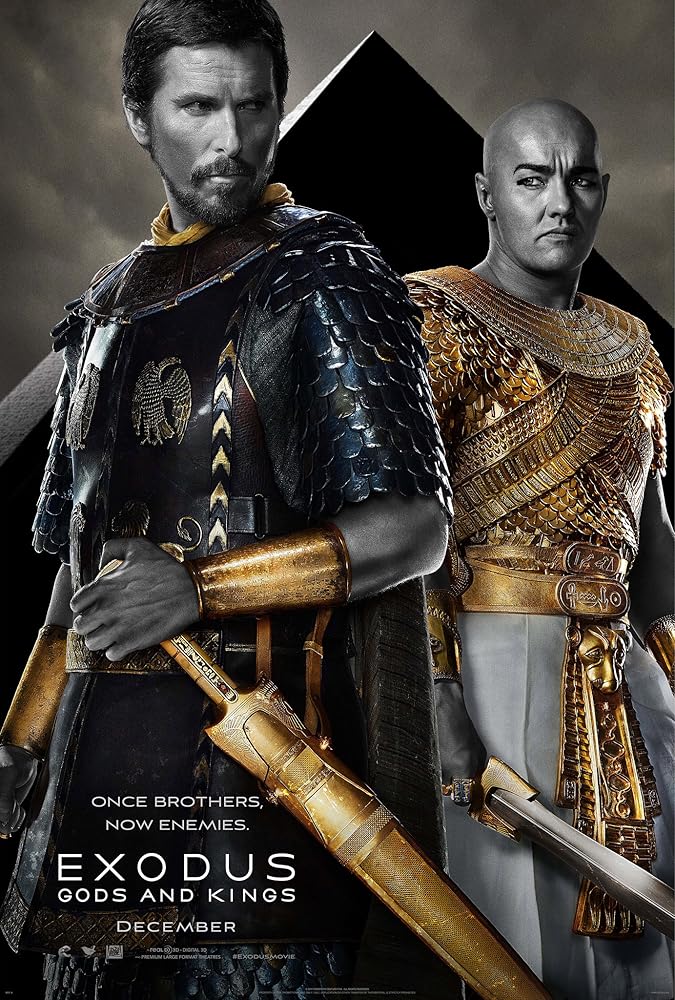
Why were there so many Christian films in 2014? In part, because Ridley Scott's adaptation of Moses' story hit theaters in early December. If we're to believe Scott's comments regarding the film's casting, had he bothered scouting for actors whose background remotely reflected those of characters and historical persons of Middle Eastern descent roughly 2000 BCE, we'd have gone down a film that year. Apparently, hiring actors whose skin is too dark or whose names are too foreign-sounding when making a film about the Exodus narrative means no studio will fork over a budget big enough to depict the Plagues or Parting the Red Sea properly. Whether the film was worth dousing Joel Edgerton, John Turturro, Aaron Paul, and others in varying degrees of brownface is a little bit up in the air, as the final product is a fairly mixed.

Giving a tiny bit of credence to Scott's financial justification for whitewashing and brownfacing his cast, the special effects during the big, spectacular Acts of God sequences are appropriately grandiose, and have an interesting bent to their execution. The film tries to find some natural means of explaining fantastical events, and so the plagues have initially sound justification for the Nile turning to blood, frequent swarms of destructive insects, and boils upon every Egyptian. Moses parting the Red Sea is treated as a potentially coincidental happening with only circumstantial ties to his own actions, which he must take advantage of as means of proving his connection to God to the doubting tribes. When it comes time for God's hand to become visible and explicit in its actions, the visuals gain a properly cinematic sheen, with a creeping shadow claiming each firstborn and the sea slowly collapsing back in on itself in a rushing tidal wave.

Exodus' new interpretation of Moses has some merit as well. It ditches the traditional role of shepherd and vessel of God in favor of a military man whose connection to the Lord may well be resultant from a traumatic head injury. There's a potentially neat dynamic around the midpoint, when Moses has returned to Egypt and determined to free his people through guerrilla warfare, intending to break Ramasses' will through attrition. As a concept, it makes some sense for a man brought up to lead armies to approach freedom from a fighting standpoint, and the film expands on this notion by contrasting it against God's proof that He can manage the same strategy far more effectively. I can see the intent, slowly nudging Moses out of his comfort zone and into the part of spiritual leader, and it might've worked!

But then we get into a major problem with Exodus: Gods and Kings: the storytelling and acting. Say what you will about Cecil B deMille as a director of crowds rather than actors; The Ten Commandments handily demonstrates how, with a lengthy enough running time and some talented players on hand, he could hammer a fully fleshed, comprehensive version of the material. Ridley Scott, working with still considerable two-and-a-half hours of screentime and actors of far greater standing than Charlton Heston, somehow cannot wrangle an ounce of humanity or relatability out of one of the quintessential religious stories about the power of faith and striving for freedom. He changes the script up far too frequently, giving Christian Bale and Joel Edgerton very little time to establish their characters as much beyond the same basic personalities in a slightly different situation before they overextend themselves or fade into the background. It's weird to think of a movie this long as feeling rushed, but it tries to cram in several additional scenarios for the rival brothers to work their way through in addition to the already shifting narrative of scripture, which makes odd moments like Edgerton's over-reliance on bellowing his lines to convey emotion, or the absolute stone-cold-stunner of, "From an economic standpoint alone, what you ask is problematic at best," stand out all the more.

Moses suffers the most here, as Scott's conception of a more secular prophet of the Jewish peoples comes off half-formed at best. The notion of moving him from commander of armies to rough-hewn freedom fighter to the Moses of Biblical understanding DOES have merit, but the film's eagerness to move from scenario to scenario means it never really slows down to examine Moses' psychology, or the deeper implications of his transformed state. A large portion of the middle stretch is taken up with Moses arguing with God in little circles about the morality of his actions without moving forwards. While his hollowed, resigned warning to Ramasses on the eve of the tenth plague and full confirmation of God's might has promise, it becomes a weirdly-shaped wrinkle when Moses' next big action involves triggering the parting of the seas with an act of doubt at God's presence. He awkwardly jolts from state to state depending on what the film deems necessary, and for all the hats he wears throughout the narrative, we ultimately see something less than the textual Moses.

When considering Biblical stories and characters, one needs to remember they rarely follow modern conventions of narrative structure or dynamic characters. The presentation on page frequently involves little more than "and then this happened, and so it was, and then this happened, and so it was, and then..." while the characters we're meant to learn from achieve their status as teachers by way of embodying an infallible moral righteousness. Introducing fallibility and uncertainty, then, is an easy way to make the old patriarchs and prophets more relatable, and examine their ideologies in greater detail. Taking Moses for an example, you have a man who knows exactly what he means to do the second God comes into his life, and hammers against the Pharaoh with unflinching certainty until he succeeds, only to turn the wrath of the Lord upon his own people when they fall short. Following the need to transform the character into something understandable and readable as an actual person in the moment, deMille kept the strong authority figure image, and whilst heavily emphasizing Moses' role as a lawmaker and Jesus-like figure, a good fit for mid-50s American culture.

Ridley Scott and Christian Bale's Moses does not only suffer from the story refusing to slow down long enough to examine him as a person - he sinks further because the film is naked about its intent to change him for profit. This Moses is not a man brought up to lead armies who later uses his experience to engage in a dragout war with his brother because it contrasts with any particular weightiness against his eventual turn to pure belief and subservience to God. He is a general-king because it enables to filmmakers to actionize the material, cram a few extra battle sequences in amidst the scenes of Biblical devastation, leverage the allure of a recently-departed Batman hanging around the studio. Action is not an inherent evil, and can be readily employed to underscore some greater point within the story, but Exodus' action scenes exist only to wow. Without proper interrogation of what this new strategically-minded, ready-to-doubt characterization means for Moses, the lurching nature of his character arc becomes more pronounced, and we end where we should have started.

They go and sideline the Golden Calf portion of the story, too, which is pretty much the most important part of Exodus if you're trying to give Moses a story about coming into conflict with God's divine wrath and learning to trust in His will instead of the strength in your own hands. There's fertile ground in a changed Moses suddenly turning against the very people he won over, the challenge of leading them to as pure a faith as his over forty years in the desert, and it's relegated to a single, far-away shot. That's how unwilling Gods and Kings is to engage with the implications of its alterations.

Initially, I felt three made for a fair rating. Ridley Scott at least provided some rather impressive vistas and battle sequences and visions of destruction on a mass scale. As I thought through the film more, though, I realized most of those visual effects-dependent scenes were either unnecessary attempts at actionization, or an inkling less impressive than equivalents in the deMille epic thanks to the (relative) ease of creating such shots in a computer compared against wranglings tens of thousands of cast and crew for similar effect. Though I do still find the Plagues and the Red Sea sequence both visually compelling and well-executed storytelling, I don't think the press of so many other visuals souring the more I contemplate them deserves too high a praise. Loop the brownface back into the discussion, and I'm more than happy to give Exodus: Gods and Kings my patented "there's some good things here, but man, the bad will weigh on your mind" rating.

Next time: The final installment of this impulsive Christmas series! Who all's ready for Kirk Cameron to celebrate the virtues of greed, gluttony, and conspicuous consumerism!

I'm not.

2.5/5

Tuesday, December 24, 2019

Left Behind (2014) - A Fanfic of the Apocalypse

(The following content is reran from the 2018 Christmas marathon on Letterboxd, as originally seen here.)

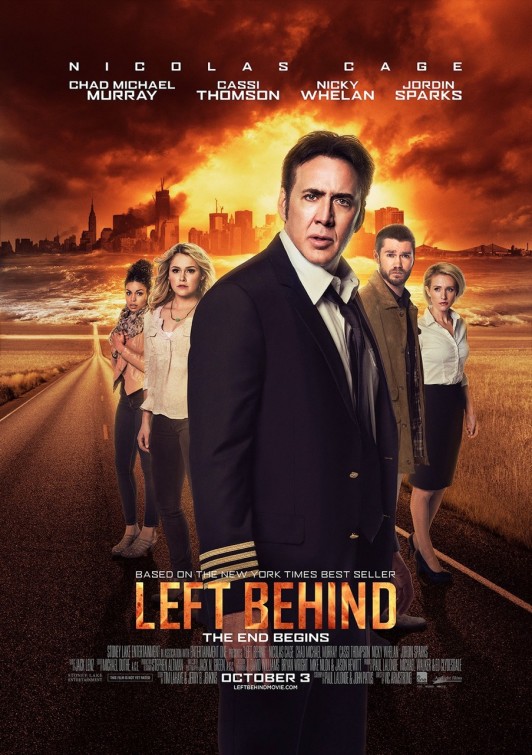
Why were there so many Christian movies in 2014? In part, because writer/producer Paul LaLonde finally raised sufficient funds to get a new adaptation of Tim LaHaye's sixteen-volume Left Behind series off the ground. A previous trilogy of films about the exploits of RAYFORD STEELE and BUCK WILLIAMS in the wake of the faithful's physical Rapturing to Heaven saw increasingly weak critical and financial success, and Kirk Cameron's continued slide into Evangelical nutjob-ery made his return impossible, so LaLonde instead snagged up a paycheck-desperate Nic Cage, a few vaguely recognizable character actors, and set about with his readaptation. Unlike his fellow Christian filmmakers, he didn't finish his movie in time for the lucrative Easter season, and evidently didn't feel like holding back for a month until Christmas, so the final product wound up dumped in early October and quickly forgotten.

Side note: In spite of a crowdfunding campaign for a sequel failing miserably, LaLonde has announced plans to adapt all sixteen books of the Left Behind series. Maybe he'll actually get around to filming something interesting on one of these future outings.

I'm incredibly disappointed in Left Behind. You hear the plot summary of the books and think to yourself, "Well, it might not sound GOOD, but they at least commit to spouting some absolute lunacy." Millions upon millions of good Christians bodily vanish in an instant, and the whole world instantly falls into rioting and chaos. A select number of survivors form the Tribulation Force to defend and convert the remaining unfaithful during seven years of hardship. There's conspiracies and redrawn national borders and armies of millions and a ceaseless war against the Antichrist against a backdrop of flame as the sun ejects half its matter onto the planet's ever-quaking surface. The whole thing's predicated on the notion all non-Christians need to hurry the hell up and get with the program lest they experience untold suffering for their staunch refusal to believe, but it's sort the sort of thriller where Russia can form a union with multiple European nations to simultaneously nuke Israel, only for God to vanish the nukes and plant them in the capital cities of the aggressors seconds before detonation. If the piled up nonsense still isn't tantalizing enough, I remind you this new adaptation has Nic Cage as a man whose faith is tested in the first hours after the Rapture. We have open invitation to completely lose our shit here.

Instead, it seems LaLonde and director Vic Armstrong decided the "try to act like we're normal people who believe normal things so the conversion message sells better" part of the job was more important than the "Lean into a full sixteen books of increasing fantasy insanity" aspect. A film starring a paycheck-cashing Cage and supporting actors in starring roles from a stuntman director never had much chance of achieving a great deal of depth, but relegating the action to Captain Steele's attempts to land his plane and nothing else smothers the film. With such a limited scope, all the movie has space for is characters with one-note personalities getting into arbitrary conversations/arguments in a confined space, while those whose book-counterparts are presumably more developed suffer through having to solve a conflict totally unrelated to their later apocalypse ministry. There are exactly three people who matter in this movie if my interpretation of the Wikipedia summaries for the books is correct, and their movement throughout the film can be easily boiled down to "is not a Christian" for 95% of the runtime, and "is a Christian" for the final 5%. That's not a heck of a lot to hang a "land the airplane" thriller on.

They could offer up SOMETHING here, but even if I set aside my disappointment at not seeing Nic Cage wage psychological warfare against the UN-leader Antichrist, there's nothing. The other passengers on their airplane occasionally set-up possibly interesting conflicts, like the pissing match between the Muslim and the little person, or the guy convinced everything is happening because aliens, or the woman who resorts to threatening everyone with a firearm after she becomes convinced they're all in on an act to steal her child. These situations are universally defused within two minutes of their introduction, and wrap back around to the same ol' "where did the other people go?" question without fail. Buck Williams is a total wash of a character, despite the half-hour prior to the Rapture taking its time to give him some connection to almost everyone onscrreen. Cage barely emotes as Steele, not even bothering with his trademark swaggering awkwardness, and favoring a bland, generically frustrated "ordinary man in a crisis" persona. Steele's daughter gets a lot of screentime wandering the post-Rapture world looking for her brother, which accomplishes nothing other than introducing a short cameo from another book character, and underscoring just how awful God is in this fictional world.

God seriously needs a better publicity guy. Throughout this review series, I keep mentioning how the Bible contains plenty of good messages and guidance for living one's life, so long as you read it critically and understand the cultural gaps between when it was written and the present day. However, across five films - four of which so far have served as not-so-covert attempts at converting nonbelievers - we've seen nothing but idle interventions, echoing silences, and a penchant for cruel torture, with this film representing the height of the final tendency. Were it not for Captain Steele's conversion in the last few minutes, I'd consider it a decidedly anti-religious film, what with all the focus on chaos and confusion and suffering as a result of his great gift to the world. I know and you know it's all MEANT as a time of hardship to sort out the worthy from the unworthy and grant the nonfaithful a final, true test of character before the End Times proper, but the movie never once mentions any of this. We're apparently supposed to watch all this destruction, see the devastation of parents who lost their children and good people deemed wicked sinners for a simple human failing, and think this a good and right part of God's plan because... well, because Nic Cage tells his passengers to pray before landing, I think.

It is, if nothing else, a spectacular self-own: You realize your source material has a little too much crazy religious fundamentalism to effectively work as propaganda, so you expunge everything but the inciting incident and "thrills" of trying to land a plane in a panic, only to also leave out all clarification for why the audience should take these developments as beatific, thus making the deity you worship look even crueler than his book-counterpart's relentless hammering upon the earth. Nothing works in Left Behind, unless you want to count the unintended comedic value in scenes like the bait-and-switch electric toothbrush, Nic Cage's last second attempts to avoid collision with a wholly-Raptured plane, or the sheer speed with which polite society descends into petty thieving and murder once there aren't any TRUE Christians left. I'm only giving it 1.5 stars because it does such a thorough job of scrubbing out the truly hateful parts of its ideology as to work against its own purposes, and argue the virtues of agnosticism. Nic Cage's performance barely rises above sleepwalking, so why bother?

Next time, Ridley Scott does some whitewashing, but still makes a real movie.

1.5/5

Monday, December 23, 2019

Heaven is For Real (2014) - An Exploitation of Innocence


(The following content is reran from the 2018 Christmas marathon on Letterboxd, as originally seen here.)

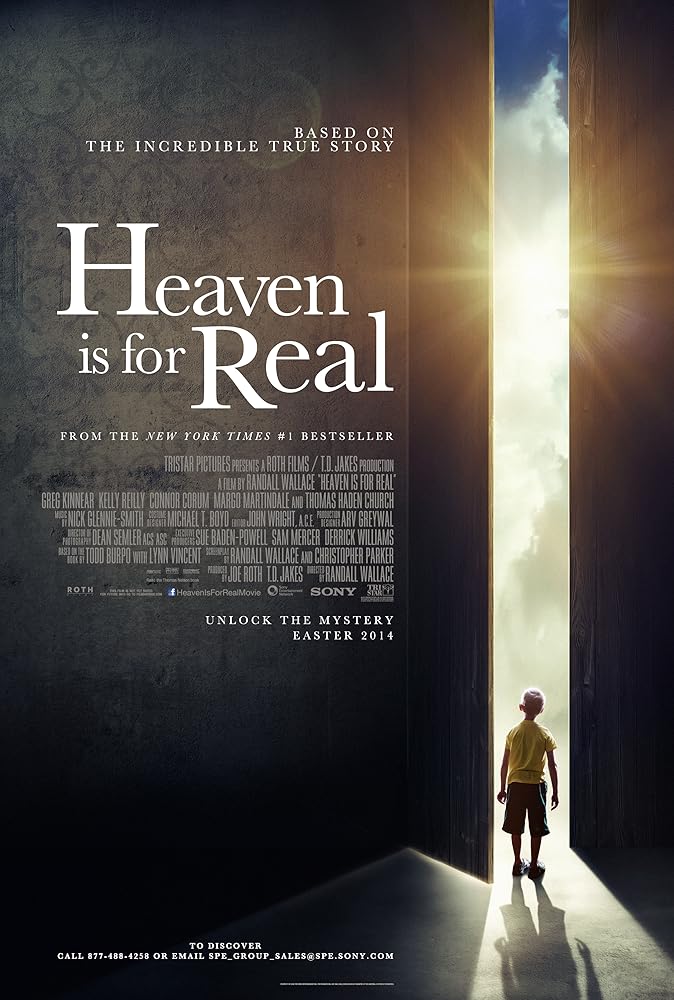
Why were there so many Christian films in 2014? In part, we can thank Todd Burpo, for deciding his lucratively successful Heaven Is For Real ministry venture simply couldn't make do with a successful tell-all book, press tours, and speaking appearances by his underaged son Colton, all recounting the boy's trip to heaven during an appendicitis surgery when he was three. In addition to all his other flush sources of income, Todd decided he needed to give his son his very own movie, directed by a real director, starring real actors, and distributed by a production company whose reality is questionable at best but leans towards interaction with this plane on good days. I won't bother with the question of whether the movie deserved to exist - while I'm normally inclined to say all artistic expression deserves a chance, Todd Burpo's entire career over these last fifteen years has rested upon the exploitation of a child who only just recently became a legal adult. He has no right to treat his son like a rarefied prop with which to entertain and inspire the masses, and he certainly should not predicate a kid's upbringing on being The Single Most Important Person On The Planet. It's terrible parenting to use your offspring for financial gain, and if there's an ounce of truth to anything he spews about heaven by manipulating Colton's story, I can't imagine any criteria through which he gains entry.

Shouldn't come as any great surprise, then, that Heaven Is For Real's biggest issues spring from the need to satisfy Todd's narrative. Carved away from the terrible real life circumstances leading to its creation, there's merit to the inciting incident and subsequent fallout as a story in its own right. A man of faith who wears many hats in his close-knit community suffers a series of medical and financial woes, culminating in the near-death of his toddler-aged son on the operating table. He soldiers on through the pain despite shaken beliefs, until his son claims to have left his body and seen the Lord God and Jesus. This spins into two interlinking issues, as the father is desperate for any reason to strengthen his beliefs again and begins treating his son like an authority figure instead of raising him, and the larger community bristles at the notion of their pastor moving from preaching useful metaphor to Biblical literalism. There's something interesting in the notion of laying a man so low and asking him to continue displaying the same level of strength and confidence he embodied before in the face of doubts and personal weakness. You could wrangle a decent ending out of such a story.

In fact, while watching, a superior version of this tale cropped up in my head. Basically, Todd realizes he's let his need to believe beyond a shadow of a doubt overwhelm his duty as parent and preacher, and potentially run the risk of damaging his son's development. The solution isn't to find irrefutable proof in Colton's statements and make the whole community come about to a new way of thinking, but rather to synthesize his two duties. He was neglectful towards Colton towards the start of the picture, after all, and the weakening of his passion for preaching correlates strongly to his increasing need for evidence. As a man of faith, he knows his scripture, and as a father, he knows his son. The two roles need not come into conflict with one another - the confidence and displays of strength he needs as a father can revitalize his sermons, and the depths of his faith can enable him to believe Colton's stories through his own lens of understanding without deferring the power in a father-son relationship to a child in hopes of greater understanding. Leave the actual truth of Colton's trip to heaven ambiguous, call for unity through common love of Jesus and the Bible's teachings, and there you have it. Got a fairly decent Christian film with a nice little "love your kids, don't obsess over details, be a pillar for the community" message in it.

Course, with the Burpo family so closely involved in this film's financing and production, such an alternate take is all but impossible. A story very loosely inspired by real events might fly with such a different interpretation, but with Todd Burpo and his ministry getting a say in the story, no dice. Because the film needs to end with Colton proving heaven exists and Todd resolving all his woes with said proof, the promising material becomes total naff. The movie only acknowledges Todd's immediate, eager transfer of control to Colton as weird insofar as his failing to find the RIGHT way to give Colton control to bring about the appropriate revelation. Those viewing his behavior as distressing or inappropriate are cast as simply doubting without reason or angry at God for not granting them special treatment. The question of literal scripture against metaphorical readings drops out of sight the moment Colton goes from describing general childlike interpretations of what he's heard in church to truth bombs beyond his understanding. Every conflict and character has to eventually run aground of the undeniable "truth" and come around to a singular point of view, and so the movie loses any impact its high-minded questions might've offered.

Any religious movie preaching a fundamentalist viewpoint is bound to be bad, but this isn't to say the final product is devoid of merit. The camerawork goes a fair ways towards keeping the film in the "bad but I can respect some elements" two star category, rather than the lower realms of actual hate the source and story deserve. Visually, Heaven Is For Real acquits itself well, thanks to Randal Wallace's direction of alternately storied/hacky cinematographer Dean Semler. The Nebraskan vistas and awe-inspiring glances to the sky have more of a gentler 80s Mad Max or contemporary Dances With Wolves feel than the same man's work on something like Peep Beep Meme Creep 2, and there are some interesting camera pushes here and there which feel like they belong in a better movie. There's a general folksy sense about this community and its people, one I rather like in spite of its total lack of authenticity when compared against the millionaire who minted his fortune by using his son. I can even find some merit in the way Greg Kinnear plays Todd's wide-eyed obsession opposite Connor Corum's innocent proclamations.

If you want a good idea of how Heaven Is For Real feels in a neatly-wrapped package, I think it's worth considering an early scene where Todd visits a psychologist concerning Colton's strange behavior. She dispenses some highly sensible avenues for diagnosis and treatment, only for Todd to effectively go "What if hlurgly blurgy bloo," which prompts her to suggest ESP as a more reasonable alternative. Todd then dismisses her profession, and refuses to consider his son as anything except a perfect source of knowledge who's causing HIM problems for the rest of the runtime. The movie as a whole also dovetails from something with the potential for constructive conversation into, "Well I can't understand it, so I'll just say something crazy and dig in my heels." Give more consideration to Colton's needs and experiences, acknowledge Todd's maladaptive reactions, do anything except fall back on an unexamined revitalization of faith. Anything's better than allowing a man who quite plainly views his son as a cashflow more than a person any measure of vindication.

Next time - Kirk Cameron's flamed out, so we're doing apocalypse fan-fiction with Nic Cage instead.

2/5

Sunday, December 22, 2019

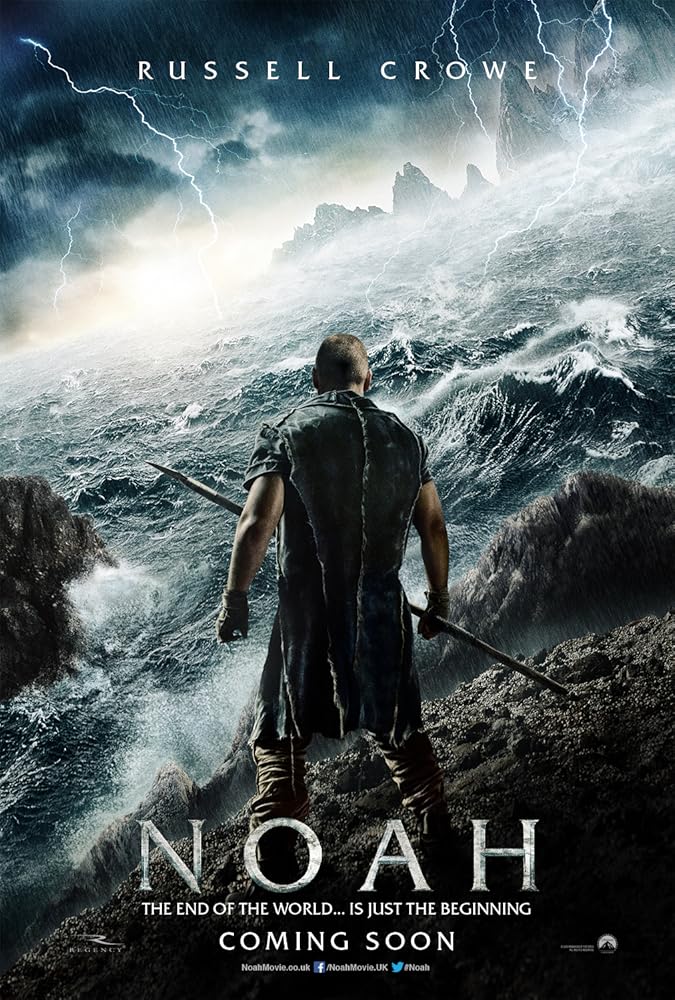
Noah (2014) - A Blockbuster From the Arthouse

(The following content is reran from the 2018 Christmas marathon on Letterboxd, as originally seen here.)

Why were there so many Christian films in 2014? In part, because Darren Aronofsky's fifteen year struggle to bring his vision of the Biblical Flood to the big screen finally bore fruit. A director whose work frequently involves characters pushing themselves to radical extremes, Aronofsky makes an interesting helm for the story of Noah, the patriarch who left all mankind to die beneath God's raging seas to preserve the sanctity of Creation. It's both a reversal and embrace of his usual ideas about the self and the masses, and it all comes packaged with a massive budget and expectations for big returns, courtesy of his success with The Wrestler and Black Swan. As the film proved a success critically and financially, and comes from the mind of a director with actual artistic ambitions, the only "did this movie need to exist" joke I can think to make involves slinging mud at mother! for trying a move into entirely symbolic territory and losing some of the power.

Aronofsky finds a far more even balance between metaphor and narrative this time around. Several passages of Noah creep into pure visual storytelling, and not just those involving the voice of God penetrating Noah's thoughts as a rapid series of powerful images. The reinterpretation of Watchers as victims of God's wrath and eventual precursors to the New Testament style of forgiveness-based salvation also lends way to interesting creature design and bits of worldbuilding to create a unique yet still Biblically-grounded setting. Noah's retelling of Genesis' opening passages through a flashing look at the Big Bang, planetary formation, and evolution that gives way to the key images of the Eden story helps underscore his character of a highly principled man trying to interpret his Creator's will through preset personal beliefs - a man who holds all he sees as dear, intruded upon by the sin of simply living, commanded to oversee its destruction. And then you have the contrast between a manmade apocalypse of fire, Enoch's vision in a time when the descendants of Cain ruled the land, and Noah's prophecy of devastation by water. Both presented as horrifying, especially when we see the survivors attempting to drown out the screams of thousands left to suffer and die on the mountaintops, but only one carries the divine promise of something after.

Compared to mother!, the metaphors at play here have a far clearer purpose, and relate more directly to characters who register as actual people. I've seen much critique of the decision to cast Noah as a figure who would murder his own grandchildren to ensure humanity's extinction, but I think it works very well within the film's parameters and Biblical cnaon. All the really hard parts leading up to the flood - interpreting his visions, constructing the ark, gathering the animals, defending it against invaders - are presented as grand undertakings, yet comparatively nothing compared to squatting in the dark for months on end with the knowledge of his supposed duty. In a twist on the usual Judeo-Christian narrative of prophets and chosen men passing God's tests by proving themselves willing to enact his will no matter the cost, Noah comes through this period in which nobody can dissuade him from the ultimate evil by looking into the face of a newborn child, and showing mercy. For once, the Creator wants to see his progeny spare a life, set aside the grim determination necessary to watch the whole world die, and mark the beginning of a new era with compassion rather than the murderous rage of Cain. Taking this route gives us Noah as a miracle worker and a mere man, prone to false beliefs and internal conflict as much as any other - a far stronger character than Jennifer Lawrence's being totally subsumed into her role as God's power of creation and destruction.

Other characters make for somewhat compelling cases, though unfortunately most suffer the opposite problem as mother!'s cast, and become mere pieces in the narrative. Ham's secretive relationship with Tubalcain aboard the ark has some interesting aspects of temptation and the sin of arrogance, which makes for a good extension of the earlier corruption of a "we make our own destiny" mindset. I'm also rather a fan of Og and the other Watchers, and their brief journey from distrustful, bitter souls to sacrificing warriors. Looking at the rest of Noah's family, though, they seem a little empty, and don't make much of an impact on the story. For all of Aronofsky's subtextual challenging of Noah's inherent righteousness as a patriarch, he doesn't really afford wife Naamah or adoptive daughter Ila a chance to interrogate his beliefs before the flood, or play a part in his turn to peace afterwards. They scream and cry to no avail with all the passion of archetypes and none of the unique embodying aspects of individual characters, and ultimately weaken the notion of the necessity of a balance between total fealty to the Creator and blazing one's own trail. Consequently, Tubalcain's temptations seem more unexamined and obviously evil, rendering him a conventional arrogant bad guy in the middle of a narrative calling for something more nuanced.

There's other things I could complain about, like how unnaturally well-groomed Shem and Ila look compared to the grimy naturalist aesthetic of their family, or the grand scope of the special effects straining against even a liberal $125 million budget and making some of the more "epic" scenes look awkward, but I think I've gotten the bulk of my analysis and valid critiques on paper. Aronofsky definitely does better work when he has something concrete and human to come back to rather than the excess of a pure passion project. While Noah is very much a personal story for him, the demands of a film designed as a blockbuster keep him focused on attaching his keen eye for visual symbolism and intense editing to a story about actual people. He didn't produce a masterstroke thanks to the neglect of other characters and the unfortunate shortstop of ideas right before pushing them to something truly complex and layered, but he did make possibly the best Bible movie of the lot for this project. I'm beyond glad we have a creator who wants to consider the Bible as sacred text AND inspiration for their own thumbprint. A whole seven films of blind lionization in a single month might drive me mad, so I'll gladly take intriguing and beautiful yet somewhat stilted.

Anyways, next time we're exploiting a child's close shave with death. That'll be fun.

3.5/5

Thursday, December 19, 2019

Son of God (2013) - A Biography For Believers

(The following content is reran from the 2018 Christmas marathon on Letterboxd, as originally seen here.)

Why were there so many Christian movies in 2014? In part, we can thank Roma Downey and Mark Burnett of Lightworkers Media for deciding they needed to net some extra revenue from their 2013 History Channel miniseries The Bible, and releasing a cut down version of the four episodes concerning Jesus' life and deeds to theaters in late February. Whether or not the world needed this particular film to kick off the slate of seven to pierce the mainstream radar that year is a worthwhile question - the film leaves out many notable scenes from the Gospels and foregoes the series' narration, leaving behind a story already told free from character moments and unique stances on the Biblical narrative without proper transitions or context for what we're seeing. To the right eye, Son of God is pretty much useless as anything but an extension of the series' DVD sales (and, bizarrely, two redundant literary adaptations). We sat through all two hours and twenty minutes last night, though, so I feel obliged to treat it as a standalone work of adaptation, even bearing in mind the material was not designed to play this way.

On its own merits, Son of God isn't the worst thing in the world. I rather liked some of the little moments scattered about here and there, like introducing Jesus by half-submerging him in water as a means invoking his baptism and foreshadowing the later walking on water, or how Jesus' prayers in Gethsemane are cut against the pharisees and his disciples making their own calls to God. A few of the miracles have the basis of interesting techniques around them, such as Jesus feeding the 5000 by simply encouraging them to lift their baskets to the sky and bringing them down full of bread and fish, or the intense closeups marking Lazarus' resurrection. The guy playing Jesus mostly bases his performance on strong declarative readings of the famous sayings, which at least works well if you're only asking for a cliffnotes version of (most of) his famous deeds. It's not much, I'll confess. Having something nice to say about the film is still a welcome surprise, though.

Looking at the total scope, there's practically nothing here. While I mentioned the lack of important sequences like turning water to wine or the trial before Herod, I doubt this works well as compelling docudrama or fiction on its own merits. Son of God starts at the belief in Jesus' divinity and the importance of his ideals, and so resolves to spend its runtime presenting the necessary beats one after another without much flair. Jesus performs miracles and claims himself God's chosen son, confounds the local authorities with wise sayings beyond their comprehension, and astonishes his disciples most by claiming faith without sight is a grander thing than faith based on proof, in complete and total lockstep with what the Good Book says he did. His rage at the moneylenders in the Temple, his agony in the garden, his pain on the cross, they all come through without the slightest hint of the passion inherent to the story's very name. Jesus does what he does and is miraculous because Jesus does what he does and is miraculous in the Bible, and the movie thinks the tome so holy and worthy of reverence that it only deviates by omission, and never interprets or enhances.

I understand the reticence to do so. I'm no Biblical scholar or Christian - I came up in an agnostic household, my first exposure to the whole religion was a daycare teacher telling me I'd go to hell for not knowing what the Bible is, and that sort of soured me on the whole experiment for a while - but the tenants of the faith are familiar to me. If Jesus' story and the power inherent to him work best when you accept them unquestioningly, then to point to the Holy of Holies and claim something's wrong, that you can do it better, is akin to saying the new covenant between man and God has no power. Personal reinterpretation may be fine, depending on your sect, but in general one should strive to accept and internalize what's on the page, and never put out something defying the Word. If you're going to put the Bible on-screen, the best thing to do is to put it there as literally as possible, and stay out of its way.

Leaving aside the issue of trying to stage such a historical telling while casting actors whose ties to the Israeli homeland are almost nil, I don't think placing the holiness of the text above the personal connection does anyone any favors. Nothing is liable to supersede the original text, and a passionate reinterpretation designed for its time can have profound impact. After years of discounting the Bible and Christianity as institutions with good morals but not much modern value, watching Jesus Christ Superstar and seeing the story of Jesus in such a raw, emotional, humanizing manner on all levels got me interested in the continuing impact and validity of the story and its related tales for the very first time. That movie might scream 70s fashion and deliberately place itself both within and apart from the original setting by filming in on-location ruins, yet it is as alive and vibrant a tale as any I've seen. Judas and Caiaphas and Pilate all serve as barbing questions against the assumption of Jesus' divinity and good nature, and Jesus himself expresses open doubts as to the necessity of his project, only to be met with an abstract, inscrutable answer from God. The entire final half-hour demands an answer for why from Jesus again and again, and is only met with silence, and ultimately the confusion and anguish of the crucifixion.

And still, for all the silence, all the doubt, all the legitimate reasons to think Jesus only brought himself and those around him needless pain, the film ends on a shot of the cross silhouetted against the setting sun, a shepherd tending to his flock in the fields below, captured on film entirely by accident. If you want to distill the idea of believing without seeing, and so finding the Lord wherever you look into a single image, that's how you do it.

Son of God just has Jesus say as much before vanishing in a beam of light, because that's how the book did it, and so that's how we'll do it. It is so afraid to cast Jesus as anything except a man made of quotes and deeds, it robs him of whatever power a more heartfelt, artistic depiction might bring, and so fails as a recruitment tool.

It's a safe, easy, for-the-faithful only film, one which completely fails to understand the faithful need challenging and testing more than the non-believers. I cannot condemn it, for it does nothing condemnable save duplicate without skill or understanding. There exist far better depictions of this tale, far better stories inspired by it, far better shared connections from the heart of a moved believer to your own. Unfortunately, because we're looking at films designed to provoke, proselytize, and exploit those who have faith, we're not looking at many of those this Christmas season. I've got a surprise scheduled at the end to make sure this series is more than endless complaints about those who believe differently than I do expressing their religion wrong, but with what's coming up next on the docket...

Well, at least Son of God intends to preach the Word as it exists on the page.

2.5/5

Tuesday, December 17, 2019

Inherit the Wind (1960) - The wood was rotten. The whole thing was put together with spit and sealing wax.

Letterboxd Season Challenge 2019-2020!  Theme five, part three - stage to screen adaptations!

(Chosen by John!)

Inherit the Wind is, considered as an adaptation of the famous 1925 Scopes trial, overly-dramatic to the point of cartoonishness.  Leaving aside the fudged and invented facts about motives and proceedings, the air within the courtroom is one of open combat between Spencer Tracy and Frederick March, well beyond even the utter pig circus of the real thing.  The literal anti-evolution carnival in the first act cannot compare for spectacle against the two men loudly and brashly raising objections over minor infractions of legal procedure as prelude to massive spiritual violations as they double down on lingering personal animosity and purest ideology.  What starts as a trial over a man violating a state law about teaching evolution swiftly forgets the man himself except as a cudgel against the opposing counsel in a war of words over fundamentalism vs critical thought, which too eventually falls to a series of verbal body blows that act to destroy the recipient's reputation amongst an undignified public far more than serve whatever judicial purpose the trial started within.  It's a battle of twin acting giants with a sweltering courtroom as the battleground, and firmly held beliefs about the fate of America wielded as weapons - spectacle enough to whip the viewer into a furor strong as any rousing, corrupted round of John Brown's Body.

Where Stanley Kramer and original playwrights Jerome Lawrence and Robert Edwin Lee keep the cartoonishness from overwhelming is through the careful consideration afforded towards balancing the mania with the melancholic, in guiding the viewer to realize just what this all cost.  It's easy to look towards March's blustering, belching, platitude-spewing Matthew Harrison Brady making an utter fool of himself in the prosecutor's box and witness stand, consider the roaring, foaming crowds he inspires to deeper wells of hatred, and think the film simply oriented against fundamentalism in its religious form, wailing against an easy target like a freshly tuned-in teenage atheist.  Matt, however, is frequently shown to quiet considerably when away from the courtroom and his masses, reminiscing over times gone by with Henry Drummond and nursing a deepset fear of losing the spotlight in his old age - it's hard to consider him a wholly good man as Drummond insists he once was or had the potential to be, but the depths of vulnerability and moral terror March draws from the script's already-prominent sympathetic angle makes it hard to consider his ultimate fate anything other than tragedy.  And while the public of Heavenly Hillsboro have no single voice (aside from maybe Claude Akins' Reverend Brown, who loses the people when he damns his only daughter to hell in a fit of brimstone preaching), it is clear they're easily co-opted by whoever shouts loudest and makes the cleverest points in the moment, only to revert back to their hateful ways once the fire of the moment dies down.  No wonder that in a film with Gene Kelly delivering snappy witticisms and withering speeches in his ever scene, they're still easily pulled into a dynamic between cheering Brady and Drummond.

The way Kramer treats Drummond underscores the story's greatest tragedy.  His highly active camera, sliding through crowds of people to find the best extreme close-ups, the most impactful arrangement of figures in tight quarters even with substantial distance between them, loves best to work its magic on Drummond, punctuating his snappy remarks to indicate skill beyond Brady's need for an audience to sound like he's made a good point.  Tracy's acting already exudes confidence and intelligence of the highest order, but the camera positions him as hero of heroes for recognizing the non-reason motivating the town and practically showers him in non-verbal praises for being the only person to call it out... and incidentally papers over his own failings.  After all, when he gets a good head of steam, he can pontificate just as well as Brady.  He introduces an air of casualness to an already loose courtroom and embraces the local system's peculiarities when extended towards him as a matter of fairness.  He keeps his head about him for an admirably long time, but his points drift away from defending his client and towards arguing the merits of enlightenment well before he feels the sting of Brady bullying an innocent girl to tears and blocking his best witnesses, and resorts to hammering Brady with go-nowhere stock-standard atheist rebuttals to easily disputed aspects of the Bible.  The game of set-em-ups-knock-em-downs pushes so far, it utterly destroys Brady's reputation where nothing else could, and leads into the desperation that triggers his untimely death.

None of this to claim Drummond had the wrong idea, or is somehow to blame where the film avoids total blame of those it frames as in the wrong.  The problem lies not with Drummond as a man, but with the situation he had to navigate, which would've broken or subsumed one of lesser character before first act's close.  Though Lawrence later outright specified he and Lee wrote the play as a subtle means of critiquing McCarthyism a la The Crucible, I think the work functions equally well as a straightforward critique of the media circus around the original trial, or the rhythms of court dramas especially when considering Kramer's work here, or any quagmire wherein the spectacle of ferocious battle overtakes level heads and an honest sense of law.  The trial and public demanded harder hits, wittier comebacks, a total destruction of an idol representing one side or another, and because Brady had a softer belly and a bigger obvious weakness in his dependence on a flock, he fell beneath the weight of Drummond's blows before Drummond could realize he too stepped over the line and acted uncouth in the same manner as all around him.

Consider the way he weighs Darwin and God's word in his hands at the close, before slapping them together and marching out to the tune of Battle Hymn of the Republic.  Regardless of where man came from, whether the gradual course of evolution from "lower" lifeforms over billions of years or instantly through the divine hand of the Lord from naught but dust and clay; what comfort or insight holds either answer when the fight to prove one or the other cost a man his life?  Or a town its dignity?  Or a family its stability?  Or a state its convenient legal blindness for decades?  Or the historical record a clean view of a symbolic hoax trial?  Or an industry its best minds?  Or a nation its sense of trust and stability?  The fervor of the fight can only encourage its participants to destroy in the course of chasing victory, regardless whether they intend nobility or ill.

Causes deserve their strident champions, but they also deserve an arena in which clear minds and well-spoken exchanges may play out free from all sense of clashing swords.  The public deserves a judicial branch predicated on preventing the ludicrousness of the monkey trials, in real or fictional forms.  We all especially deserve a life apart from fanaticism and tribalism and all the other assorted -isms that make a life part of some poison mob instead of the worthwhile thing it truly is.  Kramer makes this point by taking you to the edge, exciting you enough that you'll cheer on Drummond's legal strategy the same way the townsfolk cheer on Brady's nonsense, and then hits you with the revelation of just what's happened.  I initially called it a shovel to the face, but a more fitting analogy is likening it to a rock sinking to the pit of your stomach, never making itself evident until the full weight is settled right at the bottom.  We must have a care for how we tolerate foolishness from even our greatest allies, else we too inherit the wind and become masterless servants.

(Talk about one director making two radically different pieces a few years apart.  I can see all the skill in framing and editing and conducting actors and incorporating music Kramer brought to It's a Mad, Mad, Mad, Mad World, even the particular manner of working humor into proceedings - but wat a wholly different effect!)

4.5/5