Showing posts with label thriller. Show all posts

Saturday, May 23, 2020

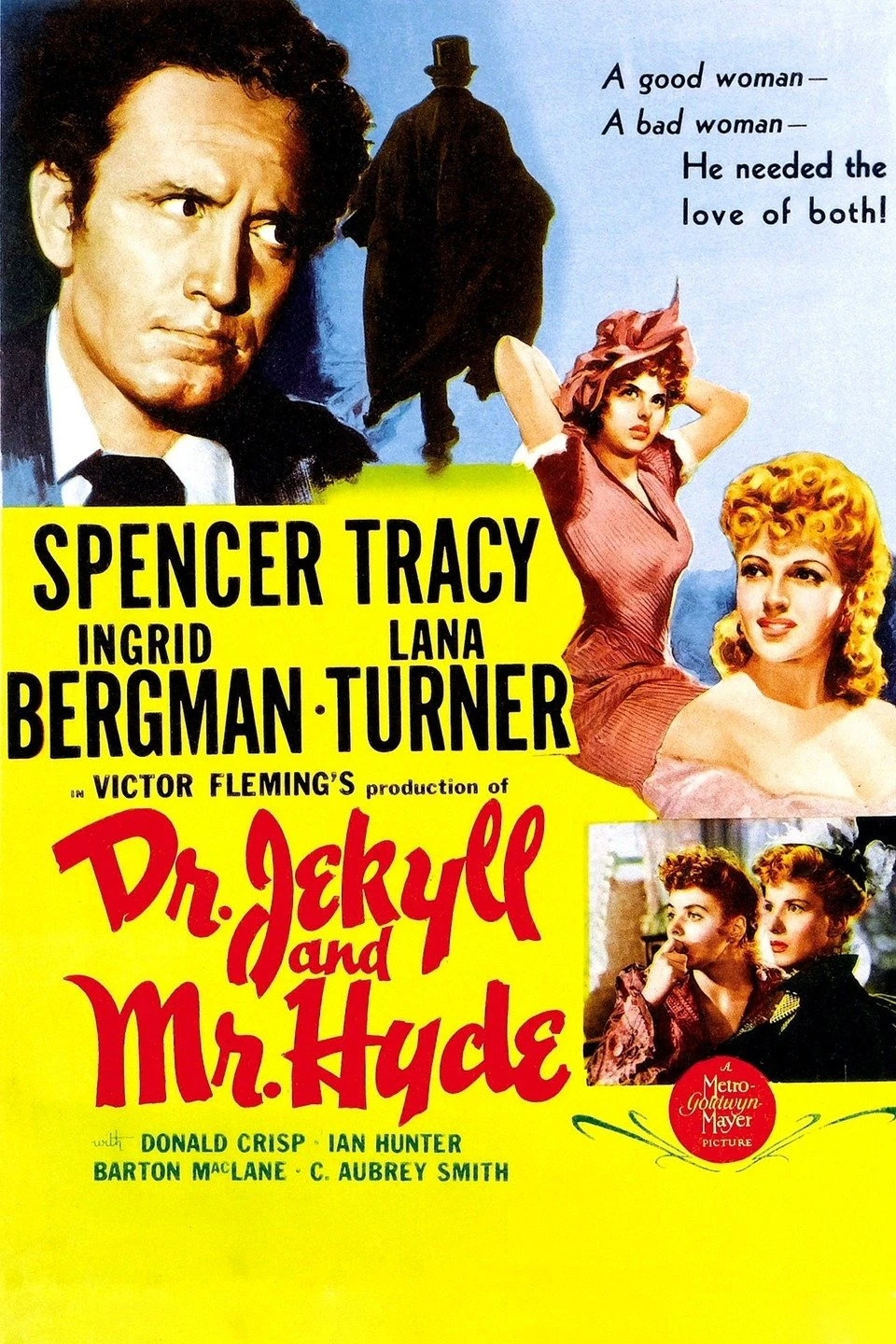
Dr. Jekyll and Mr. Hyde (1941) - Dream that they've all turned into white mice and crawled into an eternal pumpkin!


It's the Letterboxd Season Challenge!  Theme twelve, part one - a film starring Ingrid Bergman!

(Chosen by me!)

It takes a bit've time to settle in with Spencer Tracy and Ingrid Bergman in the parts of Dr. Jekyll and Ivy the barmaid respectively, primarily owing to the accents.  Neither is turning in a bad performance throughout the first act of Victor Flemming's remake of an adaptation of a stageplay based on the Robert Louis Stevenson novella, far from it as Tracy brings his usual hard-mouthed moral pillar with a gentler side to his performance of the good doctor with a disturbing preoccupation over evil, and Bergman makes her part as a would-be rape victim turned slinky temptress to her savior come alive with just how thirsty she plays the role.  As set-up for the film's later dive into a crueler relationship once Jekyll takes his serum and unleashes Mr. Hyde, their flirtations come across well enough... but the accents are still quite a lot to accept.  Tracy a little less so, seeing as American-accented leads in American productions set in Britain is a fairly common practice, and he strikes a compelling enough figure by simply being Spencer Tracy to make the lack of an effort to put on anything remotely posh easy to filter.  Bergman, however, is only two years out from learning to speak English for her part in Selznick's remake of Intermezzo, and trying her damndest to strangle her natural Swedish accent into a lower-class Irish brogue.  Heaven help her, it's not happening - she slips back into her usual mode with great frequency, and her constant seizing onto dialect snippings like "ain't" or replacing "my" with "me" do little except sound odd coming from someone whose screenpresence was otherwise so refined.  S'a thing you have to sit with and learn to accept across the nearly two-hour runtime, cause it never gets better no matter how hard she tries.

I focus so much on the accenting issues in this first paragraph because I think it's necessary to note the film has some uphill territory to cover before detailing how I believe it traverses the terrain like completely flat ground throughout the second act.  Once Jekyll unleashes Hyde and goes out for a night on the town, Dr. Jekyll and Mr. Hyde settles into its true intentions, and produces a second act worth praise all on its own terms.  Not at all what you'd expect with Hyde storming about foggy ol' London Town causing a ruckus in bars and making himself a disreputable member of the community (though the act's opening scenes do give you some've that, if incredibly toned down), the film is most interested in exploring how Hyde acts as a manipulative hand behind Ivy's back to cost her a job, isolate her from her friends, and push as far into depicting their abusive relationship as the Hays Code would allow.  Bergman stands as the focus character for this half-hour stretch, and weird accent or no she's doing a fantastic job of portraying an abuse victim in what feels like a realistic manner.  True, you still get the histrionics that can be recut as Fay Wray-style screams for the trailer, but her response to Tracy's mocking runaround conversations and mind games as he pushes her into giving him what he wants are excellent, doing her best to keep her composure against someone who's obviously harmed and violated her many times over even as he's dead in her face and she's on the verge of breaking entirely.  Scenes set apart from Hyde see her putting on a brave face for friends and tip-toeing around anything she thinks might earn her another assault, suddenly recoiling into a ball of defensive excuses when she can't hide the scars.  On Tracy's end, his Hyde certainly isn't a stunning physical or behavioral transformation compared to some of the more lauded actors to fill the part, yet I think him playing it as merely a crueler, disheveled Jekyll rather than a completely split personality opens the film to further exploration of whether or not his postulations regarding good and evil in the human soul are as accurate or bifurcated as he believes.

Fact, let's talk Jekyll/Hyde theory for a moment before digging further into the film.  Per Jekyll's outline in an early dinner scene, those aspects he calls good and evil are inherit to all, expressed not in totality one way or the other, but intermingling at all times, a little of each depending on the circumstance.  To isolate one from the other, express the evil in a man as a wholly different person from the good-facing side, should follow into the good living with a clear conscience and no impulse to do wrong.  Locked away from one another, one might even eradicate the evil altogether by giving it no outlet, no infusion of serum to bring its full force to bear on the physical world.  Course, as we know from Stevenson's novella, Jekyll cannot be considered a righteous innocent if he indulges Hyde's expression at all, for Hyde is of him, a man born of thoughts and impulses within his own brain, and if the two are to draw on knowledge and memories of the other and mutually regard their back-half as a figure worthy of disgust, then they must know what their mirrored self does and why.  Jekyll might safely say, "It was Hyde who did all those horrible things, Hyde, not Jekyll," yet he alone is responsible for drinking the formula that gives Hyde flesh, just as Hyde is responsible for taking the same to hide behind the guise of Jekyll.  Whatever Hyde does is an exercise of what Jekyll wants to do, and in denying Hyde reflects on him and continually indulging his evil side another night's escapades, Dr. Jekyll's supposedly pure half a soul becomes stained with every drop of blood Mr. Hyde sheds.  If, say, Dr. Jekyll were to continually unleash Mr. Hyde in the name of venting his frustrations over not being able to marry his fiance due to her father's concerns, and allows Hyde to torture and rape an innocent woman because it leaves him feeling better, then it's not really good and evil he's separated: it's presentable and unpresentable, only called by another, morally simplified name.

So!  All this in mind, why on earth does Dr. Jekyll and Mr. Hyde ask us to sympathize with Jekyll during the third act?  Despite all the work it puts towards locking our sympathies squarely in Ingrid Bergman's corner, once her scene of pleading with Tracy to save her from the insidious Hyde is over, the film takes a turn towards Hyde coming into prominence without the serum, has him murder Ivy, and spends the remaining half hour fretting over how poor innocent Jekyll has lost control over his totally separate evil side.  It's terribly incongruous, dedicating so much time and effort towards depicting an abusive relationship full of manipulation and heavily implied rape as something horrifying, postulating on how the rapist is not a separate person but the inherent desires of a front-facing "good" man, and then escalating to murder our most sympathetic character before acting like the murdering rapist is somehow still deserving our pity.  Worth noting, I think, the picture doesn't get into Jekyll's perspective during the second act at all, so we're left with a bland reassurance of his goodness without any attempt to explore why he unleashed Jekyll so many times, which can only lead to the worst assumptions about his person.  The whole thing plainly doesn't work, as the story only functions if you throw away everything we've been told about how the Jekyll/Hyde dynamic works here and believe Jekyll a tragic protagonist because he's the protagonist and so should be counted as tragically struck low.  What's more, in refusing to examine the why behind Jekyll's actions or condemn him for it, an entire ACT's worth of material I think excellently executed suddenly feels like a cheap, exploitative depiction of the exact same subject matter, because all Ingrid Bergman's suffering comes to is a quick murder and hand-wringing over how oh, how totally innocent is the man who allowed this atrocity!  Such a powerful depiction of abuse and rape denied a point beyond "Isn't it all so horrifying" does not gain from the absence; it only subtracts, and lessens, and yes, cheapens the whole thing by making it a commodity for entertainment rather than a serious issue.

I do so hate it when lazy storytelling taints an otherwise good aspect in a film with the taste of sand and ash.  I hate it doubly so when it's a film with such beautiful views of a reproduced Victorian London shrouded in fog and enclosed spaces darkened by the presence of a single man, a film with good performances across the board and chilling music and some rather nice if not standout effects sequences for the transition from Jekyll to Hyde and back.  Going with a zeroed-in focus on Hyde as a rapist to one victim has massive potential for a character study into the presumptuous nature of Jekyll and men of his like, but without a point beyond "Don't ya feel sorry for him?" all this good work adds up to a bad film.  The post-film conversation with Connie last night ranged for quite a while longer than usual as we debated whether the film deserved 3 stars for its technical and performative aspects, or 2.5 for its thematic failings.  While I argued in favor of the former for a time, after listening to Connie's perspective and considering it in view of my own history of assessing well-made films with major themeing flaws, I think the lower rating is only right and consistent.  If you're gonna do Jekyll and Hyde and expect the audience to stand with Jekyll at the end, either run with Hyde as a more typical force of mayhem and standard crime, or don't even try if you mean to go so hard on the magnifying-glass look at abuse.  "Man willingly unleashes his devils and terrorizes a woman until he ultimately murders her" and "Man never did anything wrong, pure cinnamon roll, etc" do not jive at all.

(The fades employed to transition between the two aspects are pretty impressive technically when you consider how well each successive shot matches to the next, especially given how many subtle little movements Tracy makes that somehow flow near-seamlessly from one to the next, but the part where they try to focus on his eyes by rendering them as a separate strip over the rest of the picture falls apart the second you notice a horizontal stripe of his head bouncing around independent the rest.)

2.5/5

Saturday, May 9, 2020

The Fits (2015) - Must we choose to be slaves to gravity?


It's the Letterboxd Season Challenge!  Theme eleven, part two - a film distributed by Oscilloscope Laboratories!

(Chosen by Jackie!)

.。*゚+.*.。It's exorcising personal demons time*゚..。*゚+


I've discussed my difficulties participating in middle school and high school sports here a few times before.  Primarily as they pertained to the social aspects, bad interactions with my mental issues and hazing and bullying and the like. The actual running wasn't too easy either, tho, and I don't mean in the sense that pumping your arms and legs hard as possible for miles on end is physically taxing even when you're used to doing so day in and day out.  The part where you feel like you belong to a team, use the energy of those around you to better your performance and feed back into the loop with your own contributions was demanding for someone inclined to hole up inside their own head and define themselves as apart rather than within, especially when forming non-antagonistic relationships was already so difficult.  Even a sport so isolated and self-determined as racing requires an understanding of the self as part of a collective, which proved an understanding I could never fully grasp.  Never hit second gear or second wind or whatever you'd like to call it, never took any interest in what my teammates were doing, always felt stressed and drained by people trying to encourage me instead of boosted like I know they meant.  Really, honestly, truly getting what it means to remain oneself while giving it all to a team is maddeningly difficult, and I'm still not sure I'll ever be capable of putting it into practice.  It's a matter I'm always looking to work on, of course, for one must deal with one's devils in addition to simply acknowledging them, but when you're right on the wire, it almost has to be something you either tap intuitively or can't access at all.

All to say, what jumps at me most about The Fits, the directorial debut of Anna Rose Holmer and acting debut of Royalty Hightower, is how they use main character Toni's struggle to balance her old sport of boxing amongst boys with dancing drills amongst girls as a mysterious psychic illness sends her new friends into spasmic fits to explore that sense of individualism amidst the collective.  An early moment I found particularly telling is Toni's initial audition to join the Lionesses, when older girl and instructor Legs emphasizes the need to think of themselves as a unit, and lays out the complicated series of drill steps they're to demonstrate.  Toni, in a space she's not at all comfortable in just yet, and coming from a background where the camera and sound design have emphasized her tendency to obliterate all save herself for the sake of focus, dances about as badly as everyone else in her new group, yet takes the experience harder.  She's not able to engage in the locker room like her new peer, hiding in a stall to avoid others seeing her change while simultaneously listening in on their calls.  During practice, the camera often spins with Toni as its pivot point, highlighting how everyone around her seems perfectly capable of following the steps, yet she remains slightly out of time, tending to misplace or mistime steps, keeping a barrier between her and the group she wants to join.  She still returns to run stairs and work boxing routines with her brother, and during private moments in these exercises, she practices in isolation and seemingly starts to get it when she feels freer to treat the dance like a fight to be overcome, yet when she returns to group practice it never translates.

There's a fear of losing herself entirely if she clicks with the team, one her interactions throughout the film complicate through interesting wrinkles.  When the titular fits start striking the older girls, we the audience can tell each one manifests differently than the last, and eventually understand they leave no lasting harm, but they're still frightening seizure-like events that disrupt the flow of events and prevent Toni from taking advantage of moments when she's closer to getting it.  The uniform sense of uncertainty they produce, however, also enables Toni to bond with the two girls who take to hanging around her in calmer moments, Maia and Beezy.  Beezy in particular gives rise to many positive interactions, opening doors for Toni with temporary tattoos and ear piercings that mark a more physical transformation, and spending a night running about the fitness center in the dark during a rapturously shot scene, which transitions into a moment of quieter understanding when Toni helps Beezy after she gets scared and pees herself.  For Maia's part, she seems a quieter hanger-on for some time, yet shows herself as a more contemplative older presence, specifically as we move to the third act and Toni is able to have an honest conversation with her after the fits appear more sporadically and make the future of the team more uncertain. Of course, just as everyone starts feeling safe because they think the fits can only impact the older girls, Maia and Beezy have their own fits in short succession, and leave Toni more isolated than ever.

What's interesting here is how this sense of isolation plays into Toni's preexisting feelings of being an intruder in a space not meant for her.  In the downtime between notable events, she's often seen blanching at items signifying her welcomeness to the group - picking at the temporary tattoos, fiddling with the piercings before tearing them out, placing herself a subtle distance away from the main body of girls, pinching and pushing herself.  While her distant, colder relationship with Beezy after the latter has a fit can be read as the fits themselves drawing a line between those who've had them and those who've not, I can't help but wonder if Toni thinks of herself as having caused all this.  She shows up, and all of a sudden what looks to her like a cohesive singular unit starts falling apart and feeling afraid.  Even her own friends start acting distant to her because she's too aggressive and stand-offish before they experience a fit.  Her interactions with the boys' boxing team grow less frequent and more distant throughout the film, until she's looking in on their practice in shots framed to mirror her looking in on the drill team for the first time, except there's no more curiosity, only distant observation.  The things that made her part of this old world seemingly disrupt this new world, yet the new experiences here make it so she can't go back and still feel herself.  All the world seems gray, her ears buzz with anxious pounding rhythms, everyone seems distant, fit or no fit, and Toni just doesn't seem to belong anywhere.

So we come the finale, when Toni has her own fit, and it makes one question just how much these are truly negative experiences.  True, they're outwardly frightening, striking at random and producing different effects in each person, yet we've also inhabited the perspective of someone who doesn't possess the faculties or insight to understand what anyone who experiences a fit truly makes of it.  In Toni's case, when her feet leave the ground, and she dances the routine with an energy and individual strength not seen prior to this, we come to understand the experience as one of gained insight.  She envisions herself approaching the covered bridge where she and her brother practiced, shedding her gray sweatsuit to reveal the spangled, colorful Lioness uniform beneath, and dances in perfect time with her team in a variety of locations visually defined as her's throughout the film.  Understanding of the matter I outlined above comes to her for the first time: that it's not about becoming less to contribute to a whole, but about making a whole from many wholes, using the greater flow to build what's already within you, and expand the energy outward in kind.  Yet despite this revelatory moment, we don't see the aftermath.  Toni's teammates are still shown as intimidated by her dance, and when she falls to the floor smiling in the last shot, all we get afterwards is the Lioness hype chant and a return to the tingling, anxious music over the credits.  She gets it now, and will likely have a chance at building her friendships again, but do her revelations match to what her friends came to understand?  We aren't to know.

The Fits offering no insight into what comes next seems appropriate to me.  Much work as Holmer and production/writing collaborators Lisa Kjerulff and Saela Davis put into crafting a world where we can instinctively understand Toni's internal divide, the mysterious, otherworldly nature of her own fit pairs perfectly with what I talked about above.  The actual click is internal and personal in a way no camera or cut can adequately capture - we can only see the aftermath, and the film's conflict is more about Toni coming to balance her two worlds and be comfortable in her own skin than actually dancing as part of the Lionesses.  If she feels she's mastered it, and can show such mastery to others even in the midst of what they've come to view as a scary experience, then we must take whatever comes next on faith.  Perhaps I only think this way because I never got to this point, and remain uncertain whether I ever can.  From listening to the commentary on Criterion this morning, though, I feel confident saying the filmmakers achieved such intuition, and crafted a powerful film about the same,whilst exploring matters of gender expression and growing up in the same breath.  An intense, multitudinous picture, The Fits is bound to register as a profoundly personal experience for all who watch and remember the struggle of trying to be one for the sake of all.

4/5

Thursday, February 20, 2020

Ring (1998) - You better get some rest; I have a deadline.


It's the fifth Letterboxd Season Challenge!  Theme eight, part one - a foreign horror film!

(Chosen by me!)

I think it only fair to begin by noting how a proper discussion of Ring inevitably clashes against spoilers, spoilers everyone knows about though they be.  Ever since Hideo Nakata's adaptation of Kōji Suzuki's 1991 horror novel literalized the "frightened to death" aspect of the Ring Virus by transforming the moment of death from a simple hallucination-induced heart attack to vengeful ghost Sadako crawling from the well that served as her grave and out the victim's television to enact an abstracted killing blow, a pale, stringy-haired girl in white has been the franchise's defining image. Appropriately so, given it's an incredibly striking sight no matter the execution, an extension of the book's technology-as-conduit-for-supernatural-curse concept in a way friendly to continuous reinvention across the American remakes and numerous sequels in both Japan and the US during a time of rapid technological evolution, in a manner the original restriction to video tapes and phone calls couldn't hope to make interesting beyond changing the cursed tape's medium.  Thanks to Nakata's not-quite original and Gore Verbinski's The Ring making such an enormous splash in their respective markets, Sadako crawling from YOUR TV has become fodder for nightmares and jokes aplenty in the last twenty years.  You talk about Ring, you talk about the TV thing.

As such, talking about Ring by focusing on the film's bulk concerns across its runtime makes the lack of televised emergence conspicuous by its absence.  The journey undertaken by journalist and single mother Reiko Asakawa and her videographer ex-husband Ryūji Takayama across the second and third acts involves a great deal of level-headed investigative work into the origins of the cursed tape, with a mind towards breaking the curse by laying the ghost to rest.  There's absolutely no paranormal activity beyond the tape's evil aura until an hour's way in, which presents as psychic visions rather than hauntings, and Sadako's signature manifestation doesn't take place until the final ten minutes as a twist about how the protagonists were dead wrong as to her nature.  If I were to play coy with this and try to preserve the twist for everyone, it wouldn't work, because you all know what made Sadako iconic, and you'd figure out all my talk about plain Jane research and agonizing over retrieving the body of a wrongfully murdered woman was all mere prelude to a twist, simply by way of my not mentioning someone coming out a TV screen.  So we're just gonna note how the film's big famous moment can't function as a legit surprise anymore if you've extremely basic working knowledge of the culture, and move on to more fertile discussion.

Like I mention, Reiko's response to the cursed tape and her seven day deadline is more rational and intelligent than one might expect from a supernatural curse story.  There's an element of dogged pursual to her early movements, an undefined, restless need to see the cause behind her niece's sudden, inexplicable death days earlier, the kind've unknowing march towards doom you'd conjure when thinking of the paranormal intersecting with the mundane.  Once she's viewed the brief, surreal tape and been warned of her fate (no "Seven days..." whisper over the phone in this version, just the same eerie metallic scraping sounds from the tape), though, her next moves are all very sensible - contact someone she knows and can trust who has relevant experience studying and dissecting taped media, exercise her skills as a journalist, and start looking for a solution based on slowed-down viewings and cross-referencing.  A good chunk of the film passes with Reiko and Ryūji studying the tape frame-by-frame, seeking out clues and dissecting hidden meanings from the seemingly disconnected imagery, which gives the film this strange yet appealing atmosphere of extended repetition making the sights and sounds yet more disconcerting mixed with the reassurance of discovery and understanding.  Ring plays in large part like a serious-minded murder mystery, with the curse hanging overhead as a vague, barely-comprehended threat.

The horror, therefore, comes about through the increasing inadequacies of their method.  No matter how much Reiko extracts from the tape or how close she comes to understanding its origins and breaking the curse, it's not enough to prevent her young son from watching the tape late at night in a mid-movie twist, condemning him to the same fate without him ever knowing what he's done.  The work necessary to to unravel clues and discover new angles takes time, and on-screen captions remind us how quickly Reiko's clock is running down; it seems like no time at all between the roomy seven day starting point and our arrival at an all-too-close two.  Despite a rather blase attitude towards confirmation of psychic phenomena on both leads' part (one I suspect worked better in the book, where the protagonist's journalistic background had an element of past failed paranormal exposés), contact with various psychically burnt objects and persons as they get closer and closer to Sadako produces more overtly freaked-out reactions, and marks the characters' potential inability to handle the situation before them.  It gets a little bit clunky when the film uses overt flashes of the tape's imagery and sound to remind us how certain places, objects, and persons relate back to the clues rather than subtler interlacing, or when negative turns are accompanied by the otherwise quiet score going utterly manic on  the screechy strings, but in total effect the build rests on a solid foundation of exposing the limitations inherent to rational thinking when faced against the beyond.

When it comes time for the movie to climax, the twist enables it to do so twice in a row, with distinct approaches to the payoff.   In the first, Reiko and Ryūji's toilsome efforts to empty the abandoned well and retrieve Sadako's body may not entirely parse as to why the characters believe doing so will save their skins, but it turns on the great image of Reiko hauling heavy buckets over the course of many hours as her body grows weary and the sight of honeycombed crawlspace barriers facing the outside takes on a distinct menace, even knowing nothing's coming.  When she and Ryūji swap places and she's rooting around in the stagnant wellwater for the corpse, the shift to a damper, more claustrophobic environment continues the film's sense of undefined paranoia, and brings it to the head with the discovery of the corpse, oozing slime from its sockets like grateful tears as the seventh day fully passes and Reiko is saved... only for it all to come to bunk.  Just as the fake-out climax trades on an intensified version of the vaguely menacing feel of the preceding story with the payoff seemingly reward for such diligence under pressure, Sadako's sudden emergence stomps all over any sense of fairness or meaning to the film's events, killing Ryūji for reasons we cannot understand.  Once Reiko puts two and two together, and realizes it was not their hard work towards discovering Sadako's origins and laying her bones to rest that broke the curse, but rather the most innocuous, natural step she took that transferred it instead, the story attains  a wonderfully nasty bent.  There's a demand for cruelty from anyone who views the tape, a need to intentionally expose others and expect them to do the same in a never-ending cycle, and that's just that.  The relief of thinking those tested investigative convictions finally paid off, followed immediately by proof positive they're useless against real evil.

For its strengths, Ring does seem a touch lacking in a few places.  The gender-flipping of the protagonist from the book's Kazuyuki Asakawa to Reiko and the subsequent change of Ryūji from friend to divorced husband introduces the possibility for a more meaningful relationship dynamic between the two, one the film does not adequately explore outside a few brief moments.  It's more focused on the process of understanding and halting the curse than exploring the characters doing so in great depth, and so leaves them in a bit of an emotional limbo regarding one  another.  Something similar effects Reiko's relationship with her son, who's obviously very important to her yet drops from the film once he views the tape, to serve as little more than another reason to break the curse beyond Reiko dies.  These noted, the picture still goes plenty far on the journey to test how much a rational series of questions are worth under unusual and demanding circumstances, and the sheer meanness of its twist lands with a satisfactory thwack even when you know it's coming and spend the whole film waiting to see someone scramble out've an analogue set.  Much as later entries and online culture have diluted the special, unique fear of Sadako's emergence (coming out of a Jumbotron at scale is a natural evolution, but it is also extremely silly), Ring's dedication to earning that sigh of relief before gutpunching the wind from your lungs ensures its USP continues to demonstrate value as a scare worthy of the construction around it.

(I rather like how every other element of the tape has a concrete explanation, including the audio playing over the crawling figures, yet the crawling figures themselves remain unexplored and open to interpretation.  Adds to the creepiness and the sense of the investigation coming to naught.)

3.5/5

Wednesday, February 12, 2020

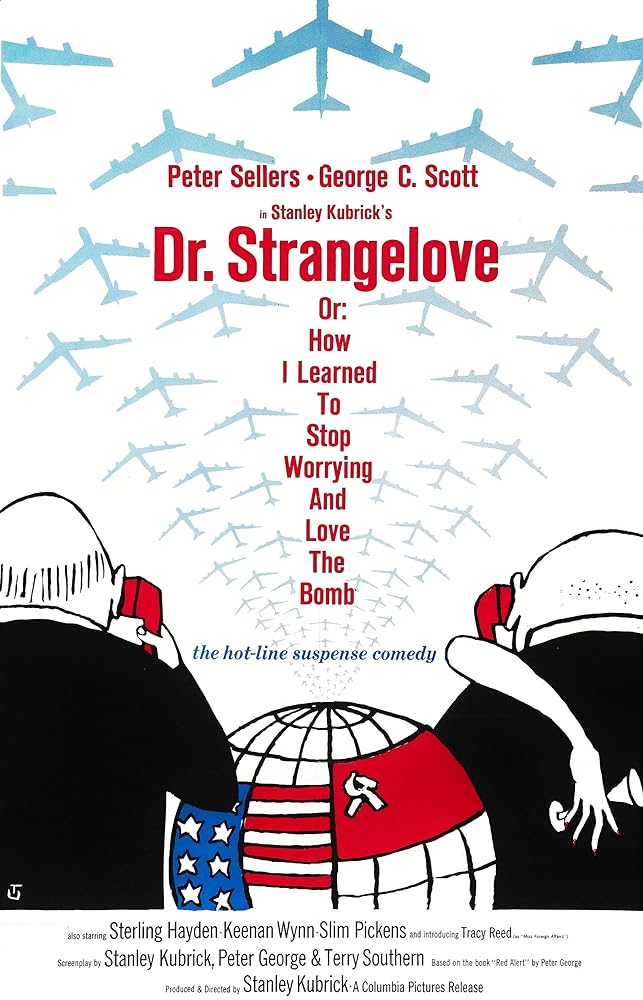
Dr Strangelove or: How I Learned to Stop Worrying and Love the Bomb - Nuclear Warhead. Handle With Care.


It's the fifth Letterboxd Season Challenge! Theme seven, part three- one of Spike Lee's essential films for aspiring directors!

(Chosen by John!)

Nothing written herein will be new or insightful. Without proper academic training into the act of film analysis, I cannot provide you a single word about Dr. Strangelove or: How I Learned to Stop Worrying and Love the Bomb any different than what a multitude of thousands have already said over these last fifty-five years. Not because Stanley Kubrick was some kind of inherent genius whose works are far too intricate for mere mortals to tackle, requiring a deftness of wordsmithery and cinematic insight beyond the ninety-ninth percentile before any decent work can take place - bout a year ago I watched and reviewed his Eyes Wide Shut during a different challenge, and managed a detailed piece I find satisfactory. Difference is, I watched Eyes Wide Shut for the first time then, without any preconceived notions or general knowledge of its general reception or common interpretations, a benefit of the film sitting outside the core Kubrick classics. Dr. Strangelove, by contrast, is a film I've watched in full multiple times since high school, regularly use as idle YouTube clip entertainment, read about from any new critic I discover who's covered it in any substantial detail, and love for all the reasons everyone else on the planet loves Dr. Strangelove. I know, you know, everyone knows the best lines, the ins and outs of what makes the performances tick and what Kubrick did to make George C Scott act Like That, all the little sexual innuendos, the Thing about how Kubrick insisted the table in the War Room be pool felt green despite the film's being shot in black and white. "You can't fight in here, this is the War Room!", "Precious bodily fluids," "He'll see the big board!", "Mutiny of preverts," Major Kong riding the bomb, "MEIN FUHRER, I CAN WALK!", all of it.

Still, I write, and write quite substantially on every film I watch for these challenges, so a lack of fresh insight shan't serve as any deterrent. In the name of maintaining forward momentum, let me simply state the observation I mean to work and expound upon in the bulk of this review: Dr. Strangelove is as cacklingly funny as it is because Stanley Kubrick did not make a comedy.

To clarify, he certainly conceived the scenario and directed his actors in the manner of a comedy. One can hardly look at George C Scott masticating on hunks of snack food between flustered, easily-excited outbursts and think his General Turgidson anything other than an immensely funny figure. Same goes for all three of Peter Sellers' characters, be they Group Captain Mandrake fighting back an emotional breakdown as he tries to calm his commanding officer's psychosis, President Muffkin ineffectually managing his staff and generals with ill-projected strength, or Doctor Strangelove gleefully describing a eugenics program to survive the end of the world while his Nazi hand flies into salutations. Beyond this core group, other characters aren't quite so wacky of immediately humorous, but Sterling Hayden's Jack D. Ripper and Keenan Wynn's Colonel Bat Guano are both such tightly-wound, deathly serious military men that their self-important speeches can't be anything save giggle-worthy, in isolation or in contrast to Mandrake's flustered replies. Clowns in positions of power all, even Slim Pickins, whose Major Kong is perhaps the mildest of the bunch despite his natural and entirely out-of-place Texas drawl, and still gets the film's bleakest, best punchline all to his lonesome.

Through Major Kong and his crew aboard the 843rd Bomb Wing, we can understand what I mean by Kubrick not making a comedy. Their scenes contain jokes same as the rest of the film, primarily quick lines from Slim and absurd background details, which render the plane a locker room hangout much as a militaristic instrument of death, but their composition and placement in the film do everything in their power to dissuade any impression you're watching a comedy. The majority of production design choices reflect Kubrick's typical eye for detail in a set based on then-top secret military hardware, the camera prefers views which emphasize the cramped space and the movements of dials and switches and blinking lights, the cutting shows us every man engaged in his obscure function as the crew flies onward to their final destination. Any time we jump to join the 843rd, the soundtrack strikes up a drum-based rendition of When Johnny Comes Marching Home, and the action plays out like any other military movie wherein a contingent of our good ol' boys are out on a mission to save Democracy and Freedom, and nothin's gonna stop 'em. They'll follow orders to a T, endure heavy enemy fire, face setbacks that mean their inability to return home safely, and still they fly on, fearless and undaunted! That they are flying a mission whose success means an end to all living things, one which sees every other character is tying themselves into hysterical knots in a desperate attempt to halt it, matters not one whit to how things play out.

Cross your eyes and ignore Slim Pickins and the pin-up girls on the safe containing classified orders, and there's really nothing funny about this stretch of Dr. Strangelove. Even once Mandrake and Ripper's side of affairs has concluded, and Muffkin and Turgidson and Strangelove are approaching their peak, the 843rd is still playing out its war game completely stonefaced, still emphasizing the technical work necessary to pull a last-ditch bombing run, still marching to its heroic tune. Right up until the bomb drops with Major Kong astride its girth, and the film corpses hard as it possibly can with him yippin' and hootin' and waving his hat all the way down to smack dab in the middle of Mother Russia with the world's biggest atomic penis between his legs... and then silence.

Such an effect applies across the entirety of Dr. Strangelove. Across every technical aspect, across set design, lighting, camerawork, sound editing, shot-to-shot cuts, Kubrick composes like he did and would any other film across his career, as a director driven to get everything just so and generate an atmosphere of cold, carefully manipulated sterility. The War Room is this monstrously huge, mostly empty space, with dozens of men all cramped around a comparatively little table with hot lights creating massive dark spaces all around and an imposing map of the world flashing ominous updates overhead. Ripper's office is laid out and decorated according to the sensibilities of a respectable military man, and gradually gets completely trashed by gunfire until it's an almost impressionistic space with slatted lights and obscure destruction strewn all around. Spaces we glimpse with comparative briefness still communicate a fussy, uncomfortable environment, such as the too open operating centers and offices Mandrake calls his own until he's stuffed into a cramped telephone booth, or the confusing mess of mirrors in General Turgidson's bedroom, which make it impossible to tell how he'll enter the frame until he does. Our view into these spaces consists of extremely long takes of two characters in close conversation, low close-up angles to emphasize projected strength, and more heavily cut sequences designed to show how stressed and uncertain all parties involved feel at any given moment. It looks and feels for all the world like the kind of military thriller that gets your teeth clenched til they feel like shattering, scootching forward to the edge of your seat desperate to know if they'll make it or not.

Except the subjects in the midst of this clockwork contraption of a tension machine are a group of sexually stunted, immature, undisciplined men who boggle for the camera and say patently ridiculous things in patently ridiculous ways, and make it beyond clear their petulance and desire to feel just a little bigger rules above anything else. I can only think of two instances in which the film is shot to explicitly laugh alongside the audience - when Kong rides the bomb, of course, and when Bat Guano gets a nice close-up of the Coca-Cola company squirting their product in his face. Beyond these two moneyshots, Kubrick does not once deviate from his thriller sensibilities. The script takes the plot seriously and makes damned well sure we know its every mechanism, the camera glares on like we can gleam some greater meaning from seeing these very important men in crisis, the editing holds and holds and holds til we can bear it no more, and then holds off the next cut just a bit longer for good measure... and George C Scott is in center frame, imitating an airplane and getting hopping excited about his boys dropping a nuke on the Ruskies to trigger a doomsday device. Or Sterling Hayden speechifying about how the commies are gonna fluoridate children's ice cream to an extremely uncomfortable Peter Sellers, or Sellers arguing with an unseen Russian premier like an old married couple, or any number of other silly things that completely destroy your faith in the chain of command. Completely unoriginal, argued to death argument here, but the contrast of the most handsomely mounted political thriller you ever done seen, and Peter Sellers talking up breeding caverns and wrestling an evil hand while Scott muses about megadeaths like a little boy in an old lech's body leaves you only the choice to either cry and commit suicide at the state of the world, or laugh at the same.

Even moreso than concerned Terrence Malick and Days of Heaven, I cannot recommend aspiring filmmakers try and emulate Stanley Kubrick's actual techniques. Genius and detail-oriented though he was, his work and writings about it clearly evidence a man who frequently demanded excellence beyond reasonable expectations from all around him, obsessed over things that didn't matter, and actively manipulated his actors instead of working with them if it suited the film. His methods produced some of the greatest films of all time, but I'd not think anyone who wants to work beyond a single project should try and do as he did. Rather, for the purpose of this challenge theme, I say we take Dr. Strangelove as a lesson in the power of contrasts - how complete and total dedication to a contrary tone with your actual, intended vibe peeking through juuuuuuust enough to recolor everything around it can pay massive dividends. The moments when the film breaks down and laughs alongside its audience are exceedingly rare, but its big break represents one of the most iconic images of Kubrick's notably iconographic career, and certainly the funniest of the bunch, so, y'know. Probably worth a study there.

(I meant to put my personal favorite moment from the film as a final tag here. I'm not doing so because I just can't choose one. It's either "HAS HE GOT A CHANCE? HELL YEAH HE....!", "Well, he went and did a silly thing..." or, "Our source was the New York Times.")

5/5

Thursday, October 3, 2019

Léon: The Professional (1994) - Is life always this hard, or just when you're a kid?


Letterboxd Season Challenge 2019-2020!  Theme one, part three - a favorite film from one of the past hosts!

(Chosen by John!)

All three films chosen for this first theme offer the possibility of discussions around their alternate cuts, between A Nightmare on Elm Street's different endings and the infamous disaster of New World Pictures recutting Nausicaä into Warriors of the Wind.  I made brief mention of the one and no mention of the other, as they aren't quite relevant enough to the common watching experience to hold the center of an extended discussion around the same.  With Léon: The Professional, though, we've a film whose different versions are substantially different from one another to such a degree as to prompt radically different responses from the viewer.  On its initial US release in 1994, the film lost twenty-two minutes of footage directly depicting more uncomfortable aspects of Léon and Mathilda's relationship, namely an extended montage of Mathilda helping Léon with his contract killing and almost dying in the process, and two major scenes of her attempting to initiate explicitly romantic and later sexual contact between the two.  It's easy to see why scenes that outright confirm child endangerment and near-miss child-adult intimacy were traded for a more ambiguous tone, but having seen the director's cut (or international version or long version or however you prefer it called) last night, I believe the cuts here do the story's depth more harm than good.

Luc Besson's stylish visuals already emphasize an uncomfortable sense of closeness, introducing us to major characters with a series of shots depicting little pieces of their bodies filling the frame, lingering on the mundane and routine of their downtime, framing shot-reverse-shot conversations as close to the actors as possible.  With so emotionally stunted a pair as an illiterate hitman who knows his job, his plant, and precious little else, and a prepubescent girl from an abusive home who lost everything in the blink of an eye, such tight, millimeter-distant images are practically necessary to draw them from their shells.  Their circumstances keep them largely separated from the outside world, rarely imbuing anything outside the immediate sphere of Léon's rented apartments, and are often blunt with one another to the point of denying a serious emotional dynamic otherwise.  This isn't to say they lack care of affection for one another - a big part of the film's success comes down to how Léon and Mathilda are honest to one another without fail, direct about their every thought and intention to a fault - but rather, they care too much about some particularly taboo subjects to show much.  Léon knows full well what he's doing when he trains Mathilda to serve as an assassin yet does so anyways when he repeatedly fails to get ahead of her quick wit and smart mouth, and Mathilda's traumatized, easily-impressionable young mind drives her to push for a sexually active relationship with Léon despite the situation deteriorating every time she does so.  If Besson didn't force us into such close-quarters with this pair during every interaction, their tendency to repeatedly stonewall one another emotionally might leave the film without a driving conflict.

Not Gary Oldman's evergreen, maniacal performance as corrupt DEA agent Norman Stansfield, understand.  He'd practically vanish from the film too without its real conflict - the razor's edge of whether or not Mathilda will succeed in her advances, and more importantly the why behind her success or failure.  Taking the film as initially released in US markets one understands the lion's share of the conflict.  Léon's decades of isolation as a killer and general social vacuum leave him unable to handle Mathilda's shocking statements of being in love and wanting to have sex, so he shuts her down and out by emotionally distancing himself, which frustrates Mathilda and drives her to do something impulsive like sneak back into her active crime scene of an apartment or nearly commit suicide to prove her dedication to Léon, who subsequently has to bend and guide Mathilda down the path to a revenge he thinks she's better off without.  However much the pair benefit one another (be it Mathilda teaching Léon to read or Léon keeping Mathilda alive), however much the pair are able to clearly speak their minds for good or ill (there's a LOT wrong with how they interact if we're looking for a healthy, stable relationship, but Mathilda is always up-front about wanting to have sex, and Léon is always simple and blunt about saying no), their inability to understand one another emotionally causes the situation to grow progressively unstable.  Their lives are threatened by Stansfield not because he's a deranged, drug-abusing, power-tripping lunatic who can and will call down every cop in NYPD to get his way,  but because Léon and Mathilda cannot live with one another without this push-pushback-slide dynamic gradually shoving them towards Stansfield's path.

In the theatrical cut, there's effectively no resolution.  Those scenes in the international cut, however, provide both more extreme, boundary-pushing content, and a solid set of beats to bring Léon and Mathilda into a state of emotional stability between each other.  When Léon takes Mathilda on jobs with him, he's crossing a line he simply does not in the theatrical version, placing an actual child in mortal danger and subsequently encouraging her to push things far further with the champagne and attempted-kiss in public scene.  It is integral that he realize what he's done after she's nearly blown to shreds by a paranoid client, and good that he opts to leave her behind on his next job in the following scene, but because he leaves her behind with the same forceful, no discussion approach as always, he only pushes things to the breaking point when Mathilda spends hours brooding and ultimately decides to kill Stansfield on her lonesome.  The subsequent sequence where Léon is forced to save her life becomes the result of his choices throughout the whole film, and demand the change in affect during the other major cut scene in his apartment.  Mathilda comes on stronger than ever, attempting to seduce Léon into bed as thanks for her rescue, and he finally responds with equal emotional honesty as his earlier practical honesty, telling her about how his first and only love was killed by her father to defend his family's honor, prompting Léon to kill the man for revenge and flee to America to become a cleaner.  It seems this, ultimately, gets through to Mathilda, and when she brings Léon to bed rather than watch him sleep in his chair another night, it is only so she can have someone close and reassuring by her side while she sleeps.

You get into a very messy situation when considering the nature of Léon and Mathilda's relationship, for despite the young girl wielding most of the power and influence over an older man who can't quite keep pace with her, we as an audience know for certain the ability to control things still lies with Léon by virtue of his age and greater experience.  A girl so young cannot be responsibly considered the the driving force in any age-gapped relationship, much less one whose impulses drive her to bloodlust and straight lust beyond her years.  If we only take the theatrical cut, without these scenes, Léon remains an entirely passive figure until the action climax, the film only ceding him any real responsibility in the relationship when he does a bunch of badass things to help Mathilda escape Stansfield alive.  With the full film in mind, with Léon recognizing how wrong his passivity in turning Mathilda into a killer like him and allowing her to lash out emotionally are, with Léon treating Mathilda like someone who deserves to know everything rather than someone only deserving a distancing hand, we have instead a film that reaches an emotional climax point that strengthens the action climax.  These two are definitively not lovers, their unease towards one another is far better sublimated by opening up rather than giving in, and there is no chance in hell Léon would ever touch Mathilda, or even Mathilda touch Léon once she properly understands his heart, I should think.  Had they come to this revelatory breakthrough earlier, they might have even avoided their tragic ending.

But they do not, and likely could not, not with how deeply marked they are by their respective traumas, not with how the coincidences that saved Mathilda's life placed her in the care of a man she found inappropriately irresistible with nobody from the outside to help or intervene.  This ending seems sadly inevitable, and though they both grow and mature for the better in one another's company, it's only Mathilda who gets to live beyond these encounters.  With any luck, she can flourish alongside Léon's plant, and become something more than what fate near-deigned her.

Comparatively speaking, the only real "benefit" the theatrical cut has from these removals is making the moment when Léon wakes up in bed next to Mathilda seem all the more pedophilic, since it lacks the emotionally-heavy lead-in that actively denies any possibility of sexual contact between the two.  If the intent was to remove any uncomfortable implications, showing us a man waking up in bed next to a little girl with no explanation as to how they got there fails completely.  Why that scene was spared the chopping block when the scene of Mathilda brooding after Léon leaves her at home because it lost the context of her almost dying, when it can readily map to practically any emotion the audience wants her to feel is beyond me.

Besson's full vision for Léon: The Professional spends large portions of its runtime dancing through fire, and certainly comes close to walking away with more than just singed toes from time to time - I'm still not sure if Léon actually has a moral concept that sleeping with a child is wrong and has the personal motivating factor of a lost love on top of that, or if it's only the tragedy born from his own prior romance and reaction keeping him from sleeping with Mathilda.  To my best estimation, it succeeds in its goal of deftly treading dangerous grounds to deliver a satisfying, resonant story with flying colors.  The central relationship turns out weirdly wholesome for all its near brushes with pedophilia, Jean Reno and Natalie Portman communicate a whole hell of a lot've internal conflict for playing characters who are walled off from the world, and the dual contrast between them and Oldman's exploding maniac/the internalized domestic scenes against the slick, efficient action scenes helps the film pound at heart and mind in the same motion.  It's a dangerous collision of technical ballet and utterly mad scramble for safety on a plane that could erupt with a single misplaced step, and walking away having entertained and moved without more than some soot on its face is downright incredible.

(Quick thing to put to lie: I saw some rumors flying around claiming Besson's original script included an actual sex scene between Léon and Mathilda.  Closest I can find to a source on that is this page, which reeks of fakery, and has only been covered by clickbaiting sites like Cracked and WhatCulture.  Considering Besson's already a bit of a sex creep in real life, and considering there are numerous corroborated stories of Natalie Portman's parents objecting to scenes of her character smoking and being glimpsed naked in the shower yet none of them reacting to a sex scene, either the scene was cut long before casting calls went out, or someone's lying through their teeth, and I'd be gobsmacked if a supposed screenplay that's apparently virtually identical for the first fifty minutes but completely changes to something with a far inferior writing style after that point and somehow made its way into some nerd's hands if even the actors never saw it has any degree of voracity.)

4.5/5