Showing posts with label no rating. Show all posts

Saturday, May 16, 2020

Not Your Typical Bigfoot Movie (2008) - Vietnam DOES have a Bigfoot!


It's the Letterboxd Season Challenge!  Theme eleven, part three- a film distributed by Oscilloscope Laboratories!

(Chosen by John!)

(To be read to the tune of All This Time.)

Events of late make it difficult to say how one should feel about the main subjects of Not Your Typical Bigfoot Movie.  In fairness, Dallas Gilbert and Wayne Burton's conspiratorial mindsets should always make it difficult to determine the best approach to understanding them, for a conspiratorial mindset will always mean an otherwise amiable person is given towards myopic views on who knows how many otherwise agreeable topics, towards pushing friends and family away in the name of maintaining ideological purity, and towards twisting the world before their own eyes into something that will always agree with them no matter what.  From the documentary, we know Dallas and Wayne are (were in Dallas' case - he passed in 2016) given to these mindsets, for they admit it readily enough on-camera numerous times.  I more mean, however, that with conspiratorial attitudes taking over so many online spaces friendly towards the elderly in recent years, and with those views being so easily coopted by bad actors looking for an easily riled army to spread more substantially dangerous lies and calls to action amidst the Bigfoot hunting and the UFO spotting, the notion of a harmless conspiracy theorist is difficult to believe in this day.  Any one might prove the pressure point in an online campaign to harass the families of shooting victims, or fire a vulnerable population into protesting coronavirus quarantine protocols, or spread coded language to radicalize the youth.  It's difficult to sit back and believe in the notion of a harmless conspiracy theorist when even belief in Bigfoot is the merest step or two removed from something far more sinister, and with a decade-plus passed from this film's release and Jay Delaney showing little interest in cross-examining his subjects, I don't want to reflexively think kindly of these two when I don't know what the next few years brought.

Let's back off from the bully pulpit, though, and examine the actual film.  Important as it is to acknowledge a documentary cannot show one all the facts, what's on-screen still matters, and what's on-screen here does paint a sympathetic picture.  Dallas talks about estranged family members, Wayne makes it clear he has and continues to use threats of suicide to control people (something I'm inclined towards and find detestable in both myself and others), and both men make it clear they've staked their families' financial futures on proving Bigfoot real, but it's hard to think them wicked figures.  Given a stretch to talk about their mutual passion, both men speak with conviction and passion, and importantly a respect for others who show them respect in turn.  To Dallas' mind in particular, he believes in the Bigfoots he finds in his clearly empty photographs so deeply and dearly, it is more a matter of lacking faith in others that stands in his way of finding proof.  Such an attitude can read as sad, and for sure in a few quiet, solitary moments, he seems morose at how impossible his self-appointed task seems.  Yet from what we see, he's got his family, he's got his beliefs, and even if he doesn't have nearly so much money or respect as he'd like, what he holds is his.  Similar attitudes are evident in Wayne, who talks just as much about his attempts to continually better himself and accept his past failings as he does his regrets over those failings or his oncoming financial and legal woes.

It helps when Delaney captures incidents which incline us to understanding how easily others can takes advantage of Dallas and Wayne, foe and friend alike.  When Wayne appears on an internet radio program to discuss his theories and misspeaks about the timing of showing a photo to a dead friend, it is the host who seizes on the error and mocks Wayne to the point that his followers deface and doxx Dallas' website.  When Thomas Biscardi, a noted Bigfoot hoaxer cum hunter comes to town, the contrast between his hunts and the expeditions Dallas and Wayne undertake do much to frame him as an antagonistic figure.  These two older men go into the woods with their Native American words of power and their cameras ready to capture any moving shadow, the trip as much a reason to spend time with buddies as it is a serious attempt to capture Bigfoot; Biscardi drags everyone out late at night, plays disturbing recorded screams into the dark, and berates and belittles everyone who's not taking his mission to fool people seriously as he is.  The pair are plainly uncomfortable around Biscardi, and yet when he abandons them and skips town the next night, it is still a sad moment for the pair as their chance to work with someone they consider one of the greats slips away.  It's much like Wayne says in a roundabout manner during his (somewhat uncomfortable) rant against all political figures: nobody ever considers them as two old men chasing after something they sincerely believe in.  All anyone ever sees are rubes to mock or exploit or celebrate when they take a lick.

Owing to the evidently serious monetary strain both men place their families under thanks to their focus on Bigfoot rather than more sound routes to money, I can't quite say Dallas and Fred's obsession makes them admirable.  The difference between the mystique of sincere belief and taking it too far is the moment when you stop inconveniencing only yourself and start worsening the lives of those who depend on you. At the same time, though, their strategy for making money rather dispels a good deal of my concerns from the opening paragraph: the pair aren't able to see their blurry nothing photos cannot possibly make them any money, and so lack the dishonesty to fake them and exploit others.  Being victims within their own community who also use their mutual conspiratorial belief as a means through which to bond and better themselves makes me think, whatever happened in the years after this documentary, however the conspiracy theory crowd has become something terrible and ugly beneath the wing of the Alex Jones and Steven Crowders of the world, Dallas and Wayne have likely sequestered themselves away from all that.  I hope to God they have, for while Not Your Typical Bigfoot Movie won't win anyone over for its filming or ambition or deep insight into anything beyond these two men and their little corner of Ohio, something in the cozy banjo music and amiable manner from our main subjects makes me want to believe in the goodness of their hearts.  I might not ever see what they see or think what they think, but long as they aren't out there trying to make others less or do harm to the marginalized, I'm happy to let Wayne live as he lives and wish Dallas a restful sleep.

(The Amazon rental for this film includes Delaney's 2001 short, American Dream, which interviewed Dallas and Wayne on the same topic and eventually morphed into this production.  It's nice to see it there, but it's also more focused on just letting the two of them explain their Bigfoot theories than talk about and live their lives, which is the main draw of the feature and not half so interesting, so I can't confidently recommend the short, even if it is only ten minutes.)

Saturday, May 2, 2020

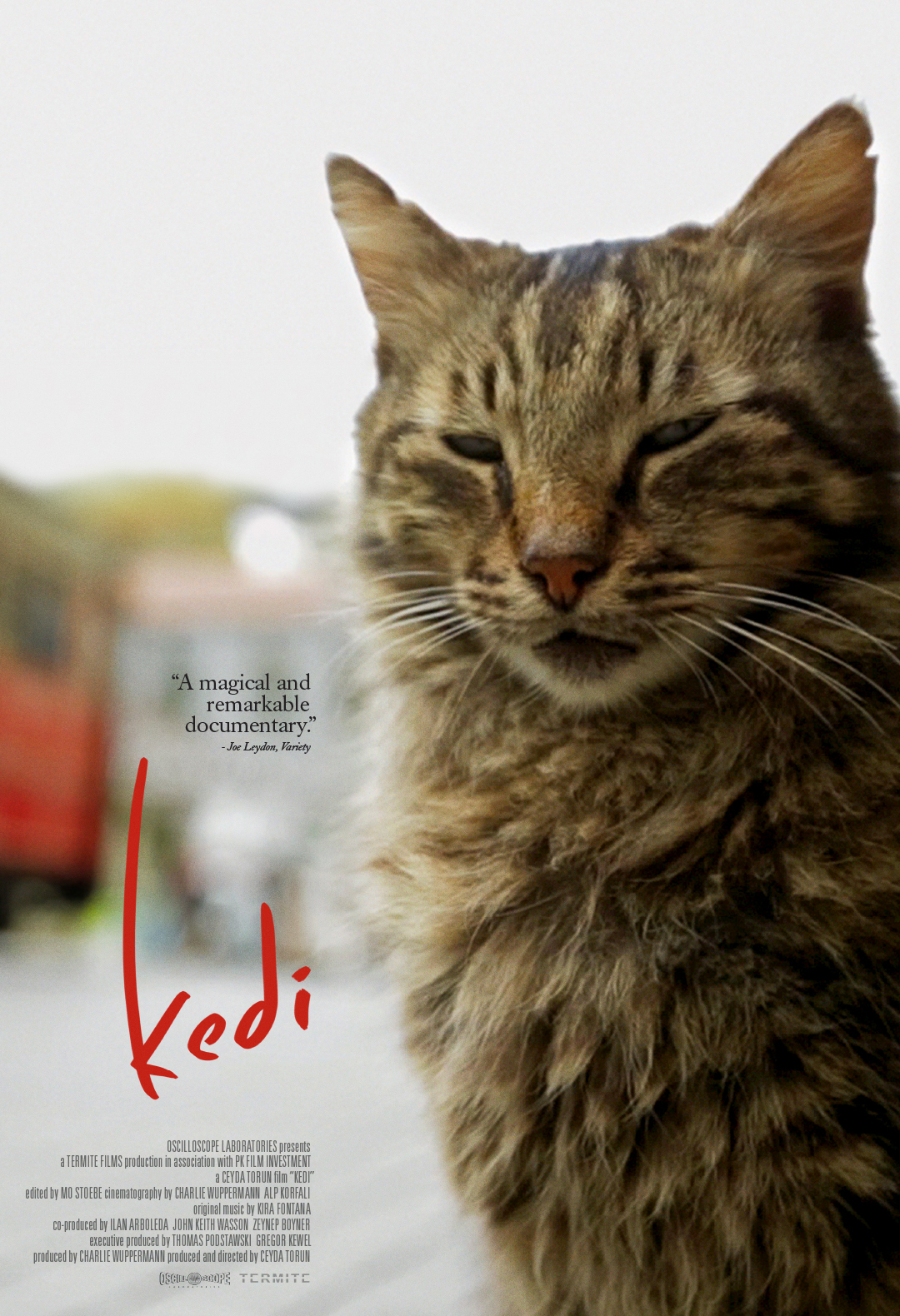
Kedi (2016) - Cats know that people act as middlemen to God's will.


It's the Letterboxd Season Challenge!  Theme eleven, part one - a film distributed by Oscilloscope Laboratories!

(Chosen by me!)

I should like to avoid melancholy while writing this review.  Kedi is exactly the film to get me feeling depressive in the watching, thanks to its documentation of the cats from Istanbul including numerous scenes of people tending to stray kittens and discussing their methods for dealing with death and monologuing about modern developments making the city less suitable for humans and animals alike.  It's enough to inspire thoughts of personal inadequacy and inability to handle a crisis, or fall into the depths of fear towards losing pets and loved ones, or spiral the drain of powerlessness at the advance of progress taking away green spaces and wild places.  I've issues aplenty readily triggered by seeing these sights, and I could very easily dedicate the entire review to a bleak, despairing outlook.  However, while Kedi contains these passages as a matter of necessity, in order to honestly discuss all aspects of life with cats in the Turkish city, it is not dominated by them.  The dominant mode is one of watching and appreciating and loving cats, celebrating all they do, and our role as their companions and caretakers.  If Ceyda Torun has the fortitude to film and edit and present such sad sights, I have the emotional strength to discuss her movie as its own thing, an even piece of documentation whose highs are equally worth discussing as its lows.

What makes Kedi so special a film, worthy your consideration beyond offering eighty minutes of cats running around doing their thing?  Universality, I think.  Between the structure built around a glimpse into the daily lives of seven different cats throughout the city with plenty breaks to trace the non-central players as well, the interviews with the people most familiar with these four-legged inhabitants, and the wide scope Torun and her crew trace across Istanbul, Kedi imparts a strong sense of kindred spirithood across the distance.  Of finding feline personalities similar to those we know wherever we are, of applying personhood to the cats and thinking of them as we would any other neighbor, of feeling an ethical obligation to ensure their health and safety, of balancing the scales between getting so little in return for so much effort and understanding the nuances of their affection for mutual benefit.  Cliched (and untrue if we're honest) as it remains to call love for cats or any other companion animal the one global constant across all cultures and walks of life, the film is inclined to make anyone who loves cats believe the idea by virtue of showing us so much.  A man breaking off an interview to take an injured kitten to the vet for emergency help, a woman with depressive issues talking about how caring for the alleycats in her neighborhood proves therapeutic, a sailor alternately discussing the history of cats in Istanbul and wondering at their supernatural side, numerous off-screen narrations describing the personalities they find in the local psychopath and the ladies' cat and the social butterfly and the conniving thief - amidst it all, you're liable to stop and say, "Hey, I've known/know a cat like that!" or else, "I've done that/thought like this before!" and the distance between you and Istanbul becomes a vacuum and collapses instantly.  Might not work for everyone, but it certainly worked for the whole watch party last night, and worked constantly.

There is, I've seen, some debate as to whether the inclusion of the human interview segments dilutes the film any, takes away from the potential of a work purely dedicated to watching the cats go about their business free from interpreting voices.  Being as great a lover of purity in form as I am, I can definitely see the argument, and think it has merit.  After all, the universal appeal of cats is quite obvious on the face of it, just by how utterly dominant videos of the same have been in the culture before even the internet - America's Funniest Home Videos and the like.  It would doubtless make a wonderful meditative experience, the only voice the silent word of the camera operators and editors as they guide us through the streets from a cat's eye view.  In total, though, I think the imposition worth it, for the simple reason that verbalizing the humanity the human residents find in the cats is probably the most potent idea Torun advances through Kedi.  To find human traits in the non-human animal is, of course, a quirk of the human condition, a somewhat ridiculous extension of useful traits that proved adaptive to survival many millennia ago.  We all do it, though, because lifelong/generational proximity is bound to engender such thinking patterns, and while we might agree this or that cat has this or that personality from simply watching, part of the point is that vacuum collapse, and one feels certain in their thinking far better if another speaks and confirms yes, I do think this cat is a little clingy, or a bit of a troublemaker, or very suave for a cat.  In effect, we need the humanity of the people as they commentate on the humanity of the cats to find the commonality across it all just a little bit clearer.

You run the risk of losing common agreement when you go the tone poem route, and despite thinking cats excellent subjects for a tone poem, I do not think Torun's vision for Kedi runs down that route.  It is not merely about the cats of Istanbul, but the cats of Istanbul, and the people of Istanbul, and modern Istanbul itself, as viewed through the frame of cats.  You could focus on them exclusively and count on the resonance of the city and its movements in the background to communicate the same ideas, or you could keep it all in frame and find the unifying whole with an unusual subject at the forefront.  Either choice works, since cats are cats and lovely subjects all the same, but Kedi is only Kedi if the people vocalize alongside their less verbal furry friends, in the same way I only feel right discussing the film in total effect rather than drilling into what strikes me hardest about the watching experience.  It's fine and good to take a single idea and squeeze it until all potential is wrung and a paint can be derived from its contents with which you paint the whole canvas.  It's perhaps more worthwhile (and in my case, healthier) to draw from many sources, and coat the canvas with all you can acquire.  Striking though a solid color block be, the total picture of life best emerges when you consider the joy of a cat leaping from ground to roof in a single bound alongside the human who marvels at their superhuman power, and the lamentations at how they can't do more for the less fortunate.  It's all necessary to get what's going on.

(I do so love Gamsız and his little sideways knock.  Hope he and all the other cats are still doing fine four years on.)

Sunday, April 19, 2020

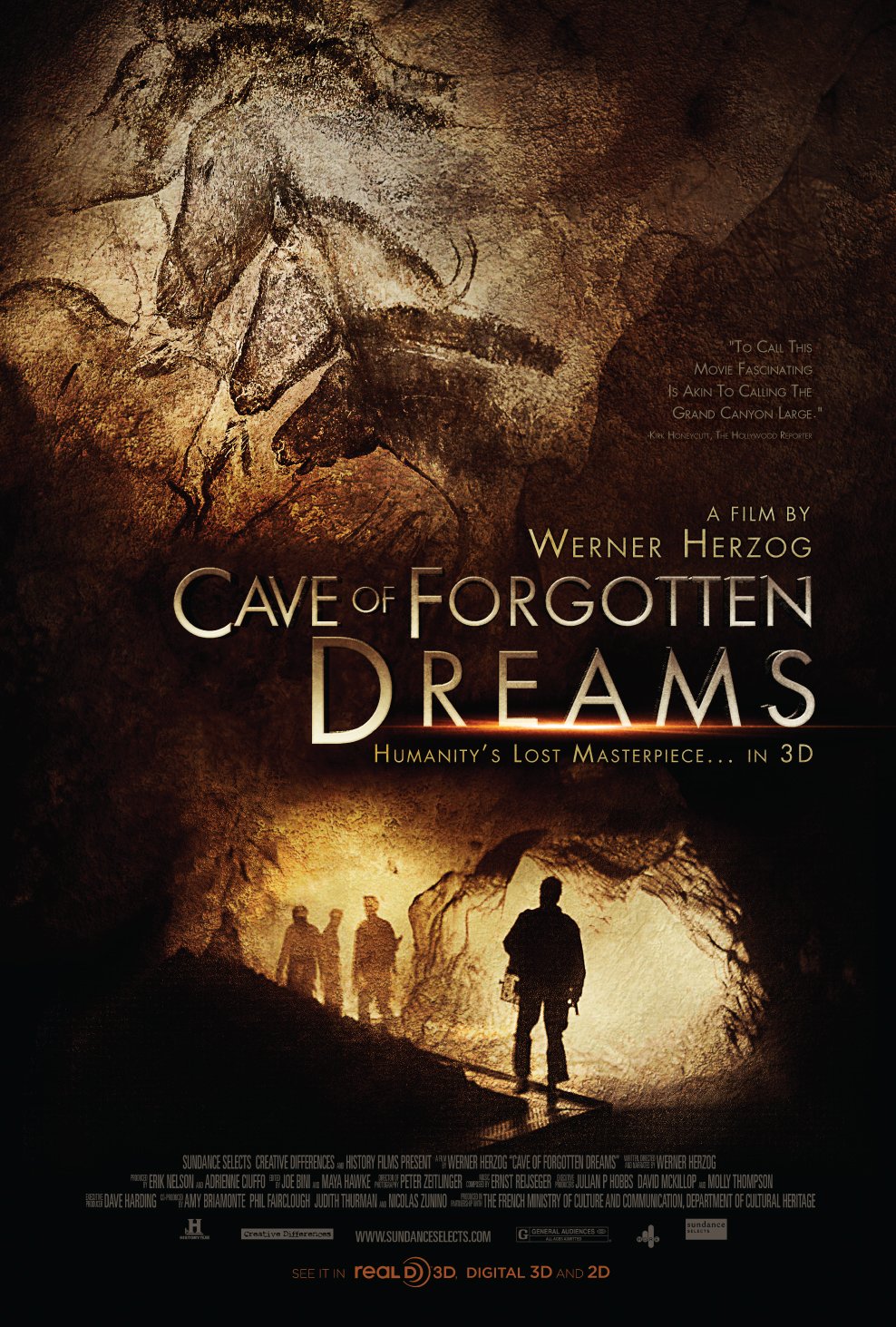
Cave of Forgotten Dreams (2010) - There seems to have existed a visual convention extending all the way beyond Baywatch.

Extra Large Movie Poster Image for Cave of Forgotten Dreams (#1 of 3)

It's the Letterboxd Season Challenge!  Theme ten, part three - a cinéma vérité film!

(Chosen by John!)

Let's not make the whole, "Well this film isn't good, proper, Christian cinéma vérité in the true sense, but the list said it was and we stick to our picks," thing a little postscript at the end.  Let's address the matter right up front: director Werner Herzog is not one to embrace the theory of observational cinema.  When he's crafting fiction, he is determined to leave his thumbprint on the work prominently as possible with his often unsafe working practices and method of handling actors; when helming a documentary, his unique, strangely compelling voice is perpetually at the forefront, and we are given constant reminders of how there is a camera, and lights, and a crew, and the person of Werner Herzog involved in every stage of production.  He will not vanish into the background like a fly on a wall, and indeed noted his belief that a director should instead serve as a hornet constantly attacking their subject in an interview chronicled by the New York Times around Cave of Forgotten Dreams' American release.  We have, to all appearances, chosen a film whose contents scantly reflect the tradition of an invisible camera and subjects captured in perfectly natural surroundings.  As he notes, by virtue of the Chauvet cave paintings' depth within their cavernous home both upon initial creation and after a rockslide buried the initial entrance from view, one cannot appreciate them without artificial light, be it from a torch or stage light.  Herzog and his crew at first cannot stand in this space without accompaniment from researchers well-versed in the safety protocols and history behind the cave, and because they are along for the ride, we are going to hear more than plenty from them throughout the film, their words addressed directly to Herzog and the camera.  Peppered throughout we find many vignettes showing the work towards digitally mapping every inch of the cave, inspecting reproduced artifacts from nearby sites in a museum, talking of ancient hunting practices and music and sniffing for cave scents.  Cave of Forgotten Dreams is anything but cinéma vérité, moreso than High School owing to Wiseman's disdain for the term, or Man with a Movie Camera due to Vertov predating the very idea.

And yet, for all this, Herzog does employ techniques we might call purely observational.  At a few key points throughout and most prominently for the climax, he ceases his speech, banishes all persons from the frame, and chooses to only film the paintings in all their preserved beauty.  It is of course impossible to say there's NO intended influence from the director or crew in these passages - he places so much emphasis on the importance of light in making the animals on the walls dance and move in a proto-cinema earlier in the film, it's impossible to ignore how his own lights shift across the rockface - but by comparison there is no guiding hand musing about the nature of those who came here before, no expert detailing why certain images are so fascinating.  When we come down to the matter, it is simply us, the painted animals, and the temporal distance collapsed to zero.  One expects this in a documentary cave paintings, naturally.  If you're gonna take a camera into a fragile location sealed off to all save a handful of experts, you'll eventually stop talking and show what you've found to show.  Why make note of Herzog staying quite when anyone with even the tiniest awareness of how incredible it is to find a direct link to a moment and people 32,000 years past would keep their trap shut?

I do so because I think, despite Herzog's disdain for observational cinema and his tendency to make knowing Werner Herzog is behind all this a top priority, his limited use of observational techniques here is more effective for their sharing time with his usual methods than they would as a total work in themselves.  Pan the camera across the walls, let us appreciate the paleolithic artwork, and it is all awe-inspiring, yes, but the context is so much more.  The paintings become more incredible when someone who knows what's up explains how we can trace the journey of one particular painter through the tunnels thanks to his crooked little finger, when we are given cause to deliberately contemplate the fragility of the calcite structures, when someone explains the limitations that prevent us from getting a full look at an angularly protruding stalactite with a union of woman and bull painted round its circumference.  To follow the archaeologists and art historians and geologists and even the strange perfumer fellow who's determined to find new caves by identifying their musk and following his nose is to gain necessary knowledge, place a specific idea behind WHY we find these images of hunts and wilds long extinct so compelling.  Equipped with this understanding, when we are finally left alone like Herzog and his crew in the furthest confines of the cave, with only these ancient paintings before our eyes, we are able to draw on that which we now know, consider them more fully, and feel our unnamed hypnotic compulsion to look and drink and be one with our ancestors coalesce into an informed sense of commonality.  For my part, knowing more about how they took advantage of the texture and contours of the cave walls sharpened my appreciation for how their tableaux takes on the appearance of a plain observed from a high place, certain features tangibly in the distance, others obscured by foliage and rock formations and the like.  It became a true window into another time, thanks to my learning how and possibly why it was made this way.

 My regular readers will note I constantly harp about purity of form when it comes to movies, dolling out greater praise for works that achieve in one particular manner to a sharpened peak.  While my aesthetic preferences will typically swing this way, it's important to note the equal strength found in a marriage between disciplines.  The tradition behind cinéma vérité, when coupled with a more usual form of heavy-handed, carefully guided documentation, can reveal untold truths about the subject when we finally do back off and look with nothing more than mechanical eyes.  With regards to the Chauvet cave and the paintings within, I wonder whether a more adamantly observational director, interested only in filming the walls, could have captured the same sense of compressed time Herzog manages here?  Learning as we do before our time with light against ancient paint and older stone grants the paintings a stronger sense of humanity, some more visible image of an early homo sapien crouched before their work, bringing it to life before our eyes as we puzzle out their thought processes, their intents, their dreams.  Would the cave speak so legible a tongue if presented on its own, or do we truly need all Herzog includes as a Rosetta stone?  Furthermore, could this explain why Herzog chooses to focus on the albino crocodiles in a nuclear power plant-dependent jungle enclosure several miles away?  After all, the crocodillians will not have any guides or experts to inform them about what the paintings could mean or why their creators chose to draw them, anymore than the tourists in Lascaux would in the days those paintings were open to a mold-breeding public.  In an artistic, anthropomorthized sense, when they see what we see, free from intellectual guidance, will they too dream of the horse on the open plain?

Do Crocodiles Dream of Wild Horses is the name of my new album, look for it on store shelves.

Sunday, April 12, 2020

Man with a Movie Camera (1929) - An experimentation in the cinematic communication of visual phenomena.

Mikhail Kaufman, Elizaveta Svilova, and Dziga Vertov in Chelovek s kino-apparatom (1929)

It's the Letterboxd Season Challenge!  Theme ten, part two - a cinéma vérité* film!

(Chosen by Jackie!)

Dziga Vertov so believed in cinema, he renamed himself for the camera's motion, from the Ukrainian for "spinning top."  His faith in the mechanical eye's ability to capture actualities as they happened, free from any need for characters or narrative, formed the basis for his goals in Man with a Movie Camera.  The three-year project was to serve as a revolutionary cry in support of cinema as the modern art of the people, an artform capable of capturing an entire city in motion without resorting to the techniques of theater or literature, or indeed any medium other than the purely cinematic.  Per the conventional wisdom, he succeeded in his aims while failing to reach the public, crafting an experimental piece of pure filmmaking the likes of which have rarely, if ever, been equaled, just unfortunately timed to release after Battleship Potemkin made a Soviet realist approach the popular mold at home and abroad.  He was, tradition holds, a man fighting the whole weight of narrative film with something completely detached from narrative.  To my eye, however, watching Man with a Movie Camera reveals Vertov failed in even this respect, for his film does adhere to a three-act structure, does communicate in the language of those who came before.  I do not count this failure as a failure he could have avoided, though, nor a failure that speaks to Man with a Movie Camera falling short of its primary goals - rather, I consider it a demonstration of how handily Vertov illustrated the possibility for a moving image to speak the human tongue, and ultimately be a human art.

Let me explain.

The film proper begins with a movie camera atop a movie camera, and the theater's patrons settling into their seats as a projectionist brings the house lights down and the projector to speed, but the first we see of our true subject denies motion entirely.  Our city in the morning is asleep, the rich and poor alike in repose in their quilted bed and bare park benches, the storefronts speak to no one, the great machines all still and quiet.  Trace of activity attract attention ever so slowly: the early risers walking the streets, the pigeons aflutter in the air, the man with the movie camera trotting the landscape and preparing his shots for the day.  With time, the residents rise and busy themselves with freshening and dressing for the day, some already tirelessly working as others blink sleep from their eyes and reluctantly go through the motions.  Even the camera must take time to adjust to the light and focus on the right details and keep its shutter open.  Soon, the traffic begins, workers appearing from nowhere to ready the planes and trains and automobiles, beginning the day's delicate balance of a thousand vehicles narrowly avoiding ten thousand pedestrians.  The pace of life is not entirely even, for the shopworkers have the luxury of sleeping longer than the street cleaners and and transit operators, yet they too must rise and prepare for the day as the machines that truly power the city are brought to life - these, it must be noted, show no hesitance, instantly springing to life and achieving full speed within seconds.  Inside twenty minutes, Vertov and cameraman brother Mikhail Kaufman have brought their subject to its full swing, the camera tracing Kaufman as he places himself in out of the way places to get the shot, slipping under barreling locomotives and perching atop moving cars and walking against the crowd and climbing to high perches to find just what he needs.  All is as it always is...

...and then we transition with a stop.  We move from establishment to exploration with a moment's consideration for the editor, Vertov's wife Yelizaveta Svilova, as she holds the celuloid in its raw, unmoving state, and brings it to life with careful cuts.  Initially an invisible hand taken for granted, we will see her numerous times throughout the remainder of the film, keeping us firmly aware that someone must make these images dance as they do, in addition to our existing awareness towards their place in the movie theater and their selection by someone holding the camera.  The kino eye IS perfect in capturing exactly what it is set to capture, exactly as it is before its lens, but it is nothing without those who operate and discern.

Speaking of operation and discerning, we come to our second act, exploring the city's operations.  Vertov contrasts images more here than at any other point in the film, and it is interesting what he chooses to contrast in what order.  The usual choices are right up front, the camera swiveling atop a balcony to capture marriage and divorce at the same instant, a baby's birth and a man's funeral, the celebration of new beginnings and the mourning inherent to passing.  From this lofty comparison of ultimate extremes, he suddenly finds interest in that delicate balance again, positioning the camera between trams and atop trains and at intersections to capture how readily accidents COULD happen, and how narrowly it all speeds on, even tilting mirrored images towards one another to squash Kaufman between passing vehicles with barely an inch to spare - and then we take a minute or two to watch those who ARE unfortunate enough to take a hit, and the rescue and medical services which follow.  Necessity must compliment indulgence, so we next turn our attention to those who partake in leisure and service during working hours, and intercut them with those who package and craft and toil to keep the same functional.  Notably, halfway into this sequence Vertov starts prominently cutting Svilova's editing process in place of the other workers, arguing for the act of movie-making as laborious and necessary a task as wrapping products and tending weaves and minding traffic.  He does not, I think, places these images against one another to imply conflict, for the laborers are shown to enjoy their task just as much as the patrons do their constant repose, and he does them great kindness by then placing them in complimentary positions against the act's grand finale, the thunder of machines.  Mines, forges, power plants, enormous dams, the necessary lifeblood of the modern metropolis, all captured at the height of their operation, tunnels and pools and rushes of water so great they darken all but themselves... and still, the workers and the man with the movie camera are distinctly visible, their actions presented as essential to the continued movement of it all.

And so we stop again, if in a less jarring way than the sudden freeze frame of the first transition.  The factory workers power down their machines, the laborers put down their labor, and the whole city moves to a third act, one of leisure and play.  We engage ourselves at the beach, the track, the amusement park as the people magically fade into their places naturally as you please, and Vertov becomes endlessly fascinated with their activities.  On those who partake in sport, he makes time to freeze on their most dynamic action, capturing both the total motion and the instant of the human body in peak exertion.  The beachside visitors he photographs simply for their own sake as people.  We watch as many become purposefully dirty before washing off at the same instant, see the children enjoy a magic show as the dancers kick and the track stars hurdle and the carnival-goers shoot and the  motorists ride, the millions upon millions doing as they please with the hours they are given.  Through it all there is the man with the movie camera, Kaufman towering over the tallest buildings and rising from unlikely places to get his shot, the great mechanical eye capturing reverse games of chess and excess drinking at the bar from whatever angle is needed.  As the editing grows faster and the images of the day's activities begin to blur into one impression of pure movement, even the camera takes a break, gamboling an awkward dance atop its spindly legs free from the operator's influence.  At this point, we might expect the film to end with another stoppage, watching as weariness sets in and the city goes to sleep, resting for yet another day of weeks of months of years of this endless ballet we call life.

But Vertov does not stop.  The city does not come to rest.  Instead, it splinters, magnifies, kaleidoscopes into many.  Numerous complimentary views fill the screen all at once, reflections of the city as the every-city, the images we have seen before folding on themselves to become the all that is one.  Rather than halt, the city ascends, returning us to the movie theater to watch as it becomes the very nature of the film before Vertov's audience, before, as we might assume, every audience.  The city IS the art, and as we can see by way of Vertov positioning Kaufman as a giant filming his subjects on the screen one last time, so too are those who create such art.  While the kino eye is great, we have already established its limitations, and here we see this expressed in as literal manner as possible: Kaufman's filming as part of the film itself, and the final shuttering montage of Svilova cutting cut itself with the audience, the film, the cameraman, the camera, until we reach our last, enduring image of her eye within the camera's eye.  It must, Vertov argues, all be one.  The city, the people, the subject, the camera, the operator, the director, the very idea of cinema as the modern art - by their total nature as solid, true subjects before the camera's eye, the mechanical and human alike must BE cinema, nothing more, nothing less.

Vertov, I think, fails to make his point in as pure a manner as he hoped because to tell stories in the mode we are conditioned to understand stories is as much part of what he wanted to capture as the city free from story.  Stripped from all but the barest framing device, however, I also think he makes his point as beautifully as he could possibly have done.  Man with a Movie Camera both is and isn't film freed from all that came before; it answers to the master of segmented structure same as any other tale, while performing under this one remaining constraint as only a movie can, through the contrast of living images and nothing else.  Failure here becomes success, proving his point in a more roundabout manner than his own preferred firebrand manner, and in the process becoming a piece of motion picture-making appreciable to any eye.  He truly makes the photoreceptors of glass and viscera one and the same, the idea of a city and its people as they are the natural subjects for both to consider and subsume, and I would even go so far as to say he does so to such great effect as to make the eventual dominance of narrative cinema something in line with his views.  His techniques here became the basis for so much of the cinematic language as we now speak it, whether directly taken from his visual text or recreated by others further on down the line; regardless of the moving picture lacking so clean a cut as he fought towards, the form is distinctly its own entity according to the pattern he illustrated all the same.

(*Which, again, it's not really cinéma vérité, predating the concept as it does by a good 40 years or so, but we chose what we chose from our list, and some of Vertov's views on the camera as the perfect objective eye do fit with the "fly on the wall" idea behind the movement.)

Saturday, April 4, 2020

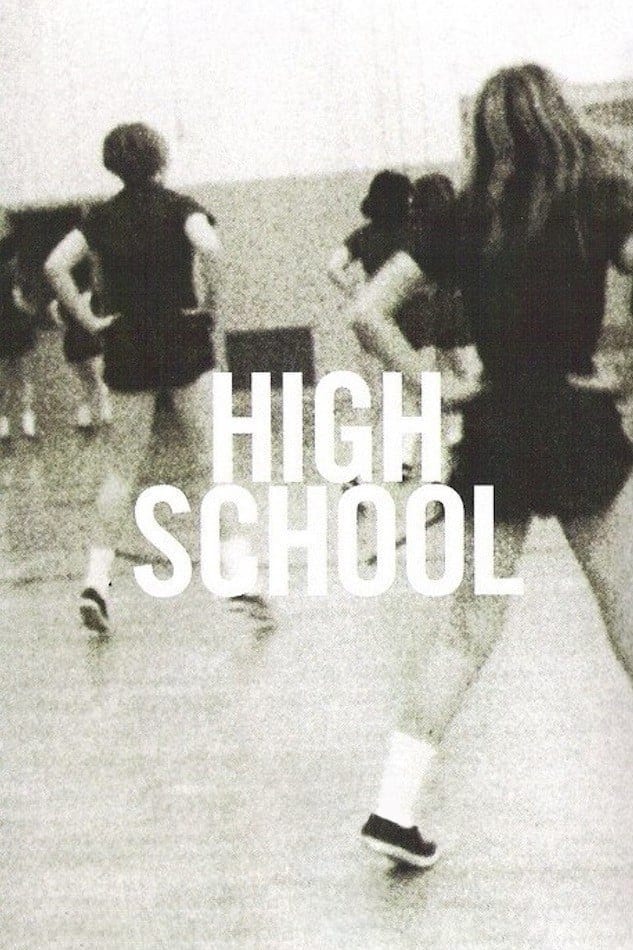
High School (1968) - It's against my principles, you have to stand for something.


It's the Letterboxd Season Challenge!  Theme ten, part one - a cinéma vérité* film!

(Chosen by me!)

The uniting theme of discussions about Frederick Wiseman's 1968 documentary High School typically holds Wiseman shot and edited the faculty of Philadelphia's Northeast High School to argue they less teach their students the assigned curriculum and valuable skills for independent living, and more constantly drill and drone and degrade with the end goal of producing uniformly gray members of a conformist system.  Some arguments further advance this notion by noting how the film takes place against a backdrop of the counterculture revolution and growing dissatisfaction with the war in Vietnam, and construe intent to paint certain amongst the teachers and disciplinary staff as doubling down on their usual techniques in the vain hope of halting the crushing tide.  It is an understandable perspective to adopt, both in face of how Wiseman presents ample scenes of students trapped beneath apparent doubletalk and quickly escalating punishment and the endless bore of great poetry made bland by bad reading, and how the 1960s carry a commonly accepted Identity in the generally held western world and the United States in particular.  This was a time of Unrest, of Change, of the youth who'd seen a rise in visibility and souring of temperament over the preceding decades finally coalescing into a Movement - whether you're living through the moment as with audiences and critics of its day or watching from a distance as now, the image of a teacher reading private correspondence from a student convinced they'll die in Vietnam against that student's expressed wish for privacy within the letter, and then claiming their success as a grunt destined to die in some anonymous jungle is proof High School works conjures the image of a system that's either failing its intended goals, or meeting them perfectly.

I understand these perspectives, and I agree Wiseman's film is cut and presented to drive the idea firmly as he can manage.  His vignettes are carefully chosen and placed in relation to one another with visible intent of wearying on the strength of collective memories within similar halls and against similar authority figures.  High School is a film sympathetic to the teenager in all of us, the person trapped in a sterile, nonstimulative environment for hours of the most valuable years of our lives, wishing the prick at the front of the room would shut up and let us go five minutes early.  It understands your feeling the adults are dead set on grinding every last piece of you from your person with arbitrary rules and unfair detentions and lessons about what a REAL man does, what CONSEQUENCES there'll be in the REAL world if you don't toe the line, how the line and the toeing thereof is the be-all end-all from the moment you graduate to death's door.  I hold it is right for Wiseman and his work to adopt and argue this perspective, for the experience of being in school and blanching against authority is near-universal; even as someone who socialized better with their teachers than their peers and took to lessons so well I'd actively ask for extra work just to keep the mental stimulation going, I've been in the spot of thinking this is all designed to get rid of me and replace that with what THEY want.  You'll clash against authority and find you're not as equal as you'd like in your teenage years one way or another, model student or no.

I hold, however, that a screed against teachers as willing engines of conformity is not all High School contains for the discerning eye.  Indeed, I'm of a mind to argue the film's just as sympathetic towards the faculty and staff as it is the students who struggle beneath their byzantine rules.  Call it a lingering niggle of doubt born from liking my instructors better than the people who'd shun or belittle me, but I cannot believe the high school experience is truly MEANT for such grinding with individualism as the meat.

One has to understand, the film shows Northeast High School as an unpleasant environment for anyone within its confines.  The only people who show a spark of humor or vibrancy are those who don't have to call its blank white brickwork and uncovered fluorescent lights home forty weeks of the year, parents and guest speakers and the like.  The building itself is an unpleasant, confining structure, and the activities going on within are repetitive by nature, necessarily so if a student is to hypothetically retain any information.  Thing is, while we are only shown a lesson or so per classroom, a single meeting of a club, a few handful of shots in the gym, a limited glimpse into the most telling examples of teachers and administrators failing to reach their charges, you must know, from common experience, there is so much more we don't see.  Lesson plans repeated across days, the same faces week after week, the same lessons year after year.  Routine serves as a millstone for those who have to enforce it as well, because there are still people responsible for said enforcement, people who must balance the nightmarish task of imparting information in an interesting, retentive manner, and remaining distant enough from their pupils to act accordingly when a stronger hand is needed.  Both the English teacher reading "Casey at the Bat" in a monotone that robs the poem of all life, and the English teacher trying to make learning cool by teaching Simon and Garfunkel's "The Dangling Conversation" and failing to roue any interest fall prey to the same problem - this environment is not good for anybody.

How could it be?  The United States model of education asks the impossible of those who serve at its whim, to perform as robots while remaining available as a thinking emotional creature when needed, to educate a body of hundreds while thinking of each unit as a person worthy attention and nurturing, to do this until you can perform no more and yet never show signs of fatigue.  The teachers and faculty here can only look bad before Wiseman's camera, for the easiest, most natural response to such conditions is to do whatever you can to get through the goddamned day.  It'd make everything so much easier if nobody piped up or made trouble, if everyone just did as they're told and marched through freshman to senior years without requiring special attention, if those who DID require special attention were dealt with quickly and easily so you can get onto the dozens more who require the same today alone.  All this against a backdrop  of barren walls and glaring lights and prison-like air and the knowledge you'll have to keep coming in again and again and again, that if you leave to do anything else either someone will replace you and endure the same, or no one will and your colleagues will struggle to pick up the slack.  A drive for conformity, I think, arises not because anyone particularly wants to live in a world where marching in lockstep and speaking as expected when expected and thinking authority should not be questioned, but because we've all inherited into a situation so difficult and grinding and so very terribly samey that trying for control is perhaps the response requiring the least effort.

It sucks.  It does.  For everyone.  Understandable as the reaction is, the students are the ones who suffer because their instructors are pressured until they too ask the impossible from their charges, which is the real tragedy of the high school experience, which is why Wiseman's High School is the way it is.  To balance his film between the two perspectives would lose the raw expression of what it feels like to endure these conditions and lessen the youthful drive to push back and be new and different and stubborn on purpose, yet to leave the limitation of its present state with regards to how the situation comes about in the first place unacknowledged is wrong to my mind.  It'd be ever so nice if I could conclude here by saying the solution is and always will be greater mindfulness about what the easy road will do to those around and below you under strenuous circumstances, for those in charge of education to give it their all every single day to the last and fashion a better environment.  Aware as I am, though, of the ever-diminishing value of education by those in power above our instructors, of the constant underfunding across the country, of how even with maximum effort there ARE the bad actors who want to exercise power and genuinely do see the goal of education as the production of unthinking drones subservient to the whims of those who'd use them as gears in a revenue-generating machine or pawns in a holy war... I cannot make such a suggestion in good faith.  Best I can say is we should ditch those enclosed buildings and make the switch to open-air like the schools I came up in, because honestly, so much of the oppressive environment comes down to not getting any goddamned air or sun between classes, students and teachers alike.  Can't bear the thought of working there for decades on end.

(*I know Frederick Wiseman prefers the term "observational documentary" for his films, but the list we were linked to as example includes it as an option, so we're sticking to our guns here.)

Saturday, January 25, 2020

Hoop Dreams (1994) - This whole thing is revolving around money.


It's the fifth Letterboxd Season Challenge!  Theme seven, part one - one of Spike Lee's essential films for aspiring directors!

(Chosen by me.)

Some personal context: I ran cross country and track in high school.  Had done so since middle school on recommendation from my parents I find some extracurricular activity, and kept at it until graduation through sheer inertia.  I'd run all through the last few years and somehow not quit, why stop now?  In retrospect, sticking it out was a poor idea, because bad experiences with the team, my coach, my self-esteem, and pretty much anything and everything related to running now comprise the majority of my memories about high school, and play a big part in my reticence to think about that period of my life as anything other than an amorphous mass I wish hadn't happened.  Snapping in the middle of a race and trying to punch a teammate for cheering me from the sidelines, trying in vain year after year to stop the team from hazing new members, almost getting pushed off a cliff during a practice run as a joke, undergoing multiple breakdowns at running camp that probably predicted my more extreme breaks in university, the generally poor recurring impression of someone yelling at or lecturing you for not trying harder when you'd genuinely given your all.  Doubtless there are good experiences in there too, of managing a personal best sub-11 minute two mile race or briefly feeling like part of a cohesive social unit, but it's all overwhelmed by the lingering echo of being flat-out told my life would go nowhere because I didn't get an athletic scholarship for college or getting practically run over by a crowd eager to cross the course without considering the person running last place.  I do not like being reminded of my high school athletic career, and would much prefer it fade from memory entirely.

So, for my part, Hoop Dreams plays as a three-hour protracted reminder of such, and I need to power through these personal issues to discuss its contents.  Regardless of differing circumstances, many of these images and incidents resonate nonetheless.  William Gates' summer sporting camp was a prestigious recruiting program for potential college talent where mine was something run by friendly coaches to keep the team bond high over break, but the sense memory of being angrily lectured over how you have to meet your potential or else you'll amount to nothing stings all the same.  Arthur Agee shows far more potential as a varsity player on his basketball team than I ever did as a member of the JV squad for cross country, yet I still remember the pressure to perform academically and physically.  I never had a talent scout single me out as special while their entire story is predicated on such potential uplift, I took well to study where they struggled, I came from a financially and emotionally stable household where they both felt the impact of poverty around the corner and frequently absent fathers, I'm white and could treat sports as just a thing to do, they're black and got caught in a system where sports were presented as the only avenue to personal advancement.  And despite all of this, despite my lack of serious injury and promise of greatness and any direct parallel beyond "I played a sport in high school," the recurring sight of their coaches getting aggressive in a heated moment was enough to make the majority of Hoop Dreams a very much unwanted trip down Traumatic Memory Lane.

Let us therefore set all this aside, and discuss Hoop Dreams on its own terms, for it is still a remarkable feat of documentary filmmaking that deserves consideration beyond the context of my baggage.  This is, above all else, a remarkably empathetic picture, one originally conceived as a thirty-minute television program for PBS before producer/director saw the potential in his subjects' story well beyond his original commission for a piece about playground basketball.  Such an expansion in scope could easily become like any other documentary following a promising or interesting subject through an atypical period of their life, either fully focused on the subject to exclusion of all else, or filtering other people in their circles as relevant only in how they relate back to the main story.  With Hoop Dreams, James and his crew took advantage of their increased prerogative to film and edit a view into high school athletics and black urban life with an eye for giving everyone in the story a say.  One can be cynical and claim Spike Lee lists this as an essential film for personal reasons (he pulls a brief appearance as a speaker at Gates' summer camp, and audio from Do the Right Thing appears on a radio program), but I believe any aspiring directors should take the film's commitment to a complete picture to heart.

Our core focus is very much on William and Arthur as they are accepted to the prestigious Saint Joseph High School on the strength of their basketball talent, only for William's skill on the court to earn him a sponsor who helps him stick it out to the end despite debilitating knee injuries andnear-misses at greatness, while Arthur's supposed lesser potential costs him a scholarship and forces him back into public education with the private school holding his transcripts and future hostage.  Despite more than half of the story's timeline playing out in the first thirty minutes before James received a grant for true larger scope filming, the film makes the most of its glimpse into these four years by expanding its focus beyond whether or not William and Arthur will perform well in their respective leagues and graduate on time.  It is as much their story as those of Emma Gates and Sheila Agee trying to keep their families afloat amidst long periods of unemployment and uncertain marriages, as of Bo Agee's struggles to stay on the right side of the law for the sake of his wife and children, as of William Crawford attempting to live vicariously through his son's achievements, as of William's girlfriend Catherine and their newborn child.  Its concerns lie not only in the realm of success on the court, but on the exhaustion and frustrations inherent to an underfunded education system, the dual-faced nature of private schools' supposed altruistic uplifting, the unfair pressure to perform, the difficulty of accepting something less when you were promised the world, trying to be more than just your valued physicality.  It will ask and explore questions of just how fair its entire premise is when considered against the value of more substantial social reform just as readily as it will buy into the dream of making the NBA as something worth watching every shot of the semi-finals over.

And importantly, vitally, it does not make villains of its participants, nor martyrs of its subjects.  Regardless of how often Bo slips back into near-compulsive crime, were asked to understand him as a man trying to do right by his family, not a failure or criminal.  William Crawford's relationship to his son is more tragic than disgusting, as we see him a man who missed his shot and never found his center again.  Coach Pangborn of Saint Joseph's is a far, FAR more aggressive, abrasive coach than Coach Bedford of Marshall High, and Bedford's accusations of Pangborn screwing over Arthur because he couldn't profit off the boy as much as he'd have liked land hard and true, yet we also see enough of Pangborn's function as head coach and lead staffer at the private school to understand he goes through such a story with every potential talent he encounters.  There are actions aplenty to flay these people alive over, and justifiably so, if only doing so wouldn't cost Hoop Dreams its vision of William and Arthur as kids doing their best under less than ideal circumstances.  Even without knowing as we do now that neither achieved their golden dream of matching Isiah Thomas and playing for the majors, the film places careful emphasis on how important it is they live their lives according to what's best for them now and in the future, and not forever wallow in the bog of what might've been.  To demonize those who let them down or complicated their lives would be to consequently place shine on them beyond just being teenagers doing their level best - make Pangborn or Bo look worse through open condemnation, and you place William or Arthur on pedestals above what they are.

Certainly, through its willingness to present just how needlessly harsh and punitive student athletic programs can be towards those they tempted with promises of glory, Hoop Dreams isn't at all wishy-washy for its refusal to condemn.  I mean not to claim it thinks the systemic or personal wrongs it observes and presents as guiltless or morally neutral.  Rather, I mean it refuses these moral judgments out of fidelity to the goal of completeness.  Everything here is meant to come across on the same level of persons grappling with their own issues, never invalidating those who cross its camera or implying their personal benefit or punishment would meaningfully change things for those caught in the same situation.  There's temptation aplenty over the course of three hours to find someone who can play the bad guy, and yet we reach William and Arthur's graduations with a lasting sense of these lives as nuanced REAL lives.  All will continue on best they can, regardless of where the road takes them (or took them, in the case of those gone too soon in the following years), and make what comes  their way into worthwhile lives all the same.  Dreams of stardom can motivate one to reach beyond, it it's important to take what you actually grasp no matter what it is, and I believe Hoop Dreams imparts this with a successful totality of purpose better than most documentaries.

It's a withering, difficult film for me thanks to my excess high school baggage, yet I believe it hits so hard precisely because its rounded, detailed portraits of all participants shortens distance and makes the commonalities stand out all the more.

Thursday, January 2, 2020

Limite (1931) - How would you feel if I told you she had leprosy?

Letterboxd Season Challenge 2019-2020!  Theme six, part one - a South American film!

(Chosen by me!)

A preface: Limite shall not receive a numerical rating at this review's conclusion.  Though claiming, "You watched this movie wrong!" is typically anathema to my perspectives as a critic and film fan alike, reviewing my own reactions as the film unfolded led me to believe I did exactly this.  Per the Walter Salles video essay accompanying the film on Criterion Channel as of this writing, director Mário Peixoto came from an artistic background steeped in poetry and the numerous experimental film movements across Europe in the 1920s before anything we might consider the typical narrative cinematic form.  His goals in creating Limite thus reflect this by placing emphasis on mood and movement far above any semblance of story in the manner of so many arthouse pictures, though it is not entirely a clean break.  To make a quick comparison against Tabu and the larger F.W. Murnau oeuvre, where Murnau would use a subjective camera and non-literal filmic techniques to suggest more spiritual passages or plunge his world into total otherness whilst still telling a story, Peixoto deploys what few narrative elements he has in complete subservience to the emotional thematic explorations on-screen.  Someone with more modern expectations of how films with narrative passages function might see these moments, and feel inclined to extrapolate narrative structural intent where there is none.

Or, put in simpler terms: the framing device with the boat threw me for a loop, because I thought it was going to be important to discern how each of the three silent, morose passengers came to be there, and spent more of the movie trying to puzzle out a beat-to-beat structure than appreciating the imagery and poetry Pexioto conjures.  Limite is an incredibly difficult movie to sit through with this mindset, as its many exploratory and experimental passages come to feel like lengthy distractions that drag longer than one would like.  Fortunately, I came to appreciate the film's actual intent further into the picture, but by the time I did so, I'd become fidgety and somewhat agitated, and so know I did not get the full and proper Limite experience.  Trying to assign a rating under these circumstances would lead to an unfair and uninformed numerical score, one which threatens to stand out more than anything I have to say.  So, on this understanding, I'll spend the rest of this review trying to communicate my analytical perspective on what Limite is an how it functions, and hopefully we'll get something more worthwhile from the exercise than me focusing on how I was, in a word, more bored than I'd've liked while watching.

So, that framing device.  After we see a woman gazing into the camera with rough, handcuffed hands round her neck, visions of a distant, tumultuous sea dancing before her eyes, we fade (as we do for numerous shots across the whole film) to a ramshackle rowboat with three people inside, a man and two women.  The man is perpetually bent over in contemplation, occasionally accepting something to eat or sharing a glance with his companions, but primarily affecting an air of one who wishes to never talk again.  The first woman, dressed in white, though occasionally animate and friendly, soon comes to turn her back against her fellow seabound captives, and stare out at the waves without showing the camera her face for most of the film.  The second woman, this one in black, lies on the boat's floor for much of the introduction, soon comes to sit next to the man in much the same pose, though she seems somewhat distressed by how the first woman will not make eye-contact.  Towards the end of the film, the man spies something in the distance and dives off the boat to chase after it, and following a montage of foamy waves breaking against the rocks and one another, we find the first woman clinging to a board from the capsized boat, with no sign of her companions, or any human life for miles around.

The above represents the entirety of what Limite communicates about its characters in the framing device.  Over the course of the first hour or so, we learn the man was a fisher who fell in love with another man's wife, the first woman was an escaped convict, and the second woman left a dissatisfactory marriage.  This, now, represents the entirety of what Limite will tell us about its characters, for their attempts to recollect their experiences clash directly against the film's theme.  Oftentimes when we follow them into their memories, we will trace their steps as they traverse long distances, only for the camera to get caught up in panning across a recently logged stretch of forest and have to jog back a few paces to find its subject crouched and weeping by a gate, or else wander away from their perspective entirety to focus on the wavering of a half-blown-away dandelion.  Our camera is happy to sit behind one subject as she stares into a lake that appears to be a sky, only to go whirling through the air the second her attention is the tiniest bit distracted, pulling alley-oops and loop-de-loops through the sky in a total desynchronization with her literal experience.  Sometimes it will track upwards into the pure white of sky and remain lost there for a good minute, or pan down across the blurred, radiant light from a white newspaper and white dress reflecting the midday sun, or float away from them to view the already striking fauna in the area through a negative filter that bathes all these sharp black objects in a white halo.

These people are not the camera's primary concern in Limite, and yet we always come back to them.  When we do stick around to see what's going on, we find their lives little more than turbulent chaos.  The man streaks through a field in agony, screaming out for someone as the camera rapidly zooms in on his face on the same cut again and again until he's tripping over the grassy hillside and can no longer remain upright.  One woman is glimpsed at a sewing machine, the camera lingering over extreme close-ups of her various tools, before a tight view of her scissor blades finds her sliding a finger across the entire edge, and then cuts to black.  The other spends quite a considerable time trudging along a dusty path, only to confront a man at the top of the stairs with a long, withering glower, before trudging back out to who knows where.  And even still, when the camera bothers with a human perspective, it will leave these characters behind in favor of repeatedly zooming on a fountain hole spitting water, staring up at a pair of might carved crosses, or resting on a train wheel's pivot as it begins to spin away from the station.  As a whole, the film only breaks from purely visual expression to communicate with language a total of two times - once when we glimpse a newspaper headline, and once when the man is told some particular information about the woman he's running an affair with that could only come through dialogue.

All of these sequences, sympathetic to the characters' lives or no, recognizably human or wholly nature-focused, are presented as memories.  Flashbacks.  We fades to and from them from within the rowboat, and when the characters are unable to strike up conversation, set about to paddling anywhere (as one of the woman fails to at one point), or do anything save sit and glower, they resolve to sit and glower and remember some more.  And it must be understood, these are not typical filmic flashbacks, for your typical film will render a memory much the same way it renders literal, immediate reality; maybe you'll get a hazy filter or a hint of an unreliable narrator to differentiate the two states, but on the whole the effect is the same.  With Limite, Pexioto seems determined to do nothing short of capture the entire experience of a memory.

You're a person if you're reading this, you know how it goes.  The way your brain catalogs and retrieves information is not based in pure 1:1 recollection of events as they happened, and a memory is not ONLY the events as you perceived them.  There's a complex tangle of associated emotions, wandering thoughts, trivial recollections, a sense of a wider life lived beyond the context of this one event.  The most unimportant little moments stand out, and you may well recall the sight of a half-naked dandelion head dancing in the breeze better than your passage down a dusty road on a difficult day, or feel as if your head went spinning off a cliffside and into oblivion as you contemplated the last few hours, or remember the world as nothing but the view of a blinding white sky as you experience profound agony.  From a cinematic perspective, it is incredibly difficult to capture a feeling so deep into the emotionally subjective as to leave behind any recognizable human experience, so the best way to capture this is by following impulse, and crafting images well beyond anything recognizably empathetic or human in the midst of what you present as a memory.

There's really no use in trying to understand the three characters trapped on the rowboat, as we see with the aforementioned final montage of waves.  Much as listening to someone else recollect their dream can be boring because you don't have all the associations necessary to really GET it, watching someone remember as a film acknowledges the full extent of sensory ties and wandering thoughts tied to a memory is a difficult, frustrating exercise.  You'll gleam feeling far more readily than logical sense, so Limite feels a sad, disgruntled, cornered experience that can tell you what emotional peaks marked these characters' final decision to get into a boat together, but never what events marked the journey beyond some broad sense of who they are and where they came from.  Because this is completely divorced from the larger life experiences required to really grok their perspective, you see the limits of perception and communication come into sharp focus as the film goes on.

Trying to directly transplant a memory - not the words one would use to describe it, or the images one would use to represent the actual event it draws upon, but the full, complicated, messy extent of a memory, lengthy connective tendrils and all - is practically impossible.  You'll sooner break the cuffs round your own neck that restrain you from communicating the whole, undiluted, compromise-free experience of your own life than get these three people except as emotional entities.  Which, ultimately, is the best we can do in daily life anyhow.

I'm aware I do something like this any time I come across a really old film missing any part of itself, and I'm aware it's not entirely fair to either old silents fortunate enough to receive a full restoration or the ones completely lost to time, as it implies a nobility in being incomplete, but I think one can best understand Limite through the single scene Pereira de Mello and later the Mário Peixoto Archives were not able to restore.  In the early going, as the quality of film degrades and increasingly obscures our view of proceedings, the man turns to the woman lying on the floor in the rowboat, and we cut to an intertitle indicating he helps her in some way.  This represents one of the very few times the boatbound characters interact with each other in any meaningful way, and it is entirely obfuscated by footage too damaged to restore.  It may seem odd to consider a fortuitous loss, until one remembers the film's opening and closing shots heavily imply the rowboat scenes too are a recollection of the woman with another's cuffs round her neck.  Her back was turned to these events, and so the single most recognizably human event in the whole framing device is lost to the ages, the one meaningful moment of face-to-face interaction obliterated by there not being a memory to draw upon.  Limits of memory, limits of celluloid, pretty much one and the same.

Through all this, I think it worth remembering that while I can draw all this analysis from Limite, it was still a frustrating film for me to watch, even as someone who normally deeply enjoys experimental and silent features.  To anyone and everyone who seeks this out, be it through Criterion or one of the film's numerous YouTube uploads, I'd recommend the following - do not watch it as you would another film.  Set aside notions of narrative satiation at the door, regardless of what appearances tell you during the framing device.  Simply come to experience the imagery, internalize the feelings, empathize best you can with this deliberately splintered, obtuse attempt to explore how we can never fully grasp where these people came from and where they are going.  It will play infinitely better with this perspective in mind, and perhaps even produce understanding greater than my own.  Something like this deserves consideration on its own level, and while I've done my best to approximate an appreciation grounded at this altitude, my immediate, in-the-moment experience did not properly reflect this.  Best I can do is provide a guidepost for you the reader, and hope to see with clearer eyes whenever I next watch.

Friday, November 29, 2019

Mixed Nutcrackers - The Nutcracker at the Bolshoi Theater (1989)

(T'ain't the poster for the 1989 production.  Please roll with it nonetheless.)

Yep!  In case you thought I was at all sane and would afford the much-delayed Season Challenge stuff its proper day in the sun, we're plowing ahead with another holiday marathon, and one even larger than the last to boot!  Here on Mixed Nutcrackers, we'll take stock of multiple filmic adaptations of ETA Hoffmann's 1816 story The Nutcracker and the Mouse King and Pyotr Ilyich Tchaikovsky's 1892 ballet The Nutcracker, and see if any of em are worth half a damn!  There's Rankin-Bass/Sanrio collaborations, Macaulay Culkin's unfortunate youth, Tom and Jerry for some reason, and inexplicable attempts to merge light children's fantasy with epic war dramas!  Plus, y'know, some nutcrackers, some sugar plums, and a whoooooooole lotta renditions of Tchaikovsky's most famous compositions.  We're already overexposed to the Dance of the Sugar Plum Fairy, Dance of the Reed Flutes, and the Trepak melody thanks to their idle usage in various Christmas movies and advertisements, so catching ten works with these numbers in their proper context over the course of a month or so is sure to drive us completely and utterly mad.

Which is the whole reason of the season, is it not?  Deliberately exposing yourself and friends to potential annoyances?  Yeah.

Before we start in earnest, though, there's a little bugbear requiring our attention: I've approximately zero familiarity with any version of The Nutcracker, much less the ever-in-production ballet with such ubiquity it's been celebrated and derided alike as Baby's First Ballet.  Though I can no doubt pick up on the particulars of a story initially written and popularly performed for the five-to-ten demographic by watching the other films in this marathon, it seemed untowards to enact this whole shebang without giving the source material the time of day.  So, in this opening entry, we'll take some time to discuss Hoffmann's initial story, and a production of Tchaikovsky's famous ballet, as a matter of prelude.  For reference's sake, my choices here were a public domain audiobook of the story provided by YouTube channel FullAudiobooks, and an upload of the Bolshoi Ballet Company's 1989 production found here.  They're both worth a look if you too need a crash course on what this whole nutcracking business is about.

I think the original Hoffmann story acquits itself best in the early going, before any hint of magic beyond Godfather Drosselmeyer's mechanized marvels rears its head.  The descriptions of Marie's home in full, warm Christmas splendor and the barely contained, excited habits she and brother Fritz keep as they discover new toys and leap from fascination to fascination has about it a comfortable, friendly vibe I very much enjoy.  One feels one hardly needs more than the children's personalities, the simple conflict between Marie's greater appreciation towards a wider variety of possibilities and Fritz's stubborn attempts to act a grown soldier, to remain satisfied.  With a different turn, the story could handily end at Drosselmeyer repairing Marie's beloved Nutcracker and ending on a message about the value of kindness and appreciative thinking.  Might not've provoked such fascination in Alexander Dumas decades later, or Tchaikovsky's compositions, but it'd make a tight, nostalgic little yarn confined entirely to a little lesson on Christmas Eve values.

As there is more to The Nutcracker and the Mouse King than its opening, I find it curious how the story loses some of its charm in my eyes the more fantasy elements it introduces.  The battle between the toy soldiers and the Mouse King's forces is quite fun with how it gradually unfolds from a few strange occurrences to full-small-scale war, Drosselmeyer's story about how the Nutcracker came to be is a nice self-contained yarn though a bit long-winded and convoluted in the way old fairy tales trend towards, Marie trying to save herself from the Mouse King gets a bit repetitious, and the solid chunk dedicated towards Marie and the Nutcracker Prince travelling through the Land of Sweets loses me entirely.  It's doubtlessly down to my age at first exposure, as one hardly expects a story structured and worded with kids in mind to fully thrill an adult, but it falls into a bit of a pattern wherein we're only watching wonder after wonder pass by with minimal involvement from the principles, none of which captures my imagination too much.  Much as I'd hope to find a little childlike sparkly-eyes in any children's work, no dice here.  This proves slightly concerning, as the whole Land of Sweets sequence provides the majority of compositions in Tchaikovsky's personally selected Nutcracker Suite, as well as character and imagery fodder for much of the adaptations to follow.  Hopefully, my not finding the big "isn't this all so spellbinding and awe-inspiring" beats from Hoffmann's story too enchanting doesn't imply a lack of enjoyment in the future.

(I'll briefly remark - between Marie finding something of her godfather's countenance and character in the nutcracker, her transferring her feelings towards him onto the lifeless doll, inventing a youthful nephew for him after hearing about one in his story, and ultimately being proven right, with the young man agreeing to marry him at the ripe old age of eight in the closing pages DOES make the story vaguely uncomfortable in places.  S'mostly a sweet runaround about a girl imagining herself an adventure and romance; some parts still impart some iffy implications.)

With regards to the Bolshoi Company's production of The Nutcracker, I'll have to lay down critical perspective for the moment.  I do not know enough about ballet (or dance in general) to provide any meaningful critique of how it plays out, or designed, or performed.  Ballet when used for cinematic effect, yes; ballet on its own terms, no.  For all I know, this could be the single greatest production of The Nutcracker ever undertaken, and all others are pale imitations of its perfection, or it could be a good effort since surpassed by grander stagings.  How'm I to tell when all I can see is people dancing what I presume is very well, and a fantasia of colors and costumes playing out across the screen?

Well, putting things thusly IS a little disingenuous.  I might not have any overarching opinion on the ballet or its execution, but I CAN at least provide a few stray thoughts.  For example, I thought it impressive how a few dances employed a larger number of performers to supplement the main talent - one can take it as either additional characters joining in on the fun or fight, or an expansion of their mindset to a multitude of persons that express their thoughts and feelings in a grander manner than usual.  The decision to portray Drosselmeyer as a literal magician when presenting his gifts in the early first act communicates much the same notion about his interventions into the magical world as the story's hints towards his greater involvement without needing words, and fits the dancer's limber, spirtely movements incredibly well.  Mouse King's defeat playing more as retreat than distraction leading to a decisive final blow makes a good way to position Marie's involvement as central, though it did confuse me somewhat when the second act contained the Nutcracker Prince recounting his victory with a more traditional final duel on-stage until I thought to look at the Wikipedia summary.  It's incredibly odd how the Arabic Coffee dance in the Land of Sweets lasts longer than the Spanish Chocolate, Chinese Tea, and Russian Candy Cane dances combined - maybe something to do with the length of compositions, maybe it's that way in the original work?  So much has been rearranged since the initial, poorly-received 1892 production, so it'd come across as odd to me if that particular of timing were grandfathered in.

Naturally I'm most impressed by Natalya Arkhipova's rendition of the Sugar Plum Fairy dance.  This is going to sound so, SO mealy-mouthed and ill-educated, but there's a clockwork quality to her movements, very fast motions executed in tiny chunks with a definite pause in-between.  If one considers how those pauses vanish from sight near entirely during the faster spins, and how many mental calculations it must take to hit each point just so in such a compressed time frame even with the rigorous years of training high-end ballet demands, it becomes downright miraculous to think anyone could get it right in one go, much less night after night for a whole holiday season.  The different qualities of movement (twirls, gliding limbs, high kicks, etc) corresponding to individual instruments and conversing with one another as the various segments of the orchestral pit intersect is also quite impressive.  So concludes the extent of my ability to technically or artistically critique this ballet.

This formality out of the way, I'd say we're free to explore the nine(!) following Nutcracker-based works this Chrimbo season.  If I'm not driven to a frenzied rage by Dance of the Sugar Plum Fairy's opening celesta notes by month's end, I hope y'all enjoy the marathon!

(And hey - maybe if y'all are good this year, I'll host last year's marathon here too.)

Tuesday, November 12, 2019

Day Four of the Loft Film Festival - Advocate (2019) and Travelling While Black VR experience (2019)


(Skipping Saturday's screenings kinda sucks on my end, because the presenter announced the judges' having chosen Advocate for the CICAE award right before the screening, and while I'm going to give it a glowing review, finding this out before giving the film a shake for myself feels like it has ever so slightly biased me against it in favor of thinking Aga the better picture.  We'll try and leave that matter for the wrap-up post on Thursday, though, and simply write about the film as seen.)

The greatest trick Rachel Leah Jones and Philippe Bellaiche pull in Advocate is purposefully withholding a critical piece of information until the last moment.  They have, of course, an admirably clever bag of tricks to draw upon throughout, and in deference to the effectiveness of this trick, I shall do the same until towards the end, focusing instead on their other techniques for the time.  Needless to say, all the tricks in the world cannot do squat without a strong subject, and Lea Tsemel is quite worthy of nearly two hours about her life.  The film is divided between her latest cases defending a thirteen-year old Palestinian boy who stabbed two Israeli teenagers and a young Palestinian woman who detonated a bomb that killed nobody but left her mangled, and regaling her life story as a lawyer and human rights activist through media pieces throughout the decades and interviews with her family and clients, who are often one and the same.  In the present day, we see her researching cases, engaging in rapport with her legal team, dealing with press outside the courtroom, counseling her clients, and living her life in the between-spaces, giving the impression of a tough, spirited professional who still embodies great compassion without needing to set a second of it during trials.  In the past, we are perpetually reminded of how the uneasy and violent Israeli  occupation of Palestine has manifested itself in small ways over the years, and understand the importance of even one figure looking behind the decrees of terrorism and inhumanity to try and help those others decry as despicable.

In both modes of documentation, the screen often splits, typically directly along the horizontal middle, showing two different angles on the same event from either vertical slice, or segregating a third of live action footage on the left or right from photographic montages in the remaining two-thirds.  It's a simple technique, one used to increase the density of parsable information in thousands of documentaries, but it has greater impact for what often happens when part of the frame contains Tsemel's clients.  To protect their identities in moments where their faces appear, the filmmakers have commissioned traced-over animations of the live-action footage, rendering a large part of the screen a crinkled mass of paper with inked impressions of people moving through its frame.  Crucially, the paper is not mere drawing paper; it is comprised of rapidly shifting legal documents, court records and written arguments and printed laws, the sort of things Tsemel frequently consults in her line of work.  When the line dividing the client from the solid, present reality takes the same form as the line dividing footage from the past and an interviewee from the present, an entanglement forms.

These clients, though hopeless cases nobody would consider worth defending at first glance, are not just defendants in a trial with the whole nation of Israel set against them.  They are decidedly intertwined with all the lost causes and hopeless cases Tsemel has championed in the past, their fates resting on precedents formed by their attorney and the few like her who think them worth the effort.  Success doesn't just mean freedom or a reduced sentence, it means another stack of papers in the file, joining thousands of others who might help future Palestinian freedom fighters.  Even failure means another well-documented example of injustice, of how the state and the people it represents refuse to hear any possible qualifying evidence or extenuating circumstances, a tiny step forward but a step all the same.  The people Tsemel represents walk through her case histories because they themselves have become part of those histories, for good or ill, and there is perhaps no better way to defend their identities than by constantly reminding the audience of what they will represent legally in decades to come.

And yet, the last time we see Ahmed, the thirteen-year old who stabbed two Jewish boys and plead no intent to kill, the well-worn collage of documents fades away, as does much of the detail, and we only see a young boy's face, rendered with simple black lines against stark white before the slide of an invisible elevator wipes it away.  For they lost the case - Ahmed was tried as an adult and sentenced to a full twelve years.  Leah Tsemel has lost practically all of her cases.  The numerous landmark trials we're introduced to throughout the segments documenting her own history, including the time she defended her own husband for distributing anti-Israeli literature, all ended in failure.  She has lost time and again, counting her victories in the years she has shaved from her clients' sentences, the legal precedents she has set so she can do better next time, the tiniest little things others might only accept as consolation prizes.  It's the only way she can get through it all, and even still, after nearly fifty years' hard work as her state's greatest devil's advocate, she still needs a significant amount of time to process the judge's final ruling that ignored her every argument in favor of reinforcing first impressions.  After all, a young man has to face the realities ahead of him all alone, and a young woman's family feels no recourse when their suicidal daughter and sister is branded a radical terrorist.  And we have to sit there with her, and watch it all play out, and feel it with her from a million miles away.

Advocate does not pretend there is any hope a lone defense lawyer can resolve the Israel/Palestine conflict, or turn the tide of public opinion, or even make the courts care about justice when a Palestinian stands as defendant for a violent crime.  But it does offer us a picture of someone who knows all of this is impossible, and finds reason to continue the fight and scrape away at the problem while protecting and advocating for those who have no one else, while still remaining vibrantly, personably human through it all.  Letting us know Lea Tsemel has stood at the intersection of all these historic cases, inspired so many in her life, fought for decades upon decades simply because she cannot look into suffering eyes and think their plight right, and conveniently forgetting to mention she has only a small pile of relative victories to show for it rather than a blazing record of unqualified wins until the very end forces us to consider those mildly lighter sentences and changes in convicting language as valuable and important as she does.  No matter the ongoing injustice of occupation, what she has done matters.  It has to if any of this is to come to, if not a peaceful end, then a less horrid state.

4.5/5
***
Throughout the last week, I've had a particular picture of Roger Ross Williams' Travelling While Black VR experience in my head.  One hears about an Oculus-enabled piece that takes one through the history and legacy of the discrimination and violence African-Americans experienced on the road throughout the 20th century, one imagines being placed into black shoes to experience such discrimination and violence firsthand.  Facing the reality of what happened firsthand, from the inside, and considering the emotionally straining impact being targeted while minding your own business takes.  On reflection, such an experience would most certainly become exploitative and needlessly salacious, but I could imagine no other form the film would take, and so stuck to the assumption until I actually sat down and strapped on the headset inside the restored Old Pueblo trolley bus.  And boy am I glad that Ross Williams found a far more creative application for the VR tech, because it communicates its ideas  far better than what I pictured.

See, the vast majority of your time in the virtual space of Travelling While Black is spent sitting inside Ben's Chili Bowl, a Washington DC diner named as one of the safe havens for black travelers in The Negro Motorist Green Book.  Though your location within the diner will shift behind fades to black, and occasionally you will find yourself creeping through the back room in the haze of midnight or watching what seems to be the thick smoke of an evening riot while voice-over plays, the point is less transportation to a different time and place, but rather a grounding in the immediate now.  Your viewpoint is that of an observer in the booth while the people next to you recount their stories of life on the road in the mid-20th century, their fears of being killed on a police stop just for being black, the relief they felt whenever they stepped into a space named in the Green Book.  There's brief visual aids in the form of footage playing on the ceiling during some of Sandra Butler-Turesdale's narration, and a moment when you can look to your left during Courtland Cox's segment and see him as a young man reflected in a bus' mirror while the normal diner scene plays to the right, but for the most part?  You are there in the diner, listening as if you were there in the booth with these people, listening to their stories like it's any other day.

The effect is, for someone like me who's never done VR before, perhaps a little too convincing.  Even though I'm pretty sure my headset was fuzzy and out of focus, there were times in my glancing around to take in details that I would lean forward or to the side because I wanted to get a better view of something which caught my eye, only to be reminded the camera was in a static position and would not respond to THOSE kinds of head movements.  Same thing goes for trying to rest my hands on a table that wasn't there so I could listen more comfortably.  On the flip-side of this token, though, the extended segment with Samaria Rice discussing how her son was murdered whilst traveling in 2014 hits particularly hard, because it is difficult to think of yourself as anywhere but in the booth with her, and despite the ability to look anywhere else in the restaurant, I find myself compelled to look her square in the eye as she described every detail of the night.  Perhaps her testimonial was raw and powerful enough to do this in a more conventional filmic experience, but the grounding offered by VR makes it an even more impactful part of the experience than those brief segments that matched my expectations.

Travelling While Black cuts to the heart of the matter, and makes it clear that listening to black voices coming from black spaces and black experiences is more important than vicariously living those experiences in a facsimile of the real thing.  It is not the kind of experience I can rightly rate, for its impact lies beyond the conventions of how I typically judge a work, but I can easily tell you, it is more than worth the time if it comes to your town, or is made available for commercial purchase through Oculus.  I'm even willing to overlook the headache that kicked in halfway through the drive home and persisted for hours afterwards if it meant a chance to sit and listen and feel in this manner.

Sunday, November 10, 2019

Saturday at the Borderland Film Festival - Shorts, Los Truenos de San Juan (2017), and A Day Without a Mexican (2004)

Necessary disclaimer: I had a uniquely bad experience here.  The website for the Borderland Film Fest said there would be a showing of Bad Hombres from 2019 at 10:30, so I arrived at the theater at that time.  An employee told me the showing was actually at 11, which wasn't too big a surprise - the Film at the Fence is advertised as being at 8 in the evening, while the paper's story on the festival notes 7.  So, I hung out waiting for the picture to begin... and waited... and waited... and waited until a large group of people arrived at 12 to watch the shorts.  After nearly hour of this, I was roundabout ready to go, only for them to announce they'd be skipping the last short in favor of screening Los Truenos de San Juan, which supposedly ran yesterday.  As such, I was in the theater FAR longer than expected, and got quite antsy through the documentary.  i don't much want to let the experience negatively color my views or result in an unfair post, so the following reviews will be as positive as I can make them, to offset a problem I created for myself.
***
Rapid fire short reviews, lessgo!

-The Battle of Ambos, Nogales is an amateur short interpreting the 1918 conflict that led to the first border wall between the United States and Mexico through music, film, and dance.  A lot of the techniques at play are those you'd expect from a first-time production (particularly the way footage occasionally reverses, and the deliberate over-saturation to the point of eradicating all colors save glaring white in many shots), but it's interesting how they dug into the the loss of life and human cost of the event without making much of the actual fighting.  The twirling specter of death and fire dancer who marks the last frame by dancing out of sight are rather nice touches, and it'd be neat to see what the creators do once properly established five or ten years down the line.  I would've liked a cleaner view of the short, considering the file seemed mildly corrupted, but the jerky nature of presentation adds to the feel of something fully home-grown when contrasted against the more polished material presented afterwards.

-Loving South (advertised as Minuteman on the site, and noted by director Oliver Rendon as having undergone multiple title changes at the screening) is a slice of a border patrol agent's evening as he goes about his tasks between picking up groups of illegals crossing the border.  There's racially-charged, xenophobic talk over his radio, but he himself seems the sort of man to just do his job, dropping off a young man he caught before the start without a word, and calmly accepting the next assignment at the end.  In the seven minutes in-between, we watch him putter about his sparse trailer, attending to chores and putting his thoughts in order with minimal commentary.  He's in-between spaces here, with none of the hats his job requires worn at home, and it's quite an interesting perspective to take.  Maybe there's some sadness to his movements, maybe willful obliviousness to the larger system he engages in, maybe he's just taken a job to try and keep his house in order.  Whatever it is, when he's not out in the field and just doing ordinary tasks about his bland domicile, he's still just a guy all the same.

-El pulso de la tierra (The Pulse of the Earth) was a little hard for me to watch, due to the up-close horse castration scene, complete with dog eating the freshly severed testicle at the end.  The frankness with which Fernando Alvarez presents the event, though, coupled with the short as a whole's tendency towards getting in tune with the natural world through appreciating horses, helps it feel more natural.  We're making a point about the ebb and flow of life out on the ranch, to the point of having sex in the middle of the desert shortly after the castration scene, so why not film it with such up-front honesty?  I was more than OK with the skinning scene in Aga yesterday, so I should be down with this castration scene - it's something ranch-hands do as a matter of course all the time, so why should I feel compelled to look away?

-Figures that in a group of shorts with tons of extended periods of silence and minimal dialogue, the one with heaviest on narration to the point of demanding your comprehension to get the most out of it (like, y'know, pretty much anything with narration) is the one with no subtitles.  Curse you, shoddy high school foreign language programs.  Fortunately, Juan Hernandez's Bajo el Agua (Underwater) is also a very well-shot compilation of black-and-white landscape shots and close-ups, with an obvious throughline of a woman discussing memories of her father, so while I couldn't understand a full sentence of narration, the emotional impact hit me all the same.  I really appreciate the shots of a decrepit house in the midst of a lake, the studies of an old man's face that creep in as the short goes on, and the way shots of a woman I presume stands in for the narrator increasingly come into focus before a fully-sharp image right before we watch her once-more-blurry figure walk into the sunset.  S'a good experience, regardless of whether you're behind the language barrier, and I fully understand the mix-up regarding subtitles when they were also showing this down in Sonora, where English-as-a-first-language/non-Spanish-speaking audiences are a minority, if present at all.

-José López Aramburo's Camuco was, unfortunately, not shown due to technical difficulties.  Alas.
***
Santiago Maza knows exactly what he has in Los Truenos de San Juan (The Thunderers of San Juan).  A good documentary needs a strong, unique hook to get you drawn in as soon as possible, and as hooks go, San Juan de la Vega's annual festival in tribute to San Juan Bautista is among the more immediately eye-catching.  Few religious ceremonies involve sledgehammers with illegal flashbang powder on the head being swung into the ground thousands of times over the course of several days, producing a deafening, thunder-like bang with each impact.  For all his focus on the cultural context and the reasons why people are so willing to risk limbs to celebrate in this way, Maza knows the allure of metal blasting powder against solid ground and rail irons is deeply, almost primally compelling, and so makes sure to seed his documentary with regular footage of anonymous townsfolk slamming sledges and producing white powder clouds in the aftermath.  What passes for climax in the documentary format even involves a long montage of hammer slammers cut and scored to classical music, peaking with a train running over dozens of powder bags in  a row.

I wouldn't have many words for Los Truenos de San Juan if it were just about the joys of detonation, and Maza brings along a fair amount extra.  He explores the less explosively spectacular aspects of the festival with roaming tours of its reenactments of historical events said to have involved San Juanito.  The people who produce the powder bags are given ample time to discuss their tradition, how they've seen it develop over their lifetimes, and voice their concerns about whether or not the children will take up their mantle in the coming years.  There's a good deal of footage showing certain prominent members of the community negotiating with the police for safer practices, while still working a little under the table to ensure things aren't too restricted.  Interrogation of larger issues pertaining to the town's unwillingness to cooperate with the law or willingness to put up with the harm that does befall those who get unlucky or judge their strike wrong is fairly minimal, but I still go with the documentary for exploring a unique subject I did not know about prior to watching with a decently comprehensive eye.

It's one of those docs where you definitely walk in on promise of b-roll footage, and stay for the stories and personalities.  What interrogation Maza does engage in reveals a community with a strong love of their tradition and a belief in the need to carry it on regardless of danger, tempered... or, since tempering implies strengthening, perhaps broadened... by the youthful wrecklessnesss necessary to swing a heavy weighted tool into shatterable rocks or bouncing steel beams with some pretty strong explosive substances in-between.  One might not learn much about the big picture around any of the issues it touches on, but one learns more than plenty about a slice of culture that often doesn't get this level of focus, and learns in an up-close and personal way too.  S'nice spending eighty minutes in this town, learning about its traditions and seeing the people exercise their practices.  And it all goes boom in the end with enjoyable frequency, so you're not liable to nod off while watching either!

***

(Warning: Bad writing ahead.)

Frankly, I think A Day Without a Mexican has too much going on for its own good.  The film, about a mysterious pink fog descending around California and causing all persons of Hispanic descent to vanish without a trace, already has the baseline thesis of showing how vital those from south of the border are to the local economy in a humorous way.  It already chooses to express this through an ensemble narrative looking at, among other things, a woman whose Mexican husband and half-Mexican son vanished while her half-Mexican daughter remained behind, and her sister who tries to take advantage of the moment to push her apocalyptic religious beliefs on others; a Hispanic reporter who seems to be the last Latina in California and the massive media circus around her survival; an old rancher with a xenophobic son who finds his family ties tested by the economic crisis; a Senator tires to use the situation to ascend to the governorship while his family struggles with having to work like normal people; and a set of border patrol agents whose lives are upended by the lack of illegal immigrants to chase after.  All of these storylines are required to be straight-up humorous, ironically sincere, and genuinely emotional at various points in the film, all cross over with one another at some point, and I'm pretty sure I've missed one or two plot threads in here.  This is the "what the film already has going on" paragraph.

In addition to all of this, director Sergio Arau slathers the film with a grab-bag of asides, genre digressions, and editing oddities that confuse the tone something awful.  Many characters have a background in news media, so we are afforded frequent glimpses into what television has become without contact to the outside world.  The result is a mishmash of desperate reaches for content, wild conspiracy theories played for laughs, a man who looks like John Goodman in The Big Lewbowski ranting about statistics inside a cheap TV frame, and occasional dips into mockumentary footage.  Despite this framing device, the film also makes time for quick little montages of California descending into chaos separate from the media's watchful eye, with a few skits repeating throughout.  When these asides become mainline intersections with the plot, they produce bizarre subplots like the government planning increasingly bizarre experiments on the surviving reporter under the supervision of a crackpot TV scientist.  Through this all, the film makes frequent pauses to throw up informative title cards after a particularly misinformed or stupid-sounding line, to make sure we know the score on whatever was just said.  These many, MANY chunks of content produce frequent laughs, but I have a hard time saying they're particularly graceful in their style.

Normally, I'd hit the wrap-up point ans say A Day Without a Mexican is an overstuffed, unfocused package that holds together mostly because it has so much going and trades in such cheap hooks, it'd be hard for something to NOT land every now and then.  It gets into some convoluted territory towards the end for reaching the "now is when we are serious and make our big points" moments, but rallies around a perfectly ludicrous moment for a finale, and earns some respect for digging up so much to throw at the wall.  Review done, publish button pressed.

Thing is, after watching at the border last night, several people called it a great movie, asked me if I thought so too, and I responded, "Yes."  My intent here is to give the film a 2.5 or a 3, which I would normally not qualify as a great movie.  Why respond in such a manner, beyond the obvious answer of, "There's no reason to pull down people who enjoyed a film more than you did, and keeping the conversation light is more important than spitting out your full critical opinion right then and there"?  Honestly, two things.  One, while I don't think Arau and Yareli Arizmendi's script is particularly smart or graceful, and do in fact find it broad to the point of trying to embody every single joke you could make about the border situation in 2004 at the expense of a consistent tone, it IS written in response to a complicated international relations problem that is frequently boiled down to "Those people bad, keep they out" by proponents of quick, "easy" solutions both then and now.  In its way, a film which looks at this situation, determines to find the comedy beneath the surface, and goes about the task with every tool it can manage at a downright manic pace is making the reasonable choice.  Flinging out actually informative statistics alongside snarky asides like "Contrary to popular belief, Israel is NOT part of Mexico," asking serious-minded characters to stand next to broad prop comedy, being anything and everything under the sun related to migrants across the US/Mexico border accurately reflects the reality of the situation, and makes double mockery of those who think simply throwing up a higher wall is the answer when there are so, so many factors at play.

And that's really the other reason I felt compelled to agree A Day Without a Mexican is great where I wouldn't otherwise: the wall.  As with El Norte last year, where the story of two siblings trying to survive after an illegal border crossing was enhanced by facing away from the wall and hearing the soundtrack duplicated from across the line, watching this picture with the barrier that stands as symbol for every ignorant and hateful attitude it rails against right behind the screen makes its otherwise cheesily-delivered message more impactful.  You tear your eye from the picture for a moment, look through the slats, and see, as it argues somewhat inarticulaely, yes, there ARE people on the other side just like any other, watching this kinda dumb movie and having a great time when surrounded by others.  With the stretch of wall in Nogales featuring yet more barbed-wire than it did at this time last year, and with international relations ever-deteriorating under the Trump administration, it's worth taking the time to be there and think about how, for all the anger and complex factors making any simple solutions impossible and dangerous to entertain, so much of what has fueled the fires over the last century has been little more than needless hatred towards people whose place of birth means they call themselves Mexicans where we call ourselves Americans.

It's a weird way to defend a film, I know, and I've descended into inarticulate, wide-swiping techniques myself in trying to do so.  Saying the film makes a good experience and a proper capper to a day of films in Nogales because it reminds you of how simple and complex the situation is seems paradoxical.  The alchemical processes by which a film I wouldn't otherwise like too much becomes a great time are weird and convoluted and not for a mind that has been operating on very little sleep of late to properly understand.  I can just ramble it all out onto the page, hope it makes sense, and say we really should be trying to smooth out the process of border crossing with more ports of entry and attempts at foreign diplomacy focused on addressing the reasons people come here rather than just throwing up more defenses and encouraging a culture of xenophobia.  That's all.  G'night!

(Best joke in this movie is the sleazy salesman's commercial hawking all the leftover merchandise.  Seen those guys on local TV one too many times.)

2.5/5 for the film, 5/5 for the experience.