Showing posts with label action. Show all posts

Thursday, January 16, 2020

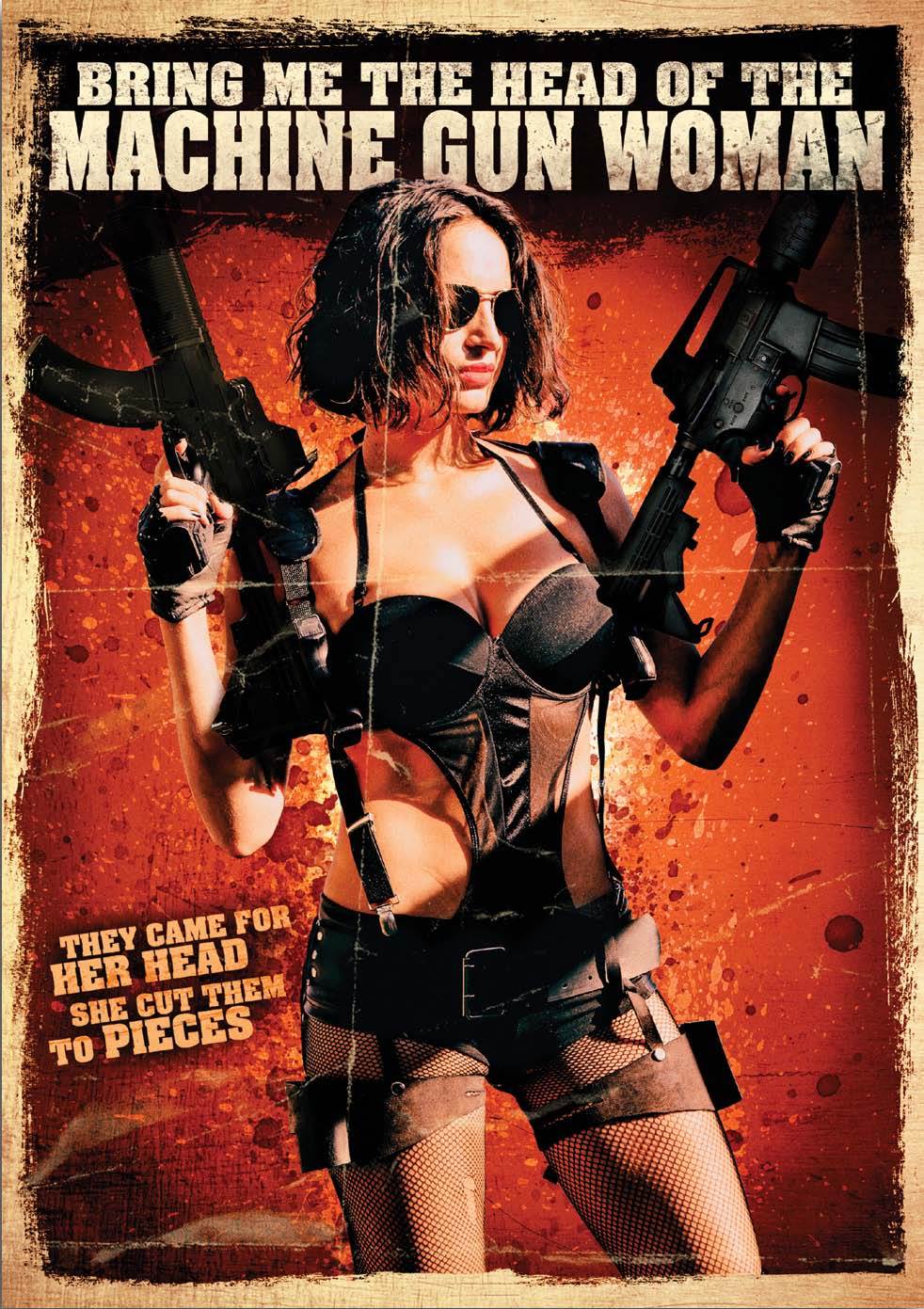
Bring Me the Head of the Machine Gun Woman (2016) - *Vageuly sexual bullet removal noises*


Letterboxd Season Challenge 2019-2020! Theme six, part three- a South American film!

(Chosen by John!)

Low-budget Chilean fimmaker Ernesto Díaz Espinoza has the start of a good idea in Bring Me the Head of the Machine Gun Woman: take a standard crime-action plot about a gutless loser caught in a mob hit, and reflect his video game obsession by styling portions of the film after the Grand Theft Auto series. As such, the tale of Santiago hunting down the Machine Gun Woman in twenty-four hours lest he find himself at the business end of a gangster's gun is punctuated with little flourishes either lifted directly from or inspired by Rockstar's popular franchise. Characters' names and bounties are flashed onscreen as means of introduction, Santiago racks up higher bounties with the crimes he commits, and segments are divided by shots of a car driving with the exact angle and framing you'd see in San Andreas, complete with GTA-font announcing upcoming missions and their success or failure. At first, it's enough to patch over the film's lack of money for proper sets or lighting by making it all feel like a big ol' piss-take on this type of exploitation send-up. Sort've a, "Haha, this dweeb's in way over his head and trying to feel like a badass by viewing things through a gaming lens, ain't it funny?" and it IS plenty amusing for a while. Genuinely seems like we're actively aware of how Santiago is this pathetic dork trying to play it smooth with hot informants way out of his league and buying an Airsoft pistol to bluff his way through a hit, and it works to great effect, for a time.

Once he crosses paths with the Machine Gun Woman, though? The movie starts to wobble and come undone at the seams. It's able to ride the goodwill of its first act for a fair way's, but one quickly realizes it's not going to do anything more with the GTA-theming beyond allow Santiago to fail missions every now and again. What worked as a clever twist on a standard grindhouse send-up reveals itself as a thin coat of paint to disguise the transition into "Nobody schlub falls for ultra-hot assassin chick who could kill him in seconds but she's actually into it." There are... attempts to make the relationship between the two work - Fernanda Urrejola definitely plays things like she's just toying with him to see if he's got anything substantial to match the gall necessary to pull a toy gun on Chile's best assassin, and they don't get together in the end, which is nice. The film still drifts away from playing with video game conventions in favor of stuff like a badly shot post-bullet removal sex scene in a car and asking Urrejola to play a betrayal scene with some really unearned slow-mo puppy dog eyes. It feels trapped between goofing on Santiago and its own premise for a quick lark, and fully embracing the power fantasy to jerk off on your face.

Push the video game weirdness further, and I'm far readier to go along with Bring Me the Head of the Machine Gun Woman. The film already cold opens on the Machine Gun Woman taking out some colorful assassins in a convenience store, including a one-man band whose drums come outfitted with guns. It already has heightened moments like a man blowing his scalp sky high with a shotgun to the chin after he's shot in the leg, or a crusty old fucker with some mad HTML skills for his character-select page on HireAnAssassin Dot Org. We've room aplenty to push the bounty thing further by having Santiago rack up incremental pesos for petty crimes along the way, or even lose wanted money for particularly wimpy actions. Show things from the Machine Gun Woman's side, give us some insight on what a video game world's like for someone who's essentially an untouchable top-ranked player. Get in more carjacking to build up to Santiago finally stealing a high-class sports car at the end and instantly losing it, maybe playing on the constant shittiness of the vehicles he nabs. Hell, if you really wanna make the sex scene work, just cram a Hot Coffee joke in there somehow. Once you start looking for ways to get these bits and bobs into the film, it becomes ridiculously easy to get even more ridiculous without spending THAT much more money.

I'm aware my saying "the best way to improve this movie is to double down on the gimmick!" doesn't make the film sound like it has much potential on its own merits, and... yeah, Bring Me the Head of the Machine Gun Woman is trash no matter what you do with it. Important thing is, the GTA stuff has the potential to make it unique trash, fun trash, the kind of trash you don't mind getting in your mouth while you're wallowing neck-deep. It's definitely got that appeal going for the first twenty-five minutes or so, before slowly bleeding as it becomes more about the standard, boring trash of 0/10 dork falls for 10/10 killer without as much gaminess to stem the flow. I'll champion appealing, enjoyable trash, and if you can make less engaging garbage into more exciting rubbish by mucking around with game concepts, then yeah, I'm down. Making it a bit clearer that we're kicking a power fantasy in the face rather than full-on indulging one would be nice too, but I believe going "Yeah, it's Vice City or whatever but it's a Chilean movie," would help achieve the same effect along the way. Just gimme my full-impact stupid viddy bootleg movie already.

(It's almost impressive how they captured the look of driving in GTA so perfectly, and then use an awful-looking first-person view where someone's hand takes up 90% of the screen for the gunplay. The Goldeneye 007 rip-off movie is shooting two streets down, guys.)

2.5/5

Thursday, December 26, 2019

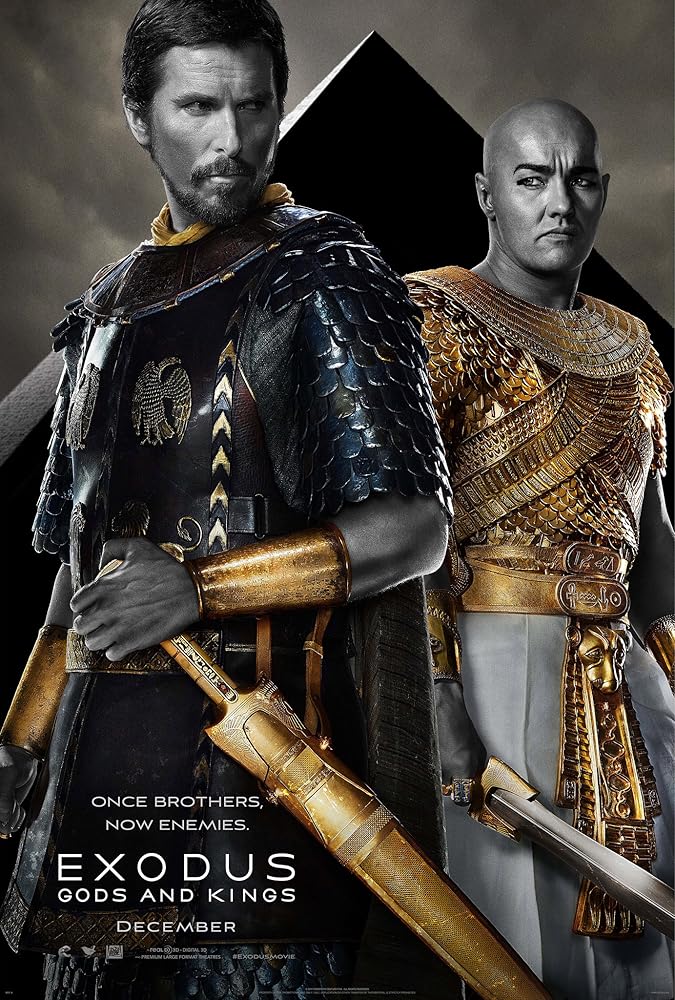
Exodus: Gods and Kings (2014) - A Reinterpretation of Scripture

(The following content is reran from the 2018 Christmas marathon on Letterboxd, as originally seen here.)

Why were there so many Christian films in 2014? In part, because Ridley Scott's adaptation of Moses' story hit theaters in early December. If we're to believe Scott's comments regarding the film's casting, had he bothered scouting for actors whose background remotely reflected those of characters and historical persons of Middle Eastern descent roughly 2000 BCE, we'd have gone down a film that year. Apparently, hiring actors whose skin is too dark or whose names are too foreign-sounding when making a film about the Exodus narrative means no studio will fork over a budget big enough to depict the Plagues or Parting the Red Sea properly. Whether the film was worth dousing Joel Edgerton, John Turturro, Aaron Paul, and others in varying degrees of brownface is a little bit up in the air, as the final product is a fairly mixed.

Giving a tiny bit of credence to Scott's financial justification for whitewashing and brownfacing his cast, the special effects during the big, spectacular Acts of God sequences are appropriately grandiose, and have an interesting bent to their execution. The film tries to find some natural means of explaining fantastical events, and so the plagues have initially sound justification for the Nile turning to blood, frequent swarms of destructive insects, and boils upon every Egyptian. Moses parting the Red Sea is treated as a potentially coincidental happening with only circumstantial ties to his own actions, which he must take advantage of as means of proving his connection to God to the doubting tribes. When it comes time for God's hand to become visible and explicit in its actions, the visuals gain a properly cinematic sheen, with a creeping shadow claiming each firstborn and the sea slowly collapsing back in on itself in a rushing tidal wave.

Exodus' new interpretation of Moses has some merit as well. It ditches the traditional role of shepherd and vessel of God in favor of a military man whose connection to the Lord may well be resultant from a traumatic head injury. There's a potentially neat dynamic around the midpoint, when Moses has returned to Egypt and determined to free his people through guerrilla warfare, intending to break Ramasses' will through attrition. As a concept, it makes some sense for a man brought up to lead armies to approach freedom from a fighting standpoint, and the film expands on this notion by contrasting it against God's proof that He can manage the same strategy far more effectively. I can see the intent, slowly nudging Moses out of his comfort zone and into the part of spiritual leader, and it might've worked!

But then we get into a major problem with Exodus: Gods and Kings: the storytelling and acting. Say what you will about Cecil B deMille as a director of crowds rather than actors; The Ten Commandments handily demonstrates how, with a lengthy enough running time and some talented players on hand, he could hammer a fully fleshed, comprehensive version of the material. Ridley Scott, working with still considerable two-and-a-half hours of screentime and actors of far greater standing than Charlton Heston, somehow cannot wrangle an ounce of humanity or relatability out of one of the quintessential religious stories about the power of faith and striving for freedom. He changes the script up far too frequently, giving Christian Bale and Joel Edgerton very little time to establish their characters as much beyond the same basic personalities in a slightly different situation before they overextend themselves or fade into the background. It's weird to think of a movie this long as feeling rushed, but it tries to cram in several additional scenarios for the rival brothers to work their way through in addition to the already shifting narrative of scripture, which makes odd moments like Edgerton's over-reliance on bellowing his lines to convey emotion, or the absolute stone-cold-stunner of, "From an economic standpoint alone, what you ask is problematic at best," stand out all the more.

Moses suffers the most here, as Scott's conception of a more secular prophet of the Jewish peoples comes off half-formed at best. The notion of moving him from commander of armies to rough-hewn freedom fighter to the Moses of Biblical understanding DOES have merit, but the film's eagerness to move from scenario to scenario means it never really slows down to examine Moses' psychology, or the deeper implications of his transformed state. A large portion of the middle stretch is taken up with Moses arguing with God in little circles about the morality of his actions without moving forwards. While his hollowed, resigned warning to Ramasses on the eve of the tenth plague and full confirmation of God's might has promise, it becomes a weirdly-shaped wrinkle when Moses' next big action involves triggering the parting of the seas with an act of doubt at God's presence. He awkwardly jolts from state to state depending on what the film deems necessary, and for all the hats he wears throughout the narrative, we ultimately see something less than the textual Moses.

When considering Biblical stories and characters, one needs to remember they rarely follow modern conventions of narrative structure or dynamic characters. The presentation on page frequently involves little more than "and then this happened, and so it was, and then this happened, and so it was, and then..." while the characters we're meant to learn from achieve their status as teachers by way of embodying an infallible moral righteousness. Introducing fallibility and uncertainty, then, is an easy way to make the old patriarchs and prophets more relatable, and examine their ideologies in greater detail. Taking Moses for an example, you have a man who knows exactly what he means to do the second God comes into his life, and hammers against the Pharaoh with unflinching certainty until he succeeds, only to turn the wrath of the Lord upon his own people when they fall short. Following the need to transform the character into something understandable and readable as an actual person in the moment, deMille kept the strong authority figure image, and whilst heavily emphasizing Moses' role as a lawmaker and Jesus-like figure, a good fit for mid-50s American culture.

Ridley Scott and Christian Bale's Moses does not only suffer from the story refusing to slow down long enough to examine him as a person - he sinks further because the film is naked about its intent to change him for profit. This Moses is not a man brought up to lead armies who later uses his experience to engage in a dragout war with his brother because it contrasts with any particular weightiness against his eventual turn to pure belief and subservience to God. He is a general-king because it enables to filmmakers to actionize the material, cram a few extra battle sequences in amidst the scenes of Biblical devastation, leverage the allure of a recently-departed Batman hanging around the studio. Action is not an inherent evil, and can be readily employed to underscore some greater point within the story, but Exodus' action scenes exist only to wow. Without proper interrogation of what this new strategically-minded, ready-to-doubt characterization means for Moses, the lurching nature of his character arc becomes more pronounced, and we end where we should have started.

They go and sideline the Golden Calf portion of the story, too, which is pretty much the most important part of Exodus if you're trying to give Moses a story about coming into conflict with God's divine wrath and learning to trust in His will instead of the strength in your own hands. There's fertile ground in a changed Moses suddenly turning against the very people he won over, the challenge of leading them to as pure a faith as his over forty years in the desert, and it's relegated to a single, far-away shot. That's how unwilling Gods and Kings is to engage with the implications of its alterations.

Initially, I felt three made for a fair rating. Ridley Scott at least provided some rather impressive vistas and battle sequences and visions of destruction on a mass scale. As I thought through the film more, though, I realized most of those visual effects-dependent scenes were either unnecessary attempts at actionization, or an inkling less impressive than equivalents in the deMille epic thanks to the (relative) ease of creating such shots in a computer compared against wranglings tens of thousands of cast and crew for similar effect. Though I do still find the Plagues and the Red Sea sequence both visually compelling and well-executed storytelling, I don't think the press of so many other visuals souring the more I contemplate them deserves too high a praise. Loop the brownface back into the discussion, and I'm more than happy to give Exodus: Gods and Kings my patented "there's some good things here, but man, the bad will weigh on your mind" rating.

Next time: The final installment of this impulsive Christmas series! Who all's ready for Kirk Cameron to celebrate the virtues of greed, gluttony, and conspicuous consumerism!

I'm not.

2.5/5

Tuesday, December 24, 2019

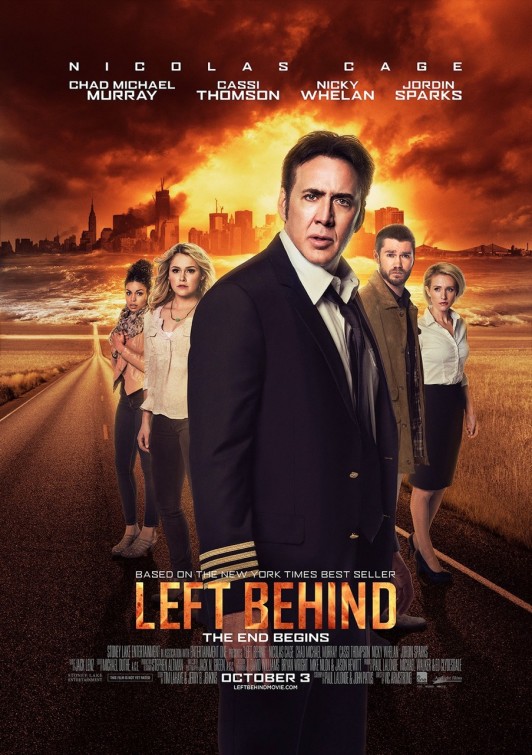
Left Behind (2014) - A Fanfic of the Apocalypse

(The following content is reran from the 2018 Christmas marathon on Letterboxd, as originally seen here.)

Why were there so many Christian movies in 2014? In part, because writer/producer Paul LaLonde finally raised sufficient funds to get a new adaptation of Tim LaHaye's sixteen-volume Left Behind series off the ground. A previous trilogy of films about the exploits of RAYFORD STEELE and BUCK WILLIAMS in the wake of the faithful's physical Rapturing to Heaven saw increasingly weak critical and financial success, and Kirk Cameron's continued slide into Evangelical nutjob-ery made his return impossible, so LaLonde instead snagged up a paycheck-desperate Nic Cage, a few vaguely recognizable character actors, and set about with his readaptation. Unlike his fellow Christian filmmakers, he didn't finish his movie in time for the lucrative Easter season, and evidently didn't feel like holding back for a month until Christmas, so the final product wound up dumped in early October and quickly forgotten.

Side note: In spite of a crowdfunding campaign for a sequel failing miserably, LaLonde has announced plans to adapt all sixteen books of the Left Behind series. Maybe he'll actually get around to filming something interesting on one of these future outings.

I'm incredibly disappointed in Left Behind. You hear the plot summary of the books and think to yourself, "Well, it might not sound GOOD, but they at least commit to spouting some absolute lunacy." Millions upon millions of good Christians bodily vanish in an instant, and the whole world instantly falls into rioting and chaos. A select number of survivors form the Tribulation Force to defend and convert the remaining unfaithful during seven years of hardship. There's conspiracies and redrawn national borders and armies of millions and a ceaseless war against the Antichrist against a backdrop of flame as the sun ejects half its matter onto the planet's ever-quaking surface. The whole thing's predicated on the notion all non-Christians need to hurry the hell up and get with the program lest they experience untold suffering for their staunch refusal to believe, but it's sort the sort of thriller where Russia can form a union with multiple European nations to simultaneously nuke Israel, only for God to vanish the nukes and plant them in the capital cities of the aggressors seconds before detonation. If the piled up nonsense still isn't tantalizing enough, I remind you this new adaptation has Nic Cage as a man whose faith is tested in the first hours after the Rapture. We have open invitation to completely lose our shit here.

Instead, it seems LaLonde and director Vic Armstrong decided the "try to act like we're normal people who believe normal things so the conversion message sells better" part of the job was more important than the "Lean into a full sixteen books of increasing fantasy insanity" aspect. A film starring a paycheck-cashing Cage and supporting actors in starring roles from a stuntman director never had much chance of achieving a great deal of depth, but relegating the action to Captain Steele's attempts to land his plane and nothing else smothers the film. With such a limited scope, all the movie has space for is characters with one-note personalities getting into arbitrary conversations/arguments in a confined space, while those whose book-counterparts are presumably more developed suffer through having to solve a conflict totally unrelated to their later apocalypse ministry. There are exactly three people who matter in this movie if my interpretation of the Wikipedia summaries for the books is correct, and their movement throughout the film can be easily boiled down to "is not a Christian" for 95% of the runtime, and "is a Christian" for the final 5%. That's not a heck of a lot to hang a "land the airplane" thriller on.

They could offer up SOMETHING here, but even if I set aside my disappointment at not seeing Nic Cage wage psychological warfare against the UN-leader Antichrist, there's nothing. The other passengers on their airplane occasionally set-up possibly interesting conflicts, like the pissing match between the Muslim and the little person, or the guy convinced everything is happening because aliens, or the woman who resorts to threatening everyone with a firearm after she becomes convinced they're all in on an act to steal her child. These situations are universally defused within two minutes of their introduction, and wrap back around to the same ol' "where did the other people go?" question without fail. Buck Williams is a total wash of a character, despite the half-hour prior to the Rapture taking its time to give him some connection to almost everyone onscrreen. Cage barely emotes as Steele, not even bothering with his trademark swaggering awkwardness, and favoring a bland, generically frustrated "ordinary man in a crisis" persona. Steele's daughter gets a lot of screentime wandering the post-Rapture world looking for her brother, which accomplishes nothing other than introducing a short cameo from another book character, and underscoring just how awful God is in this fictional world.

God seriously needs a better publicity guy. Throughout this review series, I keep mentioning how the Bible contains plenty of good messages and guidance for living one's life, so long as you read it critically and understand the cultural gaps between when it was written and the present day. However, across five films - four of which so far have served as not-so-covert attempts at converting nonbelievers - we've seen nothing but idle interventions, echoing silences, and a penchant for cruel torture, with this film representing the height of the final tendency. Were it not for Captain Steele's conversion in the last few minutes, I'd consider it a decidedly anti-religious film, what with all the focus on chaos and confusion and suffering as a result of his great gift to the world. I know and you know it's all MEANT as a time of hardship to sort out the worthy from the unworthy and grant the nonfaithful a final, true test of character before the End Times proper, but the movie never once mentions any of this. We're apparently supposed to watch all this destruction, see the devastation of parents who lost their children and good people deemed wicked sinners for a simple human failing, and think this a good and right part of God's plan because... well, because Nic Cage tells his passengers to pray before landing, I think.

It is, if nothing else, a spectacular self-own: You realize your source material has a little too much crazy religious fundamentalism to effectively work as propaganda, so you expunge everything but the inciting incident and "thrills" of trying to land a plane in a panic, only to also leave out all clarification for why the audience should take these developments as beatific, thus making the deity you worship look even crueler than his book-counterpart's relentless hammering upon the earth. Nothing works in Left Behind, unless you want to count the unintended comedic value in scenes like the bait-and-switch electric toothbrush, Nic Cage's last second attempts to avoid collision with a wholly-Raptured plane, or the sheer speed with which polite society descends into petty thieving and murder once there aren't any TRUE Christians left. I'm only giving it 1.5 stars because it does such a thorough job of scrubbing out the truly hateful parts of its ideology as to work against its own purposes, and argue the virtues of agnosticism. Nic Cage's performance barely rises above sleepwalking, so why bother?

Next time, Ridley Scott does some whitewashing, but still makes a real movie.

1.5/5

Monday, December 23, 2019

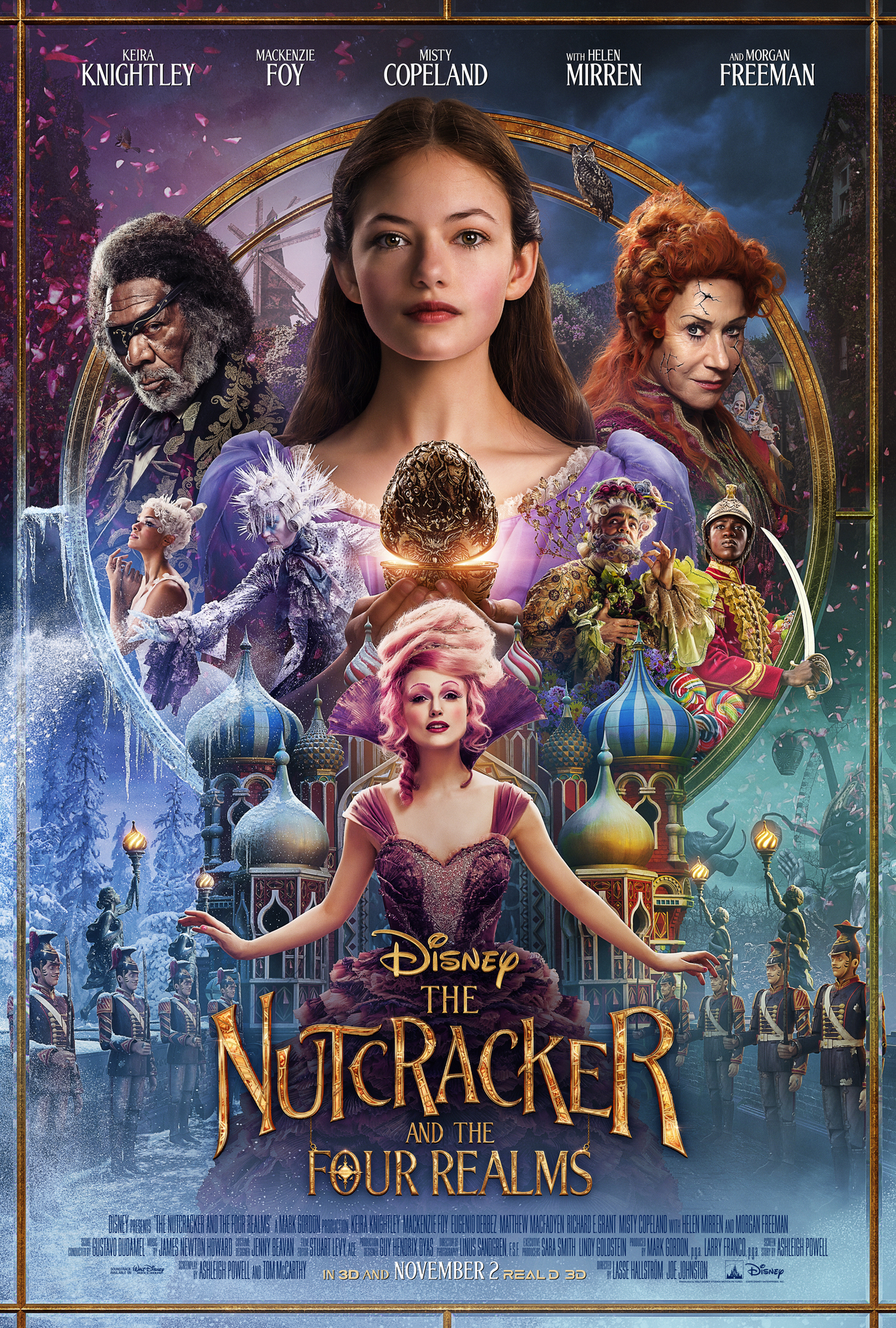
Mixed Nutcrackers: The Nutcracker and the Four Realms (2018)


Over the last month, I've spent quite considerable hunks of time puzzling over why The Nutcracker and the Four Realms exists.  The reasons are quiet obvious and take little time to figure, of course - Disney intersected with Tchaikovsky's work very briefly when they adapted his Nutcracker Suite for a segment in Fantasia, Disney's been on a streak of remaking various classics of theirs both major and minor alike, and 2018's Star Wars offering targeted the traditional May release window rather than their new Christmas block, so turning out a big-budget Nutcracker film like they've been proprietors and overseers of the beloved property all this time works for a holiday market thing.  They don't even have to buy a whole studio to get the rights like they'll have to if they ever want to make coin off The Wizard of Oz, they've just gotta pretend that their all-encompassing dominance over childhood nostalgic properties has a transference effect across anything and everything in the public domain with the tiniest connection to Disney, and voila!  It even makes sense why it is the way it is, for Tim Burton's vile take on Alice in Wonderland made over one billion dollars worldwide, Kenneth Branagh's better Cinderella did respectable business for its budget, and overconfidence in the Disney offices keeps bad ideas afloat even after, say, Alice Through the Looking Glass turned out a financial disappointment.  You've a license to print money with recognizable properties done up in action-fantasy regalia, so away we go, 130 million dollar budget, gonna be a grand ol' time, woo!

My questions were more philosophical in nature.  Why are we here, at this point on the board?  Must it continue on like this?  Is there any conceivable creative spark behind the greenlighting and production of this film, or is it truly just an idea whose final form doesn't matter so long as someone can check off a little box on a list of Good Ideas What Will Make A Billion Dollars?  The answer to all of these questions is yes, without fail, but I wonder all the same.  The trailer and related marketing materials, though over-designed to such a degree as to embody a wonkily admirable aesthetic all their own, simply looked so boilerplate and uninspired in what they implied, it seemed the only reason any of the Nutcracker stuff showed its face was for the purpose of having a little more reason to use the Sugar Plum Fairy dance and Waltz of the Flowers on the soundtrack than normal in a Christmas movie.  And is that really what anyone wants to make a movie about?

Not asking whether the audience wants to SEE it or not, no, I'm curious about the folks who've gotta write and act in and design and direct this stupid thing.  Is this how you wish to spend your twilight years, Morgan Freeman?  Is this how you foresaw your first big mainstream exposure coalescing, Jayden Fowora-Knight?  How exactly did you get here, Lasse Hallström?  Were the ABBA music videos and What's Eating Gilbert Grape and all those dog movies not enough?  Must you architect something with no soul?

Whatever the reasons (for I'll never know), The Nutcracker and the Four Realms exists, and it's about exactly what its trailers make it out as.  New take on Clara Stahlbaum going through a magical adventure in her Godfather Drosselmeyer's house, except instead of a small skirmish between toys and mice with a semi-sweet kinda romance as the main pull, it's this big to do about a locked mechanical egg without a key gifted by her dead mother and a fantasy kingdom the elder Stahlbaum created from crude inert matter with multiple realms based on a few dances from the Tchaikovsky ballet, and wouldn't you just know it the whole thing's gone to hell in a handbasket with a mysterious arch villainand frightening circus imagery and need for a strong warrior queen to march forth and save us all as prophecy foretold and aaaaaaaaaaagh.  Pretty lookin' but vapid to the extreme, and lacking in any real identity of its own - in addition to all the bog-standard "Classic fairytale kingdom from your childhood is a little more Game of Thrones now" trappings, they've pinched bits and bobs from Alice, Oz, Narnia, and Disney's newer animated canon entries with shameless liberty.  The whole concept's a glass-molded, sugar-coated diorama piece, endlessly reflective of its counterparts an tasting of nothing in particular, a bad bedrock for any story to rest upon.

Somehow, with such an easy formula as, "Exposit, adventure, twist, conclude" to follow as inherited from all the other fantasy imitators its imitating, The Nutcracker and the Four Realms manages to back itself into a corner with some impressively bad character writing.  Clara, as played by Mackenzie Foy (who shall remain largely blameless, for not doing anything with the following is probably nobler than making a futile effort), has an alright if simple set of traits at the movie's start: she's clever and into tinkering with machines, she's upset about her mom's death, doesn't want to socialize in the way expected of her societal station, and clashes with her father over how to deal with the grief, retreating into her mechanics as he does his stuffiness.  With the whole thing regarding her mysterious locked egg that no amount of tinkering can open without the key, there's the basis for a bit of self-discovery and growth via the medium of an adventure in bootleg Middle-Earth cum Narnia.  Too bad for us, though, soon as she follows a string into the Four Realms, she becomes little more than an audience surrogate.  All sense of individual personality gets wiped away so she's free to marvel at the pretty sights and wonder at the new characters and feel sad when we're supposed to feel sad and get invested when we're supposed to get invested.  Lacking much identity of her own for a goddamned half-hour effectively distances one from her, and primes you less to fall under this world's magical spell, and more notices how it's so concerned with crunching exposition that it only spares about ten seconds total to show you three of the four realms from the title.

(Seriously, they're probably the best designed locations in the film, and we get a single shot of each.  Rest of the movie's in a comparatively empty - and probably easier to render - golden palace and various sparse dead woods.)

So, follow me on this one, please, I'm about to do a Thing.  Clara has learnt all about the ins and outs of the Four Realms, the supposed dangers posed by Mother Ginger in the disgraced Fourth Realm, and how her mother used a giant machine called The Engine to bring the whole fantasy kingdom to life, effectively making her heir to God's throne in this land.  The three good regents need The Engine to build an army to stand against Mother Ginger or else face extermination, but woe of woes! it's broken!  Now Clara, showing signs of life and personality for the first time in ages, perks up and suggests she might be able to tinker with the machine and solve the problem, because she's really good with machines and finally has someplace where her talents will be appreciated!  But no, we don't actually need her skills or anything unique about her - we need her mother's key, the same key that opens her mechanical egg.  Off a-marching we a-go, having a grand old time running about the Fourth Realm, getting attacked by mice, creeped out by clowns, just sorta doing whatever action-y thing comes to mind to tick off time because this little key hunt is all we have for a second act... long story short, Clara gets the key, opens the egg, and nothing.  She's devastated, because her mother left a note saying everything she needed was right inside the egg, and there's nothing, so clearly there's nothing important or special about her.

Gee gosh willikers, wouldn't you know it, we get back to the palace, turn on the Engine, and the Sugar Plum Fairy's really the villain for reasons that don't matter and I don't really care about.  Point being, she throws Clara in the tower dungeon and plans to destroy the whole Four Realms or something, and Clara?  Clara starts getting ideas in her head.  Clara starts thinking she has to reach deep down inside, find an inner strength she never knew she had, trust in her knowledge of the laws of mechanics, use them to escape and figure out a way to save the day.  She enacts a great escape with lots of verve and daring-do!  She spirits her way back into the throne room, where her mother's Engine is spurting out unstoppable tin soldiers!  And in a grand act of self-actualization, she sneaks up to the machine, and... uses her tinkering skills to shut it down and stop the Sugar Plum Fairy.  Turns out what she needed to do was exactly what she thought she needed to do at the start of the second act, just with an arbitrary march to kill her self-confidence and a little alone time to figure out something about herself she already knew.

That's not a character arc.  That's a character ten-yard penalty.  "Achieved self-actualization too soon, ten yards back, first down."

I don't know.  What else'd'y'want from me here?  The Nutcracker's a complete non-entity with no personality and even less reason for being singled out as important in the movie's shaky lore, the backstory and whole dramatic situation relies on implications from Morgan Freeman and flashbacks to Clara's mother which communicate a wholly different backstory than the one Sugar Plum's heel-turn is predicated on through monologue, and its ten steps backwards ten steps forwards story has nothing to say at the end of the day beyond "Keep visiting your childhood imaginary kingdom, or it'll all burn to ash because you weren't good enough to not grow up!"  I liked the Mouse King's reimagining as a mouse golem comprised of thousands of mice, though far more as a concept than for how he looks or anything he does, some portions of the expository ballet are rather pretty in both physical movement and the practical effects around the dancers, and the soulless tin soldiers are fairly, appropriately creepy.  I'm rather upset at how they only play a few snatches of the final dance piece on a tinny little music box before swapping over to the more "dramatic" sounding Waltz of the Flowers for the real final dance and - does it matter?

Do my further critiques and weak, minor praises have any purpose?  It's not fundamentally broken like the Tom and Jerry outing, and it doesn't fall as far into eye-popping, misguided arrogance as 3D, but unlike those works, I cannot think of how to improve this.  If I intuited some better means of handling Clara's arc (read: making it an arc in the first place), devised a better use of our first act time than uselessly oggling empty spectacles whilst hiding away the ACTUAL production design achievements behind weird editing choices, strained and labored and sweated to scrub out the uncomfortable "child God fantasies must last forever!" implications, it wouldn't be for anything.  The base idea of "The Nutcracker but we're Lord of the Rings and Narnia now" is bad and nonfunctional of itself, and my absolute best suggestion, being "Use a different concept," requires eradicating the movie entire down to its bones to keep suggesting anything better.  Uniquely-shaped failure to write a coherent story for its heroine marks the most remarkable thing about The Nutcracker and the Four Realms, and I'm half-inclined to say we shouldn't imagine a better movie in its place, because a muck-up like this is too rare and special to deny.  Why continue spilling digital ink on a work I've declared poorly conceived from start to finish, and cannot accept the obvious answers over the whys of its existence for how much they shake my faith in an inherently good universe?

Movie's bad.  Don't go watching it.  Check out Nutcracker Fantasy and the 1973 Nutcracker short instead.  They're far more charming, creative, better designed, and free on YouTube as of this writing to boot.  Hell, watch the Barbie movie, it at least does more with its golem character and out-and-back narrative structure.

2/5
Sunday, December 22, 2019

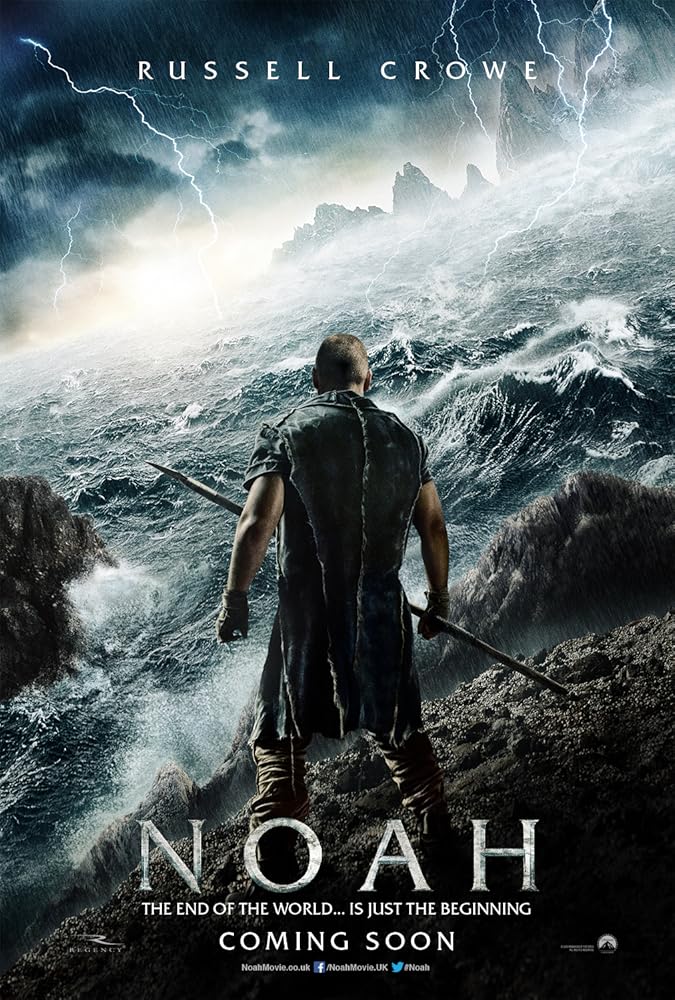
Noah (2014) - A Blockbuster From the Arthouse

(The following content is reran from the 2018 Christmas marathon on Letterboxd, as originally seen here.)

Why were there so many Christian films in 2014? In part, because Darren Aronofsky's fifteen year struggle to bring his vision of the Biblical Flood to the big screen finally bore fruit. A director whose work frequently involves characters pushing themselves to radical extremes, Aronofsky makes an interesting helm for the story of Noah, the patriarch who left all mankind to die beneath God's raging seas to preserve the sanctity of Creation. It's both a reversal and embrace of his usual ideas about the self and the masses, and it all comes packaged with a massive budget and expectations for big returns, courtesy of his success with The Wrestler and Black Swan. As the film proved a success critically and financially, and comes from the mind of a director with actual artistic ambitions, the only "did this movie need to exist" joke I can think to make involves slinging mud at mother! for trying a move into entirely symbolic territory and losing some of the power.

Aronofsky finds a far more even balance between metaphor and narrative this time around. Several passages of Noah creep into pure visual storytelling, and not just those involving the voice of God penetrating Noah's thoughts as a rapid series of powerful images. The reinterpretation of Watchers as victims of God's wrath and eventual precursors to the New Testament style of forgiveness-based salvation also lends way to interesting creature design and bits of worldbuilding to create a unique yet still Biblically-grounded setting. Noah's retelling of Genesis' opening passages through a flashing look at the Big Bang, planetary formation, and evolution that gives way to the key images of the Eden story helps underscore his character of a highly principled man trying to interpret his Creator's will through preset personal beliefs - a man who holds all he sees as dear, intruded upon by the sin of simply living, commanded to oversee its destruction. And then you have the contrast between a manmade apocalypse of fire, Enoch's vision in a time when the descendants of Cain ruled the land, and Noah's prophecy of devastation by water. Both presented as horrifying, especially when we see the survivors attempting to drown out the screams of thousands left to suffer and die on the mountaintops, but only one carries the divine promise of something after.

Compared to mother!, the metaphors at play here have a far clearer purpose, and relate more directly to characters who register as actual people. I've seen much critique of the decision to cast Noah as a figure who would murder his own grandchildren to ensure humanity's extinction, but I think it works very well within the film's parameters and Biblical cnaon. All the really hard parts leading up to the flood - interpreting his visions, constructing the ark, gathering the animals, defending it against invaders - are presented as grand undertakings, yet comparatively nothing compared to squatting in the dark for months on end with the knowledge of his supposed duty. In a twist on the usual Judeo-Christian narrative of prophets and chosen men passing God's tests by proving themselves willing to enact his will no matter the cost, Noah comes through this period in which nobody can dissuade him from the ultimate evil by looking into the face of a newborn child, and showing mercy. For once, the Creator wants to see his progeny spare a life, set aside the grim determination necessary to watch the whole world die, and mark the beginning of a new era with compassion rather than the murderous rage of Cain. Taking this route gives us Noah as a miracle worker and a mere man, prone to false beliefs and internal conflict as much as any other - a far stronger character than Jennifer Lawrence's being totally subsumed into her role as God's power of creation and destruction.

Other characters make for somewhat compelling cases, though unfortunately most suffer the opposite problem as mother!'s cast, and become mere pieces in the narrative. Ham's secretive relationship with Tubalcain aboard the ark has some interesting aspects of temptation and the sin of arrogance, which makes for a good extension of the earlier corruption of a "we make our own destiny" mindset. I'm also rather a fan of Og and the other Watchers, and their brief journey from distrustful, bitter souls to sacrificing warriors. Looking at the rest of Noah's family, though, they seem a little empty, and don't make much of an impact on the story. For all of Aronofsky's subtextual challenging of Noah's inherent righteousness as a patriarch, he doesn't really afford wife Naamah or adoptive daughter Ila a chance to interrogate his beliefs before the flood, or play a part in his turn to peace afterwards. They scream and cry to no avail with all the passion of archetypes and none of the unique embodying aspects of individual characters, and ultimately weaken the notion of the necessity of a balance between total fealty to the Creator and blazing one's own trail. Consequently, Tubalcain's temptations seem more unexamined and obviously evil, rendering him a conventional arrogant bad guy in the middle of a narrative calling for something more nuanced.

There's other things I could complain about, like how unnaturally well-groomed Shem and Ila look compared to the grimy naturalist aesthetic of their family, or the grand scope of the special effects straining against even a liberal $125 million budget and making some of the more "epic" scenes look awkward, but I think I've gotten the bulk of my analysis and valid critiques on paper. Aronofsky definitely does better work when he has something concrete and human to come back to rather than the excess of a pure passion project. While Noah is very much a personal story for him, the demands of a film designed as a blockbuster keep him focused on attaching his keen eye for visual symbolism and intense editing to a story about actual people. He didn't produce a masterstroke thanks to the neglect of other characters and the unfortunate shortstop of ideas right before pushing them to something truly complex and layered, but he did make possibly the best Bible movie of the lot for this project. I'm beyond glad we have a creator who wants to consider the Bible as sacred text AND inspiration for their own thumbprint. A whole seven films of blind lionization in a single month might drive me mad, so I'll gladly take intriguing and beautiful yet somewhat stilted.

Anyways, next time we're exploiting a child's close shave with death. That'll be fun.

3.5/5

Saturday, October 5, 2019

Takeru Yamato (1994) - You misunderstand me. It is the name I shall carve on your tombstone!


Letterboxd Season Challenge 2019-2020!  Theme two, part two - a swords and sorcery film!

(Chosen by Jackie!)

I think film based on ancient myths and legends often fall into a trap of their source material predating modern storytelling conventions by so long as to require active legwork to bring them up to standards.  After all, many of these stories were meant as parables rather than narratives, yarns of creation and heroic deeds and grand tragedy that explain or contextualize a vital aspect of the natural world or a people's shared identity, easily identifiable to all upon repetition, reinforcing a sense of who we are.  Plots repeating across cultures and details painted with the broadest brush are part of the point.  You couldn't get the point across half so cleanly if the teller were liable to forget important details halfway through the telling.  The mythological tradition of Japan may differ slightly from those of western cultures this aphorism typically applies to, but I'd imagine the tale of Yamata no Orochi, his tricking and slaying by the exiled thunder god Susa-no-O, and the discovery of the Kusanagi blade within one of his eight tails works along similar lines.  We're recounting how one of Japan's Imperial Regalia was discovered in an example of cunning winning over power.  Works just fine for oral tradition, but you need a little more than the barebones details in a film.

Takeru Yamato (otherwise known as Orochi the Eight-Headed Dragon, probably in evocation of the similarly titled Godzilla film), makes... some effort to update the telling for a modern filmgoing audience.  Whether those updates were sufficient is a matter of debate.  Takao Okawara positions the film as a fusion of several Japanese tales, merging Orochi with the moon god Tsukuyomi, and making his return to earth in a failing prison of crystal and ice the story's main ticking clock.  Elsewhere, Takeru Yamato - a legendary prince who wielded the Kusanagi in tales of old - is given an origin story, his battle against Kumaso warriors expanded into a quest to regain his honor after a mysterious power within him seemingly kills his mother and brother.  He's also given an explicit destiny, of uniting three great lights (variants on the Imperial Regalia he acquires throughout the film), and defeating the terrible eight-headed dragon in direct combat.  For good measure, we've also got a romantic subplot for him to work through, mostly because the legendary Takeru lost a wife to a sea monster.  This all sounds fine and dandy, and would play fine if given proper animating impetus.

Well, there's where the film stumbles.  It leans in HARD on the destiny aspect, propelling Takeru from place to place less because there's some driving force behind the film, and more because a godly hand from on high says he needs to.  The actors all play their parts pretty flat and passionless for the grand mythological stakes at play, with lead Masahiro Takashima especially failing to make much special impression.  His chemistry with Yasuko Sawaguchi as love interest Oto is almost entirely nonexistent, which isn't too much of a problem when their scenes together are so touch-and-go in nature, but becomes a massive weight on the third act when their undying love for one another is supposed to help defeat Orochi,  and you just don't feel it.  Nothing much ever feels like it's happening for any bigger reason than fulfilling formalities, which ain't great when you want to get caught up in some high-flying mythological action.  The whole thing's just ever-so-slightly draggy, and keeps me from earnestly running along with its plot.

Doesn't help that in a lot of ways, Takeru Yamato isn't much to look at, either.  I understand this was something of a lower-budgeted film for Toho, having taken Okawara off the Godzilla films to helm this as the start of an intended trilogy, but the film  is devoid of their usual lo-fi charm.  They're typically at least charmingly low-budget, skillful within the constraints of their cheapness.  A lot of the creatures on display here are incredibly stiff for coming out've a company that spent the previous forty years perfecting these techniques.  The chrome, bird-shaped god Amano Shiratori makes more appearances than most any other creature, and has no points of articulation whatsoever.  Kumasogami looks alright, if incredibly slow and dinky in combat, and the CG-morphing is at least neat-looking for the mid-90s.  Sea monster Kaishin Muba just sorta sits there in the background of a green-screen while his tentacles whip about rather unconvincingly.  When Orochi finally arrives in the film's final twenty minutes, his heads and necks look pretty good, as befits anything that came out of the Heisei Ghidorah molding press - but his BODY, oh god his body.  I've looked at pictures of the figurines Bandai put out, and I couldn't for the life of me tell you it had legs before doing so.  It all looks like one enormous, unmoving fleshy lump that slides forward like it's one treads or something.  He's the centerpiece of a film meant to kick-off a new moneymaker for Toho after Godzilla's intended retirement the next year, and yet I cannot see a cent of what I'd expect for a film of that status.

Don't even get me started on how the humans interact with the puppets and suitmation.  I'll admit it's rather neat Toho opted to position the creatures as either smaller than normal or send the humans into the midst of their gigantic bodies, but the effect is not convincing in the slightest.  Some of the worst effects come about when we're just trying to imply someone is sharing space with a prop that could easily be made larger with forced perspective, yet is achieved through pretty terrible greenscreen.

In fairness, by volume the movie's action is more martial arts than kaiju action, and the parts where actors are jumping about one another with swords and fists and fireballs is pretty enjoyable.  The big clash between Takeru and the Kumaso leader (who gives him the name Takeru, incidentally) even has a glint of weight and portent as the pair clash through multiple locations and grow ever-more battered.  A few moments which seem intentionally humorous land well, like when Oto is cornered by dozens of guards who appear from nowhere.  And I do have to admit, for as short of Toho's usual standards most of the effects fall, the giant gleaming samurai warrior Utsuno Ikusagami does look pretty glorious when he wrecks Orochi's shit with needless violence.

It's just most of this has to come shortly before, shortly after, or share screenspace with elements I find it difficult to sit through.  The lack of a narrative lifeblood other than "because destiny says so" highlights how much of the connective tissue is perfunctory, most characters don't register as interesting or well-conceptualized even without the performance issues, and I can be grooving along to a neat-looking effect before something cheap and amateurish bursts in to kill my vibe.  In total effect, there's bits and pieces where I appreciate the spell, but it still plays as a shoddy semi-adaptation of an oral legend without much work put towards making it cinematically viable.  For all the protagonists interact with special effects and go flying through the air, the story neglects their personage in order to work with the same broad brush strokes of character and event that an old telling from back in the 500s would rely upon, and it doesn't work onscreen all that much.  Perhaps I'd be better served by The Three Treasures, the three-hour long, Toshiro Mifune-led adaptation of this same tale Toho released back in 1959.  I'd say the effects will be worse but the story more palatable, but... honestly, knowing how much better the surrounding Godzilla films look compared to this, maybe effects 35 years regressed will feel more acceptable.

2.5/5