Showing posts with label experiential. Show all posts

Saturday, May 9, 2020

The Fits (2015) - Must we choose to be slaves to gravity?


It's the Letterboxd Season Challenge!  Theme eleven, part two - a film distributed by Oscilloscope Laboratories!

(Chosen by Jackie!)

.。*゚+.*.。It's exorcising personal demons time*゚..。*゚+


I've discussed my difficulties participating in middle school and high school sports here a few times before.  Primarily as they pertained to the social aspects, bad interactions with my mental issues and hazing and bullying and the like. The actual running wasn't too easy either, tho, and I don't mean in the sense that pumping your arms and legs hard as possible for miles on end is physically taxing even when you're used to doing so day in and day out.  The part where you feel like you belong to a team, use the energy of those around you to better your performance and feed back into the loop with your own contributions was demanding for someone inclined to hole up inside their own head and define themselves as apart rather than within, especially when forming non-antagonistic relationships was already so difficult.  Even a sport so isolated and self-determined as racing requires an understanding of the self as part of a collective, which proved an understanding I could never fully grasp.  Never hit second gear or second wind or whatever you'd like to call it, never took any interest in what my teammates were doing, always felt stressed and drained by people trying to encourage me instead of boosted like I know they meant.  Really, honestly, truly getting what it means to remain oneself while giving it all to a team is maddeningly difficult, and I'm still not sure I'll ever be capable of putting it into practice.  It's a matter I'm always looking to work on, of course, for one must deal with one's devils in addition to simply acknowledging them, but when you're right on the wire, it almost has to be something you either tap intuitively or can't access at all.

All to say, what jumps at me most about The Fits, the directorial debut of Anna Rose Holmer and acting debut of Royalty Hightower, is how they use main character Toni's struggle to balance her old sport of boxing amongst boys with dancing drills amongst girls as a mysterious psychic illness sends her new friends into spasmic fits to explore that sense of individualism amidst the collective.  An early moment I found particularly telling is Toni's initial audition to join the Lionesses, when older girl and instructor Legs emphasizes the need to think of themselves as a unit, and lays out the complicated series of drill steps they're to demonstrate.  Toni, in a space she's not at all comfortable in just yet, and coming from a background where the camera and sound design have emphasized her tendency to obliterate all save herself for the sake of focus, dances about as badly as everyone else in her new group, yet takes the experience harder.  She's not able to engage in the locker room like her new peer, hiding in a stall to avoid others seeing her change while simultaneously listening in on their calls.  During practice, the camera often spins with Toni as its pivot point, highlighting how everyone around her seems perfectly capable of following the steps, yet she remains slightly out of time, tending to misplace or mistime steps, keeping a barrier between her and the group she wants to join.  She still returns to run stairs and work boxing routines with her brother, and during private moments in these exercises, she practices in isolation and seemingly starts to get it when she feels freer to treat the dance like a fight to be overcome, yet when she returns to group practice it never translates.

There's a fear of losing herself entirely if she clicks with the team, one her interactions throughout the film complicate through interesting wrinkles.  When the titular fits start striking the older girls, we the audience can tell each one manifests differently than the last, and eventually understand they leave no lasting harm, but they're still frightening seizure-like events that disrupt the flow of events and prevent Toni from taking advantage of moments when she's closer to getting it.  The uniform sense of uncertainty they produce, however, also enables Toni to bond with the two girls who take to hanging around her in calmer moments, Maia and Beezy.  Beezy in particular gives rise to many positive interactions, opening doors for Toni with temporary tattoos and ear piercings that mark a more physical transformation, and spending a night running about the fitness center in the dark during a rapturously shot scene, which transitions into a moment of quieter understanding when Toni helps Beezy after she gets scared and pees herself.  For Maia's part, she seems a quieter hanger-on for some time, yet shows herself as a more contemplative older presence, specifically as we move to the third act and Toni is able to have an honest conversation with her after the fits appear more sporadically and make the future of the team more uncertain. Of course, just as everyone starts feeling safe because they think the fits can only impact the older girls, Maia and Beezy have their own fits in short succession, and leave Toni more isolated than ever.

What's interesting here is how this sense of isolation plays into Toni's preexisting feelings of being an intruder in a space not meant for her.  In the downtime between notable events, she's often seen blanching at items signifying her welcomeness to the group - picking at the temporary tattoos, fiddling with the piercings before tearing them out, placing herself a subtle distance away from the main body of girls, pinching and pushing herself.  While her distant, colder relationship with Beezy after the latter has a fit can be read as the fits themselves drawing a line between those who've had them and those who've not, I can't help but wonder if Toni thinks of herself as having caused all this.  She shows up, and all of a sudden what looks to her like a cohesive singular unit starts falling apart and feeling afraid.  Even her own friends start acting distant to her because she's too aggressive and stand-offish before they experience a fit.  Her interactions with the boys' boxing team grow less frequent and more distant throughout the film, until she's looking in on their practice in shots framed to mirror her looking in on the drill team for the first time, except there's no more curiosity, only distant observation.  The things that made her part of this old world seemingly disrupt this new world, yet the new experiences here make it so she can't go back and still feel herself.  All the world seems gray, her ears buzz with anxious pounding rhythms, everyone seems distant, fit or no fit, and Toni just doesn't seem to belong anywhere.

So we come the finale, when Toni has her own fit, and it makes one question just how much these are truly negative experiences.  True, they're outwardly frightening, striking at random and producing different effects in each person, yet we've also inhabited the perspective of someone who doesn't possess the faculties or insight to understand what anyone who experiences a fit truly makes of it.  In Toni's case, when her feet leave the ground, and she dances the routine with an energy and individual strength not seen prior to this, we come to understand the experience as one of gained insight.  She envisions herself approaching the covered bridge where she and her brother practiced, shedding her gray sweatsuit to reveal the spangled, colorful Lioness uniform beneath, and dances in perfect time with her team in a variety of locations visually defined as her's throughout the film.  Understanding of the matter I outlined above comes to her for the first time: that it's not about becoming less to contribute to a whole, but about making a whole from many wholes, using the greater flow to build what's already within you, and expand the energy outward in kind.  Yet despite this revelatory moment, we don't see the aftermath.  Toni's teammates are still shown as intimidated by her dance, and when she falls to the floor smiling in the last shot, all we get afterwards is the Lioness hype chant and a return to the tingling, anxious music over the credits.  She gets it now, and will likely have a chance at building her friendships again, but do her revelations match to what her friends came to understand?  We aren't to know.

The Fits offering no insight into what comes next seems appropriate to me.  Much work as Holmer and production/writing collaborators Lisa Kjerulff and Saela Davis put into crafting a world where we can instinctively understand Toni's internal divide, the mysterious, otherworldly nature of her own fit pairs perfectly with what I talked about above.  The actual click is internal and personal in a way no camera or cut can adequately capture - we can only see the aftermath, and the film's conflict is more about Toni coming to balance her two worlds and be comfortable in her own skin than actually dancing as part of the Lionesses.  If she feels she's mastered it, and can show such mastery to others even in the midst of what they've come to view as a scary experience, then we must take whatever comes next on faith.  Perhaps I only think this way because I never got to this point, and remain uncertain whether I ever can.  From listening to the commentary on Criterion this morning, though, I feel confident saying the filmmakers achieved such intuition, and crafted a powerful film about the same,whilst exploring matters of gender expression and growing up in the same breath.  An intense, multitudinous picture, The Fits is bound to register as a profoundly personal experience for all who watch and remember the struggle of trying to be one for the sake of all.

4/5

Sunday, April 12, 2020

Man with a Movie Camera (1929) - An experimentation in the cinematic communication of visual phenomena.

Mikhail Kaufman, Elizaveta Svilova, and Dziga Vertov in Chelovek s kino-apparatom (1929)

It's the Letterboxd Season Challenge!  Theme ten, part two - a cinéma vérité* film!

(Chosen by Jackie!)

Dziga Vertov so believed in cinema, he renamed himself for the camera's motion, from the Ukrainian for "spinning top."  His faith in the mechanical eye's ability to capture actualities as they happened, free from any need for characters or narrative, formed the basis for his goals in Man with a Movie Camera.  The three-year project was to serve as a revolutionary cry in support of cinema as the modern art of the people, an artform capable of capturing an entire city in motion without resorting to the techniques of theater or literature, or indeed any medium other than the purely cinematic.  Per the conventional wisdom, he succeeded in his aims while failing to reach the public, crafting an experimental piece of pure filmmaking the likes of which have rarely, if ever, been equaled, just unfortunately timed to release after Battleship Potemkin made a Soviet realist approach the popular mold at home and abroad.  He was, tradition holds, a man fighting the whole weight of narrative film with something completely detached from narrative.  To my eye, however, watching Man with a Movie Camera reveals Vertov failed in even this respect, for his film does adhere to a three-act structure, does communicate in the language of those who came before.  I do not count this failure as a failure he could have avoided, though, nor a failure that speaks to Man with a Movie Camera falling short of its primary goals - rather, I consider it a demonstration of how handily Vertov illustrated the possibility for a moving image to speak the human tongue, and ultimately be a human art.

Let me explain.

The film proper begins with a movie camera atop a movie camera, and the theater's patrons settling into their seats as a projectionist brings the house lights down and the projector to speed, but the first we see of our true subject denies motion entirely.  Our city in the morning is asleep, the rich and poor alike in repose in their quilted bed and bare park benches, the storefronts speak to no one, the great machines all still and quiet.  Trace of activity attract attention ever so slowly: the early risers walking the streets, the pigeons aflutter in the air, the man with the movie camera trotting the landscape and preparing his shots for the day.  With time, the residents rise and busy themselves with freshening and dressing for the day, some already tirelessly working as others blink sleep from their eyes and reluctantly go through the motions.  Even the camera must take time to adjust to the light and focus on the right details and keep its shutter open.  Soon, the traffic begins, workers appearing from nowhere to ready the planes and trains and automobiles, beginning the day's delicate balance of a thousand vehicles narrowly avoiding ten thousand pedestrians.  The pace of life is not entirely even, for the shopworkers have the luxury of sleeping longer than the street cleaners and and transit operators, yet they too must rise and prepare for the day as the machines that truly power the city are brought to life - these, it must be noted, show no hesitance, instantly springing to life and achieving full speed within seconds.  Inside twenty minutes, Vertov and cameraman brother Mikhail Kaufman have brought their subject to its full swing, the camera tracing Kaufman as he places himself in out of the way places to get the shot, slipping under barreling locomotives and perching atop moving cars and walking against the crowd and climbing to high perches to find just what he needs.  All is as it always is...

...and then we transition with a stop.  We move from establishment to exploration with a moment's consideration for the editor, Vertov's wife Yelizaveta Svilova, as she holds the celuloid in its raw, unmoving state, and brings it to life with careful cuts.  Initially an invisible hand taken for granted, we will see her numerous times throughout the remainder of the film, keeping us firmly aware that someone must make these images dance as they do, in addition to our existing awareness towards their place in the movie theater and their selection by someone holding the camera.  The kino eye IS perfect in capturing exactly what it is set to capture, exactly as it is before its lens, but it is nothing without those who operate and discern.

Speaking of operation and discerning, we come to our second act, exploring the city's operations.  Vertov contrasts images more here than at any other point in the film, and it is interesting what he chooses to contrast in what order.  The usual choices are right up front, the camera swiveling atop a balcony to capture marriage and divorce at the same instant, a baby's birth and a man's funeral, the celebration of new beginnings and the mourning inherent to passing.  From this lofty comparison of ultimate extremes, he suddenly finds interest in that delicate balance again, positioning the camera between trams and atop trains and at intersections to capture how readily accidents COULD happen, and how narrowly it all speeds on, even tilting mirrored images towards one another to squash Kaufman between passing vehicles with barely an inch to spare - and then we take a minute or two to watch those who ARE unfortunate enough to take a hit, and the rescue and medical services which follow.  Necessity must compliment indulgence, so we next turn our attention to those who partake in leisure and service during working hours, and intercut them with those who package and craft and toil to keep the same functional.  Notably, halfway into this sequence Vertov starts prominently cutting Svilova's editing process in place of the other workers, arguing for the act of movie-making as laborious and necessary a task as wrapping products and tending weaves and minding traffic.  He does not, I think, places these images against one another to imply conflict, for the laborers are shown to enjoy their task just as much as the patrons do their constant repose, and he does them great kindness by then placing them in complimentary positions against the act's grand finale, the thunder of machines.  Mines, forges, power plants, enormous dams, the necessary lifeblood of the modern metropolis, all captured at the height of their operation, tunnels and pools and rushes of water so great they darken all but themselves... and still, the workers and the man with the movie camera are distinctly visible, their actions presented as essential to the continued movement of it all.

And so we stop again, if in a less jarring way than the sudden freeze frame of the first transition.  The factory workers power down their machines, the laborers put down their labor, and the whole city moves to a third act, one of leisure and play.  We engage ourselves at the beach, the track, the amusement park as the people magically fade into their places naturally as you please, and Vertov becomes endlessly fascinated with their activities.  On those who partake in sport, he makes time to freeze on their most dynamic action, capturing both the total motion and the instant of the human body in peak exertion.  The beachside visitors he photographs simply for their own sake as people.  We watch as many become purposefully dirty before washing off at the same instant, see the children enjoy a magic show as the dancers kick and the track stars hurdle and the carnival-goers shoot and the  motorists ride, the millions upon millions doing as they please with the hours they are given.  Through it all there is the man with the movie camera, Kaufman towering over the tallest buildings and rising from unlikely places to get his shot, the great mechanical eye capturing reverse games of chess and excess drinking at the bar from whatever angle is needed.  As the editing grows faster and the images of the day's activities begin to blur into one impression of pure movement, even the camera takes a break, gamboling an awkward dance atop its spindly legs free from the operator's influence.  At this point, we might expect the film to end with another stoppage, watching as weariness sets in and the city goes to sleep, resting for yet another day of weeks of months of years of this endless ballet we call life.

But Vertov does not stop.  The city does not come to rest.  Instead, it splinters, magnifies, kaleidoscopes into many.  Numerous complimentary views fill the screen all at once, reflections of the city as the every-city, the images we have seen before folding on themselves to become the all that is one.  Rather than halt, the city ascends, returning us to the movie theater to watch as it becomes the very nature of the film before Vertov's audience, before, as we might assume, every audience.  The city IS the art, and as we can see by way of Vertov positioning Kaufman as a giant filming his subjects on the screen one last time, so too are those who create such art.  While the kino eye is great, we have already established its limitations, and here we see this expressed in as literal manner as possible: Kaufman's filming as part of the film itself, and the final shuttering montage of Svilova cutting cut itself with the audience, the film, the cameraman, the camera, until we reach our last, enduring image of her eye within the camera's eye.  It must, Vertov argues, all be one.  The city, the people, the subject, the camera, the operator, the director, the very idea of cinema as the modern art - by their total nature as solid, true subjects before the camera's eye, the mechanical and human alike must BE cinema, nothing more, nothing less.

Vertov, I think, fails to make his point in as pure a manner as he hoped because to tell stories in the mode we are conditioned to understand stories is as much part of what he wanted to capture as the city free from story.  Stripped from all but the barest framing device, however, I also think he makes his point as beautifully as he could possibly have done.  Man with a Movie Camera both is and isn't film freed from all that came before; it answers to the master of segmented structure same as any other tale, while performing under this one remaining constraint as only a movie can, through the contrast of living images and nothing else.  Failure here becomes success, proving his point in a more roundabout manner than his own preferred firebrand manner, and in the process becoming a piece of motion picture-making appreciable to any eye.  He truly makes the photoreceptors of glass and viscera one and the same, the idea of a city and its people as they are the natural subjects for both to consider and subsume, and I would even go so far as to say he does so to such great effect as to make the eventual dominance of narrative cinema something in line with his views.  His techniques here became the basis for so much of the cinematic language as we now speak it, whether directly taken from his visual text or recreated by others further on down the line; regardless of the moving picture lacking so clean a cut as he fought towards, the form is distinctly its own entity according to the pattern he illustrated all the same.

(*Which, again, it's not really cinéma vérité, predating the concept as it does by a good 40 years or so, but we chose what we chose from our list, and some of Vertov's views on the camera as the perfect objective eye do fit with the "fly on the wall" idea behind the movement.)

Thursday, February 27, 2020

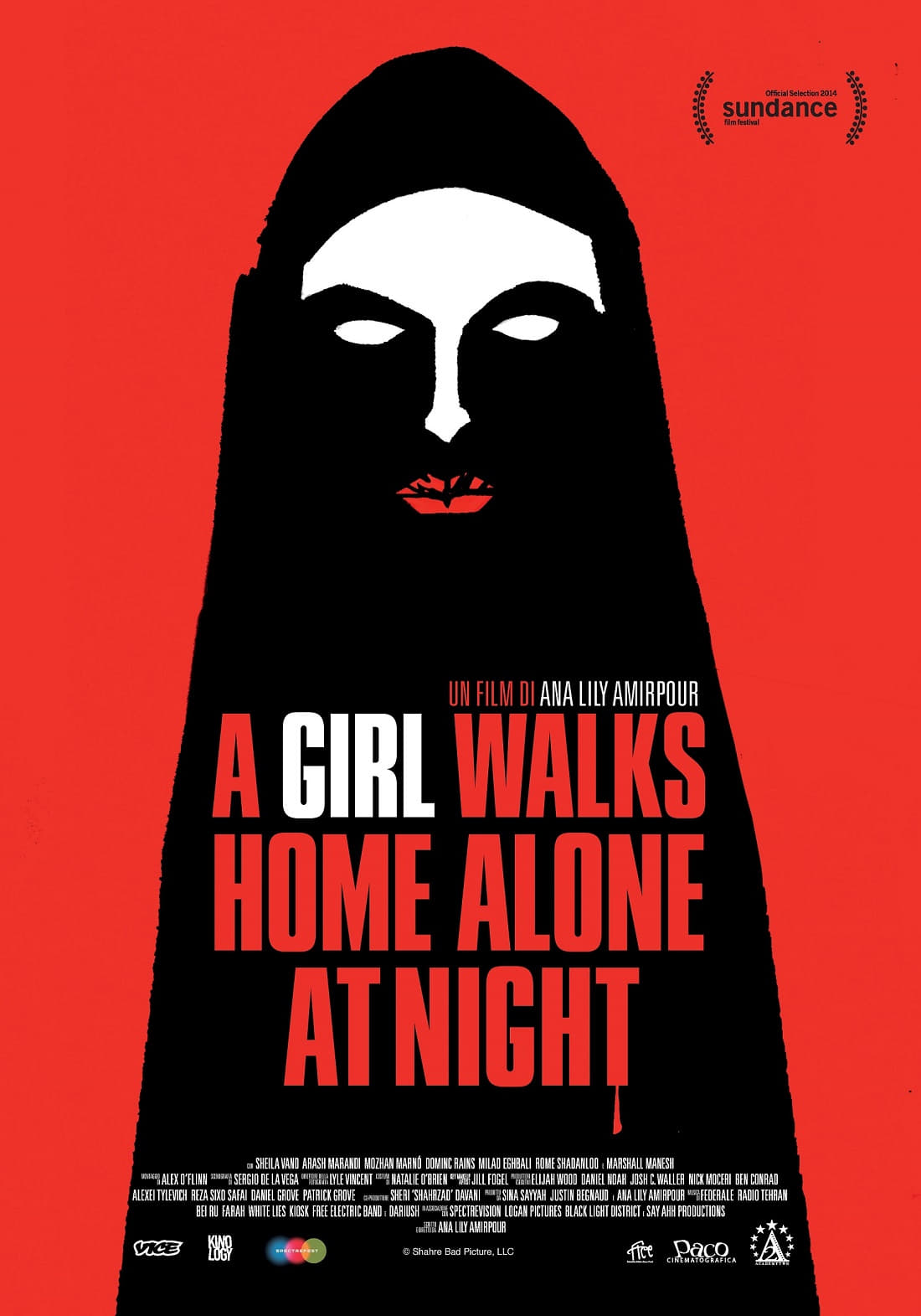
A Girl Walks Home Alone at Night (2014) - I'm bad. I've done bad things.


It's the fifth Letterboxd Season Challenge!  Theme eight, part two - a foreign horror film!

(Chosen by Jackie!)

(Well alright, A Girl Walks Home Alone at Night is an American production directed by a British-born Iranian-American, featuring Iranian-American actors, with dialogue in Farsi delivered in California locations.  It's not any more foreign in the traditional sense than would be any other film by a US citizen embracing their ancestry with others of a similar background.  Mistakes made, we press on regardless.)

In A Girl Walks Home Alone at Night, director Ana Lily Amirpour has crafted the ideal scene kid movie.  Though this is easily construed as a dismissive insult, I mean it as the most earnest compliment I can pay her film.  After all, we've a picture whose centerpiece revolves around two characters dressed in all black, both evoking vampiric motifs in their own way, one gently moving towards the other across an expansive widescreen with slowed-down disco ball lights rotating across the wall as the other turns into his embrace, contemplates his neck, and sinks into his arms to listen to his heartbeat instead.  All in beautiful black-and-white, all scored to "Death" by White Lies, grinding out across the screen over five whole minutes.  There's a weird techno-scored seduction scene that climaxes with a scummy drug-dealer getting his finger chomped off and throat ripped open, a cross-dresser dancing with a balloon, a quiet, awkward ear-piercing scene set against the backdrop of an empty trainyard, and, most importantly, a skateboarding vampire dressed in a black chador and striped long-sleeve.  This is a film purpose made to appeal to teens and college students who fuck with Bauhaus and Have a Nice Life and black out their windows to better appreciate the effects of poorly-strung atmospheric lighting on the posters of bands who'll never come to their town but inspire gobs of gif-based appreciation posts and self-insert fanfiction on tumblr dot gov in the year of our lord two-thousand and fourteen.  I'm deeply envious towards anyone who saw this right when it came out and felt the full sledgehammer-to-the-chest impact of finally seeing all their predilections thrown onscreen in a glorious act of stylistic exercise - those folks got exactly what they always wanted in their scant two-decades on this dying Earth.  All power to 'em, no sarcasm meant whatsoever.

The film lives and dies (and all states between) on how much appeal you can find in a slow-moving mood piece with minimal concessions to narrative.  To my mind, it takes the visual celebration pretty damned far, producing numerous memorable moments with little more than its two main characters stood before simple small-town backdrops and allowed to awkwardly interact as Farsi tunes play on the soundtrack.  There IS some character work going down, with Arash struggling under the pressure of his father's heroin addiction and eventually dealing himself when their dealer is sucked dry, while the nameless girl displays a streak for enacting justice and intimidation on the people of Bad City, pines for an immaterial long-lost something, and draws closer and closer to Arash through the force of what I (stealing from Connie) can only describe as his big dumbass energy.  Act delineations are primarily marked by the girl making a kill that impacts Arash's life in some manner, and their relationship takes a strange turn when she gives him what he always thought he wanted, without the film's taking time to explore what this will mean for them in the future.  Beyond these elements, A Girl Walks Home Alone at Night is far, far more about the sublimity of the girl rolling down an empty suburban street with her chador billowing in the wind, or Arash, blasted out of his mind on ecstasy and dressed in a Dracula cape, hobbling to a sitting position while the girl tries to steady him and bring him back to her place.  Time beyond these two is mostly dedicated to the small supporting cast, who exist to either more clearly define aspects of the girl's mysterious personality through bracing encounters, or do wrong so she can punctuate the moment with a swift bite to the neck, again through scenes better defined by their stark imagery than writing or acting.

Normally, I'm in favor beyond belief of works that presume the eyeline's slow journey from exposed neck to nestled beating heart are interesting in and of themselves, and turn out absolutely correct.  Here, however, I think Amirpour's decision to leave a skeleton narrative at the center results in... not exactly a poorer film, but rather one I can't help see as fallen short of its potential.  If it were exclusively a mood piece, following the camera's bliss and leaving interpretation of Arash and the girl's lives entirely to the audience, I'd find the film far more intriguing in a good way.  As filmed, there exist components like the girl savagely drinking from an unconscious homeless man, which indicates the presence of a basal need to feed beyond her active, motivated choice in targets, or the unmistakable contrast in how Saeed the dealer seductively dances towards the girl before his death and Arash's careful move to embrace her later on, which raises the question of, "Why him, exactly?" when coupled with the first point.  We see the girl express kinship with Atti the prostitute along the dimension of lost dreams and forgotten remembrances, and something in Sheila Vand's performance communicates a bottomless sadness, but there are no guideposts, no indications Amirpour means us to travel these lines of thought with intent or direction.  There's a potentially fascinating study about why Arash is the one to bring the girl beyond her situation, or how the girl's interactions with Arash liberate him whilst also crippling what seemed a potential future on his own two feet, or else some treatise on her vampiric nature reflecting or rejecting views of women in Iranian society, whether you choose to construe it as parasitic or liberating, and what that might mean for her as a person.

The film, essentially, has its toes dipped into the pool of conventional narrative just deep enough to intrigue me, and a few moments where it lowers a whole foot in and reveals great potential for these gorgeous images to become so much more in the ripples it creates; yet its dedication to being as much a visually-driven, story-free experience as possible means it never takes the full plunge and explores that which it teases to the fullest.  Perhaps I'm being a touch stupid here, asking a deliberately ambiguous film to flesh out what it only means to tease, to elaborate where silence is the intent.  In my defense, my own aesthetic concerns almost always lie with purity of form: while a work may eschew storytelling conventions and be for the sake of some ideal towards beauty or horror or coolness, if it chooses to keep a minimal story and even develop this story to some degree, I'm going to want either the story's removal or a greater cohesion between idea and image.  Blending the two often leads to feeling a weaker story, and images that would hit more potently entirely on their own or in active cooperation with an idea.  Applied here, I understand Amirpour's intent, I really do, but she has tantalized me with the possibility of seeing this picture play out with her thoughts and feelings guiding and interacting with my own, giving me insight into the specifics she's teased.  To not get these is consistent with her aims as director, and yet I cannot shake the notion of her film improving if I knew her perspective on some of these more interesting ideas beyond, "It's up to you."

That which is ambiguous about A Girl Walks Home Alone at Night would entice me to think on it as a vagary all the more if it were purely sound and vision instead of neglected narrative, basically.  Flipwise, sacrificing some of the ambiguity for specificity would work wonders in my assessment.  Again, I'm probably being stupid and unappreciative here, but I like what I like for the reasons I like it, and find it hard to stop thinking this film better if aesthetically pushed further one way or the other.  Those scenes that work still work like all hell regardless of my artistic preferences towards storytelling - I've been replaying the "Death" scene in my head all day, it's so powerful a moment.  Watch beyond the form-based hang-ups of someone who thinks Danger! Diabolik the ideal comic book movie, and you've nevertheless a splendent post-punk vampiric impression upon the brain, something unique and dark and beautiful, well-worth a watch and however many hours of debate it inspires, internal and external alike.  Shred on, you funky little vampire you.

3.5/5

Wednesday, February 5, 2020

Days of Heaven (1978) - I was hopin' things would work out for her. She was a good friend of mine.


It's the fifth Letterboxd Season Challenge! Theme seven, part two - one of Spike Lee's essential films for aspiring directors!

(Chosen by Jackie!)

The conventional approach to discussing Terrence Malick's Days of Heaven is to focus on its visual aspects. Rightly so, given its award-winning cinematography with the oft-noted golden hour exteriors emblazoning silhouettes against a gorgeous sky, and the freeform editing techniques at play affording a higher number of beautiful shots than your average movie without sacrificing its deliberate pace or contemplative tone. One could easily write a review doing little else beyond listing off the film's best shots one after another, and still communicate a good deal of what makes Days of Heaven such a gripping work of visual fiction. To get at what grabs me about Days of Heaven, though, we'll need to set aside its famed visuals, and focus on the sonic, for it is through the sound design that I think the film finds its greatest cohesion and meaning.

It is, after all, through a deafening cacophony loud as the world that we enter the picture, in a Chicago steel mill where the clatter crash clack racket bang thump of enormous machines completely swallows the particulars of an argument between Richard Gere's Bill and a foreman before the former kills the latter. Following sequences of Bill, his sister Linda (Linda Manz), and girlfriend who pretends to be his sister Abby (Brooke Adams) fleeing via train, starting on as hired hands on a wheat farm, and working the fields amongst an expansive cast of background players are equally devoid of specific information, with the camera frequently too far away to capture conversation, the voices in a crowd too numerous for total comprehension when we can hear dialogue, Ennio Morricone's score too busy with its swells and strings and swirls to give diagetic sound its due. When we are privy to spoken words, they are frequently brief, terse snatches, words exchanged in a free passing moment or divorced from the larger context by a cut to later. Our only consistent human voice throughout belongs to Linda, whose narration is as enigmatic and breezy as the editing, occasionally providing bits and bobs of inner thought we might not gauge from what we see, but most often engaging in its own form of contemplating a distant house rising above the wheat fields or staring at a grasshopper munching away at a corner of wheat by musing about esoteric matters of the heart and mind.

From the word go, Days of Heaven impresses itself as a film unconcerned with specificity, one with a far keener interest in the in-between moments of its plotted happenings. Approached like a conventional story, I doubt there's more than five concentrated minutes for the love triangle between Bill, Abby, and the sickly farmer they intend to con with a disingenuous marriage. Prior to the second act wedding, Malick's eye is on the community of workers, their hard work in the fields, their blessings upon the crops, their lines to get paid, their celebrations of a harvest well reaped, with equal weight assigned to Linda's friendship with an unnamed older girl as Bill and Abby noticing the farmer's interest in her. Afterwards, domestic drama and fears of cuckoldry are of secondary importance to the now-isolated group functioning as budding family, bedding down for winter and eventually preparing for the next harvest; even scenes where characters directly confront one another about their suspicions or toy with the possibility of murder are more about the place and mood than what the actors are doing or the characters thinking. The twin climaxes reflect this, first with the spark between natural disaster of the locust swarm and manmade disaster of the wheat fire coming with the exact moment of the farmer's rage finally breaking getting lost in the flurry of both, and then with how casually and lengthily it moves past Bill's final fate despite his actions causing every major plot development in the film. Malick's attentions are elsewhere. He's out here to explore life and experiences beyond the rigors of a Spartanly slight plot.

And yes, the vistas of characters against a dusky sky with their features darkened to nothing yet their outlines visible as midday and the wandering editing system concerned just as much with a man tapdancing to entertain a crowd as the farmer watching Bill and Abby steal away precious moments in righteous jealousy are primary means of communicating to the audience an intent to do more than bunker down on character development and traditional storytelling. This noted, I do very much believe the sonic landscape as crafted by Malick's audio engineering crew pulls a great deal of weight in getting you into the right headspace for appreciating the visuals' effect. I've already noted how cacophonous the sound of machines and crowds and raging fire can become, and how they drown out individual voices in moments of celebration, blind panic, and total indifference, but the swallowing effect really becomes complete and all-encompassing with how much the silent moments do the very same. Days of Heaven often dives so deep into its contemplation of minute detail, even Morricone's score is nearly lost to the emptiness of a room absent its usual figures, or a country sky stretching along for miles upon miles. The wind rolls along the plains, tickling stalks of wheat as it goes, captures a voice, and blows right on by without a second thought. A lone thought dances upon the breeze, its words and ideas as scintillating yet enigmatic and uninvolved as the currents it rides. Whether the world roars with the voice of a million locusts lit aflame, musically mirrors the exultation of a mass of persons rushing for a train, or falls to all-encompassing silence so total even thought itself becomes dull and distant, the individual, traditionally recognizable human experience stands as the farmhouse often does on the horizon: identifiable as itself, still significant by its presence, but rendered a smaller part of a larger whole by all that threatens to envelop it from every side.

I'd go so far as to say my own interpretation of Malick's open-ended cinematic landscape is highly dependent on viewing it as a reflection of how I read his soundscape. Those characters who skulk beneath the breeze's touch, who plan and plot and secret away all manner of hidden reasons for being, who refuse to speak for fear of not being understood, are effectively torn to shreds by the slicing force of the world around them roughly gashing their unwillingness to flow freely. In simpler terms, Bill and the farmer, our most traditionally active characters, adopt attitudes of deceptiveness and righteousness respectively the face of fates that threaten to toss them about, plant their feet too firmly, and allow their unexpressed passions to broil beneath the surface until they explode into fire and murderous rage and unfocused flight. By contrast, Linda is a decidedly uninvolved character, tossed from place to place by the decisions and failings of others, and merely tries to keep herself afloat and engaged wherever the winds may take her. Her status as weaving, winding narrator indicates this quite clearly, and the way her final words sound as if they're meant to lead into another statement before the film fades to credits casts her as a leaf who'll continue her travels whatever they mean. Abby, caught between the two states of being as one who engages in the shifting modes of living more than those around her while still entangled in Bill and the farmer's plotting, finds herself a far more ambiguous end, taking a train full of soldiers on the wings of swelling music rather than walking away of her own power to the sound of her own voice like Linda does. They who can adapt and flow through tumultuous times and settle where they settle are afforded far kinder fates than those who strain or fight against the voice-taking wind, in effect.

Speaking briefly on the film as it relates to Spike Lee's recommendation to aspiring directors, I think the primary takeaway should be one of willingness to step back and flow. Replicating Malick's exact process for crafting Days of Heaven is suicidal folly in the modern industry (hell, even in the New Hollywood days falling so vastly behind schedule with no plan for the look or feel of the final result after a year in the editing bay would likely cost most other directors the job), but the driving philosophy of being like wind, appreciating the world from a perspective alien to most persons, with a willingness to lose out on hard cognitive detail now for the sake of capturing a richer texture makes for an admirable, enviable mindset. You see this across all levels of Days of Heaven, the visual and the audio and the intangible, and it speaks to a deep enough confidence in technical craftsmanship to strive for an achieve something open and mutable and beautiful. Can't quite advocate anyone go full Malick unless they've already proven themselves or are exceptionally willing to take on a nightmarishly heavy risk, but considering the results he achieves here, a little stylistic adoption couldn't hurt.

4.5/5

Thursday, January 2, 2020

Limite (1931) - How would you feel if I told you she had leprosy?

Letterboxd Season Challenge 2019-2020!  Theme six, part one - a South American film!

(Chosen by me!)

A preface: Limite shall not receive a numerical rating at this review's conclusion.  Though claiming, "You watched this movie wrong!" is typically anathema to my perspectives as a critic and film fan alike, reviewing my own reactions as the film unfolded led me to believe I did exactly this.  Per the Walter Salles video essay accompanying the film on Criterion Channel as of this writing, director Mário Peixoto came from an artistic background steeped in poetry and the numerous experimental film movements across Europe in the 1920s before anything we might consider the typical narrative cinematic form.  His goals in creating Limite thus reflect this by placing emphasis on mood and movement far above any semblance of story in the manner of so many arthouse pictures, though it is not entirely a clean break.  To make a quick comparison against Tabu and the larger F.W. Murnau oeuvre, where Murnau would use a subjective camera and non-literal filmic techniques to suggest more spiritual passages or plunge his world into total otherness whilst still telling a story, Peixoto deploys what few narrative elements he has in complete subservience to the emotional thematic explorations on-screen.  Someone with more modern expectations of how films with narrative passages function might see these moments, and feel inclined to extrapolate narrative structural intent where there is none.

Or, put in simpler terms: the framing device with the boat threw me for a loop, because I thought it was going to be important to discern how each of the three silent, morose passengers came to be there, and spent more of the movie trying to puzzle out a beat-to-beat structure than appreciating the imagery and poetry Pexioto conjures.  Limite is an incredibly difficult movie to sit through with this mindset, as its many exploratory and experimental passages come to feel like lengthy distractions that drag longer than one would like.  Fortunately, I came to appreciate the film's actual intent further into the picture, but by the time I did so, I'd become fidgety and somewhat agitated, and so know I did not get the full and proper Limite experience.  Trying to assign a rating under these circumstances would lead to an unfair and uninformed numerical score, one which threatens to stand out more than anything I have to say.  So, on this understanding, I'll spend the rest of this review trying to communicate my analytical perspective on what Limite is an how it functions, and hopefully we'll get something more worthwhile from the exercise than me focusing on how I was, in a word, more bored than I'd've liked while watching.

So, that framing device.  After we see a woman gazing into the camera with rough, handcuffed hands round her neck, visions of a distant, tumultuous sea dancing before her eyes, we fade (as we do for numerous shots across the whole film) to a ramshackle rowboat with three people inside, a man and two women.  The man is perpetually bent over in contemplation, occasionally accepting something to eat or sharing a glance with his companions, but primarily affecting an air of one who wishes to never talk again.  The first woman, dressed in white, though occasionally animate and friendly, soon comes to turn her back against her fellow seabound captives, and stare out at the waves without showing the camera her face for most of the film.  The second woman, this one in black, lies on the boat's floor for much of the introduction, soon comes to sit next to the man in much the same pose, though she seems somewhat distressed by how the first woman will not make eye-contact.  Towards the end of the film, the man spies something in the distance and dives off the boat to chase after it, and following a montage of foamy waves breaking against the rocks and one another, we find the first woman clinging to a board from the capsized boat, with no sign of her companions, or any human life for miles around.

The above represents the entirety of what Limite communicates about its characters in the framing device.  Over the course of the first hour or so, we learn the man was a fisher who fell in love with another man's wife, the first woman was an escaped convict, and the second woman left a dissatisfactory marriage.  This, now, represents the entirety of what Limite will tell us about its characters, for their attempts to recollect their experiences clash directly against the film's theme.  Oftentimes when we follow them into their memories, we will trace their steps as they traverse long distances, only for the camera to get caught up in panning across a recently logged stretch of forest and have to jog back a few paces to find its subject crouched and weeping by a gate, or else wander away from their perspective entirety to focus on the wavering of a half-blown-away dandelion.  Our camera is happy to sit behind one subject as she stares into a lake that appears to be a sky, only to go whirling through the air the second her attention is the tiniest bit distracted, pulling alley-oops and loop-de-loops through the sky in a total desynchronization with her literal experience.  Sometimes it will track upwards into the pure white of sky and remain lost there for a good minute, or pan down across the blurred, radiant light from a white newspaper and white dress reflecting the midday sun, or float away from them to view the already striking fauna in the area through a negative filter that bathes all these sharp black objects in a white halo.

These people are not the camera's primary concern in Limite, and yet we always come back to them.  When we do stick around to see what's going on, we find their lives little more than turbulent chaos.  The man streaks through a field in agony, screaming out for someone as the camera rapidly zooms in on his face on the same cut again and again until he's tripping over the grassy hillside and can no longer remain upright.  One woman is glimpsed at a sewing machine, the camera lingering over extreme close-ups of her various tools, before a tight view of her scissor blades finds her sliding a finger across the entire edge, and then cuts to black.  The other spends quite a considerable time trudging along a dusty path, only to confront a man at the top of the stairs with a long, withering glower, before trudging back out to who knows where.  And even still, when the camera bothers with a human perspective, it will leave these characters behind in favor of repeatedly zooming on a fountain hole spitting water, staring up at a pair of might carved crosses, or resting on a train wheel's pivot as it begins to spin away from the station.  As a whole, the film only breaks from purely visual expression to communicate with language a total of two times - once when we glimpse a newspaper headline, and once when the man is told some particular information about the woman he's running an affair with that could only come through dialogue.

All of these sequences, sympathetic to the characters' lives or no, recognizably human or wholly nature-focused, are presented as memories.  Flashbacks.  We fades to and from them from within the rowboat, and when the characters are unable to strike up conversation, set about to paddling anywhere (as one of the woman fails to at one point), or do anything save sit and glower, they resolve to sit and glower and remember some more.  And it must be understood, these are not typical filmic flashbacks, for your typical film will render a memory much the same way it renders literal, immediate reality; maybe you'll get a hazy filter or a hint of an unreliable narrator to differentiate the two states, but on the whole the effect is the same.  With Limite, Pexioto seems determined to do nothing short of capture the entire experience of a memory.

You're a person if you're reading this, you know how it goes.  The way your brain catalogs and retrieves information is not based in pure 1:1 recollection of events as they happened, and a memory is not ONLY the events as you perceived them.  There's a complex tangle of associated emotions, wandering thoughts, trivial recollections, a sense of a wider life lived beyond the context of this one event.  The most unimportant little moments stand out, and you may well recall the sight of a half-naked dandelion head dancing in the breeze better than your passage down a dusty road on a difficult day, or feel as if your head went spinning off a cliffside and into oblivion as you contemplated the last few hours, or remember the world as nothing but the view of a blinding white sky as you experience profound agony.  From a cinematic perspective, it is incredibly difficult to capture a feeling so deep into the emotionally subjective as to leave behind any recognizable human experience, so the best way to capture this is by following impulse, and crafting images well beyond anything recognizably empathetic or human in the midst of what you present as a memory.

There's really no use in trying to understand the three characters trapped on the rowboat, as we see with the aforementioned final montage of waves.  Much as listening to someone else recollect their dream can be boring because you don't have all the associations necessary to really GET it, watching someone remember as a film acknowledges the full extent of sensory ties and wandering thoughts tied to a memory is a difficult, frustrating exercise.  You'll gleam feeling far more readily than logical sense, so Limite feels a sad, disgruntled, cornered experience that can tell you what emotional peaks marked these characters' final decision to get into a boat together, but never what events marked the journey beyond some broad sense of who they are and where they came from.  Because this is completely divorced from the larger life experiences required to really grok their perspective, you see the limits of perception and communication come into sharp focus as the film goes on.

Trying to directly transplant a memory - not the words one would use to describe it, or the images one would use to represent the actual event it draws upon, but the full, complicated, messy extent of a memory, lengthy connective tendrils and all - is practically impossible.  You'll sooner break the cuffs round your own neck that restrain you from communicating the whole, undiluted, compromise-free experience of your own life than get these three people except as emotional entities.  Which, ultimately, is the best we can do in daily life anyhow.

I'm aware I do something like this any time I come across a really old film missing any part of itself, and I'm aware it's not entirely fair to either old silents fortunate enough to receive a full restoration or the ones completely lost to time, as it implies a nobility in being incomplete, but I think one can best understand Limite through the single scene Pereira de Mello and later the Mário Peixoto Archives were not able to restore.  In the early going, as the quality of film degrades and increasingly obscures our view of proceedings, the man turns to the woman lying on the floor in the rowboat, and we cut to an intertitle indicating he helps her in some way.  This represents one of the very few times the boatbound characters interact with each other in any meaningful way, and it is entirely obfuscated by footage too damaged to restore.  It may seem odd to consider a fortuitous loss, until one remembers the film's opening and closing shots heavily imply the rowboat scenes too are a recollection of the woman with another's cuffs round her neck.  Her back was turned to these events, and so the single most recognizably human event in the whole framing device is lost to the ages, the one meaningful moment of face-to-face interaction obliterated by there not being a memory to draw upon.  Limits of memory, limits of celluloid, pretty much one and the same.

Through all this, I think it worth remembering that while I can draw all this analysis from Limite, it was still a frustrating film for me to watch, even as someone who normally deeply enjoys experimental and silent features.  To anyone and everyone who seeks this out, be it through Criterion or one of the film's numerous YouTube uploads, I'd recommend the following - do not watch it as you would another film.  Set aside notions of narrative satiation at the door, regardless of what appearances tell you during the framing device.  Simply come to experience the imagery, internalize the feelings, empathize best you can with this deliberately splintered, obtuse attempt to explore how we can never fully grasp where these people came from and where they are going.  It will play infinitely better with this perspective in mind, and perhaps even produce understanding greater than my own.  Something like this deserves consideration on its own level, and while I've done my best to approximate an appreciation grounded at this altitude, my immediate, in-the-moment experience did not properly reflect this.  Best I can do is provide a guidepost for you the reader, and hope to see with clearer eyes whenever I next watch.

Friday, December 27, 2019

Mixed Nutcrackers: Fantasia (1940)


Call this a belated Christmas present. After a solid month of delaying season challenge stuff so we could wade through ten different Nutcracker adaptations of varying quality, we come to Fantasia, a film wholly divorced from the rest of the marathon save its use of Tchaikovsky's music in one segment, and to pull a quote from Deems Taylor, this is all to the good. Strip away the decades of filmic evolution that led Disney so far astray as to make something so uninspired and wretched as The Nutcracker and the Four Realms, roll back the years of artistic waxing and waning, settle on down for an older form of animated experimentation, and you find Fantasia, the single most diamond perfect film Walt Disney ever produced. I am tired from spending so much time plowing through Mixed Nutcrackers this last month, and from spending so much time over this last year watching and writing about so many movies, so I am going to simply extend the Christmas gift of watching Fantasia to gushing about its varied virtues in a series of bullet points. There will, as per usual, likely turn into more full-blown paragraphs, only justified as bullet points by the lack of structural linkage between each. It's my present to me, though, so we do things how I like.

  • The flow of Toccata and Fugue in D Minor hypnotizes me anew with each watch. Credit some of the effect to Deems Taylor's introductory statements, which put one in the proper frame of mind for interpreting the abstract imagery on display, but the actual lulling spell of the images on their own tell quite the story as well. From simply playing with angled colored lights on Leopold Stokowski as he conducts facing away from the audience, to filling the screen with massive fragmenting shadows of the orchestra's sections, to the abstract interpretation of musical notes floating in space as your mind drifts away from the physical and into the purely artistic. The little blue plunking ripple dots playing through the hair to represent fingers covering holes on a woodwind are always a favorite, as are the slightly jagged wavering yellow lines dancing in a stutterstep one after the other across the sky for the strings. When the piece moves beyond awareness of even the instruments and gets into simple phantasmagorical landscapes conjured by sound alone, those rolling pink-and-black-striped hills alongside the constant return to a rolling river of red akin to volcanic flows always leave one floored by how smooth and utterly natural they look for something done entirely by hand. Ending the segment on a return to Stokowski, at first a small figure conducting a brilliant sunrise before we zoom in to find him commanding little more than a glaring, solid block of red, makes the perfect scene-setter for the rest of Fantasia. We're here to watch a dance between sound and vision, overseen by a massive crew so powerful and firm a guiding hand that it looks as if a single figure instructs its complexities by magic, and it is beautiful.
  • Of all the pieces in Fantasia, the Nutcracker Suite sounds most different from its traditional interpretation - most other pieces undergo some form of rearrangement to suit the story flow, but where the Rite of Spring and the Pastoral Symphony mostly resemble the conventional choices in modern, standardized orchestration, and Night on Bald Mountain practically set the piece's standard sound, the Nutcracker Suite was a solid decade and change out from its reinvention and revitalization in the New York ballet. As such, the instrumentation on many of its movements isn't quite what you've come to expect from their use as Christmas staples in prior decades. The Russian Dance, for instance, features reedier sounding strings and a heavier emphasis on percussion than the newer variations, while the Sugarplum Fairy Dance has a gentler, slightly eerier vibe than the more familiar crystalline, ringing interpretation. With how omnipresent many of these pieces are in the broader popular culture (and even how familiar pieces like the Arabic Dance are to the ballet community), the deviating musical choices here help make Fantasia's version of Tchaikovsky's music fall upon fresh ears every time, exactly as radical visual reinterpretations like this should.
  • Disney's animation department was really well truly at the top of their game in 1940, right? The sparkling play of dewdrops across multiplane background elements and spider's silk as fairies prepare a garden for the dawn, the elegant, flowing gossamer on the fish fins as they whirl in an underwater dance, the beautiful skipping dance of flower petals and leaves on the wind in time with the music without feeling like they're doing anything other than following a natural current upon the air, the way palpably chilly patterns of ice appears at the fairies' feet when they skate across the water as individually designed snowflakes drift down from the sky? Not to mention working multiple approaches to humanizing the non-human, from the elongated lithe torsos on the fairies, to the fish with little more than solid heads attached to practically strips of fabric, to the two wholly different modes of making anthropomorphized flowers dance between the Russian Dance and Waltz of Reed Flutes that are equally suited to the flying leaps and spinning grace of both pieces, to the unfortunate but still adorable mushrooms pitter-pattering about during the Chinese Dance? I love looking at this segment so much, and have to wonder what if Walt's ambitions came to fruition, what if we really did see animation take a turn towards Fantasia's ambitions in the following decades, without the war and the strike and the public disinterest? It's a massive shame more works at this level never came to be, even if it does leave Fantasia feeling wholly unique.
  • If Mickey Mouse is gonna hang about the movie, he might as well hang about in the best-looking Mickey Mouse short ever drawn, yeah? The Sorcerer's Apprentice is a little bit unusual for Fantasia, considering it's the only segment to function like a morality play, what with Mickey skiving off his master's discipline-building task to take the easy route of enchanting a broom to carry the water for him, and finding his efforts arrested by an inability to stop what he's started. It still works well as part of the whole, though, entirely because it ALSO functions as a chance for the animation team to show off how good they'd gotten at character animation on their flagship face, how the water effects in Pinnochio weren't merely a one-off fluke, how they could take something so simple and silly as a broom with arms and transform it into a series of arresting images by multiplying the thing and sending it on a shadow-heavy unstoppable march. The additional minor fun of playing with smoke to form bats and butterflies, the shooting stars in Mickey's dream, and Bill Tytla showing off by animating the only realistically-proportioned human in the film with some of its most subtly expressive movements enhances the fun all the more. This isn't really Mickey's movie, but he advances the project's ambitions so much by showing how a simple Mickey Mouse cartoon, once the realm of light entertainment for the real show, can stand as a legitimately artistic, lovingly-crafted work alongside the more immediately art-like pieces before and after.
  • I'm legitimately joke angry about the galaxy that starts The Rite of Spring. Just... look the thing up sometime, find a copy of Fantasia and LOOK at it. The thing's an equal to any galaxy you see animated by computers for bottom-of-the-barrel programs on the Science Channel nowadays, and they did it by HAND. S'enough to make a full-grown person cry at its beauty and the skill necessary to get it twinkling and rotating like that. Makes the sorta wonky sun we see a few seconds later all the funnier lookin', tho.
  • While the creature design in The Rite of Spring is hopelessly outdated by modern palentological standards, it holds infinite charm for me all the same. Contrast between the natural elegance of lava bubbling and flowing and tearing the earth asunder, and the pencil sketch-like early single cell organisms in the Cambrian seas make the slow march towards complex life highly satisfying to watch, particularly once we make the leap to the dinosaurs and see the sheer diversity on offer. They're quite unlike anything in the Disney style without deviating so much as to be unrecognizable as something from their house, and whether we're considering the swooping pteranodons, the massively bulky stegosauri, or the monstrous early vision of a T-rex, each offers some insight into how the late 1930s' understanding of fossil records mingled in conversation with an artist's impulse for what's most striking and memorable. I'd love to see someone, anyone, Bogleech, run a retrospective on all the designs on display here, and how they stack up to what we know now. Even if many of the ideas are a little bit silly (there's a jellyfish using its tentacles to snare a fish and chew with its membrane), an article to this effect would delight me to an equal extent as the segment itself.
  • I don't know why, but I've always liked the effect of rendering one of the brontosaurs in a panning shot as primarily painted background element for the main body, with an animated neck and head stretching out into the distance. Gets across depth in the shot quite well, and I notice it in particular every single time I watch Fantasia.
  • Leave it to Disney's Golden Age animator stable to construct a memorable, charming character from nothing but pleasing abstract shapes and pitch-perfect timing. The part where Taylor interviews the soundtrack and coaxes the simple vertical line to demonstrate its potential by vibrating in time to different instruments is an easy highlight. The fat, jiggly slabs meant to represent a bassoon's lowest notes are the absolute best, though the cheeky little triangle ting at the end of the percussion section and the wild flare they put into animating the brass make solid contenders for the title. Its little jig to the right before sliding off-screen also pleases one to no end.
  • Confession time: While Fantasia is very much the perfect movie, and while I will fight anyone who says otherwise verbally and physically, the Pastoral Symphony is always where I start to fidget in my seat just a little bit, and check the time remaining where the previous segments kept me wholly engaged and enraptured. This, I think, comes more down to my own issues with sitting still and focusing for extended periods of time than any fault of Fantasia's, for the Pastoral Symphony's vision of Grecian mythology is still a wondrous thing to look at, all gentle pastels and soft character designs and gentleness right up until Zeus shows up for a little bit of what Zeus does second best. The pegasi look majestic, their children adorable, the centaur's appropriately suave and dopey, that little romance between the blue centaurs gets me right there in the chest, the 40s Disney vision of Dionysus is about as perfect as you can get, and I am once again made angry by how lovely Iris' rainbow and the starry Athena shooting a flaming arrow cross the sky look for how much effort it must've taken to get them looking just right. It's mostly just... I don't have much to say regarding overall effect or place in the program here; it's gorgeous and gorgeosity made manifest through paint and paper and celluloid, and I've little more to contribute to the larger conversation than "purdy." Which is fine, cause sometimes a piece of art appeals to you aesthetically for no real deeper reason, and you can love it for what it is on a surface level just as is.
  • If there's one spot where the modern, widely available version of Fantasia legitimately clunks, it's when they have to awkwardly repeat some shots of a centaur strutting and posing for the camera in order to realign the visuals to the music after chopping out a solo shot of Sunflower the Racist Caricature. I'm not at all sure how you could make up for the time difference with any elegance short of biting the bullet and reinstating her for historical purposes, but even without knowing why the repetition happens, one can still tell it's not a natural choice by the original team. 
  • Every time I watch Fantasia, without exception, without fail, The Dance of the Hours starts up, and I expect it to be the place where my opinion lessens and I go, "Well this one part isn't quite so good as the rest." The whole thing's more directly comedic than any of the other segments, basing itself around the joke of performing a ballet with awkwardly shaped animals not at all suited for executing pirouettes or pliés or grand jetés. We're effectively watching a more conventional funny animal cartoon in the midst of a film about to thunder into one of the best animated finales ever put to screen, so the expectation for it to suck the joy out've the room comes wandering in uninvited without fail. And yet, I always enjoy The Dance of the Hours. As a technical achievement it's not quite the equal to those it follows, but it's a damned impressive funny animal cartoon with a wide display of body shapes and weights and impossibilities made feasible thanks to expressive characters, personable sight gags, and a sympathetic environment shifting through times of day across lovely looking color shifts. As a part of Fantasia, it works well for the same reason Mickey's appearance earlier in the film does: Disney built its bones on these funny animal cartoons, so even though they're reaching for higher and higher artistic ambitions with ideals towards the mainstream recognizing animation as a serious technique, they're not gonna forget where they came from. They're gonna elevate the funny animal cartoon by putting all their skills to use for the BEST, most graceful funny animal cartoon they can possibly manage, and I'll be smacked if they didn't produce something with admirable pacing, imaginative twists and turns, and a killer ending with the whole anarchic jumble the finale became capping with a pull back to the palace doors slamming so hard they fall off their hinges. Fantasia leaps my worries about this segment every year, solidifies itself as a favorite by assuring me it displays mastery of every technique it tries, and leaves the air clear for ideal enjoyment of its final part.
  • That Fantasia positions The Dance of the Hours' funny animal cartoon right next to its exploration of the profane and the sacred in Night on Bald Mountain/Ave Maria speaks to Walt Disney's confidence in animation's potential as a high-minded, cultured artform to equal painting or opera. You can explore the medium's most pedestrian, every-day, mass-appeal application to its fullest extent with no shame about laughing at the absurdity of hippos and elephants serving as ballerinas, turn around for a trip into the deepest bowels of hell rising up to manifest themselves upon this sinful earth in a gorgeous and frightening danse macabre, and then depict a pilgrim's journey of the long winding path to find beauty and divinity in the simple act of watching a sunrise, and have it all WORK because you're good at your job and have a vision in your mind, a spark in your eyes, and an army of hands and machines capable of bringing it all to life. Fantasia's last and best segment is so much better for working in conversation with something so simple and pleasing as "the animals they are too ungainly to dance," and illustrates Fantasia's main point better than any other individual part. It's all art, it's all beautiful, it's all worthy of love and care and admiration and immortality and all the other fine descriptive words for something so insightful and perfect. Even that which we might consider lesser deserves appreciation at the same level as the holy.
  • And yeah, even leaving aside how they interact with the movie at large, Night on Bald Mountain/Ave Maria are technical accomplishments beyond compare, in the Disney oeuvre and in the larger animation industry. I've never understood or found sources explaining just what they did to make the ghostly spirits rising from their graves and flying to the mountain peak look the way they do, but it communicates the dead rising to roam the earth better than anything else I've ever seen. Tytla's work on Chernabog is nothing short of masterful, be it his powerful flexing as he unfolds his wings, his sweeping gestures as he summons the damned to his domain, the way his face twists and contorts itself into new expressions in close-up, or the way he becomes a pillar of evil's eternal power in the sequence's final shot before cowering back to inert rock. The maelstrom of hellfire which consumes his followers and sweeps demonic figures across the camera is beautiful as it is terrible. I am all about the way they render Chernabog's exposure to the ringing light of church bells by transitioning his figure from the solid inky blacks to what look like heavy pencil sketch fills and back on each chime. And as to the pilgrims' progress through several Disney's most complex ever multiplane camera shots, well... they inspire one. Inspire one to contemplate the purpose of a disciplined walk, lit candle in hand, face obscured, following a winding path through the damp, dense woods, knowing evil lurks out there somewhere, following the hard trail laid down by ancestors long past, for the purpose of appreciating the effort behind each step, the beauty of the world scantly illuminated by your tiny light as dawn builds all around. The revelation of just how profound the simple sight of clouds drifting through the sky on a sunny morning can be with thoughts of grace in your skull. How all this, how the wild torment of wicked madness and the slow, methodical approach to showing the beauty and specialness in something that happens every day when seen with the right eyes, is directly reflective of the work necessary to make something like Fantasia possible.

God, I love this movie. Can we not talk about any other movies from now on? Can I just keep watching Fantasia once every few weeks, jotting down some new thoughts about something I noticed fresh this time, and forget about all the other bad films out there? I know we can't, for Fantasia wouldn't appear half so special if it didn't have the whole cinematic landscape to tower over as a magnificent, impeccable work of filmmaking, but... I don't wanna come down, man. The whole world seems beautiful as Fantasia from up here. I'll press on as always, cause I won't find new towers to survey the land from and find peace atop, but you won't catch me at all liking it. And we can always return here whenever we like, for the simple pleasure of being and seeing.

5/5

Friday, November 22, 2019

The Phantom Carriage (1921) - Lord, please let my soul come to maturity before it is reaped.


Letterboxd Season Challenge 2019-2020!  Theme four, part three - a silent horror film!

(Chosen by John!)

The last time I reviewed The Phantom Carriage, much of my discussion centered on the film's most notable supernatural element, of the last poor soul to die at the strike of New Years' midnight condemned to drive Death's carriage over nights that last thousands of years until the clock's next year-marking strike. What I identified as "the real meat of the film" occupies a rather brief paragraph before I get back to meditating on personifications of death and the overall effect of dwelling in semi-darkness through the cinematic medium.  In my defense, I was just getting started with long-form reviewing at this point, and trying to spit out my reviews soon as I finished watching to boot.  On this rewatch, I think it good and right to give said meat some proper focus, and pick apart just what makes Victor Sjöström's yarn of a wretch redeemed at great cost tick along so well.

I find it notable how the film allows us to think of David as a real bastard before we truly know him.  The opening sequences focus on the bedbound Sister Edit, dying of tuberculosis and begging those around her to summon one David Holm to her side for one final meeting before her expiration.  Scenes of her attendants debating the wisdom of this decision follow, and lead into said attendants scouring the small Swedish village for some sign of this mysterious man whose presence a woman of the faith desires so greatly - but to no avail.  Dialogue hints towards David Holm deliberately dodging those who seek his presence, cuing us into his insensitivity towards those in pain and need.  We then shift focus to listen in on a drunkard regaling his friends with strange recollections of a deceased friends' beliefs about those who die at the year's final chime, presented visually through a series of stacked flashbacks.  While Georges' story about the Phantom Carriage is depicted with the film's first instance of double exposure visuals in a manner that imparts otherworldly, deathly seriousness, and Tore Svennberg's performance within David's flashback personifies a man hollowed with fear at the prospect of such a fate befalling anyone, Sjöström plays the man's pantomimed speaking on either side of the flashbacks with a silent, dismissive cackle, even as he speaks of Georges' passing in such a way as to condemn him to the fate he so feared.  It is only after we separately understand the concept of David Holm as someone who'd actively avoid a dying woman's request and this nameless man as one who laughs at misery and suffering, a good half-an-hour into the film, that we're informed they are one and the same, effectively doubling our disgust.

When Georges arrives as the driver of the Phantom Carriage to inform David of his fate for the next year and expound on how he came to this state, the way Sjöström chooses to present and cut the tale short further exemplifies how he characterizes David as a worm who deserves his fate.  Pastoral scenes of David as a happily married family man with two beautiful children last only a brief time before Georges enters the scene and tempts David into a life of disorderly drunken abandonment, but they speak to how deep this man's faults run, especially to a modern eye.  Much as these scenes were likely intended as a rail against alcoholism and the damaging effects it wreaks upon society (especially given the original Selma Lagerlöf novel's commissioned purpose as public education about tuberculosis), I see David's quick descent as emblemizing the true immaturity of his soul.  What kind of man would turn to such vicious, nasty behavior as deliberately destroying a kindly Salvation Army woman's hard work on repairing his coat with full knowledge of the infectious risk she took in doing so after but a few rounds at the bottle and a brief stint in jail, if not one who didn't truly appreciate what he has?  True, the loss of his family is a devastating blow, but we begin this stretch of film with a David who acts the regular family man, and end it with one willing to risk others' deaths just because he's feeling particularly mean this morning, separated by only a month or two at most.  ANY minor slip would've brought him to this state, and exposed his unfitness to do more than forlornly usher souls to the beyond.

Most interesting of all to me on this watch, I find it fascinating how Sjöström continues David's damnation through the final stretch, and yet still finds reason to bring about his redemption.  When Georges forces David's spirit to stand beside Sister Edit's bed, and listen to her recollections about his life since she knew him, it paints a picture of a soul only a few shades removed from a true moral blackness.  In these passages, David deliberately coughs on people in the hopes his consumption will finish them off, professes a profound hatred for all joy in life, hunts his wife all across Sweden to the point of driving her to illness and exhaustion, reunites with her under false pretenses, deliberately risks infecting his children, and pulls what would become known in sixty years' time as A Jack Torrance with an axe - the only thing saving him from total irredeemablity is his unwillingness to take a swing at his wife once free.  Worst of all, the infection David earlier passed to Edit claims her life towards the picture's end, robbing the world of a truly selfless soul, one who looked on a wretch like David and saw someone deserving kindness and love and sacrifice, and pursued these beliefs to no avail beyond their respective deaths and the increased suffering of all who knew him.  There is practically no reason to want this man to do anything except suffer for the millennia that will pass before he must hand the carriage's reins over to another unfortunate bastard.

And yet he is redeemed.  When David Holm catches sight of his wife, in utter poverty, preparing poison to kill her children and take her own life to end their suffering, he is overcome with such agony at Georges' powerlessness over the living that he is granted a reprieve.  He wakes in the graveyard where he expired, rushes home, saves his wife, and convinces her of his true desire to reform, uttering the above-quoted prayer as the film's final word.  To my eye, David has Sister Edit's selfless kindness to thank for his salvation.  In life, her actions were met only with vindictive destruction and hateful rhetoric, which poisoned her and sank David further into his vagabond life of depravity.  In death, however, as David watches his life over again at Georges' side, seeing his cruelty with eyes free from its blinding effects, what stands out most is how far Edit went in the name of trying to help, even on so little a matter as patching the holes in his coat.  It is the sight of someone truly pure giving her all to the very end and no avail that makes David cower on the floor in an attempt to hide from the horror of his own life throughout the film's latter half, and it is the knowledge of how his living sins will continue to consume and rend apart all he held dear well past his death that gives rise to divine intervention, enabling David to truly repent, and earn a second chance at spiritual maturation before his final time of dying.

He does not deserve this.  He cost the world far, far too much in life, and stands as such a heartless, spineless bastard, I can't blame myself from nearly two years back for thinking Sjöström should've leaned into the abyss and denied David any salvation.  But at the same time, seeing a hopeless sinner realize the full implications and effects behind his careless actions and come to a second chance through purest anguish is the whole point of The Phantom Carriage.  The scenario's horror lies with its connotations beyond all else, its staying power with the impossibility of its conclusion.  Sister Edit's suffering and untimely death only possess a silver lining if we allow for the man she thought savable to the bitter end to be saved and grow beyond what he once was.  If, and only if the worst amongst us are treated as if they can one day become better is Death's terrible sting lessened, and only then does the empty void beneath the hood possess and deserve a human face.  S'a very Christian message, and one I'm happy to go along with for the sake of emotional wholeness.

4/5

Tuesday, November 12, 2019

Day Four of the Loft Film Festival - Advocate (2019) and Travelling While Black VR experience (2019)


(Skipping Saturday's screenings kinda sucks on my end, because the presenter announced the judges' having chosen Advocate for the CICAE award right before the screening, and while I'm going to give it a glowing review, finding this out before giving the film a shake for myself feels like it has ever so slightly biased me against it in favor of thinking Aga the better picture.  We'll try and leave that matter for the wrap-up post on Thursday, though, and simply write about the film as seen.)

The greatest trick Rachel Leah Jones and Philippe Bellaiche pull in Advocate is purposefully withholding a critical piece of information until the last moment.  They have, of course, an admirably clever bag of tricks to draw upon throughout, and in deference to the effectiveness of this trick, I shall do the same until towards the end, focusing instead on their other techniques for the time.  Needless to say, all the tricks in the world cannot do squat without a strong subject, and Lea Tsemel is quite worthy of nearly two hours about her life.  The film is divided between her latest cases defending a thirteen-year old Palestinian boy who stabbed two Israeli teenagers and a young Palestinian woman who detonated a bomb that killed nobody but left her mangled, and regaling her life story as a lawyer and human rights activist through media pieces throughout the decades and interviews with her family and clients, who are often one and the same.  In the present day, we see her researching cases, engaging in rapport with her legal team, dealing with press outside the courtroom, counseling her clients, and living her life in the between-spaces, giving the impression of a tough, spirited professional who still embodies great compassion without needing to set a second of it during trials.  In the past, we are perpetually reminded of how the uneasy and violent Israeli  occupation of Palestine has manifested itself in small ways over the years, and understand the importance of even one figure looking behind the decrees of terrorism and inhumanity to try and help those others decry as despicable.

In both modes of documentation, the screen often splits, typically directly along the horizontal middle, showing two different angles on the same event from either vertical slice, or segregating a third of live action footage on the left or right from photographic montages in the remaining two-thirds.  It's a simple technique, one used to increase the density of parsable information in thousands of documentaries, but it has greater impact for what often happens when part of the frame contains Tsemel's clients.  To protect their identities in moments where their faces appear, the filmmakers have commissioned traced-over animations of the live-action footage, rendering a large part of the screen a crinkled mass of paper with inked impressions of people moving through its frame.  Crucially, the paper is not mere drawing paper; it is comprised of rapidly shifting legal documents, court records and written arguments and printed laws, the sort of things Tsemel frequently consults in her line of work.  When the line dividing the client from the solid, present reality takes the same form as the line dividing footage from the past and an interviewee from the present, an entanglement forms.

These clients, though hopeless cases nobody would consider worth defending at first glance, are not just defendants in a trial with the whole nation of Israel set against them.  They are decidedly intertwined with all the lost causes and hopeless cases Tsemel has championed in the past, their fates resting on precedents formed by their attorney and the few like her who think them worth the effort.  Success doesn't just mean freedom or a reduced sentence, it means another stack of papers in the file, joining thousands of others who might help future Palestinian freedom fighters.  Even failure means another well-documented example of injustice, of how the state and the people it represents refuse to hear any possible qualifying evidence or extenuating circumstances, a tiny step forward but a step all the same.  The people Tsemel represents walk through her case histories because they themselves have become part of those histories, for good or ill, and there is perhaps no better way to defend their identities than by constantly reminding the audience of what they will represent legally in decades to come.

And yet, the last time we see Ahmed, the thirteen-year old who stabbed two Jewish boys and plead no intent to kill, the well-worn collage of documents fades away, as does much of the detail, and we only see a young boy's face, rendered with simple black lines against stark white before the slide of an invisible elevator wipes it away.  For they lost the case - Ahmed was tried as an adult and sentenced to a full twelve years.  Leah Tsemel has lost practically all of her cases.  The numerous landmark trials we're introduced to throughout the segments documenting her own history, including the time she defended her own husband for distributing anti-Israeli literature, all ended in failure.  She has lost time and again, counting her victories in the years she has shaved from her clients' sentences, the legal precedents she has set so she can do better next time, the tiniest little things others might only accept as consolation prizes.  It's the only way she can get through it all, and even still, after nearly fifty years' hard work as her state's greatest devil's advocate, she still needs a significant amount of time to process the judge's final ruling that ignored her every argument in favor of reinforcing first impressions.  After all, a young man has to face the realities ahead of him all alone, and a young woman's family feels no recourse when their suicidal daughter and sister is branded a radical terrorist.  And we have to sit there with her, and watch it all play out, and feel it with her from a million miles away.

Advocate does not pretend there is any hope a lone defense lawyer can resolve the Israel/Palestine conflict, or turn the tide of public opinion, or even make the courts care about justice when a Palestinian stands as defendant for a violent crime.  But it does offer us a picture of someone who knows all of this is impossible, and finds reason to continue the fight and scrape away at the problem while protecting and advocating for those who have no one else, while still remaining vibrantly, personably human through it all.  Letting us know Lea Tsemel has stood at the intersection of all these historic cases, inspired so many in her life, fought for decades upon decades simply because she cannot look into suffering eyes and think their plight right, and conveniently forgetting to mention she has only a small pile of relative victories to show for it rather than a blazing record of unqualified wins until the very end forces us to consider those mildly lighter sentences and changes in convicting language as valuable and important as she does.  No matter the ongoing injustice of occupation, what she has done matters.  It has to if any of this is to come to, if not a peaceful end, then a less horrid state.

4.5/5
***
Throughout the last week, I've had a particular picture of Roger Ross Williams' Travelling While Black VR experience in my head.  One hears about an Oculus-enabled piece that takes one through the history and legacy of the discrimination and violence African-Americans experienced on the road throughout the 20th century, one imagines being placed into black shoes to experience such discrimination and violence firsthand.  Facing the reality of what happened firsthand, from the inside, and considering the emotionally straining impact being targeted while minding your own business takes.  On reflection, such an experience would most certainly become exploitative and needlessly salacious, but I could imagine no other form the film would take, and so stuck to the assumption until I actually sat down and strapped on the headset inside the restored Old Pueblo trolley bus.  And boy am I glad that Ross Williams found a far more creative application for the VR tech, because it communicates its ideas  far better than what I pictured.

See, the vast majority of your time in the virtual space of Travelling While Black is spent sitting inside Ben's Chili Bowl, a Washington DC diner named as one of the safe havens for black travelers in The Negro Motorist Green Book.  Though your location within the diner will shift behind fades to black, and occasionally you will find yourself creeping through the back room in the haze of midnight or watching what seems to be the thick smoke of an evening riot while voice-over plays, the point is less transportation to a different time and place, but rather a grounding in the immediate now.  Your viewpoint is that of an observer in the booth while the people next to you recount their stories of life on the road in the mid-20th century, their fears of being killed on a police stop just for being black, the relief they felt whenever they stepped into a space named in the Green Book.  There's brief visual aids in the form of footage playing on the ceiling during some of Sandra Butler-Turesdale's narration, and a moment when you can look to your left during Courtland Cox's segment and see him as a young man reflected in a bus' mirror while the normal diner scene plays to the right, but for the most part?  You are there in the diner, listening as if you were there in the booth with these people, listening to their stories like it's any other day.

The effect is, for someone like me who's never done VR before, perhaps a little too convincing.  Even though I'm pretty sure my headset was fuzzy and out of focus, there were times in my glancing around to take in details that I would lean forward or to the side because I wanted to get a better view of something which caught my eye, only to be reminded the camera was in a static position and would not respond to THOSE kinds of head movements.  Same thing goes for trying to rest my hands on a table that wasn't there so I could listen more comfortably.  On the flip-side of this token, though, the extended segment with Samaria Rice discussing how her son was murdered whilst traveling in 2014 hits particularly hard, because it is difficult to think of yourself as anywhere but in the booth with her, and despite the ability to look anywhere else in the restaurant, I find myself compelled to look her square in the eye as she described every detail of the night.  Perhaps her testimonial was raw and powerful enough to do this in a more conventional filmic experience, but the grounding offered by VR makes it an even more impactful part of the experience than those brief segments that matched my expectations.

Travelling While Black cuts to the heart of the matter, and makes it clear that listening to black voices coming from black spaces and black experiences is more important than vicariously living those experiences in a facsimile of the real thing.  It is not the kind of experience I can rightly rate, for its impact lies beyond the conventions of how I typically judge a work, but I can easily tell you, it is more than worth the time if it comes to your town, or is made available for commercial purchase through Oculus.  I'm even willing to overlook the headache that kicked in halfway through the drive home and persisted for hours afterwards if it meant a chance to sit and listen and feel in this manner.