Showing posts with label dance on film. Show all posts

Thursday, December 12, 2019

Mixed Nutcrackers - The Nutcracker (1993)


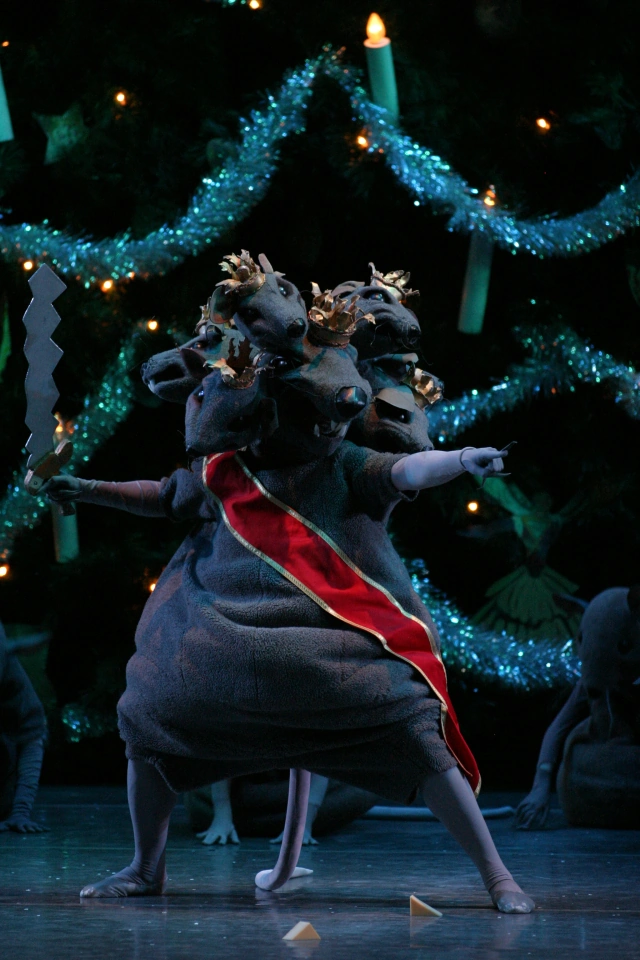
SEVEN HEADS ALERT!  SEVEN HEADS ALERT!  I REPEAT, THE MOUSE KING SHOWS UP IN 1993'S THE NUTCRACKER, AND HE HAS THE FULL, PROPER SEVEN HEADS.  THREE MOLDED COPIES OF THE CENTRAL HEADPIECE JUTTING OUT FROM BOTH SIDES, YOU COUNT 'EM UP, YOU'VE GOT ONE TWO THREE FOUR FIVE SIX SEVEN FULL HEADS!  HE AIN'T IN IT MUCH,  BUT HE MATCHES THE PROPER COUNT, AND HE'S GOT THE SAME DELIGHTFULLY ROUNDED, BAGGY BODY SUIT AS THE REST OF THE MOUSE SOLDIERS.  FIVE OUTTA FIVE.  TEN OUTTA TEN.  BEST MOVIE OF THE YEAR ALL YEARS.

Ahem.

So, this take on The Nutcracker is a bit of an odd beast.  Despite an alternate title naming it after George Balanchine's famous, life-giving and fame-bringing 1954 version of the ballet and despite drawing extensively from Peter Martin's then-present rendition, the film's overall construction gives one the impression it only exists because Kit Culkin couldn't negotiate satisfactory terms for payments on Home Alone 3, and rushed a film version of a Christmastime ballet into production so his son would have a starring role in a holiday film for the winter '93 season.  Macaulay Culkin is quite a bit more prominent than other Nutcrackers and their princely counterparts, entering the story alongside Drosselmeyer and getting teased as a potential romantic interest for Marie during the children's dancing scenes at the Christmas party.  He's got a substantial number of close-ups compared to the other major players, which reveal how Kit evidently instructed Macaulay to not move a single solitary facial muscle during the entire production, and consequently makes it seem weird the child actor so well known for his expressiveness in the Home Alone movies is playing it so dead-eyed.  Some of that might come from how Kit very obviously didn't drop a single cent on ballet lessons for Macaulay, who is asked to perform the Nutcracker Prince's dancing recap of his battle against the Mouse King (notably deleted from The Motion Picture), and does so by awkwardly shuffling in place, occasionally flourishing his arms a tiny bit, and overall looking like he does not want to be here.  Much as Tchaikovsky's ballet has the leads' absence throughout the second act baked into its traditional form, Culkin's presence makes the issue all the more head-scratching, for the constant focus on his person throughout the first act gives way to he and Clara simply sitting on the sidelines watching the cultural and candy dances with very few close-ups, and not even performing the play's final dance.  Y'all paid for The Kid What Did Home Alone In This Other Christmas Thing, now thrill as he embodies none of the traits you liked from that movie, and then gets benched so the real dancers can dance.

Course, the real dancers here aren't quite equal to those from the Bolshoi Company or the Pacific Northwest Ballet.  Lacking in technical knowhow about ballet and dance in general though I am, exposure to their filmed productions tells me there's something oddly simple about the performances here.  The group pieces are all fairly fine to my eye, big crowds in motion always having some positive effect on me regardless of technical execution, and their costumes are pretty and eye-catching all-round, so a large group in matching outfits of this type is going to work for me.  Problems arise with the solo or paired dancers, whose movements seem rather slow and restricted - the ballerina playing the Sugarplum Fairy seems especially simple and sluggish during her highlight numbers by comparison.  I have to wonder how much of these underwhelming dances are the result of my spoiling by viewing world-class performers and no one else immediately prior to this viewing, how much comes from a lack of vim and vigor during this particular production, and how much blame one can lay upon director Emile Ardolino.  I've not seen Dirty Dancing, but its reputation as one of the great dance movies led me to expect better staging and camerawork.  Where the Bolshoi production has the excuse of being a filmed live performance, and The Motion Picture works a few tricks to ease into its theatrical staging, Ardolino presents the film as 80% head-on filming of obvious stagebound sets, and renders his rare close-ups or alternate angles disappointing in effect thanks to a lack of acting from anyone onstage.  I singled out Culkin for his lifelessness due to his prominent treatment, but pretty much everyone here lacks an awareness that the camera might find them interesting at a distance any closer than fifty feet.  Such simple performances might work when viewed as live theater (not ever Nutcracker staging needs to bring the house down and strain the performers past their limits) or even filmed theater, but with the bare-minimum effort at treating this film like a movie in hand, the unimpressive footwork and static camera should make it a bit of a slog to watch.

Connie thought so, and I see where she's coming from... yet I found myself far more engaged by this production than the Bolshoi version or The Motion Picture.  I cannot call this film better than either, as despite some pretty backdrops and outfits (and those INCREDIBLE mice, ho boy!), its production design doesn't quite match the former's creativity or the latter's richness, and both contain what seem to me far better dancing.  Kevin Kline's perfunctory narration should seem insulting, and does little to help once one realizes how well the same information is communicated without words even here, and there's just simply not much here I might call exemplary.  Charming to an extent, visually pleasant, containing a mouse king with the proper seven heads as God intended, yes, but not great.  And again, here I am with a film I think lesser compared to The Motion Picture that kept me alive and awake far better.  I'm inclined to say some of it comes down to growing familiarity with both the general form and this particular show, and having multiple different points of comparison against which to actively go, "It's interesting how they're handling the cultural dances this time, and the different placement on the Sugarplum Fairy's dance has an odd effect on the flow, and what are the limited cinematic flourishes doing for the film compared to the others when they'll sometimes take the form of a slow flashback to events we saw five minutes ago, and and and?"  It's probably not so much this film having anything particularly special to stimulate my brain, as it is me having poisoned my brain with so much Nutcracker content in the past few weeks as to find the act of comparing and contrasting different versions more rewarding than I did when watching The Motion Picture a week back.  Call it engagement by way of being a fucking nerd.

Harshness aside, this staging of The Nutcracker probably simply made an ill-fit for the cinematic form.  Drawing on Connie's after-film musings again, I'd agree many of the flaws I've highlighted wouldn't stand out so prominently on the stage, considering the lack of a camera to underline the lack of emotive acting and its own inability to dance in time would remove the pressure to live up as a piece filmmaking, and the longer-standing tradition of live ballet productions compared to versioned film as film would remove the impulse to compare it to productions more specifically geared to take advantage of the medium.  In this particular mode, however?  S'fine.  Fun to poke fun at how wooden Culkin's dad made the thing by shoe-horning his famous son in, enjoyable to watch when the bodies are in motion, and happily free from the pedophilic subtext present in the ballet - or, for that matter, the textual text present in The Motion Picture.  This last really helps me find a positive spin on the film at the end of the day.  Drosselmeyer may become a bit of a dead-end character if he's not constantly present throughout the dream sequences, but if the alternative is a consciously creepy rendition orchestrating the dances in the Land of Sweets as a means of stealing young Clara's hand away from her ideal fantasy boyfriend, then LET'S play schmaltzy, cutesy child romance with no godfather in sight.  Please.

3/5

10/5 for the Mouse King

Sunday, December 8, 2019

Mixed Nutcrackers - Nutcracker: The Motion Picture (1986)


Is it the form, the ballet, or just me?  I ask because I really am giving pure ballet the fairest shake I can manage when watching these films predicated on capturing the dances above telling a story, but there's something in their construction which leaves me incapable of engaging to the degree I'd like, and ending up kinda bored.  With the Bolshoi production we watched to start this holiday project, such issues weren't a problem, what with it serving as my introduction to the piece and the form on stage in general, and also its being an introductory piece viewed more as context than a work unto itself.  With Nutcracker: The Motion Picture, there's just enough of the stuff I know about moviemaking and conventional narrative-based storytelling for me to get acquitted and start settling in for a proper watch, only for the film to shift into pure dance for a solid forty minute period, with very little in the way of prior narration or contextualizing shots to string it along.  My eyes glaze over, and I have a highly difficult time getting back into the swing of things.  Hence my question: is it my inexperience with the technical side of ballet that means I cannot adequately discuss and analyze large portions of the movie in the proper manner, the fact that The Nutcracker will almost always transform into exhibition rather than story when bound to Tchaikovsky's compositions, or am I simply not a ballet person?

However y'slice it, I struggle in finding an overarching perspective to use as framework for this review.  It is, then, perhaps inevitable I finally break down and rely on my old friend, Bullet Pointing The Review For The Sake Of Getting It Done And Not Sitting Round Without Writing Anything For Another Goddamned Day.  Little as I like calling their assistance, they're quite handy when invited over.  So, let's disjointedly discuss!


  • Per the Wikipedia page, director Carroll Ballard thought Godfather Drosselmeyer a creepy character without a sympathetic angle, and elected to change this by giving him more focus throughout the film.  His methods for doing this involve affording Drosselmeyer an extended montage wherein he conceptualizes and crafts all the ballet's players, sets, and props before falling asleep as a miniature stage opens on Clara's dream; filming Drosselmeyer's dancer in close-up and emphasizing his desire for Clara's attention during the Christmas party scenes; and positioning a dream version of Drosselmeyer as not only mischevious imp in the background of act 1's back half and select portions of act 2, but an actively intervening figure who serves as taskmaster over the dancers in the Land of Sweets, and seems to covet Clara's hand in marriage over the Nutcracker's.  If any of this is meant to immediately and obviously clear away the pedophilic underpinnings inherent to the work's exploring a preteen's sexual awakening by way of her creepy godfather's attentions, I don't quite see how.  No matter how much Clara's narration insists she loved Drosselmeyer as a paternal figure despite all the times he's distressed and frightened her, all we as the audience see is the frightening parts, and a dream version whose advances and machinations recast otherwise delightful dances as insidious attempts to steal Clara away from the other, far more valiant suitor.  That one can read the Nutcracker Prince as a stand-in for Clara's innocent romanticism doesn't help Drosselmeyer's case, nor does the fact that he's acted as a vaguely concerning person on all three levels of the film's reality.  I read the director saying "sympathetic," but all I see is "more overtly villainous."
  • The above said, I think Ballard's other attempts to make the movie more cinematic do function fairly well, particularly his conception of the war between toys and mice.  The Pacific Northwest Ballet's production already looks to have involved quite a lot've moving parts to achieve the classic effect of the set and its prominent Christmas tree growing around Clara, and subsequently swarming the stage with a large number of bodies dressed as toy and mice soldiers.  Ballard gives the whole thing a nice boost with some highly intricate effects work that's still grounded in the props and possibilities of a stage production, and adds in an ever-mutating Mouse King who physically grows and shifts behind the cuts to become this thirty-foot tall, six-headed (almost seven, give me SEVEN, dammit!) monster by the sequence's end.  I've no idea if Ballard or Kent Stowell and Mauriece Sendak (choreographer and production designer on the stage production) came up with the Nutcracker's dancer running round in a gigantic mascot head for the battle scene, but whoever did so had a killer idea.  It photographs really well on film, and the clumsy, leaping movements it draws from the dancer gives the Nutcracker a great deal of personality, far beyond the generic prince he becomes for act 2.  The bit with Clara and the Nutcracker crawling into the Mouse King's gigantic discarded robes also makes a good effect.
  • Despite the Christmas party sequence being shot on a set with enough coverage to establish a firm set of filmic fourth walls all round, I'd call it a good decision for Ballard to have leaned into his material's stage origins more and more as the film goes on.  The battle sequence, once through with its shifting, expanding props, takes place in a great black void somewhere between film and stage in nature, and once Clara and the Nutcracker Prince fall in love during the snowflake dance, their surroundings look far more like a theatrical production, painted backdrop and all.  When the film makes a shift to act 2, it employs the classic waving bits of cardboard water effect on a grand scale to achieve the look of Clara and the Prince sailing to a grand palace, and then stages the vast majority of the following dances on an obvious stage.  Think the way Gilliam shot the play portions of The Adventures of Baron Munchhausen, straight on with the curtains and the surrounding area clearly visible, the lights plainly just off-camera.  Doing this builds an understanding amongst the audience about diving deeper into a dreamscape whilst embracing the stage's ability to feel more believably unreal than anything too concretely cinematic, and personally gives me something to appreciate while failing to engage with the dancers.
  • In view of the above, I'm not quite sure the opening dream sequence was quite the best idea.  It takes the form of Clara tossing in fits in her sleep as blue-screened versions of herself, her younger brother, an ambiguous prince, and a mouse dance and fight their way across her mattress.  Clever, but not quite in line with how the film proceeds otherwise, and a bit of a dead end for anything other than unsettling the audience after a series of scenes that have already done the same.  The film takes its time getting into anything familiar, and while I can appreciate the impulse in trying to make this The Creepier Take on The Nutcracker, the music and dances otherwise carry on like we're working a more conventional angle, so the early and uncharacteristic nature of this dream both throws the pace off balance and contributes to a bit of (I suspect) unintended tonal dissonance.
  • I can confirm after this viewing, the Arabic dance DOES go on substantially longer than the surrounding three other cultural dances.  Still absolutely no idea why Tchaikovsky wrote it that way, and in this production its length does no favors to the bird-plumage-leotarded solo dancer's efforts in a moment when I'm already struggling to stay in the film.  The Chinese and Russian dances, however, do benefit from its length, as the already surprising and delightful bit of a squat lion-costumed man being used as a maypole by many children, and the three bounding, shirtless, gold-spackled black dancers woke me right the hell up more than I suspect the same material would've with a less lengthy lead-in.
  • Regardless of how little I know of ballet, regardless of how ill-able I am to discuss its particulars and the details of the dancers' efforts (I know absolutely nothing of positions, job names, or technique descriptions), and even knowing a filmic production like this would be able to run multiple takes and not do it all in one go, the strength and skill involved in making Clara and the Nutcracker Prince's final, triumphant dance work is stunning and admirable all the same.  Finishing it with a quick return to the bobble-headed regular Nutcracker gives me a nice last reason to smile as well.
I've no pretty bow to tie this all up with, no elegant package to box it within, but I hope the above is at least adequate reading.  Writing about Nutcracker: The Motion Picture in full would doubtlessly devolve into my whinging about how bored and unentertained I am by a medium I rarely imbide, and doing so seems so out of spirit for the project and season.  I'd far rather run the risk of making little sense by dancing round a few bullet-pointed ideas than ram through a conventionally-styled review in which I let my ignorance of how to talk about much of the film's contents dominate.  Knowing how, unfortunately, 1993's The Nutcracker is also primarily filmed ballet fills me with a bit of dread, but if we need to invite my overly-long-named friend to get through that too, so be it.  Just so long as there's something interesting to talk about.

3.5/5

Friday, November 29, 2019

Mixed Nutcrackers - The Nutcracker at the Bolshoi Theater (1989)

(T'ain't the poster for the 1989 production.  Please roll with it nonetheless.)

Yep!  In case you thought I was at all sane and would afford the much-delayed Season Challenge stuff its proper day in the sun, we're plowing ahead with another holiday marathon, and one even larger than the last to boot!  Here on Mixed Nutcrackers, we'll take stock of multiple filmic adaptations of ETA Hoffmann's 1816 story The Nutcracker and the Mouse King and Pyotr Ilyich Tchaikovsky's 1892 ballet The Nutcracker, and see if any of em are worth half a damn!  There's Rankin-Bass/Sanrio collaborations, Macaulay Culkin's unfortunate youth, Tom and Jerry for some reason, and inexplicable attempts to merge light children's fantasy with epic war dramas!  Plus, y'know, some nutcrackers, some sugar plums, and a whoooooooole lotta renditions of Tchaikovsky's most famous compositions.  We're already overexposed to the Dance of the Sugar Plum Fairy, Dance of the Reed Flutes, and the Trepak melody thanks to their idle usage in various Christmas movies and advertisements, so catching ten works with these numbers in their proper context over the course of a month or so is sure to drive us completely and utterly mad.

Which is the whole reason of the season, is it not?  Deliberately exposing yourself and friends to potential annoyances?  Yeah.

Before we start in earnest, though, there's a little bugbear requiring our attention: I've approximately zero familiarity with any version of The Nutcracker, much less the ever-in-production ballet with such ubiquity it's been celebrated and derided alike as Baby's First Ballet.  Though I can no doubt pick up on the particulars of a story initially written and popularly performed for the five-to-ten demographic by watching the other films in this marathon, it seemed untowards to enact this whole shebang without giving the source material the time of day.  So, in this opening entry, we'll take some time to discuss Hoffmann's initial story, and a production of Tchaikovsky's famous ballet, as a matter of prelude.  For reference's sake, my choices here were a public domain audiobook of the story provided by YouTube channel FullAudiobooks, and an upload of the Bolshoi Ballet Company's 1989 production found here.  They're both worth a look if you too need a crash course on what this whole nutcracking business is about.

I think the original Hoffmann story acquits itself best in the early going, before any hint of magic beyond Godfather Drosselmeyer's mechanized marvels rears its head.  The descriptions of Marie's home in full, warm Christmas splendor and the barely contained, excited habits she and brother Fritz keep as they discover new toys and leap from fascination to fascination has about it a comfortable, friendly vibe I very much enjoy.  One feels one hardly needs more than the children's personalities, the simple conflict between Marie's greater appreciation towards a wider variety of possibilities and Fritz's stubborn attempts to act a grown soldier, to remain satisfied.  With a different turn, the story could handily end at Drosselmeyer repairing Marie's beloved Nutcracker and ending on a message about the value of kindness and appreciative thinking.  Might not've provoked such fascination in Alexander Dumas decades later, or Tchaikovsky's compositions, but it'd make a tight, nostalgic little yarn confined entirely to a little lesson on Christmas Eve values.

As there is more to The Nutcracker and the Mouse King than its opening, I find it curious how the story loses some of its charm in my eyes the more fantasy elements it introduces.  The battle between the toy soldiers and the Mouse King's forces is quite fun with how it gradually unfolds from a few strange occurrences to full-small-scale war, Drosselmeyer's story about how the Nutcracker came to be is a nice self-contained yarn though a bit long-winded and convoluted in the way old fairy tales trend towards, Marie trying to save herself from the Mouse King gets a bit repetitious, and the solid chunk dedicated towards Marie and the Nutcracker Prince travelling through the Land of Sweets loses me entirely.  It's doubtlessly down to my age at first exposure, as one hardly expects a story structured and worded with kids in mind to fully thrill an adult, but it falls into a bit of a pattern wherein we're only watching wonder after wonder pass by with minimal involvement from the principles, none of which captures my imagination too much.  Much as I'd hope to find a little childlike sparkly-eyes in any children's work, no dice here.  This proves slightly concerning, as the whole Land of Sweets sequence provides the majority of compositions in Tchaikovsky's personally selected Nutcracker Suite, as well as character and imagery fodder for much of the adaptations to follow.  Hopefully, my not finding the big "isn't this all so spellbinding and awe-inspiring" beats from Hoffmann's story too enchanting doesn't imply a lack of enjoyment in the future.

(I'll briefly remark - between Marie finding something of her godfather's countenance and character in the nutcracker, her transferring her feelings towards him onto the lifeless doll, inventing a youthful nephew for him after hearing about one in his story, and ultimately being proven right, with the young man agreeing to marry him at the ripe old age of eight in the closing pages DOES make the story vaguely uncomfortable in places.  S'mostly a sweet runaround about a girl imagining herself an adventure and romance; some parts still impart some iffy implications.)

With regards to the Bolshoi Company's production of The Nutcracker, I'll have to lay down critical perspective for the moment.  I do not know enough about ballet (or dance in general) to provide any meaningful critique of how it plays out, or designed, or performed.  Ballet when used for cinematic effect, yes; ballet on its own terms, no.  For all I know, this could be the single greatest production of The Nutcracker ever undertaken, and all others are pale imitations of its perfection, or it could be a good effort since surpassed by grander stagings.  How'm I to tell when all I can see is people dancing what I presume is very well, and a fantasia of colors and costumes playing out across the screen?

Well, putting things thusly IS a little disingenuous.  I might not have any overarching opinion on the ballet or its execution, but I CAN at least provide a few stray thoughts.  For example, I thought it impressive how a few dances employed a larger number of performers to supplement the main talent - one can take it as either additional characters joining in on the fun or fight, or an expansion of their mindset to a multitude of persons that express their thoughts and feelings in a grander manner than usual.  The decision to portray Drosselmeyer as a literal magician when presenting his gifts in the early first act communicates much the same notion about his interventions into the magical world as the story's hints towards his greater involvement without needing words, and fits the dancer's limber, spirtely movements incredibly well.  Mouse King's defeat playing more as retreat than distraction leading to a decisive final blow makes a good way to position Marie's involvement as central, though it did confuse me somewhat when the second act contained the Nutcracker Prince recounting his victory with a more traditional final duel on-stage until I thought to look at the Wikipedia summary.  It's incredibly odd how the Arabic Coffee dance in the Land of Sweets lasts longer than the Spanish Chocolate, Chinese Tea, and Russian Candy Cane dances combined - maybe something to do with the length of compositions, maybe it's that way in the original work?  So much has been rearranged since the initial, poorly-received 1892 production, so it'd come across as odd to me if that particular of timing were grandfathered in.

Naturally I'm most impressed by Natalya Arkhipova's rendition of the Sugar Plum Fairy dance.  This is going to sound so, SO mealy-mouthed and ill-educated, but there's a clockwork quality to her movements, very fast motions executed in tiny chunks with a definite pause in-between.  If one considers how those pauses vanish from sight near entirely during the faster spins, and how many mental calculations it must take to hit each point just so in such a compressed time frame even with the rigorous years of training high-end ballet demands, it becomes downright miraculous to think anyone could get it right in one go, much less night after night for a whole holiday season.  The different qualities of movement (twirls, gliding limbs, high kicks, etc) corresponding to individual instruments and conversing with one another as the various segments of the orchestral pit intersect is also quite impressive.  So concludes the extent of my ability to technically or artistically critique this ballet.

This formality out of the way, I'd say we're free to explore the nine(!) following Nutcracker-based works this Chrimbo season.  If I'm not driven to a frenzied rage by Dance of the Sugar Plum Fairy's opening celesta notes by month's end, I hope y'all enjoy the marathon!

(And hey - maybe if y'all are good this year, I'll host last year's marathon here too.)