Showing posts with label horror. Show all posts

Saturday, May 23, 2020

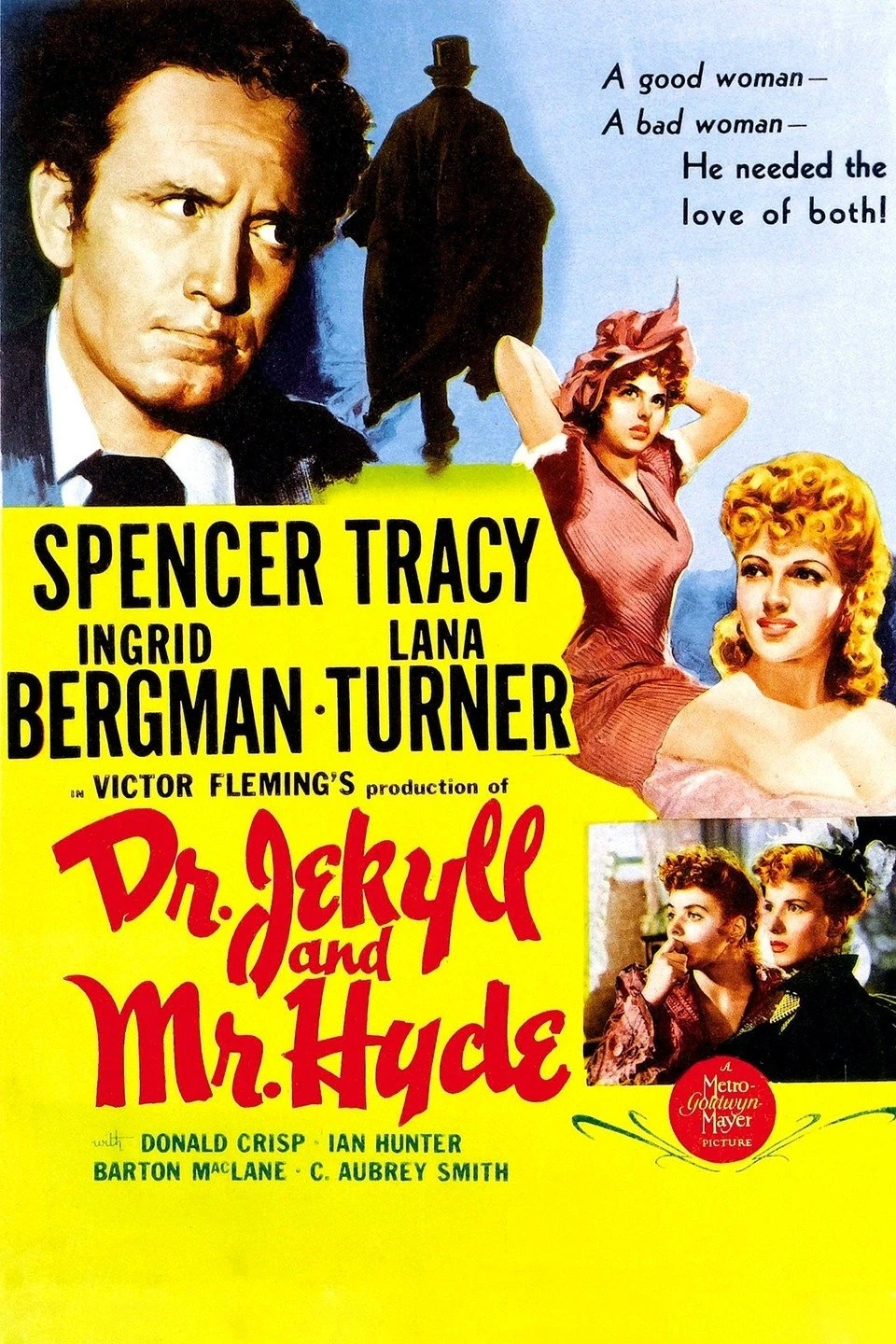
Dr. Jekyll and Mr. Hyde (1941) - Dream that they've all turned into white mice and crawled into an eternal pumpkin!


It's the Letterboxd Season Challenge!  Theme twelve, part one - a film starring Ingrid Bergman!

(Chosen by me!)

It takes a bit've time to settle in with Spencer Tracy and Ingrid Bergman in the parts of Dr. Jekyll and Ivy the barmaid respectively, primarily owing to the accents.  Neither is turning in a bad performance throughout the first act of Victor Flemming's remake of an adaptation of a stageplay based on the Robert Louis Stevenson novella, far from it as Tracy brings his usual hard-mouthed moral pillar with a gentler side to his performance of the good doctor with a disturbing preoccupation over evil, and Bergman makes her part as a would-be rape victim turned slinky temptress to her savior come alive with just how thirsty she plays the role.  As set-up for the film's later dive into a crueler relationship once Jekyll takes his serum and unleashes Mr. Hyde, their flirtations come across well enough... but the accents are still quite a lot to accept.  Tracy a little less so, seeing as American-accented leads in American productions set in Britain is a fairly common practice, and he strikes a compelling enough figure by simply being Spencer Tracy to make the lack of an effort to put on anything remotely posh easy to filter.  Bergman, however, is only two years out from learning to speak English for her part in Selznick's remake of Intermezzo, and trying her damndest to strangle her natural Swedish accent into a lower-class Irish brogue.  Heaven help her, it's not happening - she slips back into her usual mode with great frequency, and her constant seizing onto dialect snippings like "ain't" or replacing "my" with "me" do little except sound odd coming from someone whose screenpresence was otherwise so refined.  S'a thing you have to sit with and learn to accept across the nearly two-hour runtime, cause it never gets better no matter how hard she tries.

I focus so much on the accenting issues in this first paragraph because I think it's necessary to note the film has some uphill territory to cover before detailing how I believe it traverses the terrain like completely flat ground throughout the second act.  Once Jekyll unleashes Hyde and goes out for a night on the town, Dr. Jekyll and Mr. Hyde settles into its true intentions, and produces a second act worth praise all on its own terms.  Not at all what you'd expect with Hyde storming about foggy ol' London Town causing a ruckus in bars and making himself a disreputable member of the community (though the act's opening scenes do give you some've that, if incredibly toned down), the film is most interested in exploring how Hyde acts as a manipulative hand behind Ivy's back to cost her a job, isolate her from her friends, and push as far into depicting their abusive relationship as the Hays Code would allow.  Bergman stands as the focus character for this half-hour stretch, and weird accent or no she's doing a fantastic job of portraying an abuse victim in what feels like a realistic manner.  True, you still get the histrionics that can be recut as Fay Wray-style screams for the trailer, but her response to Tracy's mocking runaround conversations and mind games as he pushes her into giving him what he wants are excellent, doing her best to keep her composure against someone who's obviously harmed and violated her many times over even as he's dead in her face and she's on the verge of breaking entirely.  Scenes set apart from Hyde see her putting on a brave face for friends and tip-toeing around anything she thinks might earn her another assault, suddenly recoiling into a ball of defensive excuses when she can't hide the scars.  On Tracy's end, his Hyde certainly isn't a stunning physical or behavioral transformation compared to some of the more lauded actors to fill the part, yet I think him playing it as merely a crueler, disheveled Jekyll rather than a completely split personality opens the film to further exploration of whether or not his postulations regarding good and evil in the human soul are as accurate or bifurcated as he believes.

Fact, let's talk Jekyll/Hyde theory for a moment before digging further into the film.  Per Jekyll's outline in an early dinner scene, those aspects he calls good and evil are inherit to all, expressed not in totality one way or the other, but intermingling at all times, a little of each depending on the circumstance.  To isolate one from the other, express the evil in a man as a wholly different person from the good-facing side, should follow into the good living with a clear conscience and no impulse to do wrong.  Locked away from one another, one might even eradicate the evil altogether by giving it no outlet, no infusion of serum to bring its full force to bear on the physical world.  Course, as we know from Stevenson's novella, Jekyll cannot be considered a righteous innocent if he indulges Hyde's expression at all, for Hyde is of him, a man born of thoughts and impulses within his own brain, and if the two are to draw on knowledge and memories of the other and mutually regard their back-half as a figure worthy of disgust, then they must know what their mirrored self does and why.  Jekyll might safely say, "It was Hyde who did all those horrible things, Hyde, not Jekyll," yet he alone is responsible for drinking the formula that gives Hyde flesh, just as Hyde is responsible for taking the same to hide behind the guise of Jekyll.  Whatever Hyde does is an exercise of what Jekyll wants to do, and in denying Hyde reflects on him and continually indulging his evil side another night's escapades, Dr. Jekyll's supposedly pure half a soul becomes stained with every drop of blood Mr. Hyde sheds.  If, say, Dr. Jekyll were to continually unleash Mr. Hyde in the name of venting his frustrations over not being able to marry his fiance due to her father's concerns, and allows Hyde to torture and rape an innocent woman because it leaves him feeling better, then it's not really good and evil he's separated: it's presentable and unpresentable, only called by another, morally simplified name.

So!  All this in mind, why on earth does Dr. Jekyll and Mr. Hyde ask us to sympathize with Jekyll during the third act?  Despite all the work it puts towards locking our sympathies squarely in Ingrid Bergman's corner, once her scene of pleading with Tracy to save her from the insidious Hyde is over, the film takes a turn towards Hyde coming into prominence without the serum, has him murder Ivy, and spends the remaining half hour fretting over how poor innocent Jekyll has lost control over his totally separate evil side.  It's terribly incongruous, dedicating so much time and effort towards depicting an abusive relationship full of manipulation and heavily implied rape as something horrifying, postulating on how the rapist is not a separate person but the inherent desires of a front-facing "good" man, and then escalating to murder our most sympathetic character before acting like the murdering rapist is somehow still deserving our pity.  Worth noting, I think, the picture doesn't get into Jekyll's perspective during the second act at all, so we're left with a bland reassurance of his goodness without any attempt to explore why he unleashed Jekyll so many times, which can only lead to the worst assumptions about his person.  The whole thing plainly doesn't work, as the story only functions if you throw away everything we've been told about how the Jekyll/Hyde dynamic works here and believe Jekyll a tragic protagonist because he's the protagonist and so should be counted as tragically struck low.  What's more, in refusing to examine the why behind Jekyll's actions or condemn him for it, an entire ACT's worth of material I think excellently executed suddenly feels like a cheap, exploitative depiction of the exact same subject matter, because all Ingrid Bergman's suffering comes to is a quick murder and hand-wringing over how oh, how totally innocent is the man who allowed this atrocity!  Such a powerful depiction of abuse and rape denied a point beyond "Isn't it all so horrifying" does not gain from the absence; it only subtracts, and lessens, and yes, cheapens the whole thing by making it a commodity for entertainment rather than a serious issue.

I do so hate it when lazy storytelling taints an otherwise good aspect in a film with the taste of sand and ash.  I hate it doubly so when it's a film with such beautiful views of a reproduced Victorian London shrouded in fog and enclosed spaces darkened by the presence of a single man, a film with good performances across the board and chilling music and some rather nice if not standout effects sequences for the transition from Jekyll to Hyde and back.  Going with a zeroed-in focus on Hyde as a rapist to one victim has massive potential for a character study into the presumptuous nature of Jekyll and men of his like, but without a point beyond "Don't ya feel sorry for him?" all this good work adds up to a bad film.  The post-film conversation with Connie last night ranged for quite a while longer than usual as we debated whether the film deserved 3 stars for its technical and performative aspects, or 2.5 for its thematic failings.  While I argued in favor of the former for a time, after listening to Connie's perspective and considering it in view of my own history of assessing well-made films with major themeing flaws, I think the lower rating is only right and consistent.  If you're gonna do Jekyll and Hyde and expect the audience to stand with Jekyll at the end, either run with Hyde as a more typical force of mayhem and standard crime, or don't even try if you mean to go so hard on the magnifying-glass look at abuse.  "Man willingly unleashes his devils and terrorizes a woman until he ultimately murders her" and "Man never did anything wrong, pure cinnamon roll, etc" do not jive at all.

(The fades employed to transition between the two aspects are pretty impressive technically when you consider how well each successive shot matches to the next, especially given how many subtle little movements Tracy makes that somehow flow near-seamlessly from one to the next, but the part where they try to focus on his eyes by rendering them as a separate strip over the rest of the picture falls apart the second you notice a horizontal stripe of his head bouncing around independent the rest.)

2.5/5

Saturday, March 7, 2020

Polterheist (2018) - How're you gonna make me talk? I'm already dead.


It's the Letterboxd Season Challenge! Theme eight, part three - a foreign horror film!

(Chosen by John!)

Just reading the synopsis for Polterheist makes me unreasonably angry.  Two stupid criminals need to extort some money from their mate lest their boss have them beaten to death, but they've already killed the bloke, so they kidnap a medium and force her to channel his spirit so they can find what they're after.  Those of you in the know about your supernatural entities will understand straight away how possession by the recently deceased has nothing to do with poltergeists.  A poltergeist is very specifically the invisible paranormal manifestation of pent-up negative emotions, usually from a child or teenager, which makes its presence known by violently moving objects with intent to frighten or harm.  Granted, Poltergeist doesn't fully get this right, hitting the mark as it does with the whole household items getting stacked and thrown about whilst explaining it all as the result of a desiccated Native American burial ground (again, not really a poltergeist!), but Polterheist is off the mark entirely.  You might wonder, "Why get upset about a punny title for a ghost-infused crime movie that tells people, 'Hey, there's a ghost in this thing, just thought you should know,' by virtue of most people only knowing 'poltergeist' means 'ghost thing?'"  It's a valid question, and I'll tell you why: because if I ever write and publish a screenplay about some crooks breaking into a mansion inhabited by some shitty repressed millionaire's teenaged kid and teaming up with the poltergeist within to execute their heist, I cannot use the accurate and awesome title of Polterheist because the people behind Polterheist wasted it on this film.

(Harry Potter gets a pass for making Peeves a physical manifestation because Hogwarts is a deeply magical building filled with hundreds upon hundreds of teenaged witches and wizards for over one thousand years, so of course all that negative psychic energy would coalesce into an awful little man.)

Mark you,  the actual film behind the title contains plenty reason to hold the product itself in disdain.  Polterheist is a technically uneven film, occasionally looking pretty darned alright for its limited budget and inexperienced crew, mostly showing the detrimental effects of four camera operators and two editors working without a strong voice to unite their styles.  The visuals aren't at all consistent from shot to shot, with such highlights as a master shot and its three close-ups somehow all featuring different lighting, and an otherwise fairly tense sequence suddenly cutting to what looks for all the world like test footage for no good reason.  Such notably shaky visual language permeates the film, and extends to its sound department whose work renders loud voices and quiet environmental effects alike loud as all holy hell.  The editing team seemingly struggled with prioritization, as we spend way too much time in a black and white flashback that gives us tons of information we shouldn't get based on the presentational context, linger on jokes way longer than is at all funny, and infrequently cut over to gawk at the main mob's goings on without ever finding anything of great interest or import.

It's a sloppily made film for certain, which I can excuse to an extent due to the crew pulling something from practically nothing given what they had, and also because the main character dynamic is quite a lot've fun.  Jo Mousley runs away with the film in her part as Alice, the medium possessed by murdered criminal Frank, spitting out foul-mouthed lines and getting across a nice sense of tension through her bodylanguage throughout.  They've got nothing but profanity and damnation for anyone around them when provoked,  and time spent in a more amiable mood sees her playing well off her costars.  Sid Akbar Ali and Jamie Cymbal make a good teaming as well-to-do Tariq and Northern fuck-up Boxy, trying their hardest to sell jokes the editing is determined to ruin, and bouncing against Frank's disdain for his murderers in an enjoyable manner.  Mousley and Cymbal get a few quieter scenes together round the middle, and I start to feel there's more going on beneath the surface here than "funny bad men do a funny bad thing."  Give it a few passes in the writing room, and Polterheist could make a reasonable play for being about guilt and reconciliation and whether that's all possible in a criminal enterprise.  Elsewhere in the film, though admittedly completely contrary to the point I just made, Pushpinder Chani is capital A Acting his ass off as deranged mob boss Uday, and gets me really excited to see what happens when this absolute vicious maniac comes into contact with the main trio and learns what they've been up to behind his back.

Alack, Polterheist lets us all down.  The conclusion takes some turns regarding a hidden cache of diamonds and Frank playing Tariq and Boxy against one another, which seem fine on paper, but rely on the film's main enjoyable dynamic falling apart and vanishing for the final ten minutes.  What should play as a satisfactory revenge twist lacks the time and focus necessary to make it land, for Chani also drops straight through the floor, rendering all our cutaway to his goings on a pointless drain on the central trio's story resources.  Instead, Mousley shifts from Frank to Alice for these final movements, and despite Alice only appearing in a restrained, almost demur performance for a brief period towards the start and a briefer reprieve from possession round the middle, she has total command of the last several scenes, and drives them with a personality wholly unlike the one glimpsed before.  You could possibly construe it as possession addling her brain or an additional layer of revenge against the morons who used her as a meat puppet, but her actions are both far too vindictive and far too contrary to what our understanding of her place in the midst of a sea of angry dead would indicate should happen.  Yes, I am going to out and out say the ending is bad because she abandons a dog in the middle of nowhere, and no, I am not going to apologize.

Jackie, John, Connie, and myself all agree - Polterheist is a film with a lot've potential and a solid core dynamic that stood a chance at becoming good if more care were paid to its story.  The technical stuff, I don't think you can do much without the funding to hire a better crew or the time necessary to get this one more experience, but the premise and its main characters interactions are worth enough as they appear here to justify further attention and development.  Even if it doesn't become much more than more consistent, satisfying schlock, I'd still appreciate it more if they got it working by giving us a little more Alice and having the villains properly factor into the finale.  Hell, it's already a black comedy: maybe instead of stopping with someone on top, just have everyone keep screwing each other until they're all ghosts and can't be rid of one another.  That's a solid punchline to build towards.

2/5

Thursday, February 27, 2020

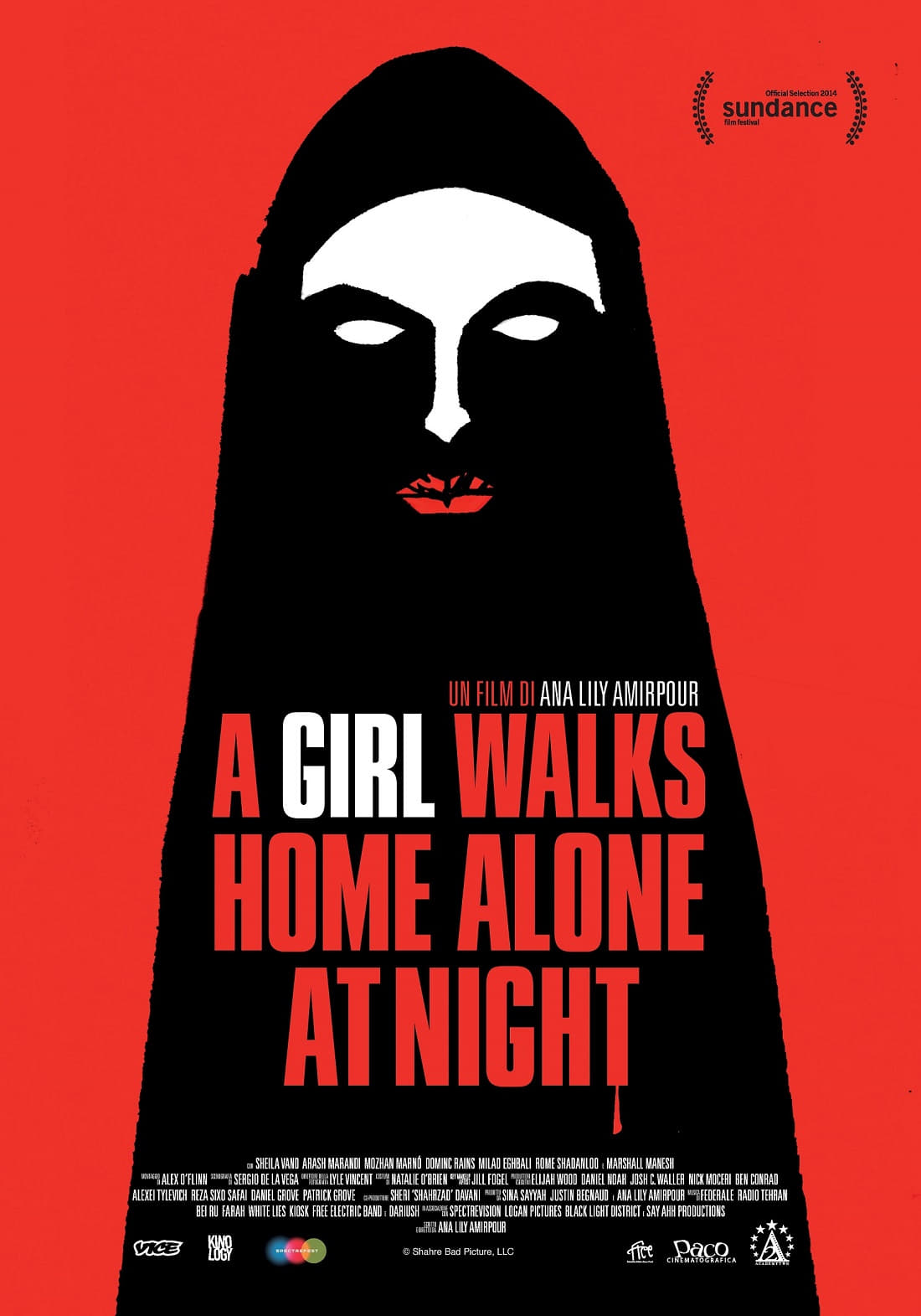
A Girl Walks Home Alone at Night (2014) - I'm bad. I've done bad things.


It's the fifth Letterboxd Season Challenge!  Theme eight, part two - a foreign horror film!

(Chosen by Jackie!)

(Well alright, A Girl Walks Home Alone at Night is an American production directed by a British-born Iranian-American, featuring Iranian-American actors, with dialogue in Farsi delivered in California locations.  It's not any more foreign in the traditional sense than would be any other film by a US citizen embracing their ancestry with others of a similar background.  Mistakes made, we press on regardless.)

In A Girl Walks Home Alone at Night, director Ana Lily Amirpour has crafted the ideal scene kid movie.  Though this is easily construed as a dismissive insult, I mean it as the most earnest compliment I can pay her film.  After all, we've a picture whose centerpiece revolves around two characters dressed in all black, both evoking vampiric motifs in their own way, one gently moving towards the other across an expansive widescreen with slowed-down disco ball lights rotating across the wall as the other turns into his embrace, contemplates his neck, and sinks into his arms to listen to his heartbeat instead.  All in beautiful black-and-white, all scored to "Death" by White Lies, grinding out across the screen over five whole minutes.  There's a weird techno-scored seduction scene that climaxes with a scummy drug-dealer getting his finger chomped off and throat ripped open, a cross-dresser dancing with a balloon, a quiet, awkward ear-piercing scene set against the backdrop of an empty trainyard, and, most importantly, a skateboarding vampire dressed in a black chador and striped long-sleeve.  This is a film purpose made to appeal to teens and college students who fuck with Bauhaus and Have a Nice Life and black out their windows to better appreciate the effects of poorly-strung atmospheric lighting on the posters of bands who'll never come to their town but inspire gobs of gif-based appreciation posts and self-insert fanfiction on tumblr dot gov in the year of our lord two-thousand and fourteen.  I'm deeply envious towards anyone who saw this right when it came out and felt the full sledgehammer-to-the-chest impact of finally seeing all their predilections thrown onscreen in a glorious act of stylistic exercise - those folks got exactly what they always wanted in their scant two-decades on this dying Earth.  All power to 'em, no sarcasm meant whatsoever.

The film lives and dies (and all states between) on how much appeal you can find in a slow-moving mood piece with minimal concessions to narrative.  To my mind, it takes the visual celebration pretty damned far, producing numerous memorable moments with little more than its two main characters stood before simple small-town backdrops and allowed to awkwardly interact as Farsi tunes play on the soundtrack.  There IS some character work going down, with Arash struggling under the pressure of his father's heroin addiction and eventually dealing himself when their dealer is sucked dry, while the nameless girl displays a streak for enacting justice and intimidation on the people of Bad City, pines for an immaterial long-lost something, and draws closer and closer to Arash through the force of what I (stealing from Connie) can only describe as his big dumbass energy.  Act delineations are primarily marked by the girl making a kill that impacts Arash's life in some manner, and their relationship takes a strange turn when she gives him what he always thought he wanted, without the film's taking time to explore what this will mean for them in the future.  Beyond these elements, A Girl Walks Home Alone at Night is far, far more about the sublimity of the girl rolling down an empty suburban street with her chador billowing in the wind, or Arash, blasted out of his mind on ecstasy and dressed in a Dracula cape, hobbling to a sitting position while the girl tries to steady him and bring him back to her place.  Time beyond these two is mostly dedicated to the small supporting cast, who exist to either more clearly define aspects of the girl's mysterious personality through bracing encounters, or do wrong so she can punctuate the moment with a swift bite to the neck, again through scenes better defined by their stark imagery than writing or acting.

Normally, I'm in favor beyond belief of works that presume the eyeline's slow journey from exposed neck to nestled beating heart are interesting in and of themselves, and turn out absolutely correct.  Here, however, I think Amirpour's decision to leave a skeleton narrative at the center results in... not exactly a poorer film, but rather one I can't help see as fallen short of its potential.  If it were exclusively a mood piece, following the camera's bliss and leaving interpretation of Arash and the girl's lives entirely to the audience, I'd find the film far more intriguing in a good way.  As filmed, there exist components like the girl savagely drinking from an unconscious homeless man, which indicates the presence of a basal need to feed beyond her active, motivated choice in targets, or the unmistakable contrast in how Saeed the dealer seductively dances towards the girl before his death and Arash's careful move to embrace her later on, which raises the question of, "Why him, exactly?" when coupled with the first point.  We see the girl express kinship with Atti the prostitute along the dimension of lost dreams and forgotten remembrances, and something in Sheila Vand's performance communicates a bottomless sadness, but there are no guideposts, no indications Amirpour means us to travel these lines of thought with intent or direction.  There's a potentially fascinating study about why Arash is the one to bring the girl beyond her situation, or how the girl's interactions with Arash liberate him whilst also crippling what seemed a potential future on his own two feet, or else some treatise on her vampiric nature reflecting or rejecting views of women in Iranian society, whether you choose to construe it as parasitic or liberating, and what that might mean for her as a person.

The film, essentially, has its toes dipped into the pool of conventional narrative just deep enough to intrigue me, and a few moments where it lowers a whole foot in and reveals great potential for these gorgeous images to become so much more in the ripples it creates; yet its dedication to being as much a visually-driven, story-free experience as possible means it never takes the full plunge and explores that which it teases to the fullest.  Perhaps I'm being a touch stupid here, asking a deliberately ambiguous film to flesh out what it only means to tease, to elaborate where silence is the intent.  In my defense, my own aesthetic concerns almost always lie with purity of form: while a work may eschew storytelling conventions and be for the sake of some ideal towards beauty or horror or coolness, if it chooses to keep a minimal story and even develop this story to some degree, I'm going to want either the story's removal or a greater cohesion between idea and image.  Blending the two often leads to feeling a weaker story, and images that would hit more potently entirely on their own or in active cooperation with an idea.  Applied here, I understand Amirpour's intent, I really do, but she has tantalized me with the possibility of seeing this picture play out with her thoughts and feelings guiding and interacting with my own, giving me insight into the specifics she's teased.  To not get these is consistent with her aims as director, and yet I cannot shake the notion of her film improving if I knew her perspective on some of these more interesting ideas beyond, "It's up to you."

That which is ambiguous about A Girl Walks Home Alone at Night would entice me to think on it as a vagary all the more if it were purely sound and vision instead of neglected narrative, basically.  Flipwise, sacrificing some of the ambiguity for specificity would work wonders in my assessment.  Again, I'm probably being stupid and unappreciative here, but I like what I like for the reasons I like it, and find it hard to stop thinking this film better if aesthetically pushed further one way or the other.  Those scenes that work still work like all hell regardless of my artistic preferences towards storytelling - I've been replaying the "Death" scene in my head all day, it's so powerful a moment.  Watch beyond the form-based hang-ups of someone who thinks Danger! Diabolik the ideal comic book movie, and you've nevertheless a splendent post-punk vampiric impression upon the brain, something unique and dark and beautiful, well-worth a watch and however many hours of debate it inspires, internal and external alike.  Shred on, you funky little vampire you.

3.5/5

Thursday, February 20, 2020

Ring (1998) - You better get some rest; I have a deadline.


It's the fifth Letterboxd Season Challenge!  Theme eight, part one - a foreign horror film!

(Chosen by me!)

I think it only fair to begin by noting how a proper discussion of Ring inevitably clashes against spoilers, spoilers everyone knows about though they be.  Ever since Hideo Nakata's adaptation of Kōji Suzuki's 1991 horror novel literalized the "frightened to death" aspect of the Ring Virus by transforming the moment of death from a simple hallucination-induced heart attack to vengeful ghost Sadako crawling from the well that served as her grave and out the victim's television to enact an abstracted killing blow, a pale, stringy-haired girl in white has been the franchise's defining image. Appropriately so, given it's an incredibly striking sight no matter the execution, an extension of the book's technology-as-conduit-for-supernatural-curse concept in a way friendly to continuous reinvention across the American remakes and numerous sequels in both Japan and the US during a time of rapid technological evolution, in a manner the original restriction to video tapes and phone calls couldn't hope to make interesting beyond changing the cursed tape's medium.  Thanks to Nakata's not-quite original and Gore Verbinski's The Ring making such an enormous splash in their respective markets, Sadako crawling from YOUR TV has become fodder for nightmares and jokes aplenty in the last twenty years.  You talk about Ring, you talk about the TV thing.

As such, talking about Ring by focusing on the film's bulk concerns across its runtime makes the lack of televised emergence conspicuous by its absence.  The journey undertaken by journalist and single mother Reiko Asakawa and her videographer ex-husband Ryūji Takayama across the second and third acts involves a great deal of level-headed investigative work into the origins of the cursed tape, with a mind towards breaking the curse by laying the ghost to rest.  There's absolutely no paranormal activity beyond the tape's evil aura until an hour's way in, which presents as psychic visions rather than hauntings, and Sadako's signature manifestation doesn't take place until the final ten minutes as a twist about how the protagonists were dead wrong as to her nature.  If I were to play coy with this and try to preserve the twist for everyone, it wouldn't work, because you all know what made Sadako iconic, and you'd figure out all my talk about plain Jane research and agonizing over retrieving the body of a wrongfully murdered woman was all mere prelude to a twist, simply by way of my not mentioning someone coming out a TV screen.  So we're just gonna note how the film's big famous moment can't function as a legit surprise anymore if you've extremely basic working knowledge of the culture, and move on to more fertile discussion.

Like I mention, Reiko's response to the cursed tape and her seven day deadline is more rational and intelligent than one might expect from a supernatural curse story.  There's an element of dogged pursual to her early movements, an undefined, restless need to see the cause behind her niece's sudden, inexplicable death days earlier, the kind've unknowing march towards doom you'd conjure when thinking of the paranormal intersecting with the mundane.  Once she's viewed the brief, surreal tape and been warned of her fate (no "Seven days..." whisper over the phone in this version, just the same eerie metallic scraping sounds from the tape), though, her next moves are all very sensible - contact someone she knows and can trust who has relevant experience studying and dissecting taped media, exercise her skills as a journalist, and start looking for a solution based on slowed-down viewings and cross-referencing.  A good chunk of the film passes with Reiko and Ryūji studying the tape frame-by-frame, seeking out clues and dissecting hidden meanings from the seemingly disconnected imagery, which gives the film this strange yet appealing atmosphere of extended repetition making the sights and sounds yet more disconcerting mixed with the reassurance of discovery and understanding.  Ring plays in large part like a serious-minded murder mystery, with the curse hanging overhead as a vague, barely-comprehended threat.

The horror, therefore, comes about through the increasing inadequacies of their method.  No matter how much Reiko extracts from the tape or how close she comes to understanding its origins and breaking the curse, it's not enough to prevent her young son from watching the tape late at night in a mid-movie twist, condemning him to the same fate without him ever knowing what he's done.  The work necessary to to unravel clues and discover new angles takes time, and on-screen captions remind us how quickly Reiko's clock is running down; it seems like no time at all between the roomy seven day starting point and our arrival at an all-too-close two.  Despite a rather blase attitude towards confirmation of psychic phenomena on both leads' part (one I suspect worked better in the book, where the protagonist's journalistic background had an element of past failed paranormal exposés), contact with various psychically burnt objects and persons as they get closer and closer to Sadako produces more overtly freaked-out reactions, and marks the characters' potential inability to handle the situation before them.  It gets a little bit clunky when the film uses overt flashes of the tape's imagery and sound to remind us how certain places, objects, and persons relate back to the clues rather than subtler interlacing, or when negative turns are accompanied by the otherwise quiet score going utterly manic on  the screechy strings, but in total effect the build rests on a solid foundation of exposing the limitations inherent to rational thinking when faced against the beyond.

When it comes time for the movie to climax, the twist enables it to do so twice in a row, with distinct approaches to the payoff.   In the first, Reiko and Ryūji's toilsome efforts to empty the abandoned well and retrieve Sadako's body may not entirely parse as to why the characters believe doing so will save their skins, but it turns on the great image of Reiko hauling heavy buckets over the course of many hours as her body grows weary and the sight of honeycombed crawlspace barriers facing the outside takes on a distinct menace, even knowing nothing's coming.  When she and Ryūji swap places and she's rooting around in the stagnant wellwater for the corpse, the shift to a damper, more claustrophobic environment continues the film's sense of undefined paranoia, and brings it to the head with the discovery of the corpse, oozing slime from its sockets like grateful tears as the seventh day fully passes and Reiko is saved... only for it all to come to bunk.  Just as the fake-out climax trades on an intensified version of the vaguely menacing feel of the preceding story with the payoff seemingly reward for such diligence under pressure, Sadako's sudden emergence stomps all over any sense of fairness or meaning to the film's events, killing Ryūji for reasons we cannot understand.  Once Reiko puts two and two together, and realizes it was not their hard work towards discovering Sadako's origins and laying her bones to rest that broke the curse, but rather the most innocuous, natural step she took that transferred it instead, the story attains  a wonderfully nasty bent.  There's a demand for cruelty from anyone who views the tape, a need to intentionally expose others and expect them to do the same in a never-ending cycle, and that's just that.  The relief of thinking those tested investigative convictions finally paid off, followed immediately by proof positive they're useless against real evil.

For its strengths, Ring does seem a touch lacking in a few places.  The gender-flipping of the protagonist from the book's Kazuyuki Asakawa to Reiko and the subsequent change of Ryūji from friend to divorced husband introduces the possibility for a more meaningful relationship dynamic between the two, one the film does not adequately explore outside a few brief moments.  It's more focused on the process of understanding and halting the curse than exploring the characters doing so in great depth, and so leaves them in a bit of an emotional limbo regarding one  another.  Something similar effects Reiko's relationship with her son, who's obviously very important to her yet drops from the film once he views the tape, to serve as little more than another reason to break the curse beyond Reiko dies.  These noted, the picture still goes plenty far on the journey to test how much a rational series of questions are worth under unusual and demanding circumstances, and the sheer meanness of its twist lands with a satisfactory thwack even when you know it's coming and spend the whole film waiting to see someone scramble out've an analogue set.  Much as later entries and online culture have diluted the special, unique fear of Sadako's emergence (coming out of a Jumbotron at scale is a natural evolution, but it is also extremely silly), Ring's dedication to earning that sigh of relief before gutpunching the wind from your lungs ensures its USP continues to demonstrate value as a scare worthy of the construction around it.

(I rather like how every other element of the tape has a concrete explanation, including the audio playing over the crawling figures, yet the crawling figures themselves remain unexplored and open to interpretation.  Adds to the creepiness and the sense of the investigation coming to naught.)

3.5/5

Saturday, February 1, 2020

A collection of FUCK YOU, IT'S JANUARY reviews

A smattering of terrible dump month release reviews written over this last month on letterboxd!

***
Stephen Sommers should've probably taken a few more passes at the screenplay for Deep Rising before he started shooting. There's a solid hook to the premise, with Treat Williams' smuggler captain carrying a group of trigger-happy mercenaries to God knows where in the middle of the ocean, only to discover they've filled his ship with armed torpedoes and chartered a course to an abandoned cruise ship. That things aren't at all what the mercs expected, what with the proliferation of smashed up rooms and digested skeletal remains throughout the liner, gives us a pretty good line into the movie. Could serve as a workable mystery to keep tensions high until we're ready for the monsters, except his movie is structured so we're constantly cutting between the smuggler boat and the cruise ship before the disaster. I understand the impulse to play with both during the first act, considering the larger boat's owner is somewhat important to the mercs' place in the movie and we need to introduce Recognizable Actress Who'll Sell Tickets Famke Janssen early on, but doing so makes it harder for the movie to grab an audience. We know where we're going and how we're gonna collide, so a large portion of the film becomes a waiting game for the plot to hurry up and let the characters figure what we already know.

It also harms the character dynamics, which weren't particularly strong to start. I suspect the production intended to coast on Harrison Ford's charisma before he turned 'em down, and so Treat Williams is largely affecting his best Ford impression to middling effect. He'd still serve if he had a good, long stretch to exercise a dynamic with his fellow crewmembers and butt heads with the mercs in interesting ways, though. Unfortunately, because we've simply gotta spend so much time on the cruise ship before it sinks, the time we have aboard the smuggler ship is halved, and Williams only has the briefest amount of time to establish a back-and-forth with Wes Studi's merc captain before they're on the liner, and people start dying. Aside from him, there's only Kevin J O'Conner around, who's too deep in snively comic relief mode to impress a relationship with his captain or the men antagonizing him, and Una Damon as first mate, who gets killed to make way for Janssen as our lead. Considering Janssen's character is entirely superfluous if you cut the mystery-ruining early scenes, has little chemistry with Williams (much less time to IMPLY a romance before they're face-smearing one another), and just not giving it her best, it feels we left a potentially more interesting character to die in favor of a conventional dangling love interest.

Our writing woes just spill out from there. Once we start killing characters it happens at an alarming clip that removes a lot of potential for interaction. Losing out on the potential mystery/thriller aspect undercuts what impact the second act revelations could've had. Even with the improvements I've suggested, the nature of the conflict basically leaves us with nothing to DO character-wise in the third act save escape the boat, which takes the form of very simple tasks being complicated by sudden bursts of busywork. All throughout, conflict and tension are generated more by characters suddenly acting needlessly aggressive rather than drawing on a dynamic built naturally through exchanges and events. The movie's even so committed to insisting Anthony Heald's boat owner is the more interesting presence, it kills Studi early in favor of having Heald act the selfish psychopath for the finale. There are bad screenwriting decisions spilled all over this movie, the cast aren't really charming enough to distract from said issues, and it's all incredibly frustrating, because I can see how some tweaks to this one early structural element might've capped these poor impulses and resulted in a stronger final product.

I go with a 2.5 rating rather than the 2 stars my discussion here implies on the merit of the film functioning fairly as an action-horror in the watching. The Ottoia-derived monster's just a massive blob of CG nothing when we see it in full, but the tentacles look fairly menacing on their own or in a pack, and have some damned good effects work for the time and budget. If you take the deaths as less scary moments and more a game of Who's Gonna Get It Next, there's a few solid whacks throughout. Treat Williams, though working an entirely thankless job with so many Star Wars references I'm not at all surprised Ford refused his participation, manages some charismatic presence through a part that doesn't really realize he's protagonist till halfway through. And like... it's a monumentally stupid part of this movie, but I do think the whole setpiece with Williams and Janssen zipping around the flooded corridors of the sinking ship on a jetski, trying to build up enough speed to ramp out while blasting tentacles and obstacles with a shotgun is a good bit've fun. I'd play that part of the Deep Rising video game, it's got a neat two-player mechanic - one of you drives and hits fire, the other has to pump and reload and aim the shotgun over the other player's shoulder.

You can see the rot settling in Stephen Sommers' brain watching Deep Rising. The same inability to write or direct meaningful character interplay, structure a screenplay without a lot've ancillary bullshit stapled on, or deploy special effects without obviously using them as spackle to hide cracks in his scenario. All things that would fester and dig their roots deeper until he went all-out with Van Helsing and just broke the movie. Here, they're a hindrance, but he gets a little something out've the enterprise all the same. Like I say, if he'd taken another week to edit the script and narrow in on the potential for a mysterious situation where the main character learns what's going on alongside the audience and has a stronger rivalry with the dangerous men he's smuggling, he might've had something wholly passable. The near-misses are always more disappointing than the total misfires, even when they're still enjoyable at their own level.

2.5/5

Thursday, December 26, 2019

Kirk Cameron's Saving Christmas (2014) - A Celebration of Avarice


(The following content is reran from the 2018 Christmas marathon on Letterboxd, as originally seen here.)

Against every better instinct I have, I'm starting this review by playing nice. The basic theory underlining Kirk Cameron's arguments in Saving Christmas is not inherently flawed or condemnable. Across multiple narrated vignettes, Kirk argues against worries about the commercialization and secularization of Christmas by finding avenues to link activities and iconography commonly associated with the holiday back to Jesus. He's effectively saying one shouldn't lose heart in the validity of their faith when they see trappings of Santa Claus and mistletoe everywhere, as a good Christian will find ways of reaffirming their connection to God and Jesus in the everyday. If you place sufficient value on your spiritual life, the idea holds merit. Make your practice a personal matter, maintain a mindful attitude surrounding its tenants, and find strength through reflection on what you believe and why.

Thing about theories, though: they can only remain pure, untainted notions in perfect isolation. When Kirk Cameron puts this theory of argument into practice in Saving Christmas, he uses it to spin baffling nonsense about how Adam needed to put the forbidden fruit back on the Tree of Knowledge to get right with God, so Jesus going up on a wooden cross was a symbolic token to the same effect, thus turning all Christmas trees into unused crosses representing the salvation of mankind. He rambles on about how the historical Saint Nicholas punching a heretic at some ancient holy conference proves the current incarnation of Santa Claus is a crusader for the faith and some kind of badass warrior preacher. Christmas presents become the New Jerusalem, a somewhat interesting theological discussion about the relationship between Jesus' swaddling cloth and the Shroud of Turin becomes reason to not bemoan the lack of a nativity scene, and nutcrackers become Herod's baby-killing soldiers, now transformed into defenders of the holy way. To Kirk Cameron, finding the sacred in the secular seemingly means pulling up little bits and bobs of trivia from hagiography and apocryphal doctrine to justify not changing one's ways or attitudes in the slightest. The application falls just a tiny bit short of the theory.

Now, this is all VERY badly presented. Saving Christmas boats a bland visual style and an incredibly boring camera. We have to listen to Kirk Cameron put on his best William Shatner impression, stretching out every single monologue to three or four times its necessary length. He and his costars act by scrunching up their faces and wiggling from one weird expression to the next in a pantomime of what they think sudden enlightenment looks like. There are completely unnecessary digressions to Not Chris Rock doing his standup routine, a conspiracy theorist rambling on about Area 52 and poison in the hot cocoa, and a protracted breakdancing sequence towards the end set to the most repetitive sounding electronic dance hip-hop cover you could squeeze out of Angels We Have Heard on High. When the movie DOES deign to focus on its main conflict of Kirk talking to his brother in the car, the visual flairs it offers to keep the monologues interesting alternate between lazily floating through caves and Christmas tree lots, and scruffy-dirty-bearded-tavern-scripture-quoting-triphop-scored-Santa-beatdowns. It is two scenes from a real movie stretched out to forty minutes, with the remaining half-hour filled by inhuman attempts at comedy.

Still... it is not inherently loathsome. Horrendously executed, amateurishly argued, insulting on multiple levels, but not hateful like God's Not Dead. I INTENDED to go the tiniest bit easy on Kirk Cameron's Saving Christmas and give it one single, solitary star, as the smallest offer of mercy. "You're completely bugnuts, Kirk Cameron, and I don't agree with a single thing you've to say. Power to you to waste your money saying it in a movie, tho," sort of thing.

Then Kirk Cameron got to justifying conspicuous consumption and holiday avarice. Jesus IS the reason for the season, after all, and because Jesus took a material form when God sent him to earth, we should all celebrate his birth by spending and hoarding and glutting ourselves to excess. MORE materialism means MORE material stuff, and the MORE material stuff you have in your life, the MORE Jesus you have in your heart, or... something.

The rest of Kirk's arguments at least have either sufficient theological merit to get a pass in isolation, or are harmless enough to pass with a bewildered, "believe what you wanna believe, man..." This, though? This is straight up "the very things people claim run against the spirit of the holiday and Christ's fundamental teachings are actually virtues we should indulge in without restraint, because I did a little bit of wordplay." It is mindbogglingly misguided at best, willfully hard-hearted and selfish at worst. The whole idea retroactively strips the rest of the film's arguments of their scarce value, as it reveals the total lack of thought and introspection behind their conception. All we have here is a mouth set into a slab flesh, blathering away with the sole aim of vindicating its own capacity to speak and eat without shame.

Having seen all seven films, the question still remains: Why WERE there so many Christian films released in 2014? We know Kirk Cameron put out his film because Kirk Cameron is a crazy person who honestly thought telling non-believers their secular trappings are actually religious out one side of his mouth while telling the faithful they should abandon their morals and mindlessly feast would somehow earn him critical acclaim or substantial profit. But why did the world see the production and distribution of not only this many films, but the wide-release and heavier-than-average media coverage of the same? Is there any linking factor between the impetus to create Son of God, God's Not Dead, Noah, Heaven Is For Real, Left Behind, Exodus: Gods and Kings, and Kirk Cameron's Saving Christmas?

After many hours of consideration, internal debate, and fine-tuned analysis, I come to the conclusion 2014 saw the release of so many Christian films because multiple unrelated entities saw an opportunity to service/exploit a monied crowd whose opinions on the larger culture included a belief that they experience undue suppression in the media, and all happened to complete and circulate their products at around the same time. Some did this out of genuine belief, some did this to fulfill an artistic impulse, some wanted to turn a profit and nothing else, and some are Kirk Cameron. Either way, an abnormally wide-spread response to a potentially profitable business venture handily explains the whole phenomenon. Shocking revelations, I know. Kirk Cameron's the one who stopped talking in code and waffled on about how the liberals want Christmas to be more PC and keep Christians from practicing in public. Blame him for the blunt, cynical verdict here.

0.5/5

Friday, November 22, 2019

The Phantom Carriage (1921) - Lord, please let my soul come to maturity before it is reaped.


Letterboxd Season Challenge 2019-2020!  Theme four, part three - a silent horror film!

(Chosen by John!)

The last time I reviewed The Phantom Carriage, much of my discussion centered on the film's most notable supernatural element, of the last poor soul to die at the strike of New Years' midnight condemned to drive Death's carriage over nights that last thousands of years until the clock's next year-marking strike. What I identified as "the real meat of the film" occupies a rather brief paragraph before I get back to meditating on personifications of death and the overall effect of dwelling in semi-darkness through the cinematic medium.  In my defense, I was just getting started with long-form reviewing at this point, and trying to spit out my reviews soon as I finished watching to boot.  On this rewatch, I think it good and right to give said meat some proper focus, and pick apart just what makes Victor Sjöström's yarn of a wretch redeemed at great cost tick along so well.

I find it notable how the film allows us to think of David as a real bastard before we truly know him.  The opening sequences focus on the bedbound Sister Edit, dying of tuberculosis and begging those around her to summon one David Holm to her side for one final meeting before her expiration.  Scenes of her attendants debating the wisdom of this decision follow, and lead into said attendants scouring the small Swedish village for some sign of this mysterious man whose presence a woman of the faith desires so greatly - but to no avail.  Dialogue hints towards David Holm deliberately dodging those who seek his presence, cuing us into his insensitivity towards those in pain and need.  We then shift focus to listen in on a drunkard regaling his friends with strange recollections of a deceased friends' beliefs about those who die at the year's final chime, presented visually through a series of stacked flashbacks.  While Georges' story about the Phantom Carriage is depicted with the film's first instance of double exposure visuals in a manner that imparts otherworldly, deathly seriousness, and Tore Svennberg's performance within David's flashback personifies a man hollowed with fear at the prospect of such a fate befalling anyone, Sjöström plays the man's pantomimed speaking on either side of the flashbacks with a silent, dismissive cackle, even as he speaks of Georges' passing in such a way as to condemn him to the fate he so feared.  It is only after we separately understand the concept of David Holm as someone who'd actively avoid a dying woman's request and this nameless man as one who laughs at misery and suffering, a good half-an-hour into the film, that we're informed they are one and the same, effectively doubling our disgust.

When Georges arrives as the driver of the Phantom Carriage to inform David of his fate for the next year and expound on how he came to this state, the way Sjöström chooses to present and cut the tale short further exemplifies how he characterizes David as a worm who deserves his fate.  Pastoral scenes of David as a happily married family man with two beautiful children last only a brief time before Georges enters the scene and tempts David into a life of disorderly drunken abandonment, but they speak to how deep this man's faults run, especially to a modern eye.  Much as these scenes were likely intended as a rail against alcoholism and the damaging effects it wreaks upon society (especially given the original Selma Lagerlöf novel's commissioned purpose as public education about tuberculosis), I see David's quick descent as emblemizing the true immaturity of his soul.  What kind of man would turn to such vicious, nasty behavior as deliberately destroying a kindly Salvation Army woman's hard work on repairing his coat with full knowledge of the infectious risk she took in doing so after but a few rounds at the bottle and a brief stint in jail, if not one who didn't truly appreciate what he has?  True, the loss of his family is a devastating blow, but we begin this stretch of film with a David who acts the regular family man, and end it with one willing to risk others' deaths just because he's feeling particularly mean this morning, separated by only a month or two at most.  ANY minor slip would've brought him to this state, and exposed his unfitness to do more than forlornly usher souls to the beyond.

Most interesting of all to me on this watch, I find it fascinating how Sjöström continues David's damnation through the final stretch, and yet still finds reason to bring about his redemption.  When Georges forces David's spirit to stand beside Sister Edit's bed, and listen to her recollections about his life since she knew him, it paints a picture of a soul only a few shades removed from a true moral blackness.  In these passages, David deliberately coughs on people in the hopes his consumption will finish them off, professes a profound hatred for all joy in life, hunts his wife all across Sweden to the point of driving her to illness and exhaustion, reunites with her under false pretenses, deliberately risks infecting his children, and pulls what would become known in sixty years' time as A Jack Torrance with an axe - the only thing saving him from total irredeemablity is his unwillingness to take a swing at his wife once free.  Worst of all, the infection David earlier passed to Edit claims her life towards the picture's end, robbing the world of a truly selfless soul, one who looked on a wretch like David and saw someone deserving kindness and love and sacrifice, and pursued these beliefs to no avail beyond their respective deaths and the increased suffering of all who knew him.  There is practically no reason to want this man to do anything except suffer for the millennia that will pass before he must hand the carriage's reins over to another unfortunate bastard.

And yet he is redeemed.  When David Holm catches sight of his wife, in utter poverty, preparing poison to kill her children and take her own life to end their suffering, he is overcome with such agony at Georges' powerlessness over the living that he is granted a reprieve.  He wakes in the graveyard where he expired, rushes home, saves his wife, and convinces her of his true desire to reform, uttering the above-quoted prayer as the film's final word.  To my eye, David has Sister Edit's selfless kindness to thank for his salvation.  In life, her actions were met only with vindictive destruction and hateful rhetoric, which poisoned her and sank David further into his vagabond life of depravity.  In death, however, as David watches his life over again at Georges' side, seeing his cruelty with eyes free from its blinding effects, what stands out most is how far Edit went in the name of trying to help, even on so little a matter as patching the holes in his coat.  It is the sight of someone truly pure giving her all to the very end and no avail that makes David cower on the floor in an attempt to hide from the horror of his own life throughout the film's latter half, and it is the knowledge of how his living sins will continue to consume and rend apart all he held dear well past his death that gives rise to divine intervention, enabling David to truly repent, and earn a second chance at spiritual maturation before his final time of dying.

He does not deserve this.  He cost the world far, far too much in life, and stands as such a heartless, spineless bastard, I can't blame myself from nearly two years back for thinking Sjöström should've leaned into the abyss and denied David any salvation.  But at the same time, seeing a hopeless sinner realize the full implications and effects behind his careless actions and come to a second chance through purest anguish is the whole point of The Phantom Carriage.  The scenario's horror lies with its connotations beyond all else, its staying power with the impossibility of its conclusion.  Sister Edit's suffering and untimely death only possess a silver lining if we allow for the man she thought savable to the bitter end to be saved and grow beyond what he once was.  If, and only if the worst amongst us are treated as if they can one day become better is Death's terrible sting lessened, and only then does the empty void beneath the hood possess and deserve a human face.  S'a very Christian message, and one I'm happy to go along with for the sake of emotional wholeness.

4/5

Sunday, November 17, 2019

The Bat (1926) - I've stood by you through Socialism, Theosophism and Rheumatism; but I draw the line at Spookism!


Letterboxd Season Challenge 2019-2020!  Theme four, part two - a silent horror film!

(Chosen by Jackie!)

Might as well start off by noting the most notable thing about The Bat as a media franchise: in his 1989 autobiography Batman and Me, Bob Kane named Roland West's 1930 sound remake of this silent comedy-mystery as a major influence on his most famous creation, Batman.  This would count for something more if it weren't for Bob Kane's major contributions to the Batman mythos beginning and ending with the idea for a guy named Batman.  Considering Kane and his estate spent a good collective seventy-seven years bilking Bill Finger of any and all creative credit on published materials, despite Finger coming up with (among other things), Batman's actual costume, the Batcave, the Batmobile, Robin, Commissioner Gordon, the Joker, Catwoman, many of Batman's villains who hail from the 1940s, and the actual stories and dialogue from the vast majority of Batman stories published during the Golden and early Silver Ages, I do not think it matters much that Mary Roberst Rinehart's 1920 Broadway smash hit eventually played before Kane's eyes as a filmic adaptation when considering the overall Batman legacy.  There's a few tiny elements in common here to make the tenuous connection a little more believable, such as the presence of a circular light with a bat silhouette in the middle, or the bat-shaped calling cards the titular villain leaves behind, but in the main, naming The Bat as a major influence on Batman's creation only gives credence and credit to a man who stole more than enough both during and after his time on this earth.  Someone let me know when a Bill Finger biography mentions this play or either film; then we can start talking.

Anyhow, as a film, 1926's The Bat proves a difficult watch.  Looking over the Wikipedia synopsis for the play, there are mentions of where exactly the act breaks go, and I can see how moments within the film are meant to function as such, yet the pace West adopts to keep things lively makes matters muddled and difficult to follow.  On paper, the tale involves the criminal mastermind known only as the Bat holing up in an old manor where an elderly woman, her youthful niece, and their live-in maid have recently taken residence, joined in short order by a mysterious new gardener, a doctor representing a bank which was robbed under suspicious circumstances, two detectives hired to chase down the bank robber and the Bat respectively, and a late-arriving roughed-up man who nobody can identify.  You set them lose on the understanding that any one of them could be the Bat, and you've the ingredients for a nice spooky run-around.  In practice, there are so many characters with so many hidden agendas, introduced at a pace which does not slow down for or discriminate between act structures, and treated as a single massive pack whose individual members don't much matter so often as to leave one completely lost.  Try as I did, I could not keep track of the plot's twists and turns and double-backs, and eventually asked the room if anyone knew what was going on, to which I received a collective, "No."

It's at least nice to know understanding the mystery is only one component involved to enjoy The Bat.  The other, pertaining to the film's miniature comedic routines, makes a nice time.  If I don't know quite what's going on or why the characters are doing what they're doing, I'm at least guaranteed to enjoy whatever's happening on-screen at any given point.  West cuts between footage and title cards at a rate which I assume is meant to duplicate the dialectic rhythms of the stage play, and finds more success than usual in the attempt.  I'm personally a fan of maid Lizzie's comedic hysterics and how overall extra she gets when faced with the slightest amount of stress.  Characters moving through the manor in a big ol' huddle leads to some decent comedic scenarios here and there, particularly when they all go swinging from the rooftops.  One of the detectives, who looks to me for all the world like Roscoe Arbuckle, gets into a little game of turn-around over a gun on a table with the mystery man while the latter's tied up, and that clicks along nicely.  Connect the gags of comedy the gags of horror, and The Bat also has some nice beats along those lines, such as the moment when the villain corners the niece in a hidden room and we finally get to see his realistic chioptera mask in detail, or the way West frequently narrows the camera's focus to just the diagonal slice of a stairwell to heighten tension.  He's a little incoherent on the big picture, but I'm having myself a decent experience.

I cannot call The Bat a particularly good movie.  Not when the reveal of whodunnit comes at the close, we all spend a few minutes discussing what happened amongst ourselves, and then I look up the plot summary on Wikipedia and find the four of us misunderstood what happened entirely.  West's film does not make the play's plot easy to follow, what with the way it hastily introduces multiple characters at a rapid clip and treats the routines the scenario makes possible as more important than the overarching structure or point of the piece.  With said routines, be they comedic or intended as frightening, serving to draw out a small smile or appreciative nod multiple times throughout, the negative impact of his plotting and character work is dampened to an extent.  It's likely not the best way to experience Rineheart's work between her original novel The Circle Staircase, the stage production, West's sound remake, and the 1959 redo with Vincent Price.  Could easily be wrong on that count - I've not experienced any of the others, so maybe The Bat as a property doesn't hold any appeal for me and this IS the best of all possible versions - but I'd imagine at least ONE of these is still funny while also making it substantially easier to follow who's who and what's going on.

(Gotta love how we just absolutely mangle the Bat's leg during the climax while elderly Miss Ogden casually goes about her crocheting.)

2.5/5

Sunday, November 3, 2019

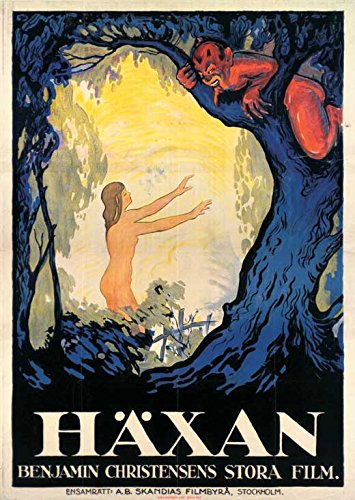
Häxan (1922) - We no longer sit in churches staring terrified at frescoes of devils.

Letterboxd Season Challenge 2019-2020!  Theme four, part one - a silent horror film!

(Chosen by me!)

There's some debate to be had over whether traditionally-defined progenitor of the documentary film, Nanook of the North, fully deserves the title.  After all, director Robert J Flaherty did not strive to capture the Inuit people as they lived at the time of production, but rather hired several actors of Inuit descent to play out the customs of their past like they constituted the entirety of Inuit culture.  Realities were ignored, narratives invented, details blurred, and overall the production is thought of as presenting a false impression of what "Eskimo" life was really like, based on American cultural assumptions of the day.  One does not come here to bury Flaherty and his entire historic footprint, though, regardless of how backwards his views and methods were, to the point of falsifying his star's name and cause of death two years after release to make his work seem more "authentic."  Much as Nanook of the North lacks true authenticity, one can still find the shape of things to come over the next century in its restagings - many of the practices on-screen were real Inuit traditions and skillsets, and in retrospect there's a certain truth to the falsehoods, if one useful for documenting the director's biases rather than the lives of those in frame.  It's far more docufiction than pure documentary, and its usefulness has shifted radically with the times, but a documentary it is all the same.

We encounter a similar issue of classification when discussing Benjamin Christensen's 1922 experiment, Häxan, retroactively subtitled Witchcraft Through the Ages for a 1968 American release.  On first blush, it seems very much in what we'd call the documentary mold, though perhaps closer to recorded lecture than anything traditionally filmic, what with the ongoing discussion of sources to be found in your playbill and the presence of a pointer guiding the eye through woodcarvings and mechanical depictions of hell.  The tone is academic, the focus on understanding how medieval scholars and priests understood the world to function.  Even when the camera shifts to presenting a filmed scene of a witch's hut in centuries past, the setting seems plausible, and the witch more an old, knowledgeable woman trusted by her younger fellows in the village as a source for miracle remedies with appropriately magical-sounding ingredients.  Shortly after this, however, Christensen's intertitle narration asserts that belief in the devil reached such heights as to make Satan a physical reality, and he pops up as Lucifer himself from behind a monk's bookstand.  We're off to the races, and won't make contact with more sensible reality for a good hour.

If Christensen's film veered into the fantastical and never returned, I'd feel no qualms about its classification.  The introduction is academic and informative, yes, but once you start watching witches fly through the night and kiss the devil's ass and eat stews of toads and unchristened children with the same eye of scholarly interest, you're more than likely exploiting safety and comfort communicated by the opening tone to scare the audience.  Let's all watch as Satan brings his faithful to a palace in the sky of wealth and delights they can never touch, tempts young maidens to wander nude through the night air from their window, and drive a convent of nuns to madness with the merest hint of his presence.  It's all realized with sets and costumes reminiscent of 15th century woodcarvings and manuscript doodles, and it's transgressive as hell for the time of release.  Just hunker on down for a bit of witchcraft-based horrors from the best a Swedish film studio's money could buy in the early 1920s.  Should be keen, yeah?

The issue becomes muddied when we consider how Häxan ends.  We return to reality for a brief consideration of torture devices and how we as a modern audience might react if forced to endure their infernal pains, dive back in for the aforementioned mad nuns passage, and then catch our heads for a final segment interrogating possible explanations for witchcraft in the past.  To Christensen's mind, much of the abnormal behavior cited as proof of allegiance to Satan can be explained as symptoms of hysteria in its various forms (or somatic symptom disorder, in the more up-to-date scientific vernacular).  Coupled with prejudiced and fearful attitudes towards anyone deemed a social outsider, or too temptuous to the faithful, or just plain not liked by a strong authority figure, a mental disorder could handily explain the vast majority of witch trials conducted by inquisitions across Europe over the centuries.  Witches, Christensen asserts, were never real, yet despite advancements in medical understanding of the mind and greater societal tolerance towards those with potentially frightening differences, the attitudes which fueled a fear of witches persist today.  After all, only the wealthy are afforded the full care of a fully-staffed clinic - the poor must endure and suffer in over-packed madhouses, and when you get down to it, what is forced, indefinite incarceration in an asylum but a more drawn-out form of burning at the stake?

Strong argument.  Resonant mindset.  Surprisingly comprehensive call for tolerance from something made nearly a whole century ago.  Applicable to discussions about how to handle mental illness in the modern day.  Damned strange case to make after indulging in images that treat witchcraft as real and immediate and vicarious as anything else in the picture.

It is here we encounter a difficulty in classifying Häxan, for it is possessed of a dual mindset.  In the one, witchcraft is as fake and ludicrous a notion as Earth at the center of a cosmos presided over by a physically tangible God, and has no place in modern times save as a specter of ills past; in the other, witchcraft is decidedly more solid and effective a cinematic reality than the unmoving images from manuscripts centuries old, and the very director calling magic and the supernatural a sham is free to run about in full devil costume, churning his butter and waggling his tongue into the camera all the way.  Christensen never acknowledges the disparity, casually showing an old woman driven to false confession by continued torture before presenting her wild inventions in a manner that suggests genuine vicarity.  From the way the film moves across subject to subject, witchcraft's existence only really depends on the needs of the moment.  The film is open to presenting beliefs born of ignorance and prejudice as just that, or presenting them like Flaherty would his Inuit subjects hunting with handheld harpoons, as the only conceivable reality.  There exists contradiction between these two modes, and it would seem to strain even the definition of docufiction to include Häxan amongst its ranks.

To solve this, I suggest we consider the film's roughly middle portion, the only passage to last across more than one of its seven segmented Parts.  The depiction of a witch trial from initial accusation to death of the last far-flung victim is as much fiction merely informed by historical research as anything else in the film, and its characters more indebted to the traditions of theatrical melodrama than a modern understanding of historical reenactment (or at least good historical reenactment - looking your way A&E), but it also makes the strongest argument for treating Häxan as a documentary of its own sort.  Amidst scenes chronicling false confessions as if they were undeniable truths, we find the inquisitors engaged in psychological torment of their charges better suited to chilling the blood than any naked moonlit dance or newborn sacrifice, or even the suggestions of instruments at torture in later sections.  They play false friend to trick a woman into confessing she may have heard of how to perform one tiny, inconsequential piece of magic at some point in her life; they drag a woman's family before her to guilt her over how they'll suffer when she's gone; they find inconsistencies in the stories as told and feel a tiny pang of empathy for those they torment, and go to their leader for an explanation of how this is REALLY the result of some magic spell or bewitchment upon their hearts.  We find, in short, the true monsters of the movie, the men who must hold directly contradictory views in their minds to assuage their guilt and carry out the destruction of several entire families to burn out witches they know probably do not exist, and yet must exist, because why else are they bringing about such suffering in the name of God?

Consider again how Christensen asserts these attitudes persist to the modern day.  We, like the priests and scholars of 15th century Europe, consider ourselves learned, better informed about the mysteries of the universe and the depths of the human mind than any before our time.  And like the priests, he posits our advancements do not preclude cruelty towards the disadvantaged, the oppressed, and the othered.  In order for this to be so, a similar form of doublethink must occur in our time, be it willful ignorance of the world's sufferings, or a distant self-justification that those who suffer in such a manner must deserve it in some way, or a personal self-justification of our own righteousness when we engage in such.  Per Christensen, a belief in witchcraft and the devil must persist to the present, in its own insidious way.  No longer in the literalized form of thinking suspicious persons as literally in league with the devil (for most of us), but in attitudes that say we are enlightened to the ways of the world and the plight of our fellows, yet allows them to burn by no fault of their own all the same.  This film is, in effect, a documentary of a mindset.

For Christensen's film to reflect this doublethink in its construction is, I should think, for Christensen to acknowledge his own shortcomings as an academic and documentarian addressing this issue.  On one level, to discuss witchcraft and the inquisitions directed at witches, one must treat the fantastical and real as matters of equal interest, particularly in a visual medium like film, where simply saying "This is what they believed witches did" is not the most effective means of communicating the idea.  On another, talking about the intellectual and moral inferiority of persons past invites one to derision by future viewers and critics, as Christensen's use of the medical term hysteria does in a time when said word has passed into common vernacular as a derogatory phrase.  Playing into the necessarily contradictory views in this manner insulates Häxan to an extent, ensures its ideas can remain evergreen.  After all, my notions about what constitutes a progressive, informed viewpoint will one day too seem hopelessly ignorant and backwards.  There are doubtlessly areas in my life where I turn a blind eye to suffering and justify it as necessary and right, as there are for all.  I, too, believe in witches after a fashion - it's just the way these things go.

We'd all do well to try and remove the bewitching of our own doing, treat those in our own lives better, and call for our governments to do the same, especially where the mentally ill are concerned.

4.5/5

Sunday, October 6, 2019

Joker (2019) - The worst part about having a mental illness is people expect you to behave as if you don't.


(Goin' full spoiler mode for a film that's still in theaters, so turn back if you aren't down for that.)

Right.  Let's have ourselves a talk about the quote in the title.  It's been in the trailers, gone viral as part of the marketing, gotten propped up as one of the big iconic capital-T Things from the movie alongside Joaquin Phoenix crying as he stretches his mouth into a fake smile and Phoenix smash-step dancing on the stairs.  And it has been... interesting for me.  Because I've said that quote before.  Paraphrased or verbatim, I've hit low points where all I want to do is lash and rant and hurt whoever's listening, and said that it's so goddamned frustrating having to go through my day under the expectation I'll act all normal when inside I'm getting angrier and angrier at myself and everyone around me.  "Yeah, me," I'll say, "it really does suck not being allowed to go round unloading all your damage on other folks whenever you want to, and getting called out when you decide to anyways out of the blue."  It is a Bad Thought, one of the repeating lines that comes up when my mental state hits its worst point, and one of those things I constantly promise myself I'll never unload with again before whoopsy-daisy!  Turns out we're right back here.

Hasn't exactly been one of those situations where it's this major trigger every time I see it - despite my problems, I'm generally collected enough to not deal with that problem, though I understand plenty others do and wish them the best in coping and overcoming.  It's more a strange situation because there's been all this talk about how Joker will get audiences inside the famous supervillain's head, make them see the world as he does, make us sympathize with the mad clown.  And it all sounds a lot of marketing guff reinforced by folks on the internet who're more than happy to repeat marketing guff if it's guff written to appeal to their sensibilities.  Until there's that thing I say when I'm having problems. My self-pitying, self-justifying line, which functions so well as a means of hurting others by implying they're doing something wrong by not tolerating my overly-aggressive nonsense, and hurting myself by explicitly stating the out-of-control, undercutting, unstable mindset is the healthy one.  That... sure is one hell of a Thing to have at the forefront of a marketing campaign.

And y'know, cliched and close to incel sadboi talk as it may sound, in watching Joker, there's an awful lot've Things in Joaquin Phoenix's performance I recognize from my own struggles with mental problems.  The tendency towards performative behavior when feeling cornered.  The attempts to sound decisive and harshly-spoken made ridiculous by storming off into a glass door or some other such unaware pratfall.  The struggle to break out of your own headspace and properly connect with folks.  The fantasizing - so much of the fantasizing.  Placing yourself in situations where you know you'd otherwise recede into the background or bomb if put on the spot, and imagining how you'd effortlessly breeze through it and get all the veneration and positive reinforcement you'd ever like.  And then when you can't idly dream anymore and come back to reality and find things aren't so good as you'd like, tearing everything out of a small space, crawling in, and not coming out for hours on end.  I've definitely done that last one more than a few times myself.

It should be noted, my life doesn't suck the same way Arthur Fleck's does.  I'm not dangling over a pit of economic ruin in a city on the verge of social revolt with an equally-ill mother to take care of and a need for multiple medications that the state pulls away once social programs get the axe.  Things are, in spite of how I feel many hours of the day, generally fine.  But Joker is out here smartly working the fears that things might be this way one day, or worse, how they might be so right now.  It's rote to say a film plays with your sense of reality, yet this film's right up front with how it does this, inviting you into Arthur's head to see how readily he detaches from reality early on, and evoking the same sudden shifts to the world acting flattering towards him at multiple points to slyly indicate when he has a break.  Most of the time, these breaks come when his situation is deteriorating, and while moments like his realizing the woman he's been courting never spoke to him beyond their initial meeting are obvious, other bits like the yuppies he murders taunting him or the city reflecting his self-image in the adoption of clown masks as a means of performance take longer to resolve themselves as real or not, if they do at all.  For the record, while I unfortunately had to give up a theory that the clown masks were all in his head (the third act doesn't really work as a narrative if you hold to it), I'm still nursing a notion that the guys he kills on the subway didn't actually do much to him, given the oddity of their singing Send in the Clowns before beating the shit out've him in the same way the street punks do at the beginning.

It could all be wrong, is what I'm saying.  Life could seem good, and the things you hold dear could all be inventions of perception to make yourself feel better.  S'a terrifying thought, and one I frequently have when down in a really dark place.  Cinematically, it's an easy place to explore, and would make a fine film on its own merits.  Where I think Joker goes right, where I think it earns the accolades it has claimed in this last month, and where I think it dodges the traps inherent to a story about how your reality isn't true and the world really wants to just beat you down, is in its refusal to validate.

Phoenix is key here.  He spends so much of the film chasing after some notion he's more important than he feels, be it a career in stand-up, a place as Thomas Wayne's son, or someone who can hold a lasting relationship.  When all lead to dead-ends, and he is left with this hollow, hating feeling inside, he breaks, and turns fully performative.  He's more dynamic in his movements, playful in his speaking, clever in his speech, more the image of a man treating the world as something to kick back against.  That fantasy of going out there, making a grand statement, and blowing your brains out for all the world to see (another one I get at times) constitutes his whole plan for the third act, and his every action is played as if however the world reacts, he'll take it as validation.  Yet the film does not reinforce, nor does it condone, because it treats his actions as disturbing, shocking, and vile as they are.  This man has killed people to make himself feel better, taken advantage of the big shot he's always wanted to enact a small-screen suicide, found a way to control his inappropriate laughter by deliberately, forcefully laughing at the horrific acts he perpetrates.  Each and every action is an act, and it is act to get attention, to feel important, to raise a middle finger at the world and tell it all to piss off.

And it is wrong.  The film treats it as wrong.  Phoenix's performance indicates he is wrong.  The whole big fantasy of becoming an important person, and what does it involves?  Breaking down on air, violently oscilating between performative and self-pityingly angry, blowing a man's brains out, and becoming the cult leader of an aimless, needlessly violent movement based in destruction as an ideology.  Big whoop, buddy.  Your dream's everyone's nightmare.  MY dream's everyone's nightmare.  That's why I push it down and try to get better.  And the thought that there might come a day when I can't push it down, because I can't control it or because the wrong stimuli come along or because I can't get the help or support I need any longer is terrifying.  And that's the big success of Joker - taking all those what if fears of living with a mental illness, playing them out to their logical conclusion, and condemning the result.  This is wrong, because the end result is the JOKER.  This is his world, this is what I get if those impulses are acted on - a nightmare world where the veneration  I want only comes from people who might want to serve a goddamned supervillain.

Now, if I've any big issue with Joker, it's in how it adheres to the whole supervillain thing.  Namely, at the climax, as Arthur's story is reaching its climax, we cut over to one of the rioters chasing a rich couple out of a movie theater, and gunning down Bruce Wayne's parents.  The camera stays with the little boy for a little too long for my tastes.  If it were incidental, a sharp punctuation note in the midst of all the chaos he's needlessly inspired, I might be good with it.  As stands, this feels like a far worse attempt to tie Batman and the Joker's origins to one another than the Tim Burton Batman film.  At least there, the connection was more casual, a nice third act twist to make the stakes more personal in the way a thousand other action films have.  Here, we've a film whose writing and star performance work their asses off to show how this is all the result of a man disintegrating and taking every little thing as an opportunity to scream at the world about how unfair it all is and work his damage out on everyone who crosses his path, and how none of it is right or justified regardless of how he feels... and then throws a little "And this was all the start of a great franchise rivalry!" note in right as it ends.  It's far, FAR too close to making his actions seem righteous and exciting rather than hellish and terminal.  A story like this, this sort of sympathetic but still firm and moral look at the Joker, should not end with Batman's creation.

I should dive out, back into healthier waters.  This has been a lot more soul-baring exercise than proper review, even though a lot with regards to the film's editing, sound design, other performances, and general visual feel deserve praise.  Just for a quick little example, it's smart in the way it brings in the Taxi Driver and King of Comedy homages, as they mostly play into Arthur's runaway, self-destructive myth making, and function as means of showing how he's taking the wrong path more than making him look cool in a shallow way.  But I've gotten dark here, and possibly implied some things about myself in finding a mirror in this movie that I really don't intend.  I just want to say, in spite of how much of my worst thoughts I find in this movie, how much I feel the fear of giving up and doing whatever and taking even the most horrific things as a means of feeling great, I am OK.  I wouldn't appreciate Joker quite so much if I wasn't OK.  In much the same way Psycho is a scary but enjoyable way of watching a mentally ill person wrench the movie's narrative away from its original track and refuse to let it go with each plunge of the knife, Joker is a terrifying look at all my intrusive thoughts and imagined scenarios.  It's a good way to see that all actualized with a palpably horrified reaction to what it all means if brought to a conclusion, and then lean back, self-reflect, and say "Let's not go there.  Let's be healthy."  Hopefully it stays this way, and we don't see it all blown to bits by Phoenix coming back to fight Batman as a more standard take on the character.

(Last note: Todd Phillips has been talking a lot of nonsense in interviews of late, all this stuff about how comedy is dead because the leftists and SJWs are out to cancel all comedians, and how he's trying to smuggle a REAL movie into the world of comic book fluff.  I very much disagree with his perspectives, and will be quite disappointed if further thinking on this film turns up that ideology in his construction.  It still works quite well for me, though, and I can't find reason to condemn his comments in the same way I condemn other directors for endangering/abusing cast and crew, so y'know... fuck what he thinks.  Movie's still good.)

4/5

Tuesday, October 1, 2019

A Nightmare on Elm Street (1984) - Screw your pass!


Letterboxd Season Challenge 2019-2020! Theme one, part one: a favorite film from one of the past hosts!

(Chosen by me!)

Down in the suburbs of sleepy Springwood, Illinois, the parents hide a dark secret. About fifteen years ago, a child murderer by name of Fred Krueger got off on a technicality, free to roam the streets preying on their kids once more because some clerk didn't sign a document properly. Fearing the worst for their families and outraged at this failure of justice, the parents banded together into a mob, tracked Fred down to an old boiler room, tortured him, and eventually burned him alive in the main furnace. Having all partaken in this horrible deed, they swore a vow of silence, such that the remaining children wouldn't ever have to think if their tormentor again, outside the odd, disused skiprope rhyme. Now, years after the incident, for seemingly no reason, their teenaged-children start talking of a man hunting them in their dreams, a man whose description sounds suspiciously like that of one Mr. Krueger...

Alongside Jason's drowning, Chucky's true nature, and the sequelized why behind Michael Myers' senseless crimes, Freddy's backstory is one of the worst-kept secrets in the 80s horror pantheon. From almost the moment I read about him in a book on movie monsters back in elementary school, the exact hows and whys of his origin were made perfectly clear to me, and serious conversation around the films always alternates between gushing about how cool even the goofiest kills are, praising Robert Englund's consistent performances across eight installments, and talking up the psychological angle at play. Knowing Nancy, this first film's protagonist, is the daughter of parents who personally murdered Freddy in his mortal life, thereby giving birth to the dream demon she must fight against, I had this expectation in my head that A Nightmare on Elm Street would be this tight horror film preying on a duel set of fears about everyone lying to you about something obscurely horrible and trying to stay awake as long as possible lest something terrible happen in your dreams. It's considered a classic for a reason, and the initial entries in most horror franchises typically have something more going on than their thrill-focused follow-ups, so surely my impressions couldn't be wrong?

On the count of "Oh no, the scary man is gonna get me in my dreams!" A Nightmare on Elm Street Works. Wes Craven quite obviously had a lot of fun designing the moments when Nancy and friends slide from waking world to dream world, and messing about with mildly surreal imagery and quick effects-based gags to get the point across. Most of the film's dream effects are loaded into the initial assault on Nancy's friend Tina, leaving most later dream sequences with one big notable scare per each following, but they're all particularly good and memorable effects as a result. It's also got just enough over-the-top gore in differing variants between Tina and Glenn's deaths to qualify as nasty and mean-spirited in that very particularly 80s way. Heather Langenkamp sells Nancy's descent into sleep-deprived irrationality well, and Englund's performance flits between manic glee and straight up bloodlust like any good slasher villain should. Read the film as a surface level nightmare about something lurking in your subconscious that will kill you the second you show any weakness, and it's pretty tops.

Recognize the placement of Nancy's mother revealing her role in killing Krueger towards the end of the second act as an attempt to raise the stakes and speak to something more horrific beneath the suburban image of Elm Street, and the film becomes a little disappointing. Looking back at the opening movements and realizing none of the actors playing parents, Nancy's or otherwise, act at all like there's something amiss makes it feel like there's active missed opportunities at every corner. Nancy grew up with people who did the dark deed, she was pretty much always destined to fall victim to a nightmare like this sooner or later - there's infinite potential for the film to explore the more immediate, real life horror of people you trust acting like they're hiding something important as you fall into hopeless terror over a catastrophe only you can see. It's so instantly recognizable as a teenage fear, even I Was A Teenage Frankenstein mined its potential, yet A Nightmare on Elm Street only decides Freddy's background exists 50 minutes in for the sake of a creepy scene with Nancy's mom. What's more, it's sandwiched between an awkward attempt to evoke The Exorcists's hospital scene without any of the effectiveness, and the blowout scene of Johnny Depp turning into a human smoothie, leaving it feeling less like a vital character moment and more like a waystation on the way to more scares. If you're looking, there's coy hints towards something being wrong with Nancy's parents in their first scene, but it's brief and easily missable if you're not tuned into the truth. I'd much rather the movie top playing coy about this stuff and just be ABOUT it.

The climax washing out doesn't help too much. By the time Nancy confronts Freddy for the last time, the movie's become too much about working out the rules of how he works and how to exploit them for an assumption of dream logic to kick in, and Freddy spends his entire time in the supposed real world chasing Nancy around like any other slasher villain could. Her realization that she only need stop believing in him to escape doesn't come from any character motivated place, and isn't afforded any time to breathe before diving into the finale. Whether you watch the original happy ending as Craven wrote it, or the studio mandated last-second twist, the power that idea holds is lost any way you slice it, either to anticlimax or a franchise-staging promise rendering it false. The whole thing seems a little bit rushed, the result of creativity or the budget running out, and leaves the film with only the surreal image of Nancy's mother sinking into the bed as a solid note for its final movements.

It's still effective as horror, mind. Between the uncertain nightmare structure, the two lead performances, and the creative use of special effects to enhance the ominous atmosphere, Craven crafted a heart-clenching scary movie through and through. Problem is, I can see a masterpiece of dual-layered storytelling just waiting for someone to acknowledge its presence lurking at the corners, and instead of leveraging that angle for additional discomfort and shock, the film dives into the mechanics of the spooky dream man for the sake of a cheap, "Ah-HA, it really DOESN'T work like that!" gotcha. I'd call this an example of a good-verging-on-great film let down by a missed opportunity to be more. A friend of mine told me the remake might be more my speed, since it both adopts the originally intended child molestation backstory and integrates mistrust of the parents into the central story. Then again, the remake also isn't generally regarded as that good, so I might just be overthinking the spooky scary nightmare boy.

(For some reason I can't explain, the final gag with the Freddy sunroof falls dead on arrival. It's weird.)

3.5/5