Showing posts with label historical. Show all posts

Sunday, April 19, 2020

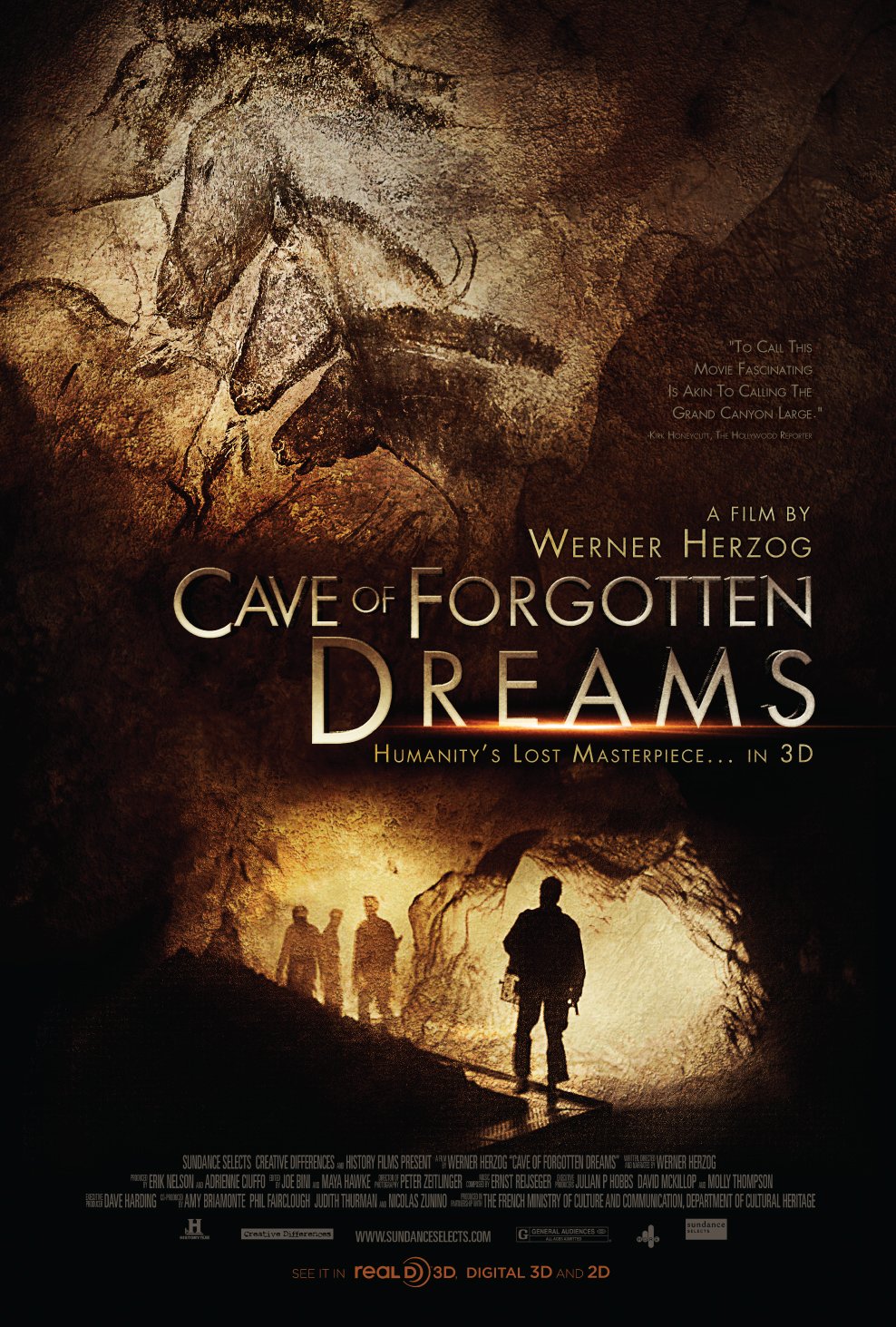
Cave of Forgotten Dreams (2010) - There seems to have existed a visual convention extending all the way beyond Baywatch.

Extra Large Movie Poster Image for Cave of Forgotten Dreams (#1 of 3)

It's the Letterboxd Season Challenge!  Theme ten, part three - a cinéma vérité film!

(Chosen by John!)

Let's not make the whole, "Well this film isn't good, proper, Christian cinéma vérité in the true sense, but the list said it was and we stick to our picks," thing a little postscript at the end.  Let's address the matter right up front: director Werner Herzog is not one to embrace the theory of observational cinema.  When he's crafting fiction, he is determined to leave his thumbprint on the work prominently as possible with his often unsafe working practices and method of handling actors; when helming a documentary, his unique, strangely compelling voice is perpetually at the forefront, and we are given constant reminders of how there is a camera, and lights, and a crew, and the person of Werner Herzog involved in every stage of production.  He will not vanish into the background like a fly on a wall, and indeed noted his belief that a director should instead serve as a hornet constantly attacking their subject in an interview chronicled by the New York Times around Cave of Forgotten Dreams' American release.  We have, to all appearances, chosen a film whose contents scantly reflect the tradition of an invisible camera and subjects captured in perfectly natural surroundings.  As he notes, by virtue of the Chauvet cave paintings' depth within their cavernous home both upon initial creation and after a rockslide buried the initial entrance from view, one cannot appreciate them without artificial light, be it from a torch or stage light.  Herzog and his crew at first cannot stand in this space without accompaniment from researchers well-versed in the safety protocols and history behind the cave, and because they are along for the ride, we are going to hear more than plenty from them throughout the film, their words addressed directly to Herzog and the camera.  Peppered throughout we find many vignettes showing the work towards digitally mapping every inch of the cave, inspecting reproduced artifacts from nearby sites in a museum, talking of ancient hunting practices and music and sniffing for cave scents.  Cave of Forgotten Dreams is anything but cinéma vérité, moreso than High School owing to Wiseman's disdain for the term, or Man with a Movie Camera due to Vertov predating the very idea.

And yet, for all this, Herzog does employ techniques we might call purely observational.  At a few key points throughout and most prominently for the climax, he ceases his speech, banishes all persons from the frame, and chooses to only film the paintings in all their preserved beauty.  It is of course impossible to say there's NO intended influence from the director or crew in these passages - he places so much emphasis on the importance of light in making the animals on the walls dance and move in a proto-cinema earlier in the film, it's impossible to ignore how his own lights shift across the rockface - but by comparison there is no guiding hand musing about the nature of those who came here before, no expert detailing why certain images are so fascinating.  When we come down to the matter, it is simply us, the painted animals, and the temporal distance collapsed to zero.  One expects this in a documentary cave paintings, naturally.  If you're gonna take a camera into a fragile location sealed off to all save a handful of experts, you'll eventually stop talking and show what you've found to show.  Why make note of Herzog staying quite when anyone with even the tiniest awareness of how incredible it is to find a direct link to a moment and people 32,000 years past would keep their trap shut?

I do so because I think, despite Herzog's disdain for observational cinema and his tendency to make knowing Werner Herzog is behind all this a top priority, his limited use of observational techniques here is more effective for their sharing time with his usual methods than they would as a total work in themselves.  Pan the camera across the walls, let us appreciate the paleolithic artwork, and it is all awe-inspiring, yes, but the context is so much more.  The paintings become more incredible when someone who knows what's up explains how we can trace the journey of one particular painter through the tunnels thanks to his crooked little finger, when we are given cause to deliberately contemplate the fragility of the calcite structures, when someone explains the limitations that prevent us from getting a full look at an angularly protruding stalactite with a union of woman and bull painted round its circumference.  To follow the archaeologists and art historians and geologists and even the strange perfumer fellow who's determined to find new caves by identifying their musk and following his nose is to gain necessary knowledge, place a specific idea behind WHY we find these images of hunts and wilds long extinct so compelling.  Equipped with this understanding, when we are finally left alone like Herzog and his crew in the furthest confines of the cave, with only these ancient paintings before our eyes, we are able to draw on that which we now know, consider them more fully, and feel our unnamed hypnotic compulsion to look and drink and be one with our ancestors coalesce into an informed sense of commonality.  For my part, knowing more about how they took advantage of the texture and contours of the cave walls sharpened my appreciation for how their tableaux takes on the appearance of a plain observed from a high place, certain features tangibly in the distance, others obscured by foliage and rock formations and the like.  It became a true window into another time, thanks to my learning how and possibly why it was made this way.

 My regular readers will note I constantly harp about purity of form when it comes to movies, dolling out greater praise for works that achieve in one particular manner to a sharpened peak.  While my aesthetic preferences will typically swing this way, it's important to note the equal strength found in a marriage between disciplines.  The tradition behind cinéma vérité, when coupled with a more usual form of heavy-handed, carefully guided documentation, can reveal untold truths about the subject when we finally do back off and look with nothing more than mechanical eyes.  With regards to the Chauvet cave and the paintings within, I wonder whether a more adamantly observational director, interested only in filming the walls, could have captured the same sense of compressed time Herzog manages here?  Learning as we do before our time with light against ancient paint and older stone grants the paintings a stronger sense of humanity, some more visible image of an early homo sapien crouched before their work, bringing it to life before our eyes as we puzzle out their thought processes, their intents, their dreams.  Would the cave speak so legible a tongue if presented on its own, or do we truly need all Herzog includes as a Rosetta stone?  Furthermore, could this explain why Herzog chooses to focus on the albino crocodiles in a nuclear power plant-dependent jungle enclosure several miles away?  After all, the crocodillians will not have any guides or experts to inform them about what the paintings could mean or why their creators chose to draw them, anymore than the tourists in Lascaux would in the days those paintings were open to a mold-breeding public.  In an artistic, anthropomorthized sense, when they see what we see, free from intellectual guidance, will they too dream of the horse on the open plain?

Do Crocodiles Dream of Wild Horses is the name of my new album, look for it on store shelves.

Sunday, March 22, 2020

The Duellists (1977) - I have submitted to your notions of honor long enough.


It's the Letterboxd Season Challenge!  Theme nine, part two - a film named a 20th century milestone in cinematography by the American Society of Cinematographers!

(Chosen by Jackie!)

Howzabout we try something a little different today?  Ridley Scott's debut feature, adapted from the Joseph Conrad story The Duel, traces the rivalry between proper, dignified 3rd Hussar Lieutenant Armand d'Hubert (Keith Carradine) and hotheaded, bloodsport-loving 7th Hussar Lieutenant Gabriel Feraud (Harvey Keitel) as they duel numerous times across the course of the Napoleonic Wars and beyond, examining just how much their encounters pervert the true and noble spirit of dueling, and how much they reveal what dueling really is.  To this end, let us strip away all but the duels.  Less review The Duellists and more discuss how Scott oversees the shooting and editing and acting in each of the major encounters to see how he characterizes each, and understand the thrust of his argument.  We'll naturally leave aside many other virtues inherent to the film, but like I say, trying something different today, so we'll just need to accept the loss.

-Prelude duel: Staged between Feraud and an unnamed civilian, we begin the film with the central question already established in the way its framing techniques contrast one another.  Where we begin with a painterly wide shot of the two figures at the ready against the misty plains like gentlemen fighters with a rustic house to balance the image, the fight itself is shot in shaky over-the-shoulder view, and becomes more frantic and unstable as Feraud unleashes his blows against his opponent.  The cause of this duel is unknown, the slight totally unexplained to the audience beyond Feraud's love for dueling, and we're already left to wonder which properly defines the practice: the refinement of the wide shot, or the barbarity of the close-up.

-First duel: In the first encounter between d'Hubert and Feraud, Scott certainly seems to favor the latter interpretation.  A battle of anger and passion more than anything else, it's practically all shaking, over-the-shoulder shots of the two men violently swinging their sabers at one another, with only a few cuts to medium when the pair pause to assess one another.  These vanish as they take the battle into a darkened cover area and the music kicks in with great intensity, the editing going faster and reaching a fever pitch as d'Hubert strikes the decisive blow.  Interestingly, Scott begins a trend of cutting to a quieter, more painterly shot in the wake of the duel, as Feraud's maid tackling d'Hubert to the ground is immediately followed by a shift over to a still life.  Even when the argument is fully in favor of reading barbarity into the practice (as fitting for a duel initiated over one party getting needlessly upset over getting arrested for dueling too much), Scott's still interposing a kind of nobility into proceedings.

-Second duel: By contrast, the actual crossing of swords here is as beautifully sculpted and gentlemanly as can be.  Compared to the drab grays of the front and the warm interior firelights amidst inky blackness that precede it, the soft purples and blues and golds and greens of early morning make the duel seem livelier than any surrounding scene, and the fight itself takes place entirely over two wide shots, which focus more on the landscape than the participants.  d'Hubert and Feraud's conduct lacks the aggression of their previous encounters, and where other fights are far bloodier, this one ends with a single slash.  However, the important thing to note is how this more refined look at dueling is immediately followed by a more conventionally shot view of the aftermath, with d'Hubert slowly becoming a mass of blood from his small wound, and Feraud openly declaring his contempt for so easy a victory, all of which lasts longer than the duel itself.  Note again the cut to refinement with a zooming shot of d'Hubert in a lovely-looking bathtub scene with his lover.

-Third duel: Speaking of said lover, the interregnum between these two encounters sees him leave d'Hubert over his refusal to disengage, and while we're mainly focused on the duels here, I'd be remiss to neglect mentioning the moment when she uses red sealant to write "Goodbye" on his sword, which he wipes away like blood on the blade to bring us into their next fight.  Befitting so major a loss to the protagonist at an act change, the third duel is the most openly vicious of the lot, opening with d'Hubert and Feraud already slashed to pieces and bleeding profusely from every new orifice.  The setting is murkier, the movements wilder, the lighting scantly flattering to anyone, and the editing fast fast fast.  One might think this a fairly definitive statement in favor of the inherently basal nature of dueling, but the way it gradually slows as the men exhaust makes me think otherwise.  There's real hatred behind their actions now, a genuine desire to kill and be done with it, yet they cannot achieve their goal with raw, physically-animating anger alone.  Even the camera loses interest as it wanders away, and subsequently wanders back on a wounded d'Hubert in another shot of painterly browns and grays with a big central contrasting object.  If this be dueling, why can it not sustain itself?

-Fourth duel: Performed on horseback, and interesting for the way its surroundings reflect the discussion between refinement and basality.  As noted with bitter irony by d'Hubert beforehand, it is meant as an honor to the cavalry, the rivalry between the two men having become noted enough to stand in for their ascending ranks in Napoleon's army - two people who're just out to cut each other because one won't leave the other alone, the pride and honor of the world's greatest military force.  From the perspective of the characters as they charge one another, the clearing of trees around them forms a perfect corridor, the ideal stage for such a battle.  Scott, however, shoots the scene primarily from the sides, so we can see how these orderly trees are only orderly from one perspective.  Seen any other way, and it's as scattered, disorderly, chaotic an arrangement as the thoughts flashing through d'Hubert's mind as he launches a decisive final strikes (an interesting technique, but considering the way it interrupts the sound editing as well, not one I find fully effective).  For something meant as a compliment to the cavalry and the bloodsport's nobility, Feraud looks an awfuler sight from one slash than at any other point, and yet d'Hubert still rides off into the sunset in still another painterly shot.

-The aborted fifth duel: d'Hubert has, in effect, been fighting for a deluded fantasy for most of the film.  Its first two acts see him believing a strong enough victory against Feraud will dissuade the man from continuing, assert the true intent of dueling as a gentleman's way of resolving uncommon disagreements and disengaging as friends or acquaintances at the end.  Across seven minutes in Russia, however, these notions are dashed entirely.  Amidst a white plain of wretched cold and endless frozen corpses, huddled around an inadequate fire, faces raw and cracking, d'Hubert spies Feraud across the camp, and watches in horror as the man uses all his strength to draw himself up, walk to the munitions, grab two rifles, and plunk himself back down with a meaningful glare back.  While the actual duel is brought off when they use their rounds to defend against a party of Cossacks after foolishly trudging off to a remote corner, the play between their eyes makes Feraud's intent in this all to clear.  This is never going to stop, at any cost, until one is dead by the other's hand.  Hardly bloodsport anymore, not something so simple that might stop for war; just raw, baseless hatred with only one terminal point.

-Interregnum: Worth breaking our pattern here for a brief note on what d'Hubert does across the next half-hour.  There are no duels to speak of, hardly even a threat from Feraud, yet the downtime as Napoleon falls and the royalists reassert their power is vital to why d'Hubert is able to win on his own terms in the end.  More specifically, on hearing Feraud is due for execution for refusing to denounce his raving Bonapartism, d'Hubert intervenes on his part and successfully convinces Joseph Fouché (Albert Finney) to strike him from the list, on the grounds that the man has defined so much of his life and pursued their combat so doggedly, d'Hubert simply cannot allow his death in this manner.  Despite the vision of hell in Russia, the man still believes in honorable conduct and a fair engagement, and so actively chooses to something which guarantees he'll always be looking over his shoulder for yet another challenge.

-Sixth and final duel: Of all the encounters, this features the thickest and wildest wilderness, the tensest and most paranoid music, a construction designed to emphasize how the two men creep towards each other through enormous ruined structures and untamed woods, narrowly missing one another's eyes until they are right on top of each other, ready to kill or be killed at any second.  And yet, vitally, it also contains the most controlled camerawork of any duel here, our view scarcely shaking or muddying even when the pistol shots fly, for it stands as the moment when d'Hubert fully asserts himself and drags the act of dueling far away from Feraud's mad, perverted idea of mindless killing to assuge the roar of anger in his brain.  For all the elements telling us this is a moment of totally lost control, it is presented in a careful, calculated manner, and this coupled with the delayed resolution of d'Hubert laying down his terms, for Feraud to act as dead to him and never engage in another duel so long as both shall live, strikes at the heart of how Scott presents the act of dueling.  There is great risk of it becoming naught but simple murder, a shade on waking life and a constant presence in nightmares, an unchained love for killing for killing's sake and seeing another bloodied and battered and dying just because you don't like the cut of their gib.  If dueling is to have any sense to it, any of its supposed gentlemanly resolve, it requires active thought and a cool head to walk through the wild and ruinous temptation offered by taking arms against another, and the firmest of resolves to MAKE it refined and civilized - something Feraud lacks, and may very well lack as he looks over the grounds of their encounter like Napoleon looking towards the horizon from St Helena.

What I find interesting about The Duellists besides all we've discussed here is the plainspoken nature of the acting.  Compared to the melodramatic vibe I took from Conrad's original dialogue, Carradine and Keitel speak their dialogue without much flair or affectation, leaving much of the work to Scott and his camera.  I do not find this a weakness, but rather an intriguing, intentional element, bringing us into a more visual examination than a more dynamic dialogue might otherwise.  While I might not fully agree with the conclusions I've drawn from this brief analysis, I'm not inclined to believe Scott does either - the material took him here, and he crafted a rather pretty picture in response.

4/5

Thursday, December 26, 2019

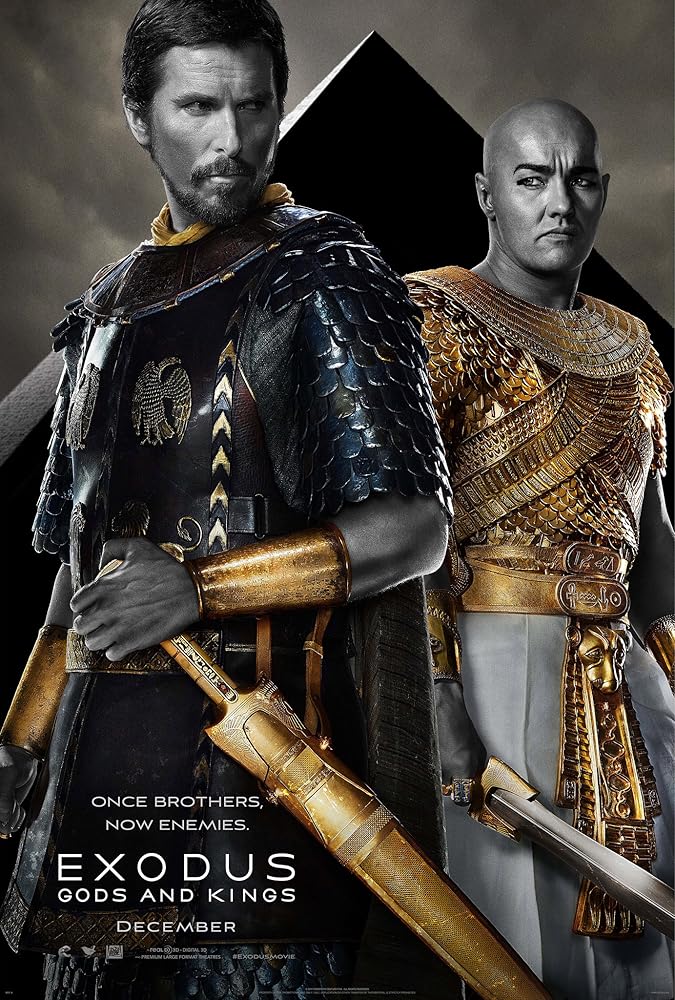
Exodus: Gods and Kings (2014) - A Reinterpretation of Scripture

(The following content is reran from the 2018 Christmas marathon on Letterboxd, as originally seen here.)

Why were there so many Christian films in 2014? In part, because Ridley Scott's adaptation of Moses' story hit theaters in early December. If we're to believe Scott's comments regarding the film's casting, had he bothered scouting for actors whose background remotely reflected those of characters and historical persons of Middle Eastern descent roughly 2000 BCE, we'd have gone down a film that year. Apparently, hiring actors whose skin is too dark or whose names are too foreign-sounding when making a film about the Exodus narrative means no studio will fork over a budget big enough to depict the Plagues or Parting the Red Sea properly. Whether the film was worth dousing Joel Edgerton, John Turturro, Aaron Paul, and others in varying degrees of brownface is a little bit up in the air, as the final product is a fairly mixed.

Giving a tiny bit of credence to Scott's financial justification for whitewashing and brownfacing his cast, the special effects during the big, spectacular Acts of God sequences are appropriately grandiose, and have an interesting bent to their execution. The film tries to find some natural means of explaining fantastical events, and so the plagues have initially sound justification for the Nile turning to blood, frequent swarms of destructive insects, and boils upon every Egyptian. Moses parting the Red Sea is treated as a potentially coincidental happening with only circumstantial ties to his own actions, which he must take advantage of as means of proving his connection to God to the doubting tribes. When it comes time for God's hand to become visible and explicit in its actions, the visuals gain a properly cinematic sheen, with a creeping shadow claiming each firstborn and the sea slowly collapsing back in on itself in a rushing tidal wave.

Exodus' new interpretation of Moses has some merit as well. It ditches the traditional role of shepherd and vessel of God in favor of a military man whose connection to the Lord may well be resultant from a traumatic head injury. There's a potentially neat dynamic around the midpoint, when Moses has returned to Egypt and determined to free his people through guerrilla warfare, intending to break Ramasses' will through attrition. As a concept, it makes some sense for a man brought up to lead armies to approach freedom from a fighting standpoint, and the film expands on this notion by contrasting it against God's proof that He can manage the same strategy far more effectively. I can see the intent, slowly nudging Moses out of his comfort zone and into the part of spiritual leader, and it might've worked!

But then we get into a major problem with Exodus: Gods and Kings: the storytelling and acting. Say what you will about Cecil B deMille as a director of crowds rather than actors; The Ten Commandments handily demonstrates how, with a lengthy enough running time and some talented players on hand, he could hammer a fully fleshed, comprehensive version of the material. Ridley Scott, working with still considerable two-and-a-half hours of screentime and actors of far greater standing than Charlton Heston, somehow cannot wrangle an ounce of humanity or relatability out of one of the quintessential religious stories about the power of faith and striving for freedom. He changes the script up far too frequently, giving Christian Bale and Joel Edgerton very little time to establish their characters as much beyond the same basic personalities in a slightly different situation before they overextend themselves or fade into the background. It's weird to think of a movie this long as feeling rushed, but it tries to cram in several additional scenarios for the rival brothers to work their way through in addition to the already shifting narrative of scripture, which makes odd moments like Edgerton's over-reliance on bellowing his lines to convey emotion, or the absolute stone-cold-stunner of, "From an economic standpoint alone, what you ask is problematic at best," stand out all the more.

Moses suffers the most here, as Scott's conception of a more secular prophet of the Jewish peoples comes off half-formed at best. The notion of moving him from commander of armies to rough-hewn freedom fighter to the Moses of Biblical understanding DOES have merit, but the film's eagerness to move from scenario to scenario means it never really slows down to examine Moses' psychology, or the deeper implications of his transformed state. A large portion of the middle stretch is taken up with Moses arguing with God in little circles about the morality of his actions without moving forwards. While his hollowed, resigned warning to Ramasses on the eve of the tenth plague and full confirmation of God's might has promise, it becomes a weirdly-shaped wrinkle when Moses' next big action involves triggering the parting of the seas with an act of doubt at God's presence. He awkwardly jolts from state to state depending on what the film deems necessary, and for all the hats he wears throughout the narrative, we ultimately see something less than the textual Moses.

When considering Biblical stories and characters, one needs to remember they rarely follow modern conventions of narrative structure or dynamic characters. The presentation on page frequently involves little more than "and then this happened, and so it was, and then this happened, and so it was, and then..." while the characters we're meant to learn from achieve their status as teachers by way of embodying an infallible moral righteousness. Introducing fallibility and uncertainty, then, is an easy way to make the old patriarchs and prophets more relatable, and examine their ideologies in greater detail. Taking Moses for an example, you have a man who knows exactly what he means to do the second God comes into his life, and hammers against the Pharaoh with unflinching certainty until he succeeds, only to turn the wrath of the Lord upon his own people when they fall short. Following the need to transform the character into something understandable and readable as an actual person in the moment, deMille kept the strong authority figure image, and whilst heavily emphasizing Moses' role as a lawmaker and Jesus-like figure, a good fit for mid-50s American culture.

Ridley Scott and Christian Bale's Moses does not only suffer from the story refusing to slow down long enough to examine him as a person - he sinks further because the film is naked about its intent to change him for profit. This Moses is not a man brought up to lead armies who later uses his experience to engage in a dragout war with his brother because it contrasts with any particular weightiness against his eventual turn to pure belief and subservience to God. He is a general-king because it enables to filmmakers to actionize the material, cram a few extra battle sequences in amidst the scenes of Biblical devastation, leverage the allure of a recently-departed Batman hanging around the studio. Action is not an inherent evil, and can be readily employed to underscore some greater point within the story, but Exodus' action scenes exist only to wow. Without proper interrogation of what this new strategically-minded, ready-to-doubt characterization means for Moses, the lurching nature of his character arc becomes more pronounced, and we end where we should have started.

They go and sideline the Golden Calf portion of the story, too, which is pretty much the most important part of Exodus if you're trying to give Moses a story about coming into conflict with God's divine wrath and learning to trust in His will instead of the strength in your own hands. There's fertile ground in a changed Moses suddenly turning against the very people he won over, the challenge of leading them to as pure a faith as his over forty years in the desert, and it's relegated to a single, far-away shot. That's how unwilling Gods and Kings is to engage with the implications of its alterations.

Initially, I felt three made for a fair rating. Ridley Scott at least provided some rather impressive vistas and battle sequences and visions of destruction on a mass scale. As I thought through the film more, though, I realized most of those visual effects-dependent scenes were either unnecessary attempts at actionization, or an inkling less impressive than equivalents in the deMille epic thanks to the (relative) ease of creating such shots in a computer compared against wranglings tens of thousands of cast and crew for similar effect. Though I do still find the Plagues and the Red Sea sequence both visually compelling and well-executed storytelling, I don't think the press of so many other visuals souring the more I contemplate them deserves too high a praise. Loop the brownface back into the discussion, and I'm more than happy to give Exodus: Gods and Kings my patented "there's some good things here, but man, the bad will weigh on your mind" rating.

Next time: The final installment of this impulsive Christmas series! Who all's ready for Kirk Cameron to celebrate the virtues of greed, gluttony, and conspicuous consumerism!

I'm not.

2.5/5

Thursday, December 5, 2019

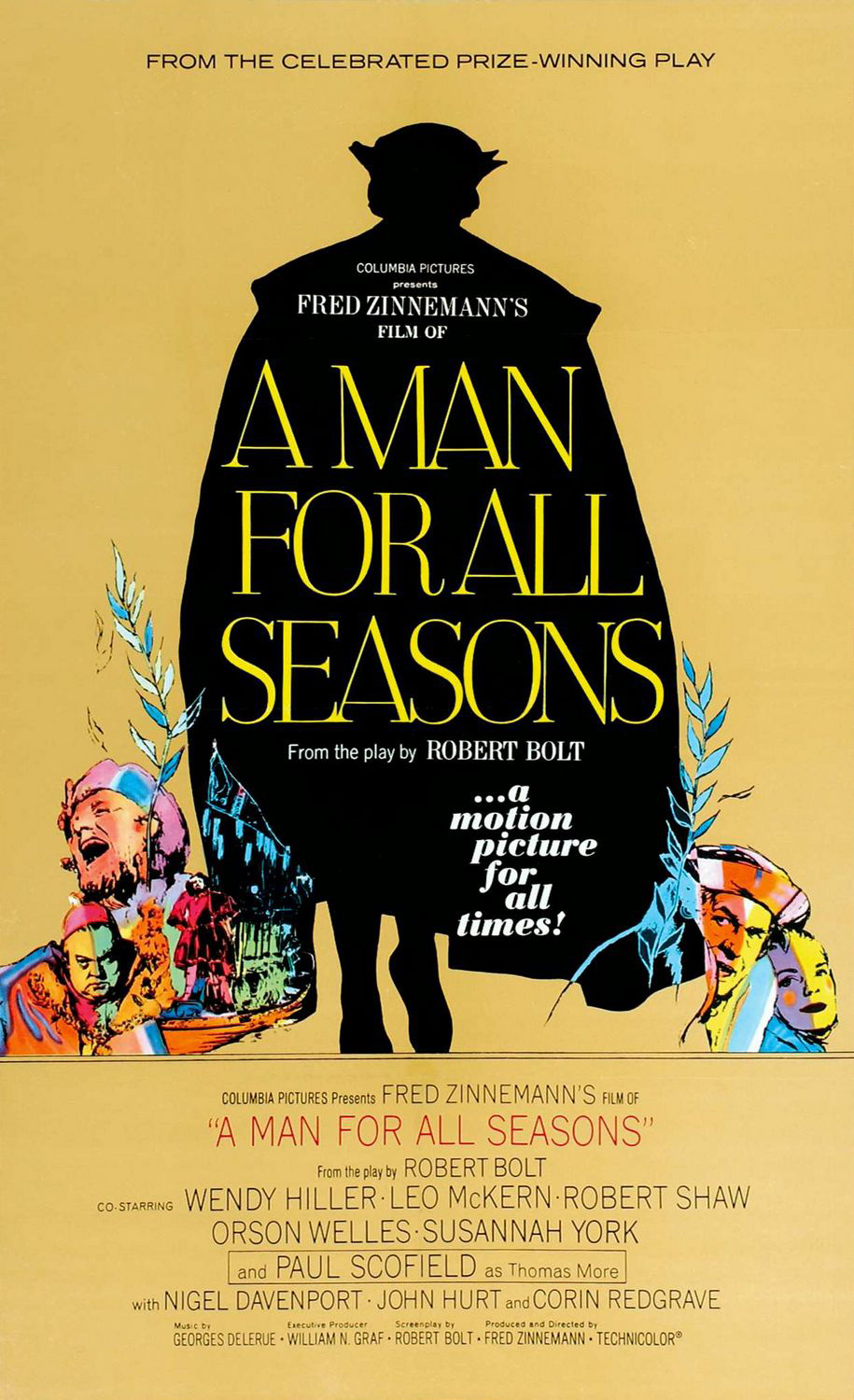
A Man For All Seasons (1966) - I trust I make myself obscure?


Letterboxd Season Challenge 2019-2020!  Theme five, part two - stage to screen adaptations!

(Chosen by Jackie!)

Let's open with some shop talk, shall we?  There's some belief amongst critics, both professionals and amateurs like myself, which posits the best example of any artistic medium is one whose most exemplary qualities best exemplify its medium's most unique qualities.  The video game that could not be any other than a video game, the painting one could not imagine as quite the same as sculpture or photograph, the film whose qualities are most vitally and enduringly filmic in nature, sort of thing.  It's a nice little maxim with quite a lot more going on beneath the surface than its simple "This is the best because it is the most" position would indicate.  A dance, for instance, might stand as an exemplary example of dance because it emphasizes the fluidity of motion possible through a highly skilled/trained performer's responses in time with music, or perhaps the strength required to achieve such fearsome or strenuous moves in so quick a time or else over such a long period, or maybe the beauty constructed by two or more in perfect, graceful sync with one another, or just maybe the elemental dance requires many in a clockwork tick-tock creation defined more by the choreographer's skill than any one dancer's choices.  What makes any dance more dance-like than the other?  Same basic problem arises when you try to concretely define what makes film film.  We can get into matters of temporal and emotional effects achieved by editing, the personalized nature of acting compared to traditional theater thanks to the camera's intimacy, the ability to visualize the impossible on a grand scale while still making room for quiet contemplation, more esoteric matters like how the picture's filmed or to what degree it is or isn't reliant on other artistic disciplines like music and whether or not the synthesis achieved by merging sight and sound is superior or inferior to their separation; but how are we to tell we're right?  And furthermore, in a time when many of film's most unique qualities at its birth (real time contrast of images, being able to move images of real things without their physical presence in the first place, animation as a discipline in general) are no longer wholly unique to it thanks to the rise of television, video games, and online video content, how exactly can we say there's any one thing that makes a movie the Most Movie?

In discussing 1966's A Man For All Seasons, I think it best to narrow the discussion's focus, and talk primarily about what makes a play so captivating, and whether or not transferring one to the silver screen without undertaking some special effort to make it more film than stagework makes a successful approach.  See, in reading reviews of the film in a search for perspectives to tackle, I found multiple pieces and posts noting how Fred Zinnemann's direction and Robert Bolt's adaptation of his own script do little to take the story of Thomas More - High Chancellor of England, author of Utopia, and noted martyr who silently refused to condone King Henry VIII's schism from the Catholic Church after so many years of opposing the Protestant Reformation under the same king, and was beheaded for it - a distinctly cinematic experience.  The film is, from this perspective, still very stagey, dependent on its words and actors to generate tension and interest in a manner more derived from the theater than the moviehouse.  It supposedly lacks a certain flair in editing, or shooting, or even acting after a fashion, which one expects from a film.  Film, after all, is not theater, and the same techniques which can thrill a live audience won't work so well on the moviegoer.  I confess to indulging in this line of thinking myself from time to time when critiquing literary or theatrical adaptations - just this last week, I put marks against The Pajama Game for lacking a more expansive manner of staging its musical numbers and confining them to soundstages in the same way its theatrical counterpart was contained by the physical limitations of the stage.  My question to you for this piece is: is it right to take the movie to task for this?

Well, yeah, depending on how you want to look at the thing.  If someone's not engaged by a film, they're not engaged by a film, and their lack of investment doesn't confer a lack of effort or thought on their part unless they give distinct and solid testimony about WHY they weren't engaged to communicate such a lack.  More likely and more fairly something in the film or else their personal taste in film that didn't click.  When the discussion surrounds fitness of adaptation from medium to medium, though, I think the question worth examining.  Certainly in my own watching I can admit A Man For All Seasons isn't quite the liveliest film from a shooting perspective.  I can't fault Ted Moore's cinematography any of his framing decisions, as he often finds interesting ways of blocking the actors to emphasize the fiery disagreements between their characters, nor can I say he totally lacks any flair beyond just filming the people, not when the repeated motif of introducing illusory power through reflections and contemplating nature when considering More before shifting to dark, brutal stonework for the corrupt institutions he stands against are so prominent features.  I CAN, however, say his deployment of these more thematically-based filming techniques are far more infrequent than one might hope, some of his extreme angle choices seem jarring against the more conventional work elsewhere, and on the whole he's not a very showy cinematographer.  He doesn't NEED to be for this story, but one more than understands the complaint about how a drama predicated on men of extreme conviction losing their tempers and communicating through grand declarations doesn't take a more daring, stylish approach to cinematography.  And though I'm going to come to his defense shortly, editor Ralph Kemplen largely strives for invisibility without too many showy cuts or unusually long takes; also fine qualities you understand, yet not what one might want from a film with this potential for explosive impact.

The problem, I think, comes in considering A Man For All Seasons as something born in the theater, and a conception of what the theater capital-I Is.  Laying aside less kind thoughts like "the people making these claims don't have much capacity to appreciate slow dramas without big displays of showmanship," I think it accurate to describe theater as the most essentially alive of the artistic forms.  So many forms of painting, sculpture, literature, etc. strive towards preserving an idea in something eternal, in a way one can find equally captivating across the decades and centuries and perhaps even millennia.  Art is referred to as the one true form of immortality, after all.  While a playwright's words and possibly stage directions will endure across performances, one potential X-factor of theater lies with the fact that it is performed by living flesh-and-blood people right before your eyes, conjuring long bygone times and ideas in the here and now, no separation beyond the unreality of production.  Those folks up there perform their craft in real time, and (one-time performances excepted) they have or will or both performed/perform again in a slightly different variation on another night.  Others have taken the mantle before and likely will again in the future.  The play is a living form of art, matched only by live music or the derived performance piece, and its ability to be something new on each repetition through hearts that beat in time with the audience's makes it Theater.

From this perspective, a play brought to film without some great transformation is a dead thing.  The performances will always take the same shape, the actors' decisions always turn out the same way, the experience never alters beyond what is achieved on final cut.  Maybe through alternate cuts in the future (cough George Lucas cough), but never in the same way a live performance can change from night to night, troupe to troupe, year to year.  Cinematic life, though highly dependent on actors in 99% of all instances, turns on the camera, the edit, the impossible, and if we only consider the essentials of what makes a movie adapted from stage a worthwhile endeavor in this way, I can fully understand why A Man For All Seasons might come across as something boring and not all that special.  Its most vitally cinematic elements stay out of the way and leave its most theatrical elements to stomp about as if they were still out on Broadway, with their warm flesh and blood replaced by cold, flat celluloid.  Doesn't make the most appealing picture.

Hence, when a mode of consideration no longer serves any use in helping us enjoy or understand a work, it is best to modify.  Although I've taken an unconscionably long time to say so, I DO still think of A Man For All Seasons the film an engaging, vibrant work.  Robert Shaw's performance as King Henry VIII might be the same every single time one turns on the film, but this does not diminish the accomplishment or visceral effect of his decision to play bombastically jolly in a way that makes his outbursts of rage at perceived slights read as active efforts to make the more steady More flinch.  Paul Scofield's lead performance as More still embodies a man of staunch religious principle whose manner and profound respect for divine law renders him a more palatable figure of spiritual conviction than many characters who hold similar beliefs (or, if we're fully honest, the historical More in all likelihood).  He still trades immensely witty, multilayered barbs with a host of character actors who can hold their own in theological tongue-spars, yet never rise far enough beyond their self-serving nature to meaningfully overcome his hardline stance on the Church's right to define law and order.  Its being an object of eternity derived from a play meant to encourage new perspectives on every performance does not, in any way, diminish the impact of Bolt's slow crawl towards realizing the hopelessness of the situation, and so redefining victory to mean standing by a single, righteous conviction above all else, nor the last minute whammy of a sudden bit of narration telling us the unhappy fates of those who persecuted More, leaving one to wonder at how evil any of them could've truly been if the vices that led to their villainy in this story ultimately produced the same fates as a man considered pious.  The delight and dread in the dialogue, More's complicated relationship with his family and fate and office, the essential vibrancy of putting this all to screen for a single production that will play the same way for all screenings across all time highlights the virtues in Bolt's work, never detracts.

I believe the film works so well because Zinnemann employs Moore and Kemplen to unobtrusive, underscoring effect.  Their work allows the film to function with minimal fuss, creating a quite lovely picture of early 16th-century England across multiple strata of life, and enables the actors to do what actors do best on film: be close and intimate with the audience.  Those moments of lost tempers, selfish, self-righteous outburst are afforded the same quiet, non-interrupting distance as bits like More sad, stately admonishment towards Richard Rich over selling his soul for Wales, and places one right there in the spittle-flecked, red-faced thick of it.  Joviality, despair, and stiff-lipped, steely-eyed conviction come across at our level, from a reality we can recognize and solid and authentic unto itself, and the ideas of what is best and right in confronting what one perceives as a moral wrong embodied by figures of great power and influence who are close confidants all the same can play out with the same immediacy as on stage.  Just as one might argue a lack of flair leaves the film staid and boring, so too can one say the lack of flair at a cinematic level allows both flair and nuance at a performative level a chance at rising to the surface, and it is this tact I take far more than the devil's advocacy I advance above.  Is it the absolute best example I've ever seen of these particular themes, or this style of performance, or this manner of presentation, or this mode of adaptation?  In honesty and earnestness, no.  But it is itself, and it is effective in captivating and teasing at my mind, and so I applaud the effort.

A thing being unchanging in form does not make it dead in experience.  The dead, for all talk of an afterlife in this film, do not experience.  It is always the living who come to A Man For All Seasons, the living who bring fresh eyes and new experiences through which to intake and interpret this one-time work.  With fresh eyes will come those who find it a less than thrilling experience, be it because they don't jive with its manner of presentation or its mode of adaptation or a simple distaste for historical drama, but there will also come new historic events to compare it against, new ways of thinking through which to view its contents, new minds who've never seen its like, or seasoned minds who've seen the like or even the film itself many times before, and yet still have wholly new experiences to color their viewing.  The great thing about film as film is difficult to define, and subject to ongoing debate - the great thing about art is its capacity to engage and inspire no matter the time or place or creed.  So, though A Man For All Seasons from 1966 is dead as theater from a strictly theatrical standpoint, it is alive and vibrant and immediate as ever as art, and so gains life as film all the same.

4/5