Showing posts with label musical. Show all posts

Saturday, March 28, 2020

The Wizard of Oz (1939) - What makes the muskrat guard his musk?


It's the Letterboxd Season Challenge!  Theme nine, part two - a film named a 20th century milestone in cinematography by the American Society of Cinematographers!

(Chosen by John!)

Fellas, fellets, all in-between, let me tell y'all somethin' - it's tough out there sometimes.  Some weeks you wind up emotionally exhausting yourself for multiple days over a lot of trivial here and there, and just don't have it in you to go through the usual motions, like writing out a detailed review for one of the greatest films ever made, even if it's one you personally love to pieces across every aspect.  I've burned myself out well and good here, but I'm still looking to provide y'all with at least a little decent content at a pace of once a week anyhow.  Fortunately, since we're looking at The Wizard of Oz, I've already got a review in my back pocket from when I first watched it at a TCM Live event in January of last year for another challenge!

Having reread my work and slept on it, I still largely agree with what I wrote, and feel I don't have any lengthy new insight a scant year later anyhow.  As such, after a few brief bullet pointed thoughts that'll probably flit between stray observations and jokes, I'll present you with my full review of Dorothy's adventures, and see you on the flipside for when we start the cinéma vérité leg of this journey with High School.  Hope you lot have a decent time staving off the coronavirus, and just remember what Charles Manson said about reruns on Family Guy: "If I haven't seen it, it's new to me!"


  • We can all agree the ASC likely chose this film as one of the 20th century's great achievements in cinematography due to its stunning, popularizing use of Technicolor to make audiences believe in the Land of Oz like no cinematic fantasyland prior.  I'll definitely agree with this, but think it worth noting how Harold Rosson's camerawork goes the extra mile to sell Oz and its tangibility in much the same way his work on the titular musical number from Singin' in the Rain.  The sets on the MGM lot are quite obviously sets, with visibly painted walls and plainly fake plants and all the trappings of reality achieved via paint and wood and fabric, yet the camera tracks a course through these spaces in such a way as to make them feel all the more vast and expansive than they already are.  It'll pan through Munchkinland or seamlessly take us through multiple sets to create the impression of a longer Yellow  Brick Road or position the character skipping towards a flat horizon, and by this movement and emphasis on space make it all feel as if it really does go on forever.  Regardless of how obvious the seams are, your brain honestly believes this is how Oz should be because the camera is so free to explore and convince you there's forever more to be seen.
  • I only briefly mention her below, and I haven't much to add others haven't noted in the preceding century, but Margaret Hamilton's performance as the Wicked Witch of the West really is one of the all-time greats, huh?  The cackle, the hunched, stalking movement, the obvious sense of enjoyment and frustration with every action, the energized presence of an actress who'd reprise the role many times over across the next fifty years out of simple love for the part.  Imagine anyone else doing half so well.  I can't.
  • There's so much to unpack from the line, "Only bad witches are evil," that the world needed to craft an entire multimedia empire with one of the most popular live stageshows ever produced at the center just to explore all the implications.
  • You'd think the Tin Man would be a terrible choice for putting out a fire, considering how oily he is at all times.
  • I've said it before and I'll say it again - I earnestly believe films with this style and approach to effectswork, not just the hoary old "We should ditch CGI and go back to practical effects!" argument, but a total embrace of taking the conventions of stage plays and giving them the best polish studio money can buy can still have a place in the modern cinematic landscape.  Please, anyone, I beg you, give me more soundstage reality productions, they're too glorious and dear to my heart to believe audiences wouldn't respond well anymore.
  • Much as it is fun to joke about movies and throw up a cynical affect at times, I really can't be insincere about this film.  Although I didn't note it in the review below, at the time I told Adept how the Munchkin Land sequence felt distinctly of its time and difficult to appreciate on its own terms, and how the Cowardly Lion's "King of the Forest" song felt like weird filler to keep the film moving rather than a fully realized work on its own terms.  These were my only complaints after my first watch, and on a second I cannot possibly imagine what I was talking about.  They're both delightful segments in a film bursting with delight and charm and whimsy and life, and I can only think I meant they felt the least of a work where everything is at the top of its game and endlessly timeless.  I watched both with the biggest of smiles alongside everything else this time, and as such feel no qualms about bumping what was initially a 4.5 star review up to a perfect 5.  It's just... so terribly good, I haven't words, aside from what I'm about to repeat.
So!

***

To dive right into the heart of the matter, The Wizard of Oz succeeded as a piece of family fantasy entertainment and entrenched itself as THE definitive vision for fantasies in live action until George Lucas upended the game some forty years later entirely because it fails to deliver its moral. Owing to the producers fearing audiences were too sophisticated to believe in Oz as a real place one might escape to, the film ends with the revelation that Dorothy merely dreamt the land of scarecrows and tin men and lions and witches, the parts of her closest allies and greatest enemy having been played by people from her average, everyday life. To give the producers some credit (as if their role in overseeing one of the greatest achievements in factory filmmaking wasn't already credit enough), it's a good decision, as it helps emphasize and transform the book's original standard fantasy adventure ending of "It's so good to be home again" into the more basally resonant, ever-iconic "There's no place like home!" which is a solid moral for a children's story. The visual stylings include little touches emphasizing the idea of comings and goings, and Dorothy's departure from Oz becomes a strong bittersweet moment when we realize the spirit of these lovable characters lives on in their real world counterparts, if not the exact forms we grew to adore.

But it is an utter failure nonetheless. The Wizard of Oz boasts larger than life, blisteringly colorful reality by way of a soundstage fantasy, the sort where you can't help but believe this is EXACTLY the way the Land of Oz should look, even if you can pinpoint the spot where set dressing turns into painted wall at all times. It has some of turn-of-the-century's most beloved children's literary characters realized through still-technically-impressive makeup and soft, charming performances from up-and-comers and vaudeville staples alike. It moves at a great clip, has little touches of comedy at every turn (I was just... so glad to hear the reactions of people who've obviously loved this film for decades and still get the fullest enjoyment out of it in the theater today), and a sentimental approach to every aspect of the production so strong that you can easily forget how brutal studio work could get eighty years back. It has the "If I Only Had A..." songs, and "Ding-Dong the Witch Is Dead!", and "We're Off To See the Wizard", and "Somewhere Over the Rainbow", for chrissake.

You can't make a movie with "Somewhere Over the Rainbow" and not have people believe it. Bringing a fantasy world to life and then telling your audience they should really be grateful for their warm bed and loved ones is always a hard sell, because you simply cannot spend so much money making the fantasy world look the way it does and expect home to look even half so attractive. In the case of Oz, Mervin LeRoy and Victor Flemming and the veritable army of MGM staffers responsible for this world did such a good job making its scenery and inhabitants feel real and immediate, the decision to deny their reality at the end comes across as little more than an attempt to avoid stepping on the toes of a far more conservative America.

Thank God the film fails. If it were to sell you on the notion of Oz as a nice fantasy, but ultimately less preferable than life on the Kansas farm, it would require a far inferior Oz. Perhaps a less menacing Wicked Witch, or a less lush Munchkin Land, or a less joyous Emerald City, or - heaven forbid! - a less endearing Cowardly Lion. Something would have to go wrong for Kansas to ring true as the best of all worlds, and then where would we be? In a time where the film doesn't continue to birth homages and inspirations for how to make the impossible believable? When its themes didn't resonate so powerfully in the wakes of both the Great Depression on original release and World War II on rerelease as to serve as a comforting delight for children the world over? When audiences would ever want to do anything but hug the Cowardly Lion and never leave him behind because he's perfect just the way he is?

No, it's better that The Wizard of Oz fails to convince the audience of a healthier moral. Such pure, unbridled fantasy took near-inhuman levels of personal sacrifice and compromise to bring to the screen. We almost saw a classic encapsulation of the studio system in its prime and the American willingness to accept flying monkeys and fraudulent wizards changed into something totally unrecognizable a million times over in the development process. A film like this is, after its own fashion, a miracle, and should a miracle stumble over its words while trying to instruct us on loving our home more than a land over the rainbow, then why not take advantage of its failure to communicate and live there for a while? Happy little bluebirds fly - why, then, oh why can't we?

5/5

Saturday, December 21, 2019

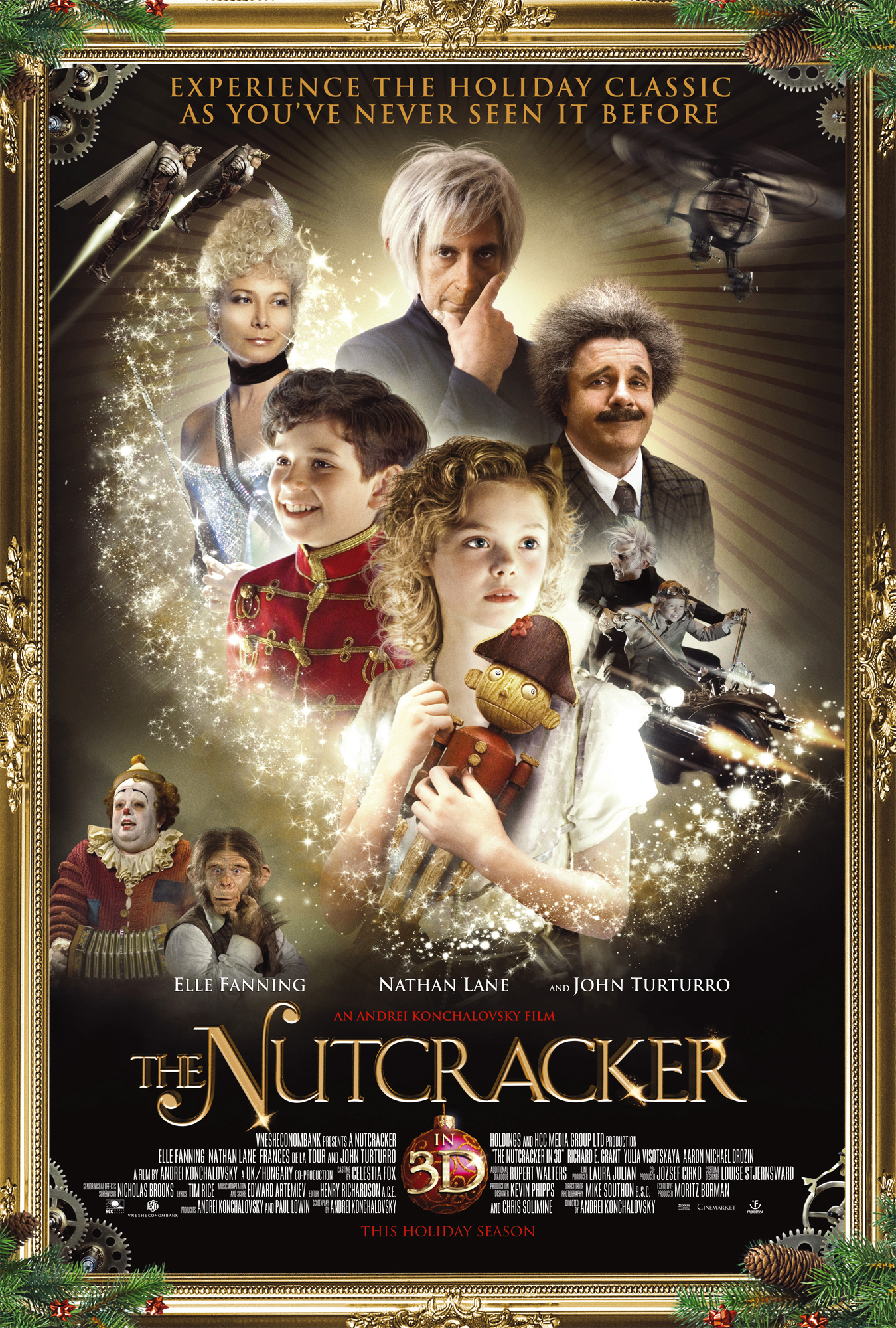
Mixed Nutcrackers - The Nutcracker in 3D (2010)


Goodness, but ambition sure can go wrong, can't it?  Andrei Konchalovsky reportedly sat on and tinkered with the idea for what ultimately became The Nutcracker in 3D (alternately The Nutcracker: The Untold Story) for a solid twenty years, long after he became a frequent film fest circuit contender, and in which time he continued to direct, write, and produce a wide variety of films across multiple genres.  This here was his passion project, a grand fantasy epic built upon little by little whenever he had time, finally realized after two decades' gestation with a budget of $90 million, well in excess of anything he'd directed since Tango and Cash.  Grand ideas given grand stage and a (relatively) lavish pocketbook, enough to justify playing with musical elements, massive soundstages, scores of extras, a wholly CG character or two, and the best 3D effects money could buy.  One might, perhaps, observe how "the best 3D effects money could buy" in the year prior to its ultimate 2010 release came from a film costing this project's budget three times over, and that the base material was shelved since 2007, and start to understand what went wrong.

Hubris is our watchword for today.  Hubris in thinking a production so plainly bloated by B-name theater actors' salaries and enormous soundstages could afford a little skimpiness on the effects budget, and so crafting a final product where flying effects and CG characters render as vaguely floating a few feet above the film rather than anywhere inside it.  Hubris in Tim Rice deciding his lyrical compositions for the musical numbers would not use Tchaikovsky's ballet pieces as a base and follow their lead with a complimentary rhythm, but rather be designed for singing along to every not, regardless of whether or not the resultant cadence sounds anywhere close to a natural register.  Hubris in believing many side characters so plainly charming on the face of it that we needn't see them between their too-brief introduction and an end-of-second-act crisis wherein they display none of their personality quirks again in favor of generic fantasy action platitudes.  Hubris in thinking spending the entire second act wholly detatched from the fantasy world and spinning our wheels on some domestic drama the film clearly doesn't care for is at all an acceptable way to stay within our budget when it really kills the pacing dead and causes many following beats to feel redundant.

Hubris with regards to the rats, oh my GOD, the rats.  I can only assume Konchalovsky and his contributors thought as far as, "Well other films use a little Third Reich imagery as shorthand for the bad guys, we can as well," and then trotted out said justification every time they wanted to add a little more.  The rats march around in full-blown SS uniforms, round up innocent people from the street, throw them into concentration camps, operate massive ovens designed to burn those they scapegoat as ruining the world, and talk up the eventual birth of a glorious rat masterrace and a Rat Empire which will last for one thousand years.  All right there, on the surface, no necessary distancing whatsoever, plain and simple Nazi stuff.  Let's not also forget, they still have rodent faces, rodent faces which look very much like Nazi propaganda caricatures of Jewish people besides, and most talk with heavy Italian/Brooklyn accents.  And listen, listen - while I am the world's foremost advocate for scaring kids through children's movies, the effects on John Turturro's face when his Rat King gets upset and he morph-roars into a monstrous rat face are all too much, all too distressing, and deployed all too frequently for how much I don't like looking at it.  Also, their arrival into the movie evokes 9/11 imagery, and Turturro electrocutes a pet shark at one point, for no reason other than making this whole thing more off-kilter and distressing.

Looking at The Nutcracker in 3D with a proper critical eye, though, trying to see beyond all the odd, excessive, easily-identifiable bad creative decisions, and figure out what really went wrong, I think the briefly mentioned structural problems drag the movie more than any of the Nazi rat stuff.  Don't get me wrong, unless we perform corrective surgery on the film, wholly remove all the Nazi motifs, and find literally any other thematic costuming as a replacement, it will always have that millstone round its neck, but figuring out the structural problems could help a lot.  You can get away with quite a bit if a story plays as familiar or resonant in the broad strokes, making your idiosyncrasies read as "Alright, go off but I'm with you" instead of "What in God's good name are you DOING?"  Bad as the Nazi rats, the child acting, and the effects compositing are, The Nutcracker in 3D's greatest weakness lies in how it flaunts conventional story structure in favor of a protracted second act in the real world, with all hints of the fantastical banished to the margins.  To illustrate my point, allow me to propose as potential alternative layout for the film, in which we only change the order and focus of events with minor eliminations to improve flow.

The first act, with Mary meeting the Nutcracker, exploring the expanded living room, and learning about the curse the Rat Queen placed upon him can play exactly as they do in the movie, except we move the introduction of the Nutcracker's three living doll friends over to the start of act 2, and place more focus on the developing relationship between the two.  Rather than spending the second act in the real world, Mary, the cured real boy Nutcracker Prince, and the doll companions spend their time trying to infiltrate the Rat Kingdom and overthrow the Rat King for good, only for the Rat King to discover them, kidnap the retransformed Nutcracker, and banish Mary and the dolls back to the real world.  THEN we can play out a shorter, tighter focused version of act 2's runaround as a start-of-act-3 crisis,and proceed with the movie's third act as is, only with better defined supporting characters and a stronger relationship between Mary and the Nutcracker. Compare this to how little screentime the two share in the film as-is, and how much of the back half of the second act is dedicated to rerunning the first act's set-up with new stakes while assuming we've any reason to invest, and the problem should be plain.  Spending so much time insisting Mary stay separated from the Nutcracker and the Rat Kingdom only serves to kill the film's capacity to engage an audience; a structure more in-line with traditional children's fantasy epics would help the piece flow, get us deeper into the weirder elements, and at least acclimatize us to the stranger elements in addition to strengthening the character work.

Or, as an alternate proposal, how about we keep the film's structure as is, weirdly lengthy return to reality and all, except we shift around our thematic focus instead?  Exact same movie up to the thirty-minute mark, except Mary's attempt to lift the Rat Queen's curse doesn't work, because for all the enchanting, fantastical sights around her, she doesn't really believe in what she's seeing just yet.  The sudden return to mundane reality thusly hits her harder, and her father's attempts to shake those silly dreams for her head has a tangible impact on her.  That whole meandering musical number where Uncle Albert sings about a magic pebble her father had as a boy connects more directly to Mary's story, and when the Nutcracker returns to bring Mary and her brother Max back for another try at liberation, she only goes reluctantly, and only invests fully for the third act because the Rat King kidnaps Max.  You can then run the third act as a simultaneous "Rescue my brother" narrative and a "I have to actually care and believe in all those childlike things like imagination and dreams" story, to boost up the effect when Mary finally lifts the curse and claims she never wants to leave this new home.  Just one change to one plot point and a shift in the main character's attitude, and you can make this odd structure work a little better.

I'm personally more into the first proposal than the second, for the first allows the film to indulge in its weird attempts at spectacle more openly than the second, which probably requires turning down the bombast to sell the audience on Mary's refusal to truly believe until the climax.  Either way, they both show how The Nutcracker in 3D didn't necessarily have to break so badly as it does.  There's so much "This is MY passion project, and we're doing it the way I like!" running through every aspect of the production, I've a hard time believing you could wrangle a wholly good or appealing story from the wreck, especially if we're really honestly truly married to doing Rat Nazis and not spending a proportionate amount of money on our effects.  With a different structure though, regardless of if it's more traditional or more suited to supporting a thematic idea, we might've seen a respectable if heavily flawed, too indulgent work that communicates something and delivers a mildly enjoyable experience.  It is broken and misconceived, but the foundations could've supported SOMETHING, rather than the haphazard mess we got.  Which, all told, is better than the total, doomed-from-the-start failure of the Tom and Jerry Nutcracker film.

(Let me tell you, it was REALLY distracting hearing Moaning Myrtle's voice coming from the Nutcracker's mouth the entire film.)

2/5

Sunday, December 1, 2019

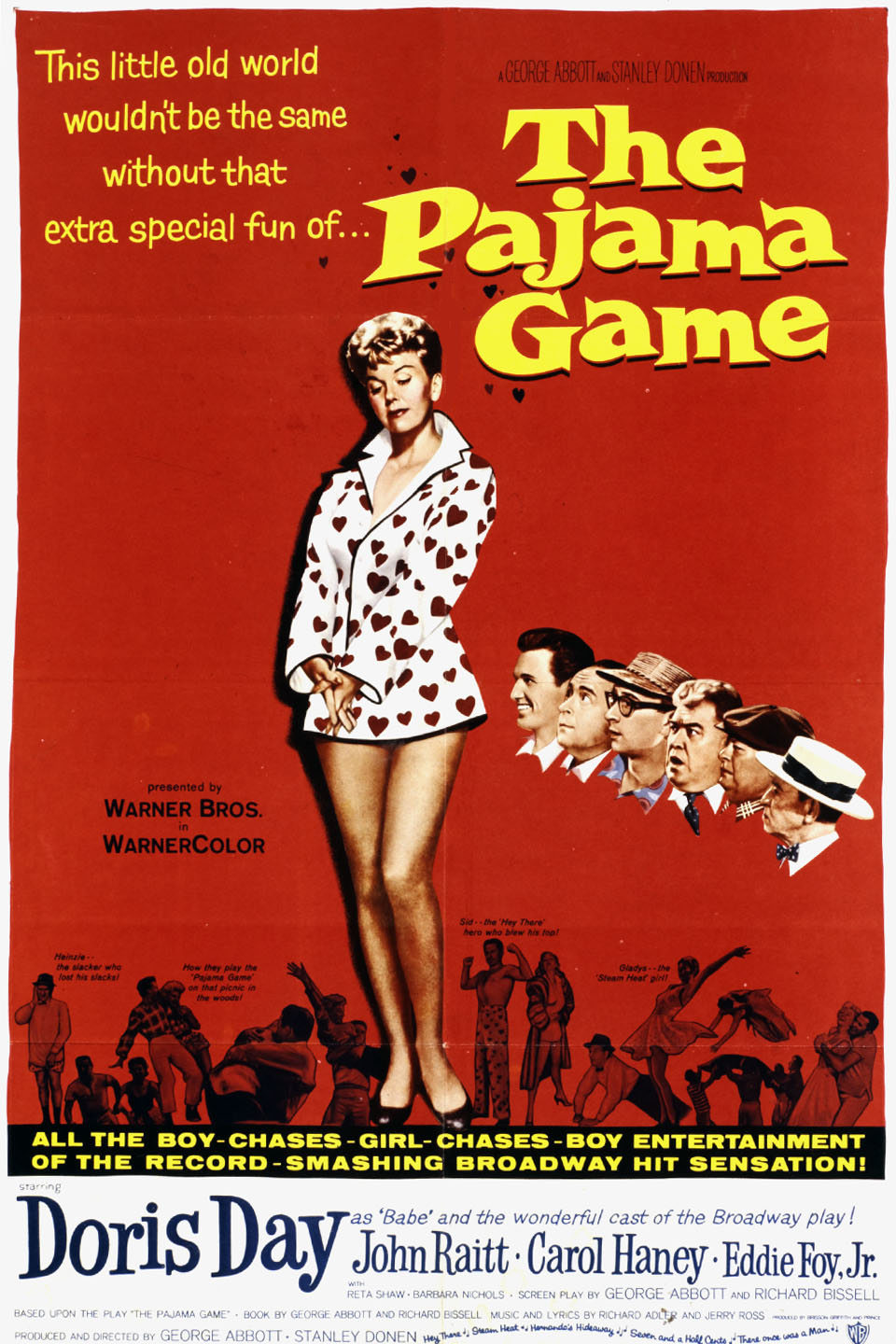
The Pajama Game (1957) - I know a dark, secluded place...


Letterboxd Season Challenge 2019-2020!  Theme five, part one - stage to screen adaptations!

I'm normally picky when it comes to older musicals.  Broadway showstoppers from the mid-century boom of plays with stories and serious issues on their minds rarely do much for me due to the focus remaining squarely upon melodrama and spectacle, while leaving their slight plots to mill about in the margins as mere excuses for the main action.  I prefer the songs to serve as primary means of storytelling, and the classic standards always treat them as entertaining diversions from the story, not really exploring any emotions or ideas beyond rapturous love, silly antics, or witheringly light tragedy through the music.  It's additionally frustrating when a work with an interesting conflict or unique setting is made to play home for yet another meet cute, fall in love, fall apart, get back together narrative with only trivial intersection with the ostensibly main conflict.  All in all, a Broadway musical from the 50s has some massive hurdles in its path if it wants to leap into my heart, and The Pajama Game hits on all the little things that annoy me about this style at a scan.

After watching George Abbott and Stanley Donen's adaptation of Abbott's hit 1954 play, I SHOULD come away with a tongue primed full've venom.  Why not?  The whole business about the pajama factory workers striking for a seven-and-a-half-cent raise serves as background dressing for the romance between Sid and Babe, which ignores the conflict for long stretches of screentime before driving a gulf between the two with a token upset, and subsequently puts no energy into their getting back together beyond "Well they're the main couple, so y'know."  Multiple musical numbers run on as little more than filler entertainment divorced from character motivations, and when they ARE character motivated, one gets situations like Babe and Sid duetting about how passionately they adore each other for two songs in a row.  As a piece of filmic work, the movie's fairly limited - despite a lively enough camera, many of the musical numbers are limited in scope and activity by the trade-in from live stage to sound stage, with only Once-A-Year-Day roaming a larger location and Hernando's Hideaway getting at all cinematic with the staging and editing.  A jealous boyfriend's murderous rage is played for laughs, the union's victory over the company is treated as overly uproarious for its eye-raising simplicity, and the overall romantic arc comes across as little more than the script asking the audience if they want these hot people to flirt some, so it SHOULD be actively hitting at every "dislike this movie" button across my entire figure.

So, why are we coming away from the experience with me metting out a four star rating?

Familiarity bias might play into it some.  I chose The Pajama Game for this theme because I'd seen a performance back in middle school, when my English teacher took the class on a field trip to watch the Tucson Community Theater's production.  As with much media I viewed at the time, I've forgotten most of the details in the intervening decades (not as big a surprise here, considering it's the only live theater show I've seen in my life, and something watched for a school project at age 12 or 13), but the standouts definitely stand out in my memory.  Snatches of Steam Heat and Hernando's Hideaway occasionally drift across my stream of conscious in free moments, and a lot of this watch was consumed by periods of "Hey!  I remember this song now!  It's great!"  That I spent an entire evening editing the Wikipedia page for the play to include details of the production from the playbill I brought home before I understood what notability constituted probably helped stick the play in my mind as something worth remembering fondly, however dimly, and primed me to think of this film as a grand ol' time regardless of elements I'd otherwise find annoying.

This doesn't quite satisfy, though.  The Pajama Game may sit in my mind as "that play I saw in middle school," but this film, divorced from my memories, still has quite a lot on offer.  Forget notions of doing something uniquely cinematic with the filmed material or using songs as a means of communicating story; the music and performances here are infectiously bouncy and varied enough to blow such preconceptions right out the door.  There's a trend towards allowing the actors' vocals to strain and fray on longer or higher notes in a way which feels highly controlled, granting moments like Doris Day's increasingly atonal response to the calls in Not At All In Love or her interplay with John Raitt on There Once Was A Man an extra degree of skin-tingling satisfaction.  The Broadway music team clearly had tons of fun tweaking at the call-and-response style of structuring, playing with swinging waltzes, rapidly shifting verbal tempos (consider the stretched out notes followed by babababababa rapidity on the verses to I'll Never Be Jealous Again, the breakneck/leisurely contrast in Small Talk, or the radically different paces on both go-arounds of Racing With The Clock), and even players dueting with themselves.  Though I'd entirely forgotten about it from the stage play, Raitt's work on the opening warning half of Hey There followed by his interplay with his recorded voice as a doubting counterpart in the second stretch was an unexpected highlight, and Day's reprise in a new, sorrowful context sold me on her status as a musical superstar better than anything in Calamity Jane.  And, of course, it helps to have big showstopper numbers like Once-A-Year-Day, which just keeps going and going and building and building without losing any of its energy or fun, and the matchlit, darkroom tango of Hernando's Hideaway, which contains the film's most well-crafted visuals.  It's an uncommonly good soundtrack all the way through, whose density only gets one charged and willing to leap from number to number with little resistance.

Beyond the music, I also think the performances help the movie along towards a higher rating quite a bit.  Looking over Wikipedia, the cuts made in adaptation rob most of the supporting cast their numbers and sideplots (Prez seems to suffer the most in this regard), but the original Broadway cast is still here minus Janis Page's Babe and Stanley Prager's Prez, and they're still giving it their all in roles they'd inhabited for three years by this point.  Carl Haney stands out in particular when the spotlight shines her way towards the end, given she's afforded the leads on both Steam Heat Hernando's Hideaway, a riotous drunken routine in the following scene, and a turn towards the climax that allows her to just wild it right the hell up with out of control screams and erratic mannerisms.  Such high-effort, high-reward mania defines the film's comedic routines, which involve large chunks of the cast getting caught in their own conflicting priorities, and blustering and shouting over one another until someone barges in to straighten the situation.  While it does not MEAN much in the way of exploring the labor conflict or romances at play, it is endearing to an extreme I cannot deny, and couples well with the same performers when they launch into song and dance.  I don't particularly need a well-defined romantic arc when Day and Raitt are giving it their all to make the all-too-short courting period seem natural before the dizzying highs of Small Talk and There Once Was A Man.  Call it emotional cheating if you will (it absolutely is), but damn if it doesn't work, and work well.

Effectively, I think the movie clips past any and all grievances I can and do raise to land at an overall positive place by doing what a Broadway entertainer does best: taking the material it has on hand, rehearsing it to perfection, and then performing with such finesse and bombast, you hardly notice or care about whatever cracks show.  Taking The Pajama Game and transplanting it to the screen with little more than some cut content and more realistic locations conducted in transit probably should break the thing in the process, and I'd be made a liar if I claimed a few elements didn't almost push me down to, at least, a 3.5.  The way Gladys and Hine-sie's little subplot resolves with them jokingly wearing prison stripe pajamas with built-in handcuffs makes me choke on my tongue a little for how bitterly 1950s it tastes, honestly.  With such strong musical and performative elements in tow, though (not to mention the production design - it's a minor thing comparatively, but I'm kinda in love with the costuming here), the film can skate right past any and all problems to convince me to go with the flow and enjoy what it has to offer.  As I've said time and again, one should strive to level with films on their level and, where possible, count a final positive experience as more important than whatever grievances come up.  In this particular case, the film's all about making good with a grievance committee, so I've an extra layer of cover for my less than professionally critical perspective than usual.

(Someone kindly tell me how Ralph Dunn wasn't made known to me as a comedic talent until last night, please.)


Lookit 'em go.

4/5