Sunday, December 15, 2019

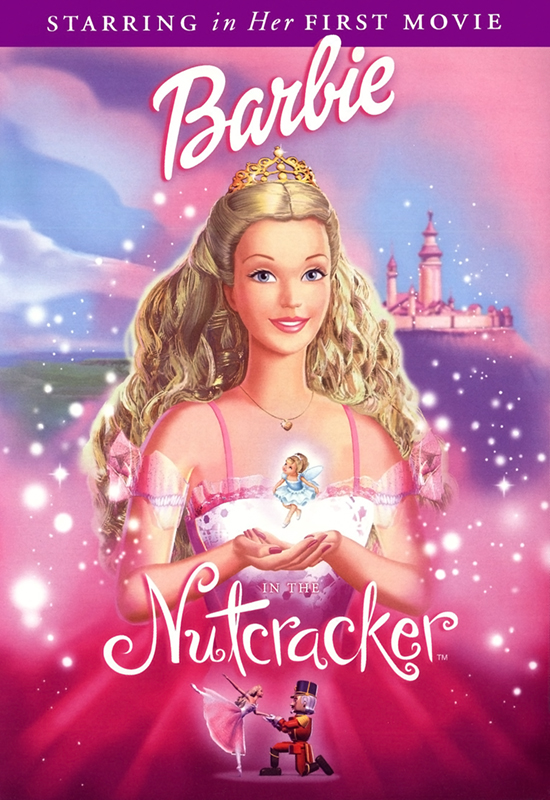
Mixed Nutcrackers - Barbie in The Nutcracker (2001)


Fun fact: this marathon was originally conceived as an All-Barbie December, on the simple basis that Christmastime is a time for tormenting friends, and nothing could possibly equal the torment of promising a Nutcracker marathon, only to dovetail into a long collection of samey Barbie films with no warning.  Only trouble is, if we DID run an All-Barbie December, I'd have to watch all of those same Barbie films myself - and, even worse, WRITE about them.  Such a joke could not possibly sustain itself across a whole month and still produce good writing, so the series was quickly converted to a Nutcracker-a-thon, and here we are today.  You can still count Barbie as the centerpiece of the series, the crown jewel from whence all other films featured sprang forth, and a perfect embodiment of why we're doing Nutcracker stuff instead of Barbie stuff.  Because let me tell y'all right here right now, I do NOT have a lot to say about this one.

Not like I didn't have a lot to say about The Motion Picture, gosh no.  Go back and read the review, I had plenty to say, just no clue how to format it into a coherent, paragraph-based piece.  Barbie in the Nutcracker challenges because it is plainly aimed at the youngest audience yet, roundabouts the four-to-six demographic, and much as the joke reviews on Letterboxd insisting this has an ending to rival Mulholland Drive in complexity and confusion, something ready-made to stop holding appeal once you enter second grade does not offer many avenues for critique.  The simplicity leaves fewer dimensions to pick at, the purity of purpose makes slagging too hard bad sport, and the lack of nostalgia in my case in particular means I cannot articulate what makes it tick for someone who saw it at just the right age in the way someone born round the same time as myself but with a Barbie obsession in their past.  So, seeing as I do still have a few concrete points to walk across, we won't rely on bullet pointing, but we will theme by paragraph, and take some time to poke Barbie in the Nutcracker's merits as an adaptation of The Nutcracker/TheNutcracker and the Mouse King, its merits as a piece of animation, its merits as a piece of children's entertainment, and how it is effected by its status as part of the Barbie brand.  Should work out just fine; let's go.

As I've noted when discussing the various ballet-oriented adaptations, The Nutcracker has an inborn problem of dropping any semblance of narrative in the back-half in favor of pure dance, and even ETA Hoffmann's original story loses its slack once Marie and the Nutcracker Prince enter the Land of Sweets.  This requires any story-focused works to find some means of tinkering the material to suit its own needs, and we've seen a few differing approaches - Nutcracker Fantasy was more inspired by ideas from the story and crafted its own narrative from near-whole cloth, The Nutcracker Prince added more supporting characters and a bit of extra drama during the final movements, and the various ballets have the benefit of about half-a-dozen scripted dances for fodder.  Barbie, for her part, sticks to the basic rhythms of a young woman receiving presents on Christmas eve, becoming delighted by a nutcracker, and having a strange dream of a war between mice and toys, with a few minor alterations.  Her Aunt Elizabeth functionally replaces now-Grandfather Drosselmeyer as gifter and One Atop The Clock, there's no party or other toy soldiers because character models are expensive, and she doesn't wake from her dream once she drives away the Mouse King with her slipper.  This last marks the film's major departure, for once it's done with the literary source's first half inside fifteen minutes, it sets aside the rest of its remaining hour for a story of light high fantasy.

This basically works as a creative choice, because it decouples the movie from novella and ballet, and largely enables it to run its own little Christmas-themed thing.  Changing the Sugarplum Fairy to a Sugarplum Princess is a weird little bit of probably-necessary marketing tampering, but making her a McGuffin that Barbie, the Nutcracker, and a few hangers-on must seek out to free a fantasy kingdom from the Mouse King's iron clutch gives a fine excuse to keep introducing new concepts, constantly move forward without flagging in one spot for too long, and introduce a few little bits and bobs of its own.  I certainly didn't expect the Barbie Nutcracker movie to feature a massive rock golem chase or a talking bat sidekick, yet they're here all the same and functioning quite nicely.  Considering the way it all looks, Mattel could've easily taken the same assets and put out a token PC game with the same story.  That courtyard in the climax seems purpose-built as a boss arena, so why not?

With regards to looks... well, it's no great shake, but was there any chance otherwise?  Round 2001, only Pixar and Dreamworks had humanoid animation anywhere close to workable, and Pixar's whole "It's more believable and endearing because they're toys" idea with Toy Story also had a greater budget, more talented artists, far more detailed environments, a stronger lighting rig, and stylized characters who aren't confined by the semi-realistic proportions and sculpting of the Barbie line.  They tried, God bless 'em they tried, but there's a stiff lack of flair to the movements and the models are way too lacking in detail to read as anything except cheap.  Attempts at animating special effects like fairies dancing through the air as they fly look more like someone messing around with the drag-and-drop tool, and the little amount of dancing present seems heavily limited by what the models could do regardless of them using mo-cap.  The lighting effects are the biggest failure, as any attempt to do something creative gives the characters this weird fuzzy halo effect that ruins any illusion of them standing in their environment, while simpler set-ups make them look like the plastic they are.  All in all exactly what you'd expect from a direct-to-video 3D animation project of this time, but I still have to give props for the effort.  The animators at Mainframe and Mattel Entertainment could've easily lit the whole thing uniformly and made no swings at more complex animations they didn't have the budget or experience to handle.  Their failures speak more to willingness to experiment than lack of ability (though don't get me wrong, the execution lacks something fierce at times - that cloudy beachside scene is just the pits).

(Plus, they recognized their inability to fully model every outdoor environment, so several of them utilize digital mattes on the skyboxes and render a few more complex panoramic scenes as fully 2D paintings, which actually caught me off-guard at one point.  I was just about ready to mock the film for not knowing what the heck a Perspective is when they arrive at a magical castle, only for it to fall down because it's a cardboard fake planted by the bad guys, which just so happens to look identical to the style used on the flat backgrounds.  They got me good there!)

I think the whole thing holds together as a cartoon for really young kids pretty well.  Fun little out-and-back adventure type narrative with just enough daring-do to keep the boys engaged while remaining soft enough for the girls, if we are to think in terms of a Mattel-executive circa turn of the millennium.  As regular readers know, I'm perpetually gung-ho for a little bit've scary imagery bound to frighten small ones a little in any product, and the Mouse King's predilection for casually turning his minions and subjects to statuary checks that box quite nicely.  We had quite a lot of fun joking about how the dialogue-driven portions of the climax are effectively Mattel discoursing on the need for consent from the governed for an effective system of government, which satisfies the whole "Gotta have something for the parents!" aspect in a manner beyond the usual crude humor.  And really, while I'm baffled by the large percentage of reviews from supposedly full-grown adults that seem to genuinely have a hard time understanding the ending (Dream real; nothing more, nothing less), the whole thing with Barbie turning out to be the Sugarplum Princess and Prince Eric being real outside the dream probably does work as a series of effective twists for anyone of the right age.  Thumbs up from me on this metric.

If there is a real weakness I can dig at here without feeling bad for going after something made for very small children with the same vigor I do more mature films or animators in circumstances unfriendly to more polished work, I think the film's position as part of the Barbie brand harms it most.  The whole thing is framed as Barbie telling a story to her... I think sister, as a means of helping her gain confidence during her ballet lessons, and the fact that main character Clara is more Barbie as Clara than a person herself leaves the film unable to pursue its ideas to the fullest.  Other characters claim Clara is a strong, brave, confident person whose presence keeps the party together and gives the Nutcracker the strength to outmatch the Mouse King, but Barbie can't do anything we might interpret as off-brand, so these qualities only come through because the characters say so.  Otherwise she's just moving from place to place and setting up more important conversations, which limits its ability to impart any positive message to its audience.  The whole thing with "Barbie was a beautiful princess all along and lives happily ever after!" comes through on a "I'm four and don't know what stories or dialogue are" level far clearer than "Barbie becomes a beautiful princess because she's a capable person who uses her inner strength to earn her happy ending" aspect.  Not to mention, ending on a scene of Barbie and her sister dancing a variation on the Sugarplum Fairy piece with step-to-step perfection kinda undercuts Barbie as a positive big sister rolemodel by having her teach it perfectly the first time with no need for anything beyond telling a story.  At least the sister struggling a little but doing better than she did at the start would've made it stronger.

Yeah, I know I'm giving way, way more credence and critique to a Barbie film than it probably merits, but one has to at least try and treat all films equally if we want everyone across all ages and outlooks to have good movies made for them.  Far, far easier to do so for a children's film than something made for members of another racial identity or sexual orientation, given we've all got some variation on that childhood experience, and I think Barbie in the Nutcracker deserves a little effort anyhow.  One can tell the crew put forth their level best for the circumstances, and while it's not great or even to my personal standards of wholly good (that lighting really kills it for me), it does what it wants to do well, and also allows Tim Curry a chance to go whole ham on the digital scenery.  Nobel goals fulfilled adequately.  Bout all one can ask for and be happy with when dealing with Barbie, I'd say, least till they had the idea for Life in the Dreamhouse and got meta with it.

(Here's some fun trivia for you - the Nutcracker's VA, Kirby Morrow, served as Goku in Ocean Group's dub of Dragon Ball Z from episode 160 onwards, while Ian James Corlett (Captain Candy) served as Goku in Saban's initial dub of the anime, and Peter Kelamis (Primm the Bat) replaced him in the Saban dub before serving in the same capacity in the Westwood dub.  Got three Gokus up in here.  Neat!)

3/5

Thursday, December 12, 2019

Mixed Nutcrackers - The Nutcracker (1993)


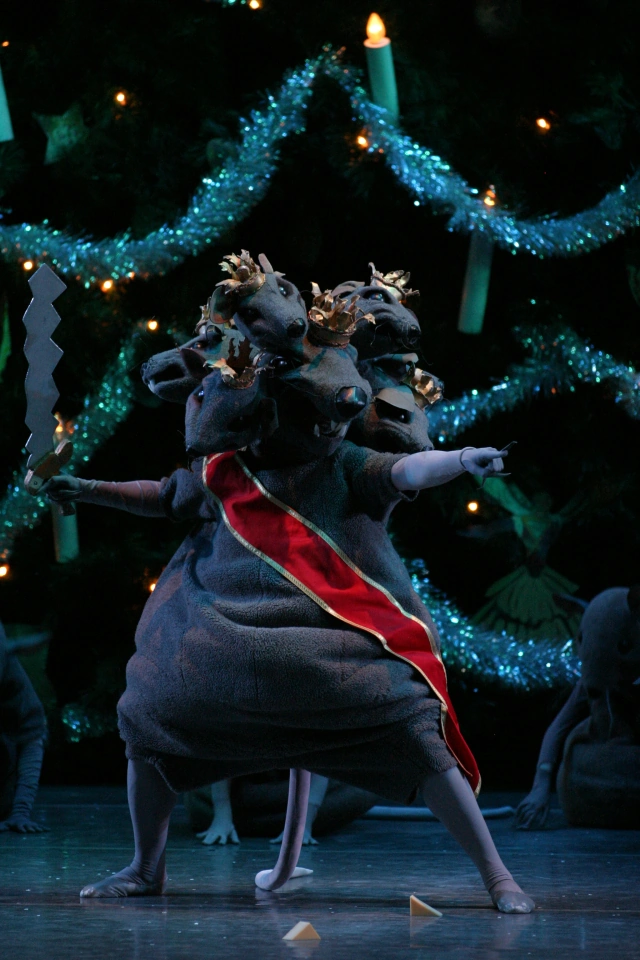
SEVEN HEADS ALERT!  SEVEN HEADS ALERT!  I REPEAT, THE MOUSE KING SHOWS UP IN 1993'S THE NUTCRACKER, AND HE HAS THE FULL, PROPER SEVEN HEADS.  THREE MOLDED COPIES OF THE CENTRAL HEADPIECE JUTTING OUT FROM BOTH SIDES, YOU COUNT 'EM UP, YOU'VE GOT ONE TWO THREE FOUR FIVE SIX SEVEN FULL HEADS!  HE AIN'T IN IT MUCH,  BUT HE MATCHES THE PROPER COUNT, AND HE'S GOT THE SAME DELIGHTFULLY ROUNDED, BAGGY BODY SUIT AS THE REST OF THE MOUSE SOLDIERS.  FIVE OUTTA FIVE.  TEN OUTTA TEN.  BEST MOVIE OF THE YEAR ALL YEARS.


Ahem.

So, this take on The Nutcracker is a bit of an odd beast.  Despite an alternate title naming it after George Balanchine's famous, life-giving and fame-bringing 1954 version of the ballet and despite drawing extensively from Peter Martin's then-present rendition, the film's overall construction gives one the impression it only exists because Kit Culkin couldn't negotiate satisfactory terms for payments on Home Alone 3, and rushed a film version of a Christmastime ballet into production so his son would have a starring role in a holiday film for the winter '93 season.  Macaulay Culkin is quite a bit more prominent than other Nutcrackers and their princely counterparts, entering the story alongside Drosselmeyer and getting teased as a potential romantic interest for Marie during the children's dancing scenes at the Christmas party.  He's got a substantial number of close-ups compared to the other major players, which reveal how Kit evidently instructed Macaulay to not move a single solitary facial muscle during the entire production, and consequently makes it seem weird the child actor so well known for his expressiveness in the Home Alone movies is playing it so dead-eyed.  Some of that might come from how Kit very obviously didn't drop a single cent on ballet lessons for Macaulay, who is asked to perform the Nutcracker Prince's dancing recap of his battle against the Mouse King (notably deleted from The Motion Picture), and does so by awkwardly shuffling in place, occasionally flourishing his arms a tiny bit, and overall looking like he does not want to be here.  Much as Tchaikovsky's ballet has the leads' absence throughout the second act baked into its traditional form, Culkin's presence makes the issue all the more head-scratching, for the constant focus on his person throughout the first act gives way to he and Clara simply sitting on the sidelines watching the cultural and candy dances with very few close-ups, and not even performing the play's final dance.  Y'all paid for The Kid What Did Home Alone In This Other Christmas Thing, now thrill as he embodies none of the traits you liked from that movie, and then gets benched so the real dancers can dance.

Course, the real dancers here aren't quite equal to those from the Bolshoi Company or the Pacific Northwest Ballet.  Lacking in technical knowhow about ballet and dance in general though I am, exposure to their filmed productions tells me there's something oddly simple about the performances here.  The group pieces are all fairly fine to my eye, big crowds in motion always having some positive effect on me regardless of technical execution, and their costumes are pretty and eye-catching all-round, so a large group in matching outfits of this type is going to work for me.  Problems arise with the solo or paired dancers, whose movements seem rather slow and restricted - the ballerina playing the Sugarplum Fairy seems especially simple and sluggish during her highlight numbers by comparison.  I have to wonder how much of these underwhelming dances are the result of my spoiling by viewing world-class performers and no one else immediately prior to this viewing, how much comes from a lack of vim and vigor during this particular production, and how much blame one can lay upon director Emile Ardolino.  I've not seen Dirty Dancing, but its reputation as one of the great dance movies led me to expect better staging and camerawork.  Where the Bolshoi production has the excuse of being a filmed live performance, and The Motion Picture works a few tricks to ease into its theatrical staging, Ardolino presents the film as 80% head-on filming of obvious stagebound sets, and renders his rare close-ups or alternate angles disappointing in effect thanks to a lack of acting from anyone onstage.  I singled out Culkin for his lifelessness due to his prominent treatment, but pretty much everyone here lacks an awareness that the camera might find them interesting at a distance any closer than fifty feet.  Such simple performances might work when viewed as live theater (not ever Nutcracker staging needs to bring the house down and strain the performers past their limits) or even filmed theater, but with the bare-minimum effort at treating this film like a movie in hand, the unimpressive footwork and static camera should make it a bit of a slog to watch.

Connie thought so, and I see where she's coming from... yet I found myself far more engaged by this production than the Bolshoi version or The Motion Picture.  I cannot call this film better than either, as despite some pretty backdrops and outfits (and those INCREDIBLE mice, ho boy!), its production design doesn't quite match the former's creativity or the latter's richness, and both contain what seem to me far better dancing.  Kevin Kline's perfunctory narration should seem insulting, and does little to help once one realizes how well the same information is communicated without words even here, and there's just simply not much here I might call exemplary.  Charming to an extent, visually pleasant, containing a mouse king with the proper seven heads as God intended, yes, but not great.  And again, here I am with a film I think lesser compared to The Motion Picture that kept me alive and awake far better.  I'm inclined to say some of it comes down to growing familiarity with both the general form and this particular show, and having multiple different points of comparison against which to actively go, "It's interesting how they're handling the cultural dances this time, and the different placement on the Sugarplum Fairy's dance has an odd effect on the flow, and what are the limited cinematic flourishes doing for the film compared to the others when they'll sometimes take the form of a slow flashback to events we saw five minutes ago, and and and?"  It's probably not so much this film having anything particularly special to stimulate my brain, as it is me having poisoned my brain with so much Nutcracker content in the past few weeks as to find the act of comparing and contrasting different versions more rewarding than I did when watching The Motion Picture a week back.  Call it engagement by way of being a fucking nerd.

Harshness aside, this staging of The Nutcracker probably simply made an ill-fit for the cinematic form.  Drawing on Connie's after-film musings again, I'd agree many of the flaws I've highlighted wouldn't stand out so prominently on the stage, considering the lack of a camera to underline the lack of emotive acting and its own inability to dance in time would remove the pressure to live up as a piece filmmaking, and the longer-standing tradition of live ballet productions compared to versioned film as film would remove the impulse to compare it to productions more specifically geared to take advantage of the medium.  In this particular mode, however?  S'fine.  Fun to poke fun at how wooden Culkin's dad made the thing by shoe-horning his famous son in, enjoyable to watch when the bodies are in motion, and happily free from the pedophilic subtext present in the ballet - or, for that matter, the textual text present in The Motion Picture.  This last really helps me find a positive spin on the film at the end of the day.  Drosselmeyer may become a bit of a dead-end character if he's not constantly present throughout the dream sequences, but if the alternative is a consciously creepy rendition orchestrating the dances in the Land of Sweets as a means of stealing young Clara's hand away from her ideal fantasy boyfriend, then LET'S play schmaltzy, cutesy child romance with no godfather in sight.  Please.

3/5

10/5 for the Mouse King

Monday, December 9, 2019

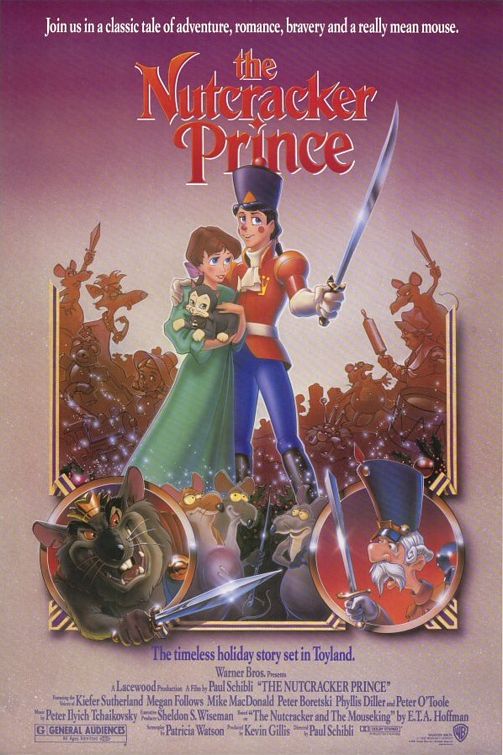
Mixed Nutcrackers - The Nutcracker Prince (1990)


Here's somethin' interesting for you - whilst watching the credits to The Nutcracker Prince last night, I noticed how a substantial portion round the middle was dedicated to "opaquers."  The term's alien to me and doesn't make its description obvious on first look, so I spent a little while Googling it, trying to find some reference to the profession of opaquing as it pertains to the film or animation industry.  My efforts were for naught, and the only reference I found to opaquing beyond dictionary definitions for "making something opaque" came from the imdb credits page for this very film.  It seems really strange for a film to have 168 artists credited for a single job I can't find any reference to online, especially when every other credit pertaining to people who designed, laid out, animated, photographed, and cut the film totaled to 176 persons, a mere eight more for every other part of making the drawings move than whatever an opaquer does.  What's going down here?  What secrets do you hide, O The Nutcracker Prince?

I've a working theory on this, and I'd love to hear any information proving it wrong, because it speaks to some unfortunate business practices if it's right.  Of those 168 opaquers, 37 are credited in a special section for Opeongo High School, Ontario-located home to graduate Kevin Gills.  Gills served as The Nutcracker Prince's screenwriter and sole credited producer, and quite a large portion of the non-celebrity voice cast were drawn from acting contributors to his cartoon The Raccoons.  It's also worth noting how, despite the film's listings noting production by Lacewood Productions, the animation credits here name Hinton Animation Studios, a studio which fell to crippling debts mid-production and was reconstituted into Lacewood prior to release.  All this, in combination with the "opaquers" coming just after the the xerographers and matching department people, leads me to believe "opaquer" is a deliberately twisted term for "colorist," one not covered under union protections, and so an easy way for a producer operating on a tight budget to cut a few costs on his film.  Why pay a few professional colorists at scale when you can farm the operation out to a whole bunch've people for very little money, and still not pay as much as if you'd hired any union-backed folks?  You can even get a little work from the high school and not pay a dime!

Now, as I mention, this is largely speculation.  I confess I don't know too much about how many workers it typically takes to get the colors done on an animated film compared to the other departments, and it's possible the use of high schoolers could come down to Gills paying his dues and offering his old school a program for teens to get a little experience in the professional filmmaking world for school credit.  There's easily a non-sinister interpretation of events if you look for it.  However, I'm not too inclined to believe it sight unseen over thinking the practice unethical, as there are still oddities in the credits like assigning a single artist to produce the backgrounds for a solid fifteen minute chunk of film where the other background artists would only need paint roughly five-and-a-half minutes assuming roughly even distribution, or the downright odd aversion to the word "colorist" when character designers are followed immediately by "character colour design."  Something don't quite add up here to my eye, and I'd love to hear from anyone more in the know about these things than me, because I'm really quite baffled.  Is "opaquer" a common job title up in Canadian production houses, or have I really found a weird cost-cutting measure?

As one might guess from the three paragraphs focused on accreditation more than anything in the film, The Nutcracker Prince gives one reason to think it made on the cheap.  It's not particularly egregious about any of these, and looks quite nice in places for what they had, but you can TELL they weren't exactly throwing around money to spare during production.  A few of the more impressive, fluid pieces of animation get reused in the same context wholesale, faster movements trend towards choppiness and lower detail compared to the norm, and numerous actions that seem best suited to smooth execution across a single shot are broken into their individual components across multiple edits and focused on as complete actions in their own right, completely killing any illusion of naturalness.  What's more, the aforementioned fifteen-minute chunk of the film with its own background artist is so thanks to a shift in the artstyle towards something far simpler and cartoonier, which effectively means the more complex, Disney-inspired animation only requires 50 minutes finished work rather than 65.  Fine as it appears in places, including some rather impressive on-screen transformations and big gestures given the clear crunch, the crunch is still clear, and marks the film as one produced under tight conditions.

Much as I'm inclined to note its low-budget, I don't much hold this against the film.  As I keep stressing, the designs work for what they are with one or two little stand-outs (primarily the Mouse King, who looks nicely frazzled and burly), the backgrounds have a good gentle quality about them, and some of the animations had me impressed at what they could pull off on not a lot've money.  The big art style shift actually works to the film's favor in my mind, as the character designs shared across both styles read better with the thinner lines, lighter colors, and slightly lesser detailing.  Its embrace of a zanier, late 50s sketchy-mod-look-embracing Looney Tunes aesthetic also helps the film's louder, slapstickier elements feel more natural, and leaves a satisfying sensation in the mind once it's all over and done with.  I very much enjoy the dedication to showcasing sequences sure to frighten small children in the audience, as when the Mouse King is stalking Clara with a fatal wound in his chest while all the animate dolls revert back to wood and plush.  We might not have artistic triumphs here, but the artistic moderate accomplishments get the idea across on their own level all the same.

Heck, with regards to the plot and story, I appreciate how much The Nutcracker Prince draws from ETA Hoffmann.  It's pretty much the same plot points in largely the same order, with details like Clara bargaining with the Mouse King after his supposed initial defeat and the passage through the Land of Sweets left intact.  We're even free from a creepy Drosselmeyer again, which I think will only be possible through these animated adaptations - the instinct to move FAR away from "what if an eight-year old's sexual awakening by way of her godfather's tricky machinations" is absolutely the right instinct.  Where the film REALLY falls down comes with its confidence in the material.  Paul Schibli and Kevin Gillis have, if not a time-tested classic, at least a well-worn, simple template on their hands, and no good reason to tack on additional details or rearrange the structure, but they do all the same.  For example, just as Nutcracker Fantasy's Tchaikovsky quotations were rather sparse and token, here the snippets from the ballet's score come far too frequently, and are overly front-loaded.  Recognizable melody follows Christmastime staple with little time for the score to cool its heels, and before we're past fifteen minutes we've used practically everything the general public might know, thus leaving the rest little to pull out for something fresh, beyond an admitedly clever use of the final waltz across multiple emotional tones.  There's too much eagerness to prove we're doing The Nutcracker, which leaves the film a bit sonically lacking as it goes on.

When considering their lack of confidence in the novella's story and structure, the problems multiply.  The battle against the Mouse King's forces and the journey into the Land of Sweets now requires the presence of multiple new doll characters to provide further slapstick comedy and exposition about the nature of the fantasy world and its kingdom, which mark a transparent grab for inattentive children's eyes.  They're not particularly enjoyable or dignified parts, especially not Peter O'Toole's elderly, bumbling toy general, who I feel earnestly sorry he ever had to voice for any reason.  Parts must've not been very good at the time.

Our biggest issue, though, comes with the exact placement of The Hard Nut flashback segment, the prior discussed 15-minute artstyle shift.  Rather than coming between the two battles between Nutcracker and Mouse King, it is positioned at the fifteen-minute mark during the opening Christmas party, and concludes at the half-hour mark, leaving the following forty-five minutes to work through the book's first and third acts back to back.  This speaks to a distinct lack of trust in the young audience to go along with the magic of toys and mice fighting without a full explanation for why there are magic toys and talking mice that don't get along beforehand, and sets bad precedent for the film to come.  Positioning such wild silliness gives the rest of the film justification to play its comedy broad and loud even when it doesn't match the more Disney-esque artwork, and leaves us with the odd problem of characters showing up to establish their gimmick and subsequently reappearing to bring it to conclusion in the space of five minutes.  Placing the flashback where it naturally sits in Hoffmann's work, as effectively the middle act, would not only break up the action and hopefully dissuade the surrounding film from going as broad as it does, but maintain the sense of wonder and magic around that first battle, perhaps hooking an unattentive audience better than "here's some exposition but it's really silly" does.

This constitutes a LOT more words than I anticipated spilling over a minor forgotten piece of 90s children's animation based on The Nutcracker, so I feel a little bad gritting my teeth and giving it the lower rating between the two I teased in my head for most of the day.  After all, despite some shrillness in the comedy and sloppiness in the animation shouldn't entirely overwhelm a solid if unremarkable overall production.  Poor construction and lack of faith are poor construction and lack of faith, however, and I've my suspicions that the same team working under the same circumstances would've produced a stronger film if they'd stuck to what they had and didn't feel the need to, for want of a better phrase, dumb it down by tweaking the order of events and adding more trendy elements for their day.  The gentler aspects of the original story are what spoke to me most, and something trying for an early prototype version of 90s eye-rolling and purposeful tone breaking just can't get all the way over the pass line in my house.  Plus, y'know, much as one shouldn't let behind-the-scenes stuff effect their viewing unless it's concrete and doing active harm to someone, I really can't shake the notion that they weren't paying their colorists a living wage during production, and that's just shitty if it's the case.  Please, please tell me I'm off-base on this.

(It's really all down to the Mouse King - a crooked tail and a hair-trigger temper do NOT compensate for one lousy head.)

2.5/5

Sunday, December 8, 2019

Mixed Nutcrackers - Nutcracker: The Motion Picture (1986)


Is it the form, the ballet, or just me?  I ask because I really am giving pure ballet the fairest shake I can manage when watching these films predicated on capturing the dances above telling a story, but there's something in their construction which leaves me incapable of engaging to the degree I'd like, and ending up kinda bored.  With the Bolshoi production we watched to start this holiday project, such issues weren't a problem, what with it serving as my introduction to the piece and the form on stage in general, and also its being an introductory piece viewed more as context than a work unto itself.  With Nutcracker: The Motion Picture, there's just enough of the stuff I know about moviemaking and conventional narrative-based storytelling for me to get acquitted and start settling in for a proper watch, only for the film to shift into pure dance for a solid forty minute period, with very little in the way of prior narration or contextualizing shots to string it along.  My eyes glaze over, and I have a highly difficult time getting back into the swing of things.  Hence my question: is it my inexperience with the technical side of ballet that means I cannot adequately discuss and analyze large portions of the movie in the proper manner, the fact that The Nutcracker will almost always transform into exhibition rather than story when bound to Tchaikovsky's compositions, or am I simply not a ballet person?

However y'slice it, I struggle in finding an overarching perspective to use as framework for this review.  It is, then, perhaps inevitable I finally break down and rely on my old friend, Bullet Pointing The Review For The Sake Of Getting It Done And Not Sitting Round Without Writing Anything For Another Goddamned Day.  Little as I like calling their assistance, they're quite handy when invited over.  So, let's disjointedly discuss!


  • Per the Wikipedia page, director Carroll Ballard thought Godfather Drosselmeyer a creepy character without a sympathetic angle, and elected to change this by giving him more focus throughout the film.  His methods for doing this involve affording Drosselmeyer an extended montage wherein he conceptualizes and crafts all the ballet's players, sets, and props before falling asleep as a miniature stage opens on Clara's dream; filming Drosselmeyer's dancer in close-up and emphasizing his desire for Clara's attention during the Christmas party scenes; and positioning a dream version of Drosselmeyer as not only mischevious imp in the background of act 1's back half and select portions of act 2, but an actively intervening figure who serves as taskmaster over the dancers in the Land of Sweets, and seems to covet Clara's hand in marriage over the Nutcracker's.  If any of this is meant to immediately and obviously clear away the pedophilic underpinnings inherent to the work's exploring a preteen's sexual awakening by way of her creepy godfather's attentions, I don't quite see how.  No matter how much Clara's narration insists she loved Drosselmeyer as a paternal figure despite all the times he's distressed and frightened her, all we as the audience see is the frightening parts, and a dream version whose advances and machinations recast otherwise delightful dances as insidious attempts to steal Clara away from the other, far more valiant suitor.  That one can read the Nutcracker Prince as a stand-in for Clara's innocent romanticism doesn't help Drosselmeyer's case, nor does the fact that he's acted as a vaguely concerning person on all three levels of the film's reality.  I read the director saying "sympathetic," but all I see is "more overtly villainous."
  • The above said, I think Ballard's other attempts to make the movie more cinematic do function fairly well, particularly his conception of the war between toys and mice.  The Pacific Northwest Ballet's production already looks to have involved quite a lot've moving parts to achieve the classic effect of the set and its prominent Christmas tree growing around Clara, and subsequently swarming the stage with a large number of bodies dressed as toy and mice soldiers.  Ballard gives the whole thing a nice boost with some highly intricate effects work that's still grounded in the props and possibilities of a stage production, and adds in an ever-mutating Mouse King who physically grows and shifts behind the cuts to become this thirty-foot tall, six-headed (almost seven, give me SEVEN, dammit!) monster by the sequence's end.  I've no idea if Ballard or Kent Stowell and Mauriece Sendak (choreographer and production designer on the stage production) came up with the Nutcracker's dancer running round in a gigantic mascot head for the battle scene, but whoever did so had a killer idea.  It photographs really well on film, and the clumsy, leaping movements it draws from the dancer gives the Nutcracker a great deal of personality, far beyond the generic prince he becomes for act 2.  The bit with Clara and the Nutcracker crawling into the Mouse King's gigantic discarded robes also makes a good effect.
  • Despite the Christmas party sequence being shot on a set with enough coverage to establish a firm set of filmic fourth walls all round, I'd call it a good decision for Ballard to have leaned into his material's stage origins more and more as the film goes on.  The battle sequence, once through with its shifting, expanding props, takes place in a great black void somewhere between film and stage in nature, and once Clara and the Nutcracker Prince fall in love during the snowflake dance, their surroundings look far more like a theatrical production, painted backdrop and all.  When the film makes a shift to act 2, it employs the classic waving bits of cardboard water effect on a grand scale to achieve the look of Clara and the Prince sailing to a grand palace, and then stages the vast majority of the following dances on an obvious stage.  Think the way Gilliam shot the play portions of The Adventures of Baron Munchhausen, straight on with the curtains and the surrounding area clearly visible, the lights plainly just off-camera.  Doing this builds an understanding amongst the audience about diving deeper into a dreamscape whilst embracing the stage's ability to feel more believably unreal than anything too concretely cinematic, and personally gives me something to appreciate while failing to engage with the dancers.
  • In view of the above, I'm not quite sure the opening dream sequence was quite the best idea.  It takes the form of Clara tossing in fits in her sleep as blue-screened versions of herself, her younger brother, an ambiguous prince, and a mouse dance and fight their way across her mattress.  Clever, but not quite in line with how the film proceeds otherwise, and a bit of a dead end for anything other than unsettling the audience after a series of scenes that have already done the same.  The film takes its time getting into anything familiar, and while I can appreciate the impulse in trying to make this The Creepier Take on The Nutcracker, the music and dances otherwise carry on like we're working a more conventional angle, so the early and uncharacteristic nature of this dream both throws the pace off balance and contributes to a bit of (I suspect) unintended tonal dissonance.
  • I can confirm after this viewing, the Arabic dance DOES go on substantially longer than the surrounding three other cultural dances.  Still absolutely no idea why Tchaikovsky wrote it that way, and in this production its length does no favors to the bird-plumage-leotarded solo dancer's efforts in a moment when I'm already struggling to stay in the film.  The Chinese and Russian dances, however, do benefit from its length, as the already surprising and delightful bit of a squat lion-costumed man being used as a maypole by many children, and the three bounding, shirtless, gold-spackled black dancers woke me right the hell up more than I suspect the same material would've with a less lengthy lead-in.
  • Regardless of how little I know of ballet, regardless of how ill-able I am to discuss its particulars and the details of the dancers' efforts (I know absolutely nothing of positions, job names, or technique descriptions), and even knowing a filmic production like this would be able to run multiple takes and not do it all in one go, the strength and skill involved in making Clara and the Nutcracker Prince's final, triumphant dance work is stunning and admirable all the same.  Finishing it with a quick return to the bobble-headed regular Nutcracker gives me a nice last reason to smile as well.
I've no pretty bow to tie this all up with, no elegant package to box it within, but I hope the above is at least adequate reading.  Writing about Nutcracker: The Motion Picture in full would doubtlessly devolve into my whinging about how bored and unentertained I am by a medium I rarely imbide, and doing so seems so out of spirit for the project and season.  I'd far rather run the risk of making little sense by dancing round a few bullet-pointed ideas than ram through a conventionally-styled review in which I let my ignorance of how to talk about much of the film's contents dominate.  Knowing how, unfortunately, 1993's The Nutcracker is also primarily filmed ballet fills me with a bit of dread, but if we need to invite my overly-long-named friend to get through that too, so be it.  Just so long as there's something interesting to talk about.

3.5/5

Thursday, December 5, 2019

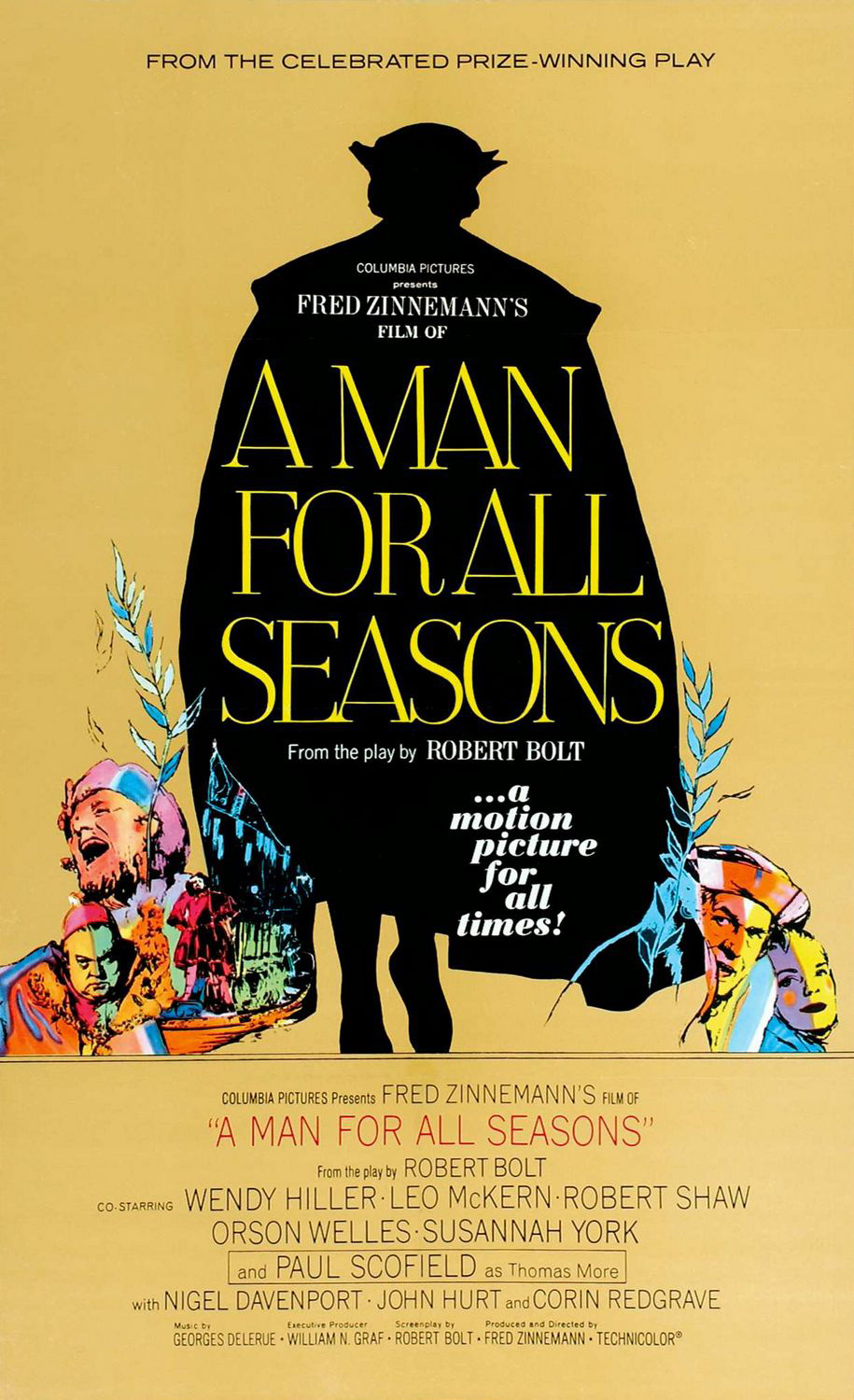
A Man For All Seasons (1966) - I trust I make myself obscure?


Letterboxd Season Challenge 2019-2020!  Theme five, part two - stage to screen adaptations!

(Chosen by Jackie!)

Let's open with some shop talk, shall we?  There's some belief amongst critics, both professionals and amateurs like myself, which posits the best example of any artistic medium is one whose most exemplary qualities best exemplify its medium's most unique qualities.  The video game that could not be any other than a video game, the painting one could not imagine as quite the same as sculpture or photograph, the film whose qualities are most vitally and enduringly filmic in nature, sort of thing.  It's a nice little maxim with quite a lot more going on beneath the surface than its simple "This is the best because it is the most" position would indicate.  A dance, for instance, might stand as an exemplary example of dance because it emphasizes the fluidity of motion possible through a highly skilled/trained performer's responses in time with music, or perhaps the strength required to achieve such fearsome or strenuous moves in so quick a time or else over such a long period, or maybe the beauty constructed by two or more in perfect, graceful sync with one another, or just maybe the elemental dance requires many in a clockwork tick-tock creation defined more by the choreographer's skill than any one dancer's choices.  What makes any dance more dance-like than the other?  Same basic problem arises when you try to concretely define what makes film film.  We can get into matters of temporal and emotional effects achieved by editing, the personalized nature of acting compared to traditional theater thanks to the camera's intimacy, the ability to visualize the impossible on a grand scale while still making room for quiet contemplation, more esoteric matters like how the picture's filmed or to what degree it is or isn't reliant on other artistic disciplines like music and whether or not the synthesis achieved by merging sight and sound is superior or inferior to their separation; but how are we to tell we're right?  And furthermore, in a time when many of film's most unique qualities at its birth (real time contrast of images, being able to move images of real things without their physical presence in the first place, animation as a discipline in general) are no longer wholly unique to it thanks to the rise of television, video games, and online video content, how exactly can we say there's any one thing that makes a movie the Most Movie?

In discussing 1966's A Man For All Seasons, I think it best to narrow the discussion's focus, and talk primarily about what makes a play so captivating, and whether or not transferring one to the silver screen without undertaking some special effort to make it more film than stagework makes a successful approach.  See, in reading reviews of the film in a search for perspectives to tackle, I found multiple pieces and posts noting how Fred Zinnemann's direction and Robert Bolt's adaptation of his own script do little to take the story of Thomas More - High Chancellor of England, author of Utopia, and noted martyr who silently refused to condone King Henry VIII's schism from the Catholic Church after so many years of opposing the Protestant Reformation under the same king, and was beheaded for it - a distinctly cinematic experience.  The film is, from this perspective, still very stagey, dependent on its words and actors to generate tension and interest in a manner more derived from the theater than the moviehouse.  It supposedly lacks a certain flair in editing, or shooting, or even acting after a fashion, which one expects from a film.  Film, after all, is not theater, and the same techniques which can thrill a live audience won't work so well on the moviegoer.  I confess to indulging in this line of thinking myself from time to time when critiquing literary or theatrical adaptations - just this last week, I put marks against The Pajama Game for lacking a more expansive manner of staging its musical numbers and confining them to soundstages in the same way its theatrical counterpart was contained by the physical limitations of the stage.  My question to you for this piece is: is it right to take the movie to task for this?

Well, yeah, depending on how you want to look at the thing.  If someone's not engaged by a film, they're not engaged by a film, and their lack of investment doesn't confer a lack of effort or thought on their part unless they give distinct and solid testimony about WHY they weren't engaged to communicate such a lack.  More likely and more fairly something in the film or else their personal taste in film that didn't click.  When the discussion surrounds fitness of adaptation from medium to medium, though, I think the question worth examining.  Certainly in my own watching I can admit A Man For All Seasons isn't quite the liveliest film from a shooting perspective.  I can't fault Ted Moore's cinematography any of his framing decisions, as he often finds interesting ways of blocking the actors to emphasize the fiery disagreements between their characters, nor can I say he totally lacks any flair beyond just filming the people, not when the repeated motif of introducing illusory power through reflections and contemplating nature when considering More before shifting to dark, brutal stonework for the corrupt institutions he stands against are so prominent features.  I CAN, however, say his deployment of these more thematically-based filming techniques are far more infrequent than one might hope, some of his extreme angle choices seem jarring against the more conventional work elsewhere, and on the whole he's not a very showy cinematographer.  He doesn't NEED to be for this story, but one more than understands the complaint about how a drama predicated on men of extreme conviction losing their tempers and communicating through grand declarations doesn't take a more daring, stylish approach to cinematography.  And though I'm going to come to his defense shortly, editor Ralph Kemplen largely strives for invisibility without too many showy cuts or unusually long takes; also fine qualities you understand, yet not what one might want from a film with this potential for explosive impact.

The problem, I think, comes in considering A Man For All Seasons as something born in the theater, and a conception of what the theater capital-I Is.  Laying aside less kind thoughts like "the people making these claims don't have much capacity to appreciate slow dramas without big displays of showmanship," I think it accurate to describe theater as the most essentially alive of the artistic forms.  So many forms of painting, sculpture, literature, etc. strive towards preserving an idea in something eternal, in a way one can find equally captivating across the decades and centuries and perhaps even millennia.  Art is referred to as the one true form of immortality, after all.  While a playwright's words and possibly stage directions will endure across performances, one potential X-factor of theater lies with the fact that it is performed by living flesh-and-blood people right before your eyes, conjuring long bygone times and ideas in the here and now, no separation beyond the unreality of production.  Those folks up there perform their craft in real time, and (one-time performances excepted) they have or will or both performed/perform again in a slightly different variation on another night.  Others have taken the mantle before and likely will again in the future.  The play is a living form of art, matched only by live music or the derived performance piece, and its ability to be something new on each repetition through hearts that beat in time with the audience's makes it Theater.

From this perspective, a play brought to film without some great transformation is a dead thing.  The performances will always take the same shape, the actors' decisions always turn out the same way, the experience never alters beyond what is achieved on final cut.  Maybe through alternate cuts in the future (cough George Lucas cough), but never in the same way a live performance can change from night to night, troupe to troupe, year to year.  Cinematic life, though highly dependent on actors in 99% of all instances, turns on the camera, the edit, the impossible, and if we only consider the essentials of what makes a movie adapted from stage a worthwhile endeavor in this way, I can fully understand why A Man For All Seasons might come across as something boring and not all that special.  Its most vitally cinematic elements stay out of the way and leave its most theatrical elements to stomp about as if they were still out on Broadway, with their warm flesh and blood replaced by cold, flat celluloid.  Doesn't make the most appealing picture.

Hence, when a mode of consideration no longer serves any use in helping us enjoy or understand a work, it is best to modify.  Although I've taken an unconscionably long time to say so, I DO still think of A Man For All Seasons the film an engaging, vibrant work.  Robert Shaw's performance as King Henry VIII might be the same every single time one turns on the film, but this does not diminish the accomplishment or visceral effect of his decision to play bombastically jolly in a way that makes his outbursts of rage at perceived slights read as active efforts to make the more steady More flinch.  Paul Scofield's lead performance as More still embodies a man of staunch religious principle whose manner and profound respect for divine law renders him a more palatable figure of spiritual conviction than many characters who hold similar beliefs (or, if we're fully honest, the historical More in all likelihood).  He still trades immensely witty, multilayered barbs with a host of character actors who can hold their own in theological tongue-spars, yet never rise far enough beyond their self-serving nature to meaningfully overcome his hardline stance on the Church's right to define law and order.  Its being an object of eternity derived from a play meant to encourage new perspectives on every performance does not, in any way, diminish the impact of Bolt's slow crawl towards realizing the hopelessness of the situation, and so redefining victory to mean standing by a single, righteous conviction above all else, nor the last minute whammy of a sudden bit of narration telling us the unhappy fates of those who persecuted More, leaving one to wonder at how evil any of them could've truly been if the vices that led to their villainy in this story ultimately produced the same fates as a man considered pious.  The delight and dread in the dialogue, More's complicated relationship with his family and fate and office, the essential vibrancy of putting this all to screen for a single production that will play the same way for all screenings across all time highlights the virtues in Bolt's work, never detracts.

I believe the film works so well because Zinnemann employs Moore and Kemplen to unobtrusive, underscoring effect.  Their work allows the film to function with minimal fuss, creating a quite lovely picture of early 16th-century England across multiple strata of life, and enables the actors to do what actors do best on film: be close and intimate with the audience.  Those moments of lost tempers, selfish, self-righteous outburst are afforded the same quiet, non-interrupting distance as bits like More sad, stately admonishment towards Richard Rich over selling his soul for Wales, and places one right there in the spittle-flecked, red-faced thick of it.  Joviality, despair, and stiff-lipped, steely-eyed conviction come across at our level, from a reality we can recognize and solid and authentic unto itself, and the ideas of what is best and right in confronting what one perceives as a moral wrong embodied by figures of great power and influence who are close confidants all the same can play out with the same immediacy as on stage.  Just as one might argue a lack of flair leaves the film staid and boring, so too can one say the lack of flair at a cinematic level allows both flair and nuance at a performative level a chance at rising to the surface, and it is this tact I take far more than the devil's advocacy I advance above.  Is it the absolute best example I've ever seen of these particular themes, or this style of performance, or this manner of presentation, or this mode of adaptation?  In honesty and earnestness, no.  But it is itself, and it is effective in captivating and teasing at my mind, and so I applaud the effort.

A thing being unchanging in form does not make it dead in experience.  The dead, for all talk of an afterlife in this film, do not experience.  It is always the living who come to A Man For All Seasons, the living who bring fresh eyes and new experiences through which to intake and interpret this one-time work.  With fresh eyes will come those who find it a less than thrilling experience, be it because they don't jive with its manner of presentation or its mode of adaptation or a simple distaste for historical drama, but there will also come new historic events to compare it against, new ways of thinking through which to view its contents, new minds who've never seen its like, or seasoned minds who've seen the like or even the film itself many times before, and yet still have wholly new experiences to color their viewing.  The great thing about film as film is difficult to define, and subject to ongoing debate - the great thing about art is its capacity to engage and inspire no matter the time or place or creed.  So, though A Man For All Seasons from 1966 is dead as theater from a strictly theatrical standpoint, it is alive and vibrant and immediate as ever as art, and so gains life as film all the same.

4/5

Tuesday, December 3, 2019

Mixed Nutcrackers - Nutcracker Fantasy (1979)


Much as I'd like to preemptively declare Sanrio's Nutcracker Fantasy the weirdest film we'll watch for this marathon, I shan't do so.  It's far too early for any statement so definitive, particularly when I've watched the trailer to Nutcracker and the Four Realms multiple times over the past week in a vain attempt to understand how and why it happened.  This said, today's film does make a fairly convincing case for the title, being a stop-motion animated work that rejiggers pieces of the ETA Hoffman story into a wholly new form inspired by The Wizard of Oz and Alice's Adventures in Wonderland, with animation courtesy of several Rankin/Bass overseas animators.  Per imdb's cast and crew page, those who worked on this film weren't CREDITED for much on their American televised work - director and editor Takeo Nakamura only has Santa Claus Is Comin' To Town listed as an animator, while puppet producer Sadao Miyamoto worked on Frosty the Snowman as an uncredited animator, Tadahito Mochinaga served as puppet technician and cinematographer on Mad Monster Party and animation supervisor on Rudolph the Red-Nosed Reindeer, and puppet designer Ichirô Komuro went on to serve as production supervisor on several of the company's 80s productions.  Only four major names I can find amongst the credited crew in total, but considering how lax most visual presentations were about giving due credit to everyone who worked on a project beyond department heads (especially where foreign workers were concerned), and considering it shot at Mochinaga's own MOM Production studio same as the Rankin/Bass specials, I have to imagine there was more behind-the-camera experience with the form and style than one can ascertain from the on-screen accreditation.

Without the budgetary and time limitations of producing for an American televised holiday market, and with the eye and money of a booming Sanrio (backed by five years of Hello Kitty sales) on their side, Nakamura and crew show what this style of stop-motion can really do with Nutcracker Fantasy.  Sets are substantially larger and more detailed than in the familiar Christmas specials, with the lovingly dressed, two-story foyer of Clara's home and the Mouse Queen's sprawling lair standing out as particularly impressive examples.  Large crowds of characters are not only possible at a greater frequency than in Rankin/Bass' productions, they also boast a wide assortment of unique character designs, rarely resorting to mothballed old props or copycat clones.  When sets of characters with the same appearance do show up, it's justified by the presence of armies of mice and wind-up soldiers, spiced up by the addition of odd-looking generals, and more than compensated for by staging a lively, multi-plane battle with several layers of action across the horizontal and vertical plane both.  The camera's also far more lively than one typically sees with this style, crawling through the dolls and transitioning across interesting composite editing effects.  Special effects too benefit from the loftier breathing room, with far more intricate and lively integration of sparkling lights and specialized sets for trick camera moves, well beyond the overlaid gauze and animated snowflakes of Rankin/Bass' work.  I have to wonder how much Sanrio's aesthetic needs and demand for quality, or else the animators' decade-long experience with the style influenced the production, for Mad Monster Party was also produced for a theatrical release, and still suffers from the same limitations as its televised counterparts.

As an adaptation of The Nutcracker, Nutcracker Fantasy is actually a pretty fascinating reworking.  In as succinct a manner as I can manage: they've taken Godfather Drosselmeyer's story about how the Nutcracker came to be with the Mouse Queen and the cursed princess and the hard-to-crack nut, transplanted it into something inspired by the looks of the Land of Sweets without the candy themeing but with the large assortment of foreign dignitaries, expanded the conflict with an ongoing war reminiscent of the opening movement's mice/toys battle, and presented it all as a maybe dream/maybe reality situation, which nicely encapsulates every important element of Hoffmann's story.  It takes far more cues from medieval fantasy and lost girls stories, given how Clara's part for much of the story is to stand on the sidelines listening and worrying, but it's quite a clever way to rope in so much detail that's otherwise dropped from the ballet.  Some portions seem drawn from the ballet, as when the foreign wisemen are clamoring over one another to propose solutions in a manner reminiscent of their dances (just with far, FAR more nations and... ethnicities, shall we say, represented).  There's even a nod to the astronomer from Drosselmeyer's story, through the Queen of Time, whose mystical, heavenly figure of sagely advice is achieved through traditional ningyō jōruri rather than stop-motion.  S'all very neat to behold, and coupled with the aesthetics of the piece, it manages to give the film its own identity while paying clear homage to its progenitor, which mark good qualities for an adaptation.

When the film plays with its own material, it's not always quite so charming.  The beginning takes several minutes to establish a sinister Rag Man figure who seems like he'll play a major role, yet drops clean out've the narrative once the Nutcracker portions begin.  I'd suspect his loss has something to do with the English dub (the only one easily available, unfortunately) chopping out about ten minutes of footage, including two live-action dance segments, though I cannot find any substantial information on the differences.  More probably common to both versions is the court of foreign wisemen, which turns entirely on lazy stereotype humor, and mostly gets past my hackles for its clear demonstration of how varied the puppet design is in this film, as well as containing both a joke about Stalin's five year plan AND an offhand reference to Der Fuehrer's Face, both of which threw me for a loop.  The film's attempts to give Clara something to do in the climax mostly center on her wandering through a magic forest and meeting several symbolic original figures who lack much of what makes the Queen of Time interesting to watch and consider.  Most they have going being voiced by Christopher Lee, with one seeing him attempt a rather bad Irish accent.  It really must be said, while it's admirable to try and exercise Clara's emotional intelligence during this stretch, prior to the effort she has nothing to do but stand around waiting for the plot to move on, rendering her an undynamic protagonist in love with the soldier-turned-Nutcracker Franz because he looks handsome and heroic.  And, well...

I say the story's weaker when it's striking out into its own concepts, when I should really say it's at the weakest when it pulls in the one thing I'd never have imagined we'd pull from the Hoffmann story.  The reasoning behind the Mouse Queen's ire, I get snipping it out.  Clara not throwing her slipper to distract her an afford the Nutcracker a win, weird considering the ballet keeps this and makes it a more decisive action than in the story, but whatever, the sequence plays out fine on its own.  Making the secret to cracking the nut and breaking the Mouse Queen's power a pearl sword rather than someone's teeth, I guess I'm fine with it despite lessening the importance of Franz becoming a Nutcracker - these puppets don't exactly have articulate jaws.  But having Clara awake from her dream, meet her visitor Fritz, find him identical to Franz, and get married to him despite a doubtless decade-or-more age gap betwixt them?  Hoy.  Bad enough an implication when it's the 1810s and marital customs were far different than now.  Even accounting for this film's still-40 year age and differences in Japanese culture, it's still a bit of a Thing to take the story beyond a young girl's self-flattering dream world and into "They actually literally got married in real life and went to live in her fantasy kingdom, which is real, forever."  Gets one chewing one's cheek lining in discomfort, and makes some of the wholesomeness drain out've the story, not at all helped by how Clara's undying love as the only thing that can save the Nutcracker from his transformed state dropping into the story a few minutes prior with a "We've been trying to tell you this was the case all along!" line, despite this very much not being the case.  You were trying to tell her the kingdom of toys and ethnic stereotypes needed saving from a two-headed mutant mouse monster so your newfound beloved could marry someone else entirely.  Don't try to sell me a story you weren't telling in the final minutes, even if I'm in your target audience, and especially don't heavily imply a marriage between child and teenager at best, child and adult at worst.

There's other problems with Nutcracker Fantasy, mostly pertaining to the English dub - the voice acting is serviceable at best, the inclusion of Tchaikovsky snippets token, the American musical numbers not really to the standard of what their contemporaries were producing, which don't do much for me anyhow.  Taking it all into account and looking for the right ribbon with which to it it in a bow, though, I think an ultimately positive assessment is in order.  The spectacle of seeing Rankin/Bass' particular take on stop-motion design and animation given greater cinematic flair and polish than I've ever seen leaves a big impression, and the way it remixes The Nutcracker and the Mouse King into its own mini-fantasy war plot whilst homaging the source material leaves me with charm aplenty to overcome the less than stellar original material.  Just the simple fact of the Queen of Time's live puppetry amidst this collection of invisibly maneuvered figures is a memorable and impressive enough testament to the creativity on display here to get me over the "why are we implying child marriage?" hurdle.  A strong start to the holiday programming proper, and one I hope at least one non-Fantasia film can surpass before the month's out.

(Points for giving at least one mouse monarch multiple heads.  We'll see if anyone managed the full seven.)

3.5/5

Sunday, December 1, 2019

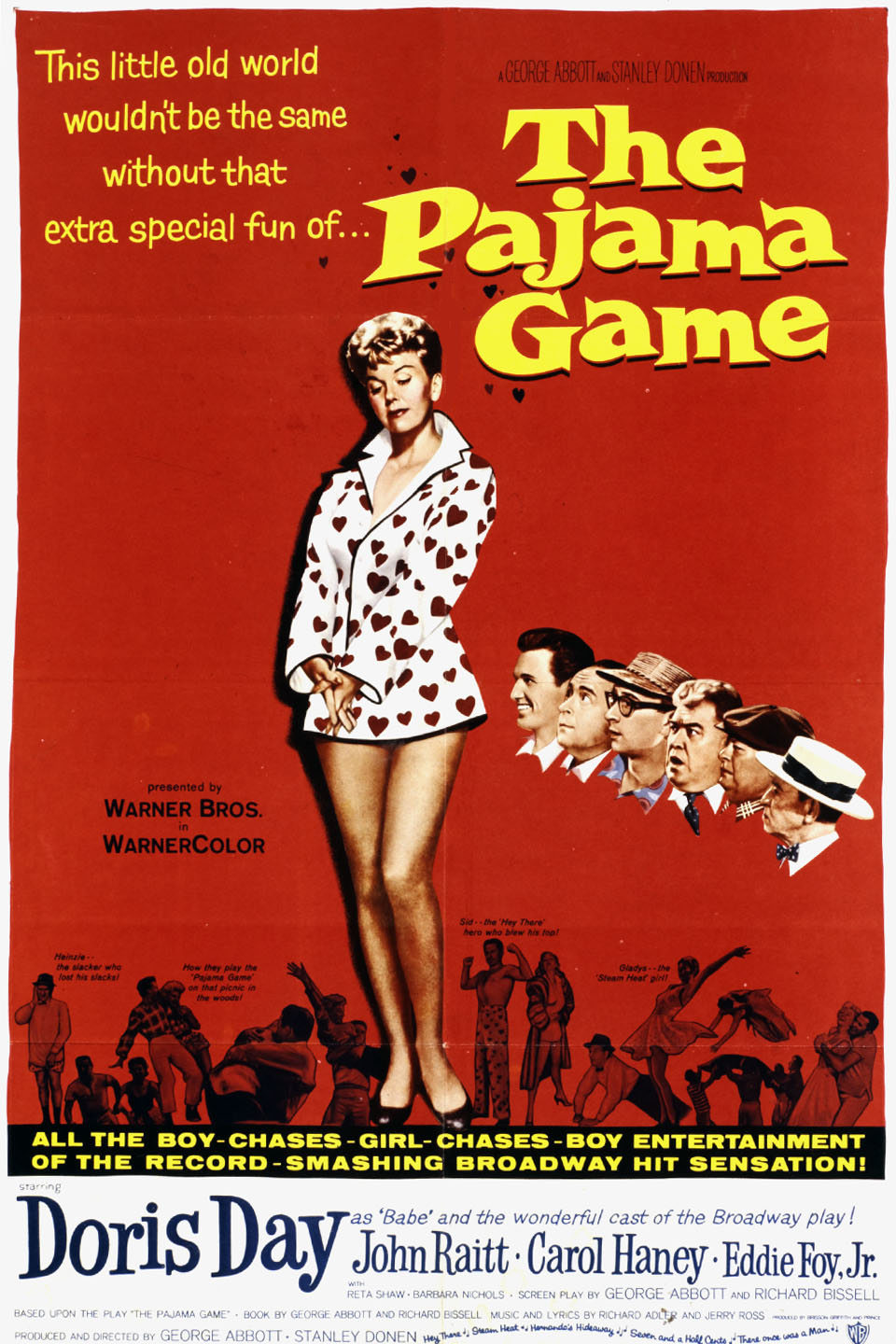
The Pajama Game (1957) - I know a dark, secluded place...


Letterboxd Season Challenge 2019-2020!  Theme five, part one - stage to screen adaptations!

I'm normally picky when it comes to older musicals.  Broadway showstoppers from the mid-century boom of plays with stories and serious issues on their minds rarely do much for me due to the focus remaining squarely upon melodrama and spectacle, while leaving their slight plots to mill about in the margins as mere excuses for the main action.  I prefer the songs to serve as primary means of storytelling, and the classic standards always treat them as entertaining diversions from the story, not really exploring any emotions or ideas beyond rapturous love, silly antics, or witheringly light tragedy through the music.  It's additionally frustrating when a work with an interesting conflict or unique setting is made to play home for yet another meet cute, fall in love, fall apart, get back together narrative with only trivial intersection with the ostensibly main conflict.  All in all, a Broadway musical from the 50s has some massive hurdles in its path if it wants to leap into my heart, and The Pajama Game hits on all the little things that annoy me about this style at a scan.

After watching George Abbott and Stanley Donen's adaptation of Abbott's hit 1954 play, I SHOULD come away with a tongue primed full've venom.  Why not?  The whole business about the pajama factory workers striking for a seven-and-a-half-cent raise serves as background dressing for the romance between Sid and Babe, which ignores the conflict for long stretches of screentime before driving a gulf between the two with a token upset, and subsequently puts no energy into their getting back together beyond "Well they're the main couple, so y'know."  Multiple musical numbers run on as little more than filler entertainment divorced from character motivations, and when they ARE character motivated, one gets situations like Babe and Sid duetting about how passionately they adore each other for two songs in a row.  As a piece of filmic work, the movie's fairly limited - despite a lively enough camera, many of the musical numbers are limited in scope and activity by the trade-in from live stage to sound stage, with only Once-A-Year-Day roaming a larger location and Hernando's Hideaway getting at all cinematic with the staging and editing.  A jealous boyfriend's murderous rage is played for laughs, the union's victory over the company is treated as overly uproarious for its eye-raising simplicity, and the overall romantic arc comes across as little more than the script asking the audience if they want these hot people to flirt some, so it SHOULD be actively hitting at every "dislike this movie" button across my entire figure.

So, why are we coming away from the experience with me metting out a four star rating?

Familiarity bias might play into it some.  I chose The Pajama Game for this theme because I'd seen a performance back in middle school, when my English teacher took the class on a field trip to watch the Tucson Community Theater's production.  As with much media I viewed at the time, I've forgotten most of the details in the intervening decades (not as big a surprise here, considering it's the only live theater show I've seen in my life, and something watched for a school project at age 12 or 13), but the standouts definitely stand out in my memory.  Snatches of Steam Heat and Hernando's Hideaway occasionally drift across my stream of conscious in free moments, and a lot of this watch was consumed by periods of "Hey!  I remember this song now!  It's great!"  That I spent an entire evening editing the Wikipedia page for the play to include details of the production from the playbill I brought home before I understood what notability constituted probably helped stick the play in my mind as something worth remembering fondly, however dimly, and primed me to think of this film as a grand ol' time regardless of elements I'd otherwise find annoying.

This doesn't quite satisfy, though.  The Pajama Game may sit in my mind as "that play I saw in middle school," but this film, divorced from my memories, still has quite a lot on offer.  Forget notions of doing something uniquely cinematic with the filmed material or using songs as a means of communicating story; the music and performances here are infectiously bouncy and varied enough to blow such preconceptions right out the door.  There's a trend towards allowing the actors' vocals to strain and fray on longer or higher notes in a way which feels highly controlled, granting moments like Doris Day's increasingly atonal response to the calls in Not At All In Love or her interplay with John Raitt on There Once Was A Man an extra degree of skin-tingling satisfaction.  The Broadway music team clearly had tons of fun tweaking at the call-and-response style of structuring, playing with swinging waltzes, rapidly shifting verbal tempos (consider the stretched out notes followed by babababababa rapidity on the verses to I'll Never Be Jealous Again, the breakneck/leisurely contrast in Small Talk, or the radically different paces on both go-arounds of Racing With The Clock), and even players dueting with themselves.  Though I'd entirely forgotten about it from the stage play, Raitt's work on the opening warning half of Hey There followed by his interplay with his recorded voice as a doubting counterpart in the second stretch was an unexpected highlight, and Day's reprise in a new, sorrowful context sold me on her status as a musical superstar better than anything in Calamity Jane.  And, of course, it helps to have big showstopper numbers like Once-A-Year-Day, which just keeps going and going and building and building without losing any of its energy or fun, and the matchlit, darkroom tango of Hernando's Hideaway, which contains the film's most well-crafted visuals.  It's an uncommonly good soundtrack all the way through, whose density only gets one charged and willing to leap from number to number with little resistance.

Beyond the music, I also think the performances help the movie along towards a higher rating quite a bit.  Looking over Wikipedia, the cuts made in adaptation rob most of the supporting cast their numbers and sideplots (Prez seems to suffer the most in this regard), but the original Broadway cast is still here minus Janis Page's Babe and Stanley Prager's Prez, and they're still giving it their all in roles they'd inhabited for three years by this point.  Carl Haney stands out in particular when the spotlight shines her way towards the end, given she's afforded the leads on both Steam Heat Hernando's Hideaway, a riotous drunken routine in the following scene, and a turn towards the climax that allows her to just wild it right the hell up with out of control screams and erratic mannerisms.  Such high-effort, high-reward mania defines the film's comedic routines, which involve large chunks of the cast getting caught in their own conflicting priorities, and blustering and shouting over one another until someone barges in to straighten the situation.  While it does not MEAN much in the way of exploring the labor conflict or romances at play, it is endearing to an extreme I cannot deny, and couples well with the same performers when they launch into song and dance.  I don't particularly need a well-defined romantic arc when Day and Raitt are giving it their all to make the all-too-short courting period seem natural before the dizzying highs of Small Talk and There Once Was A Man.  Call it emotional cheating if you will (it absolutely is), but damn if it doesn't work, and work well.

Effectively, I think the movie clips past any and all grievances I can and do raise to land at an overall positive place by doing what a Broadway entertainer does best: taking the material it has on hand, rehearsing it to perfection, and then performing with such finesse and bombast, you hardly notice or care about whatever cracks show.  Taking The Pajama Game and transplanting it to the screen with little more than some cut content and more realistic locations conducted in transit probably should break the thing in the process, and I'd be made a liar if I claimed a few elements didn't almost push me down to, at least, a 3.5.  The way Gladys and Hine-sie's little subplot resolves with them jokingly wearing prison stripe pajamas with built-in handcuffs makes me choke on my tongue a little for how bitterly 1950s it tastes, honestly.  With such strong musical and performative elements in tow, though (not to mention the production design - it's a minor thing comparatively, but I'm kinda in love with the costuming here), the film can skate right past any and all problems to convince me to go with the flow and enjoy what it has to offer.  As I've said time and again, one should strive to level with films on their level and, where possible, count a final positive experience as more important than whatever grievances come up.  In this particular case, the film's all about making good with a grievance committee, so I've an extra layer of cover for my less than professionally critical perspective than usual.

(Someone kindly tell me how Ralph Dunn wasn't made known to me as a comedic talent until last night, please.)


Lookit 'em go.

4/5