Wednesday, February 12, 2020

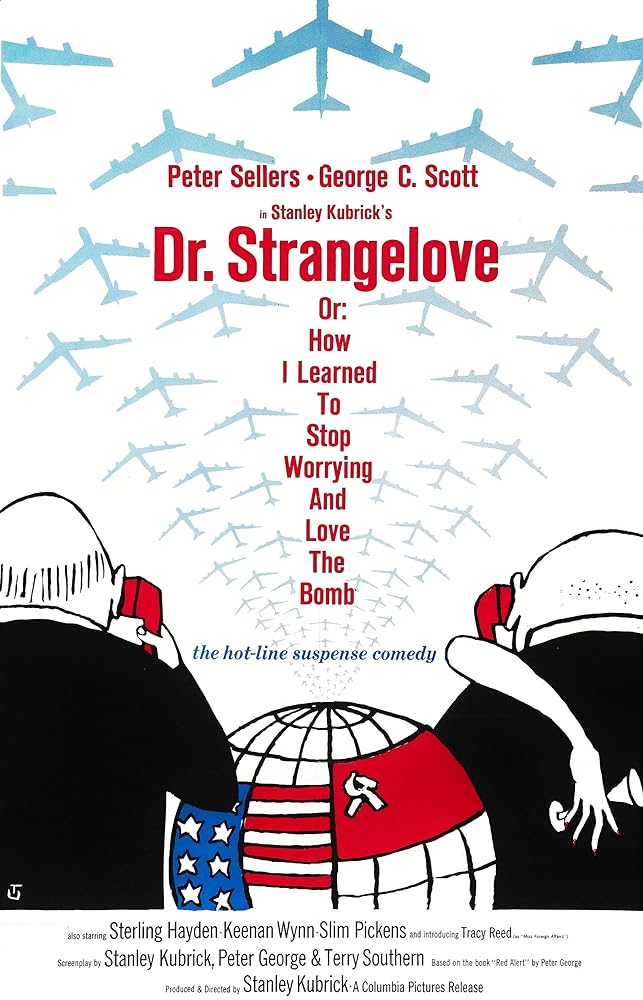
Dr Strangelove or: How I Learned to Stop Worrying and Love the Bomb - Nuclear Warhead. Handle With Care.


It's the fifth Letterboxd Season Challenge! Theme seven, part three- one of Spike Lee's essential films for aspiring directors!

(Chosen by John!)

Nothing written herein will be new or insightful. Without proper academic training into the act of film analysis, I cannot provide you a single word about Dr. Strangelove or: How I Learned to Stop Worrying and Love the Bomb any different than what a multitude of thousands have already said over these last fifty-five years. Not because Stanley Kubrick was some kind of inherent genius whose works are far too intricate for mere mortals to tackle, requiring a deftness of wordsmithery and cinematic insight beyond the ninety-ninth percentile before any decent work can take place - bout a year ago I watched and reviewed his Eyes Wide Shut during a different challenge, and managed a detailed piece I find satisfactory. Difference is, I watched Eyes Wide Shut for the first time then, without any preconceived notions or general knowledge of its general reception or common interpretations, a benefit of the film sitting outside the core Kubrick classics. Dr. Strangelove, by contrast, is a film I've watched in full multiple times since high school, regularly use as idle YouTube clip entertainment, read about from any new critic I discover who's covered it in any substantial detail, and love for all the reasons everyone else on the planet loves Dr. Strangelove. I know, you know, everyone knows the best lines, the ins and outs of what makes the performances tick and what Kubrick did to make George C Scott act Like That, all the little sexual innuendos, the Thing about how Kubrick insisted the table in the War Room be pool felt green despite the film's being shot in black and white. "You can't fight in here, this is the War Room!", "Precious bodily fluids," "He'll see the big board!", "Mutiny of preverts," Major Kong riding the bomb, "MEIN FUHRER, I CAN WALK!", all of it.

Still, I write, and write quite substantially on every film I watch for these challenges, so a lack of fresh insight shan't serve as any deterrent. In the name of maintaining forward momentum, let me simply state the observation I mean to work and expound upon in the bulk of this review: Dr. Strangelove is as cacklingly funny as it is because Stanley Kubrick did not make a comedy.

To clarify, he certainly conceived the scenario and directed his actors in the manner of a comedy. One can hardly look at George C Scott masticating on hunks of snack food between flustered, easily-excited outbursts and think his General Turgidson anything other than an immensely funny figure. Same goes for all three of Peter Sellers' characters, be they Group Captain Mandrake fighting back an emotional breakdown as he tries to calm his commanding officer's psychosis, President Muffkin ineffectually managing his staff and generals with ill-projected strength, or Doctor Strangelove gleefully describing a eugenics program to survive the end of the world while his Nazi hand flies into salutations. Beyond this core group, other characters aren't quite so wacky of immediately humorous, but Sterling Hayden's Jack D. Ripper and Keenan Wynn's Colonel Bat Guano are both such tightly-wound, deathly serious military men that their self-important speeches can't be anything save giggle-worthy, in isolation or in contrast to Mandrake's flustered replies. Clowns in positions of power all, even Slim Pickins, whose Major Kong is perhaps the mildest of the bunch despite his natural and entirely out-of-place Texas drawl, and still gets the film's bleakest, best punchline all to his lonesome.

Through Major Kong and his crew aboard the 843rd Bomb Wing, we can understand what I mean by Kubrick not making a comedy. Their scenes contain jokes same as the rest of the film, primarily quick lines from Slim and absurd background details, which render the plane a locker room hangout much as a militaristic instrument of death, but their composition and placement in the film do everything in their power to dissuade any impression you're watching a comedy. The majority of production design choices reflect Kubrick's typical eye for detail in a set based on then-top secret military hardware, the camera prefers views which emphasize the cramped space and the movements of dials and switches and blinking lights, the cutting shows us every man engaged in his obscure function as the crew flies onward to their final destination. Any time we jump to join the 843rd, the soundtrack strikes up a drum-based rendition of When Johnny Comes Marching Home, and the action plays out like any other military movie wherein a contingent of our good ol' boys are out on a mission to save Democracy and Freedom, and nothin's gonna stop 'em. They'll follow orders to a T, endure heavy enemy fire, face setbacks that mean their inability to return home safely, and still they fly on, fearless and undaunted! That they are flying a mission whose success means an end to all living things, one which sees every other character is tying themselves into hysterical knots in a desperate attempt to halt it, matters not one whit to how things play out.

Cross your eyes and ignore Slim Pickins and the pin-up girls on the safe containing classified orders, and there's really nothing funny about this stretch of Dr. Strangelove. Even once Mandrake and Ripper's side of affairs has concluded, and Muffkin and Turgidson and Strangelove are approaching their peak, the 843rd is still playing out its war game completely stonefaced, still emphasizing the technical work necessary to pull a last-ditch bombing run, still marching to its heroic tune. Right up until the bomb drops with Major Kong astride its girth, and the film corpses hard as it possibly can with him yippin' and hootin' and waving his hat all the way down to smack dab in the middle of Mother Russia with the world's biggest atomic penis between his legs... and then silence.

Such an effect applies across the entirety of Dr. Strangelove. Across every technical aspect, across set design, lighting, camerawork, sound editing, shot-to-shot cuts, Kubrick composes like he did and would any other film across his career, as a director driven to get everything just so and generate an atmosphere of cold, carefully manipulated sterility. The War Room is this monstrously huge, mostly empty space, with dozens of men all cramped around a comparatively little table with hot lights creating massive dark spaces all around and an imposing map of the world flashing ominous updates overhead. Ripper's office is laid out and decorated according to the sensibilities of a respectable military man, and gradually gets completely trashed by gunfire until it's an almost impressionistic space with slatted lights and obscure destruction strewn all around. Spaces we glimpse with comparative briefness still communicate a fussy, uncomfortable environment, such as the too open operating centers and offices Mandrake calls his own until he's stuffed into a cramped telephone booth, or the confusing mess of mirrors in General Turgidson's bedroom, which make it impossible to tell how he'll enter the frame until he does. Our view into these spaces consists of extremely long takes of two characters in close conversation, low close-up angles to emphasize projected strength, and more heavily cut sequences designed to show how stressed and uncertain all parties involved feel at any given moment. It looks and feels for all the world like the kind of military thriller that gets your teeth clenched til they feel like shattering, scootching forward to the edge of your seat desperate to know if they'll make it or not.

Except the subjects in the midst of this clockwork contraption of a tension machine are a group of sexually stunted, immature, undisciplined men who boggle for the camera and say patently ridiculous things in patently ridiculous ways, and make it beyond clear their petulance and desire to feel just a little bigger rules above anything else. I can only think of two instances in which the film is shot to explicitly laugh alongside the audience - when Kong rides the bomb, of course, and when Bat Guano gets a nice close-up of the Coca-Cola company squirting their product in his face. Beyond these two moneyshots, Kubrick does not once deviate from his thriller sensibilities. The script takes the plot seriously and makes damned well sure we know its every mechanism, the camera glares on like we can gleam some greater meaning from seeing these very important men in crisis, the editing holds and holds and holds til we can bear it no more, and then holds off the next cut just a bit longer for good measure... and George C Scott is in center frame, imitating an airplane and getting hopping excited about his boys dropping a nuke on the Ruskies to trigger a doomsday device. Or Sterling Hayden speechifying about how the commies are gonna fluoridate children's ice cream to an extremely uncomfortable Peter Sellers, or Sellers arguing with an unseen Russian premier like an old married couple, or any number of other silly things that completely destroy your faith in the chain of command. Completely unoriginal, argued to death argument here, but the contrast of the most handsomely mounted political thriller you ever done seen, and Peter Sellers talking up breeding caverns and wrestling an evil hand while Scott muses about megadeaths like a little boy in an old lech's body leaves you only the choice to either cry and commit suicide at the state of the world, or laugh at the same.

Even moreso than concerned Terrence Malick and Days of Heaven, I cannot recommend aspiring filmmakers try and emulate Stanley Kubrick's actual techniques. Genius and detail-oriented though he was, his work and writings about it clearly evidence a man who frequently demanded excellence beyond reasonable expectations from all around him, obsessed over things that didn't matter, and actively manipulated his actors instead of working with them if it suited the film. His methods produced some of the greatest films of all time, but I'd not think anyone who wants to work beyond a single project should try and do as he did. Rather, for the purpose of this challenge theme, I say we take Dr. Strangelove as a lesson in the power of contrasts - how complete and total dedication to a contrary tone with your actual, intended vibe peeking through juuuuuuust enough to recolor everything around it can pay massive dividends. The moments when the film breaks down and laughs alongside its audience are exceedingly rare, but its big break represents one of the most iconic images of Kubrick's notably iconographic career, and certainly the funniest of the bunch, so, y'know. Probably worth a study there.

(I meant to put my personal favorite moment from the film as a final tag here. I'm not doing so because I just can't choose one. It's either "HAS HE GOT A CHANCE? HELL YEAH HE....!", "Well, he went and did a silly thing..." or, "Our source was the New York Times.")

5/5

Wednesday, February 5, 2020

Days of Heaven (1978) - I was hopin' things would work out for her. She was a good friend of mine.


It's the fifth Letterboxd Season Challenge! Theme seven, part two - one of Spike Lee's essential films for aspiring directors!

(Chosen by Jackie!)

The conventional approach to discussing Terrence Malick's Days of Heaven is to focus on its visual aspects. Rightly so, given its award-winning cinematography with the oft-noted golden hour exteriors emblazoning silhouettes against a gorgeous sky, and the freeform editing techniques at play affording a higher number of beautiful shots than your average movie without sacrificing its deliberate pace or contemplative tone. One could easily write a review doing little else beyond listing off the film's best shots one after another, and still communicate a good deal of what makes Days of Heaven such a gripping work of visual fiction. To get at what grabs me about Days of Heaven, though, we'll need to set aside its famed visuals, and focus on the sonic, for it is through the sound design that I think the film finds its greatest cohesion and meaning.

It is, after all, through a deafening cacophony loud as the world that we enter the picture, in a Chicago steel mill where the clatter crash clack racket bang thump of enormous machines completely swallows the particulars of an argument between Richard Gere's Bill and a foreman before the former kills the latter. Following sequences of Bill, his sister Linda (Linda Manz), and girlfriend who pretends to be his sister Abby (Brooke Adams) fleeing via train, starting on as hired hands on a wheat farm, and working the fields amongst an expansive cast of background players are equally devoid of specific information, with the camera frequently too far away to capture conversation, the voices in a crowd too numerous for total comprehension when we can hear dialogue, Ennio Morricone's score too busy with its swells and strings and swirls to give diagetic sound its due. When we are privy to spoken words, they are frequently brief, terse snatches, words exchanged in a free passing moment or divorced from the larger context by a cut to later. Our only consistent human voice throughout belongs to Linda, whose narration is as enigmatic and breezy as the editing, occasionally providing bits and bobs of inner thought we might not gauge from what we see, but most often engaging in its own form of contemplating a distant house rising above the wheat fields or staring at a grasshopper munching away at a corner of wheat by musing about esoteric matters of the heart and mind.

From the word go, Days of Heaven impresses itself as a film unconcerned with specificity, one with a far keener interest in the in-between moments of its plotted happenings. Approached like a conventional story, I doubt there's more than five concentrated minutes for the love triangle between Bill, Abby, and the sickly farmer they intend to con with a disingenuous marriage. Prior to the second act wedding, Malick's eye is on the community of workers, their hard work in the fields, their blessings upon the crops, their lines to get paid, their celebrations of a harvest well reaped, with equal weight assigned to Linda's friendship with an unnamed older girl as Bill and Abby noticing the farmer's interest in her. Afterwards, domestic drama and fears of cuckoldry are of secondary importance to the now-isolated group functioning as budding family, bedding down for winter and eventually preparing for the next harvest; even scenes where characters directly confront one another about their suspicions or toy with the possibility of murder are more about the place and mood than what the actors are doing or the characters thinking. The twin climaxes reflect this, first with the spark between natural disaster of the locust swarm and manmade disaster of the wheat fire coming with the exact moment of the farmer's rage finally breaking getting lost in the flurry of both, and then with how casually and lengthily it moves past Bill's final fate despite his actions causing every major plot development in the film. Malick's attentions are elsewhere. He's out here to explore life and experiences beyond the rigors of a Spartanly slight plot.

And yes, the vistas of characters against a dusky sky with their features darkened to nothing yet their outlines visible as midday and the wandering editing system concerned just as much with a man tapdancing to entertain a crowd as the farmer watching Bill and Abby steal away precious moments in righteous jealousy are primary means of communicating to the audience an intent to do more than bunker down on character development and traditional storytelling. This noted, I do very much believe the sonic landscape as crafted by Malick's audio engineering crew pulls a great deal of weight in getting you into the right headspace for appreciating the visuals' effect. I've already noted how cacophonous the sound of machines and crowds and raging fire can become, and how they drown out individual voices in moments of celebration, blind panic, and total indifference, but the swallowing effect really becomes complete and all-encompassing with how much the silent moments do the very same. Days of Heaven often dives so deep into its contemplation of minute detail, even Morricone's score is nearly lost to the emptiness of a room absent its usual figures, or a country sky stretching along for miles upon miles. The wind rolls along the plains, tickling stalks of wheat as it goes, captures a voice, and blows right on by without a second thought. A lone thought dances upon the breeze, its words and ideas as scintillating yet enigmatic and uninvolved as the currents it rides. Whether the world roars with the voice of a million locusts lit aflame, musically mirrors the exultation of a mass of persons rushing for a train, or falls to all-encompassing silence so total even thought itself becomes dull and distant, the individual, traditionally recognizable human experience stands as the farmhouse often does on the horizon: identifiable as itself, still significant by its presence, but rendered a smaller part of a larger whole by all that threatens to envelop it from every side.

I'd go so far as to say my own interpretation of Malick's open-ended cinematic landscape is highly dependent on viewing it as a reflection of how I read his soundscape. Those characters who skulk beneath the breeze's touch, who plan and plot and secret away all manner of hidden reasons for being, who refuse to speak for fear of not being understood, are effectively torn to shreds by the slicing force of the world around them roughly gashing their unwillingness to flow freely. In simpler terms, Bill and the farmer, our most traditionally active characters, adopt attitudes of deceptiveness and righteousness respectively the face of fates that threaten to toss them about, plant their feet too firmly, and allow their unexpressed passions to broil beneath the surface until they explode into fire and murderous rage and unfocused flight. By contrast, Linda is a decidedly uninvolved character, tossed from place to place by the decisions and failings of others, and merely tries to keep herself afloat and engaged wherever the winds may take her. Her status as weaving, winding narrator indicates this quite clearly, and the way her final words sound as if they're meant to lead into another statement before the film fades to credits casts her as a leaf who'll continue her travels whatever they mean. Abby, caught between the two states of being as one who engages in the shifting modes of living more than those around her while still entangled in Bill and the farmer's plotting, finds herself a far more ambiguous end, taking a train full of soldiers on the wings of swelling music rather than walking away of her own power to the sound of her own voice like Linda does. They who can adapt and flow through tumultuous times and settle where they settle are afforded far kinder fates than those who strain or fight against the voice-taking wind, in effect.

Speaking briefly on the film as it relates to Spike Lee's recommendation to aspiring directors, I think the primary takeaway should be one of willingness to step back and flow. Replicating Malick's exact process for crafting Days of Heaven is suicidal folly in the modern industry (hell, even in the New Hollywood days falling so vastly behind schedule with no plan for the look or feel of the final result after a year in the editing bay would likely cost most other directors the job), but the driving philosophy of being like wind, appreciating the world from a perspective alien to most persons, with a willingness to lose out on hard cognitive detail now for the sake of capturing a richer texture makes for an admirable, enviable mindset. You see this across all levels of Days of Heaven, the visual and the audio and the intangible, and it speaks to a deep enough confidence in technical craftsmanship to strive for an achieve something open and mutable and beautiful. Can't quite advocate anyone go full Malick unless they've already proven themselves or are exceptionally willing to take on a nightmarishly heavy risk, but considering the results he achieves here, a little stylistic adoption couldn't hurt.

4.5/5

Saturday, February 1, 2020

A collection of FUCK YOU, IT'S JANUARY reviews

A smattering of terrible dump month release reviews written over this last month on letterboxd!

***
Stephen Sommers should've probably taken a few more passes at the screenplay for Deep Rising before he started shooting. There's a solid hook to the premise, with Treat Williams' smuggler captain carrying a group of trigger-happy mercenaries to God knows where in the middle of the ocean, only to discover they've filled his ship with armed torpedoes and chartered a course to an abandoned cruise ship. That things aren't at all what the mercs expected, what with the proliferation of smashed up rooms and digested skeletal remains throughout the liner, gives us a pretty good line into the movie. Could serve as a workable mystery to keep tensions high until we're ready for the monsters, except his movie is structured so we're constantly cutting between the smuggler boat and the cruise ship before the disaster. I understand the impulse to play with both during the first act, considering the larger boat's owner is somewhat important to the mercs' place in the movie and we need to introduce Recognizable Actress Who'll Sell Tickets Famke Janssen early on, but doing so makes it harder for the movie to grab an audience. We know where we're going and how we're gonna collide, so a large portion of the film becomes a waiting game for the plot to hurry up and let the characters figure what we already know.

It also harms the character dynamics, which weren't particularly strong to start. I suspect the production intended to coast on Harrison Ford's charisma before he turned 'em down, and so Treat Williams is largely affecting his best Ford impression to middling effect. He'd still serve if he had a good, long stretch to exercise a dynamic with his fellow crewmembers and butt heads with the mercs in interesting ways, though. Unfortunately, because we've simply gotta spend so much time on the cruise ship before it sinks, the time we have aboard the smuggler ship is halved, and Williams only has the briefest amount of time to establish a back-and-forth with Wes Studi's merc captain before they're on the liner, and people start dying. Aside from him, there's only Kevin J O'Conner around, who's too deep in snively comic relief mode to impress a relationship with his captain or the men antagonizing him, and Una Damon as first mate, who gets killed to make way for Janssen as our lead. Considering Janssen's character is entirely superfluous if you cut the mystery-ruining early scenes, has little chemistry with Williams (much less time to IMPLY a romance before they're face-smearing one another), and just not giving it her best, it feels we left a potentially more interesting character to die in favor of a conventional dangling love interest.

Our writing woes just spill out from there. Once we start killing characters it happens at an alarming clip that removes a lot of potential for interaction. Losing out on the potential mystery/thriller aspect undercuts what impact the second act revelations could've had. Even with the improvements I've suggested, the nature of the conflict basically leaves us with nothing to DO character-wise in the third act save escape the boat, which takes the form of very simple tasks being complicated by sudden bursts of busywork. All throughout, conflict and tension are generated more by characters suddenly acting needlessly aggressive rather than drawing on a dynamic built naturally through exchanges and events. The movie's even so committed to insisting Anthony Heald's boat owner is the more interesting presence, it kills Studi early in favor of having Heald act the selfish psychopath for the finale. There are bad screenwriting decisions spilled all over this movie, the cast aren't really charming enough to distract from said issues, and it's all incredibly frustrating, because I can see how some tweaks to this one early structural element might've capped these poor impulses and resulted in a stronger final product.

I go with a 2.5 rating rather than the 2 stars my discussion here implies on the merit of the film functioning fairly as an action-horror in the watching. The Ottoia-derived monster's just a massive blob of CG nothing when we see it in full, but the tentacles look fairly menacing on their own or in a pack, and have some damned good effects work for the time and budget. If you take the deaths as less scary moments and more a game of Who's Gonna Get It Next, there's a few solid whacks throughout. Treat Williams, though working an entirely thankless job with so many Star Wars references I'm not at all surprised Ford refused his participation, manages some charismatic presence through a part that doesn't really realize he's protagonist till halfway through. And like... it's a monumentally stupid part of this movie, but I do think the whole setpiece with Williams and Janssen zipping around the flooded corridors of the sinking ship on a jetski, trying to build up enough speed to ramp out while blasting tentacles and obstacles with a shotgun is a good bit've fun. I'd play that part of the Deep Rising video game, it's got a neat two-player mechanic - one of you drives and hits fire, the other has to pump and reload and aim the shotgun over the other player's shoulder.

You can see the rot settling in Stephen Sommers' brain watching Deep Rising. The same inability to write or direct meaningful character interplay, structure a screenplay without a lot've ancillary bullshit stapled on, or deploy special effects without obviously using them as spackle to hide cracks in his scenario. All things that would fester and dig their roots deeper until he went all-out with Van Helsing and just broke the movie. Here, they're a hindrance, but he gets a little something out've the enterprise all the same. Like I say, if he'd taken another week to edit the script and narrow in on the potential for a mysterious situation where the main character learns what's going on alongside the audience and has a stronger rivalry with the dangerous men he's smuggling, he might've had something wholly passable. The near-misses are always more disappointing than the total misfires, even when they're still enjoyable at their own level.

2.5/5

Saturday, January 25, 2020

Hoop Dreams (1994) - This whole thing is revolving around money.


It's the fifth Letterboxd Season Challenge!  Theme seven, part one - one of Spike Lee's essential films for aspiring directors!

(Chosen by me.)

Some personal context: I ran cross country and track in high school.  Had done so since middle school on recommendation from my parents I find some extracurricular activity, and kept at it until graduation through sheer inertia.  I'd run all through the last few years and somehow not quit, why stop now?  In retrospect, sticking it out was a poor idea, because bad experiences with the team, my coach, my self-esteem, and pretty much anything and everything related to running now comprise the majority of my memories about high school, and play a big part in my reticence to think about that period of my life as anything other than an amorphous mass I wish hadn't happened.  Snapping in the middle of a race and trying to punch a teammate for cheering me from the sidelines, trying in vain year after year to stop the team from hazing new members, almost getting pushed off a cliff during a practice run as a joke, undergoing multiple breakdowns at running camp that probably predicted my more extreme breaks in university, the generally poor recurring impression of someone yelling at or lecturing you for not trying harder when you'd genuinely given your all.  Doubtless there are good experiences in there too, of managing a personal best sub-11 minute two mile race or briefly feeling like part of a cohesive social unit, but it's all overwhelmed by the lingering echo of being flat-out told my life would go nowhere because I didn't get an athletic scholarship for college or getting practically run over by a crowd eager to cross the course without considering the person running last place.  I do not like being reminded of my high school athletic career, and would much prefer it fade from memory entirely.

So, for my part, Hoop Dreams plays as a three-hour protracted reminder of such, and I need to power through these personal issues to discuss its contents.  Regardless of differing circumstances, many of these images and incidents resonate nonetheless.  William Gates' summer sporting camp was a prestigious recruiting program for potential college talent where mine was something run by friendly coaches to keep the team bond high over break, but the sense memory of being angrily lectured over how you have to meet your potential or else you'll amount to nothing stings all the same.  Arthur Agee shows far more potential as a varsity player on his basketball team than I ever did as a member of the JV squad for cross country, yet I still remember the pressure to perform academically and physically.  I never had a talent scout single me out as special while their entire story is predicated on such potential uplift, I took well to study where they struggled, I came from a financially and emotionally stable household where they both felt the impact of poverty around the corner and frequently absent fathers, I'm white and could treat sports as just a thing to do, they're black and got caught in a system where sports were presented as the only avenue to personal advancement.  And despite all of this, despite my lack of serious injury and promise of greatness and any direct parallel beyond "I played a sport in high school," the recurring sight of their coaches getting aggressive in a heated moment was enough to make the majority of Hoop Dreams a very much unwanted trip down Traumatic Memory Lane.

Let us therefore set all this aside, and discuss Hoop Dreams on its own terms, for it is still a remarkable feat of documentary filmmaking that deserves consideration beyond the context of my baggage.  This is, above all else, a remarkably empathetic picture, one originally conceived as a thirty-minute television program for PBS before producer/director saw the potential in his subjects' story well beyond his original commission for a piece about playground basketball.  Such an expansion in scope could easily become like any other documentary following a promising or interesting subject through an atypical period of their life, either fully focused on the subject to exclusion of all else, or filtering other people in their circles as relevant only in how they relate back to the main story.  With Hoop Dreams, James and his crew took advantage of their increased prerogative to film and edit a view into high school athletics and black urban life with an eye for giving everyone in the story a say.  One can be cynical and claim Spike Lee lists this as an essential film for personal reasons (he pulls a brief appearance as a speaker at Gates' summer camp, and audio from Do the Right Thing appears on a radio program), but I believe any aspiring directors should take the film's commitment to a complete picture to heart.

Our core focus is very much on William and Arthur as they are accepted to the prestigious Saint Joseph High School on the strength of their basketball talent, only for William's skill on the court to earn him a sponsor who helps him stick it out to the end despite debilitating knee injuries andnear-misses at greatness, while Arthur's supposed lesser potential costs him a scholarship and forces him back into public education with the private school holding his transcripts and future hostage.  Despite more than half of the story's timeline playing out in the first thirty minutes before James received a grant for true larger scope filming, the film makes the most of its glimpse into these four years by expanding its focus beyond whether or not William and Arthur will perform well in their respective leagues and graduate on time.  It is as much their story as those of Emma Gates and Sheila Agee trying to keep their families afloat amidst long periods of unemployment and uncertain marriages, as of Bo Agee's struggles to stay on the right side of the law for the sake of his wife and children, as of William Crawford attempting to live vicariously through his son's achievements, as of William's girlfriend Catherine and their newborn child.  Its concerns lie not only in the realm of success on the court, but on the exhaustion and frustrations inherent to an underfunded education system, the dual-faced nature of private schools' supposed altruistic uplifting, the unfair pressure to perform, the difficulty of accepting something less when you were promised the world, trying to be more than just your valued physicality.  It will ask and explore questions of just how fair its entire premise is when considered against the value of more substantial social reform just as readily as it will buy into the dream of making the NBA as something worth watching every shot of the semi-finals over.

And importantly, vitally, it does not make villains of its participants, nor martyrs of its subjects.  Regardless of how often Bo slips back into near-compulsive crime, were asked to understand him as a man trying to do right by his family, not a failure or criminal.  William Crawford's relationship to his son is more tragic than disgusting, as we see him a man who missed his shot and never found his center again.  Coach Pangborn of Saint Joseph's is a far, FAR more aggressive, abrasive coach than Coach Bedford of Marshall High, and Bedford's accusations of Pangborn screwing over Arthur because he couldn't profit off the boy as much as he'd have liked land hard and true, yet we also see enough of Pangborn's function as head coach and lead staffer at the private school to understand he goes through such a story with every potential talent he encounters.  There are actions aplenty to flay these people alive over, and justifiably so, if only doing so wouldn't cost Hoop Dreams its vision of William and Arthur as kids doing their best under less than ideal circumstances.  Even without knowing as we do now that neither achieved their golden dream of matching Isiah Thomas and playing for the majors, the film places careful emphasis on how important it is they live their lives according to what's best for them now and in the future, and not forever wallow in the bog of what might've been.  To demonize those who let them down or complicated their lives would be to consequently place shine on them beyond just being teenagers doing their level best - make Pangborn or Bo look worse through open condemnation, and you place William or Arthur on pedestals above what they are.

Certainly, through its willingness to present just how needlessly harsh and punitive student athletic programs can be towards those they tempted with promises of glory, Hoop Dreams isn't at all wishy-washy for its refusal to condemn.  I mean not to claim it thinks the systemic or personal wrongs it observes and presents as guiltless or morally neutral.  Rather, I mean it refuses these moral judgments out of fidelity to the goal of completeness.  Everything here is meant to come across on the same level of persons grappling with their own issues, never invalidating those who cross its camera or implying their personal benefit or punishment would meaningfully change things for those caught in the same situation.  There's temptation aplenty over the course of three hours to find someone who can play the bad guy, and yet we reach William and Arthur's graduations with a lasting sense of these lives as nuanced REAL lives.  All will continue on best they can, regardless of where the road takes them (or took them, in the case of those gone too soon in the following years), and make what comes  their way into worthwhile lives all the same.  Dreams of stardom can motivate one to reach beyond, it it's important to take what you actually grasp no matter what it is, and I believe Hoop Dreams imparts this with a successful totality of purpose better than most documentaries.

It's a withering, difficult film for me thanks to my excess high school baggage, yet I believe it hits so hard precisely because its rounded, detailed portraits of all participants shortens distance and makes the commonalities stand out all the more.

Thursday, January 16, 2020

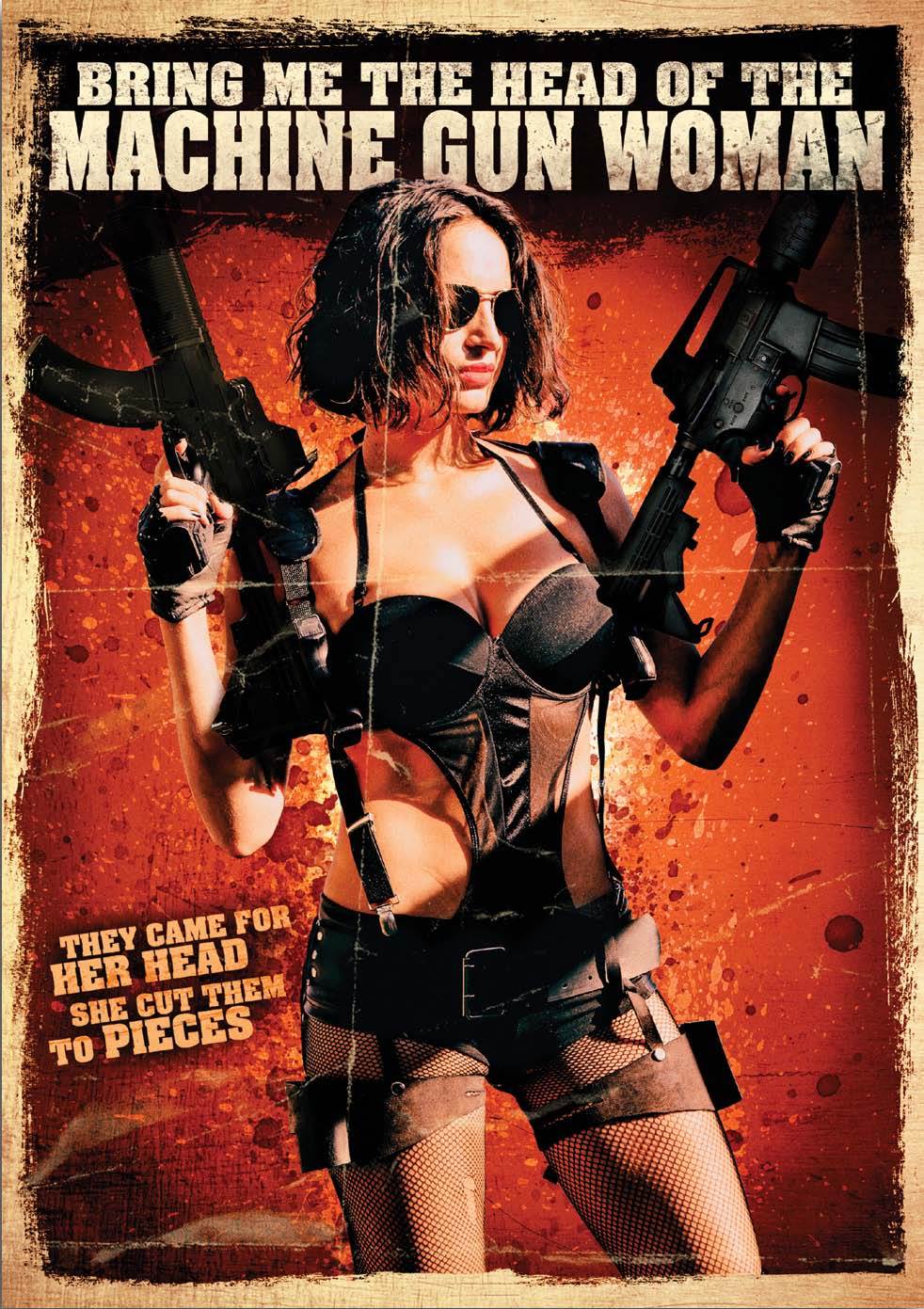
Bring Me the Head of the Machine Gun Woman (2016) - *Vageuly sexual bullet removal noises*


Letterboxd Season Challenge 2019-2020! Theme six, part three- a South American film!

(Chosen by John!)

Low-budget Chilean fimmaker Ernesto Díaz Espinoza has the start of a good idea in Bring Me the Head of the Machine Gun Woman: take a standard crime-action plot about a gutless loser caught in a mob hit, and reflect his video game obsession by styling portions of the film after the Grand Theft Auto series. As such, the tale of Santiago hunting down the Machine Gun Woman in twenty-four hours lest he find himself at the business end of a gangster's gun is punctuated with little flourishes either lifted directly from or inspired by Rockstar's popular franchise. Characters' names and bounties are flashed onscreen as means of introduction, Santiago racks up higher bounties with the crimes he commits, and segments are divided by shots of a car driving with the exact angle and framing you'd see in San Andreas, complete with GTA-font announcing upcoming missions and their success or failure. At first, it's enough to patch over the film's lack of money for proper sets or lighting by making it all feel like a big ol' piss-take on this type of exploitation send-up. Sort've a, "Haha, this dweeb's in way over his head and trying to feel like a badass by viewing things through a gaming lens, ain't it funny?" and it IS plenty amusing for a while. Genuinely seems like we're actively aware of how Santiago is this pathetic dork trying to play it smooth with hot informants way out of his league and buying an Airsoft pistol to bluff his way through a hit, and it works to great effect, for a time.

Once he crosses paths with the Machine Gun Woman, though? The movie starts to wobble and come undone at the seams. It's able to ride the goodwill of its first act for a fair way's, but one quickly realizes it's not going to do anything more with the GTA-theming beyond allow Santiago to fail missions every now and again. What worked as a clever twist on a standard grindhouse send-up reveals itself as a thin coat of paint to disguise the transition into "Nobody schlub falls for ultra-hot assassin chick who could kill him in seconds but she's actually into it." There are... attempts to make the relationship between the two work - Fernanda Urrejola definitely plays things like she's just toying with him to see if he's got anything substantial to match the gall necessary to pull a toy gun on Chile's best assassin, and they don't get together in the end, which is nice. The film still drifts away from playing with video game conventions in favor of stuff like a badly shot post-bullet removal sex scene in a car and asking Urrejola to play a betrayal scene with some really unearned slow-mo puppy dog eyes. It feels trapped between goofing on Santiago and its own premise for a quick lark, and fully embracing the power fantasy to jerk off on your face.

Push the video game weirdness further, and I'm far readier to go along with Bring Me the Head of the Machine Gun Woman. The film already cold opens on the Machine Gun Woman taking out some colorful assassins in a convenience store, including a one-man band whose drums come outfitted with guns. It already has heightened moments like a man blowing his scalp sky high with a shotgun to the chin after he's shot in the leg, or a crusty old fucker with some mad HTML skills for his character-select page on HireAnAssassin Dot Org. We've room aplenty to push the bounty thing further by having Santiago rack up incremental pesos for petty crimes along the way, or even lose wanted money for particularly wimpy actions. Show things from the Machine Gun Woman's side, give us some insight on what a video game world's like for someone who's essentially an untouchable top-ranked player. Get in more carjacking to build up to Santiago finally stealing a high-class sports car at the end and instantly losing it, maybe playing on the constant shittiness of the vehicles he nabs. Hell, if you really wanna make the sex scene work, just cram a Hot Coffee joke in there somehow. Once you start looking for ways to get these bits and bobs into the film, it becomes ridiculously easy to get even more ridiculous without spending THAT much more money.

I'm aware my saying "the best way to improve this movie is to double down on the gimmick!" doesn't make the film sound like it has much potential on its own merits, and... yeah, Bring Me the Head of the Machine Gun Woman is trash no matter what you do with it. Important thing is, the GTA stuff has the potential to make it unique trash, fun trash, the kind of trash you don't mind getting in your mouth while you're wallowing neck-deep. It's definitely got that appeal going for the first twenty-five minutes or so, before slowly bleeding as it becomes more about the standard, boring trash of 0/10 dork falls for 10/10 killer without as much gaminess to stem the flow. I'll champion appealing, enjoyable trash, and if you can make less engaging garbage into more exciting rubbish by mucking around with game concepts, then yeah, I'm down. Making it a bit clearer that we're kicking a power fantasy in the face rather than full-on indulging one would be nice too, but I believe going "Yeah, it's Vice City or whatever but it's a Chilean movie," would help achieve the same effect along the way. Just gimme my full-impact stupid viddy bootleg movie already.

(It's almost impressive how they captured the look of driving in GTA so perfectly, and then use an awful-looking first-person view where someone's hand takes up 90% of the screen for the gunplay. The Goldeneye 007 rip-off movie is shooting two streets down, guys.)

2.5/5

Tuesday, January 14, 2020

Neruda (2016) - It's more fun to help a communist than call the cops.


Letterboxd Season Challenge 2019-2020!  Theme six, part two- a South American film!

(Chosen by Jackie!)

(This review will contain spoilers.)

I am not here to review Pablo Neruda, noted Chilean communist, diplomat, and Nobel Laureate poet.  As it was with Van Gogh (reportedly an influence on today's film), I have done my level best in the last week to read up on his life, his accomplishments, his work, the controversial areas of his life, whatever I can manage between watching and writing about other films, working my job, and generally existing as a person who isn't 100% consumed by a single pursuit.  This subsequently means my perspective on the man is greatly limited, and to approach Neruda as wholly a film about the man and his mark would be to tackle the work from an angle lacking sufficient equipment and experience.  By the same token, Neruda, the 2016 film directed by Pablo Lerraín, written by Guillermo Calderón, and starring Luis Gnecco and Gael García Bernal that I AM here to review, is not wholly a film about Pablo Neruda.  It concerns a relatively brief period in his life, being the thirteen month period from Februar 1948 to March 1949 when he and wife Delia del Carril hid in various friends' safehouses across Chile to avoid arrest, during which time the Chilean Communist Party was banned and its members sent to concentration camps.  Much of Lerraín's film is content to treat these events as a distant possibility, in favor of following Neruda's attempts to remain active as an underground party representative and, most importantly to our discussion today, evade a lone policeman.

Gael García Bernal's Óscar Peluchonneau makes a fascinating presence in the film.  His first and most frequently felt role is that of disruptive narrator, sliding into scenes as little more than a voice that points out the inherent hypocrisy of the Communist Party's leadership, the hollow intent behind Neruda's words, the disgust one feels at watching a fat old man revel in his friends' collective wealth while espousing the values of a people's party in exile.  Ócar is practically omniscient in this role, which stands as intriguing contrast to his physical presence, in which he is charged to hunt down and arrest Neruda, and yet never seems capable of finishing the job.  Any time he arrives in a building where we the audience just saw Neruda entertaining with a poetic recital (cut down by Óscar as an easyily remembered, sloppily written early work that still placates the faux intellectuals in the crowd), the prey has slipped away and left behind only uncooperative witnesses.  Our intrepid lawman may ensnare a woman falsely claiming she's Neruda's wife, or corner an eager fan of Neruda's work who displays passionate love for his idol, or roughly interrogate a close colleague seen growing dissatisfied with his cohort's activities, but it's all for naught.  They'll refuse to say a bad word about Neruda on live radio at Óscar's behest, regale Óscar with scathing accounts of how fine and beautiful a man can never be understood by one so coarse and base, seem to break under intimidation without giving away anything.  He is, all told, a rather ineffectual presence, seemingly incapable of fulfilling his appointed task.

We also come to understand how, deep as Óscar's disdain for Neruda's hypocrisy runs through his veins, he too is a bundled mass of contradictions and selective views.  Where he criticizes Neruda for standing for and coming from nothing, Óscar is a man who only half-believes his father was a great officer of the law, without any real certainty that he too should hold such a title.  Óscar will tear down Neruda for using a poet's empty honeyed words, yet he is a man of great lyrical speech, inventing memorable turns of phrase with every other line and running a constant inner monologue in Gael García's gruff yet tonally pleasing voice.  Here we have a man professing an undying hatred of his mark's communist ideals whilst positioning himself as the people's will made manifest, chasing after a target he believes worthless and incompetent without making any headwind whatsoever.  And of course, we cannot ignore how his beautiful inner voice, already a strange quality for one who so despises a poet, fails him in one-on-one conversation, and he comes across a man of all bark no bite.


Thursday, January 2, 2020

Limite (1931) - How would you feel if I told you she had leprosy?

Letterboxd Season Challenge 2019-2020!  Theme six, part one - a South American film!

(Chosen by me!)

A preface: Limite shall not receive a numerical rating at this review's conclusion.  Though claiming, "You watched this movie wrong!" is typically anathema to my perspectives as a critic and film fan alike, reviewing my own reactions as the film unfolded led me to believe I did exactly this.  Per the Walter Salles video essay accompanying the film on Criterion Channel as of this writing, director Mário Peixoto came from an artistic background steeped in poetry and the numerous experimental film movements across Europe in the 1920s before anything we might consider the typical narrative cinematic form.  His goals in creating Limite thus reflect this by placing emphasis on mood and movement far above any semblance of story in the manner of so many arthouse pictures, though it is not entirely a clean break.  To make a quick comparison against Tabu and the larger F.W. Murnau oeuvre, where Murnau would use a subjective camera and non-literal filmic techniques to suggest more spiritual passages or plunge his world into total otherness whilst still telling a story, Peixoto deploys what few narrative elements he has in complete subservience to the emotional thematic explorations on-screen.  Someone with more modern expectations of how films with narrative passages function might see these moments, and feel inclined to extrapolate narrative structural intent where there is none.

Or, put in simpler terms: the framing device with the boat threw me for a loop, because I thought it was going to be important to discern how each of the three silent, morose passengers came to be there, and spent more of the movie trying to puzzle out a beat-to-beat structure than appreciating the imagery and poetry Pexioto conjures.  Limite is an incredibly difficult movie to sit through with this mindset, as its many exploratory and experimental passages come to feel like lengthy distractions that drag longer than one would like.  Fortunately, I came to appreciate the film's actual intent further into the picture, but by the time I did so, I'd become fidgety and somewhat agitated, and so know I did not get the full and proper Limite experience.  Trying to assign a rating under these circumstances would lead to an unfair and uninformed numerical score, one which threatens to stand out more than anything I have to say.  So, on this understanding, I'll spend the rest of this review trying to communicate my analytical perspective on what Limite is an how it functions, and hopefully we'll get something more worthwhile from the exercise than me focusing on how I was, in a word, more bored than I'd've liked while watching.

So, that framing device.  After we see a woman gazing into the camera with rough, handcuffed hands round her neck, visions of a distant, tumultuous sea dancing before her eyes, we fade (as we do for numerous shots across the whole film) to a ramshackle rowboat with three people inside, a man and two women.  The man is perpetually bent over in contemplation, occasionally accepting something to eat or sharing a glance with his companions, but primarily affecting an air of one who wishes to never talk again.  The first woman, dressed in white, though occasionally animate and friendly, soon comes to turn her back against her fellow seabound captives, and stare out at the waves without showing the camera her face for most of the film.  The second woman, this one in black, lies on the boat's floor for much of the introduction, soon comes to sit next to the man in much the same pose, though she seems somewhat distressed by how the first woman will not make eye-contact.  Towards the end of the film, the man spies something in the distance and dives off the boat to chase after it, and following a montage of foamy waves breaking against the rocks and one another, we find the first woman clinging to a board from the capsized boat, with no sign of her companions, or any human life for miles around.

The above represents the entirety of what Limite communicates about its characters in the framing device.  Over the course of the first hour or so, we learn the man was a fisher who fell in love with another man's wife, the first woman was an escaped convict, and the second woman left a dissatisfactory marriage.  This, now, represents the entirety of what Limite will tell us about its characters, for their attempts to recollect their experiences clash directly against the film's theme.  Oftentimes when we follow them into their memories, we will trace their steps as they traverse long distances, only for the camera to get caught up in panning across a recently logged stretch of forest and have to jog back a few paces to find its subject crouched and weeping by a gate, or else wander away from their perspective entirety to focus on the wavering of a half-blown-away dandelion.  Our camera is happy to sit behind one subject as she stares into a lake that appears to be a sky, only to go whirling through the air the second her attention is the tiniest bit distracted, pulling alley-oops and loop-de-loops through the sky in a total desynchronization with her literal experience.  Sometimes it will track upwards into the pure white of sky and remain lost there for a good minute, or pan down across the blurred, radiant light from a white newspaper and white dress reflecting the midday sun, or float away from them to view the already striking fauna in the area through a negative filter that bathes all these sharp black objects in a white halo.

These people are not the camera's primary concern in Limite, and yet we always come back to them.  When we do stick around to see what's going on, we find their lives little more than turbulent chaos.  The man streaks through a field in agony, screaming out for someone as the camera rapidly zooms in on his face on the same cut again and again until he's tripping over the grassy hillside and can no longer remain upright.  One woman is glimpsed at a sewing machine, the camera lingering over extreme close-ups of her various tools, before a tight view of her scissor blades finds her sliding a finger across the entire edge, and then cuts to black.  The other spends quite a considerable time trudging along a dusty path, only to confront a man at the top of the stairs with a long, withering glower, before trudging back out to who knows where.  And even still, when the camera bothers with a human perspective, it will leave these characters behind in favor of repeatedly zooming on a fountain hole spitting water, staring up at a pair of might carved crosses, or resting on a train wheel's pivot as it begins to spin away from the station.  As a whole, the film only breaks from purely visual expression to communicate with language a total of two times - once when we glimpse a newspaper headline, and once when the man is told some particular information about the woman he's running an affair with that could only come through dialogue.

All of these sequences, sympathetic to the characters' lives or no, recognizably human or wholly nature-focused, are presented as memories.  Flashbacks.  We fades to and from them from within the rowboat, and when the characters are unable to strike up conversation, set about to paddling anywhere (as one of the woman fails to at one point), or do anything save sit and glower, they resolve to sit and glower and remember some more.  And it must be understood, these are not typical filmic flashbacks, for your typical film will render a memory much the same way it renders literal, immediate reality; maybe you'll get a hazy filter or a hint of an unreliable narrator to differentiate the two states, but on the whole the effect is the same.  With Limite, Pexioto seems determined to do nothing short of capture the entire experience of a memory.

You're a person if you're reading this, you know how it goes.  The way your brain catalogs and retrieves information is not based in pure 1:1 recollection of events as they happened, and a memory is not ONLY the events as you perceived them.  There's a complex tangle of associated emotions, wandering thoughts, trivial recollections, a sense of a wider life lived beyond the context of this one event.  The most unimportant little moments stand out, and you may well recall the sight of a half-naked dandelion head dancing in the breeze better than your passage down a dusty road on a difficult day, or feel as if your head went spinning off a cliffside and into oblivion as you contemplated the last few hours, or remember the world as nothing but the view of a blinding white sky as you experience profound agony.  From a cinematic perspective, it is incredibly difficult to capture a feeling so deep into the emotionally subjective as to leave behind any recognizable human experience, so the best way to capture this is by following impulse, and crafting images well beyond anything recognizably empathetic or human in the midst of what you present as a memory.

There's really no use in trying to understand the three characters trapped on the rowboat, as we see with the aforementioned final montage of waves.  Much as listening to someone else recollect their dream can be boring because you don't have all the associations necessary to really GET it, watching someone remember as a film acknowledges the full extent of sensory ties and wandering thoughts tied to a memory is a difficult, frustrating exercise.  You'll gleam feeling far more readily than logical sense, so Limite feels a sad, disgruntled, cornered experience that can tell you what emotional peaks marked these characters' final decision to get into a boat together, but never what events marked the journey beyond some broad sense of who they are and where they came from.  Because this is completely divorced from the larger life experiences required to really grok their perspective, you see the limits of perception and communication come into sharp focus as the film goes on.

Trying to directly transplant a memory - not the words one would use to describe it, or the images one would use to represent the actual event it draws upon, but the full, complicated, messy extent of a memory, lengthy connective tendrils and all - is practically impossible.  You'll sooner break the cuffs round your own neck that restrain you from communicating the whole, undiluted, compromise-free experience of your own life than get these three people except as emotional entities.  Which, ultimately, is the best we can do in daily life anyhow.

I'm aware I do something like this any time I come across a really old film missing any part of itself, and I'm aware it's not entirely fair to either old silents fortunate enough to receive a full restoration or the ones completely lost to time, as it implies a nobility in being incomplete, but I think one can best understand Limite through the single scene Pereira de Mello and later the Mário Peixoto Archives were not able to restore.  In the early going, as the quality of film degrades and increasingly obscures our view of proceedings, the man turns to the woman lying on the floor in the rowboat, and we cut to an intertitle indicating he helps her in some way.  This represents one of the very few times the boatbound characters interact with each other in any meaningful way, and it is entirely obfuscated by footage too damaged to restore.  It may seem odd to consider a fortuitous loss, until one remembers the film's opening and closing shots heavily imply the rowboat scenes too are a recollection of the woman with another's cuffs round her neck.  Her back was turned to these events, and so the single most recognizably human event in the whole framing device is lost to the ages, the one meaningful moment of face-to-face interaction obliterated by there not being a memory to draw upon.  Limits of memory, limits of celluloid, pretty much one and the same.

Through all this, I think it worth remembering that while I can draw all this analysis from Limite, it was still a frustrating film for me to watch, even as someone who normally deeply enjoys experimental and silent features.  To anyone and everyone who seeks this out, be it through Criterion or one of the film's numerous YouTube uploads, I'd recommend the following - do not watch it as you would another film.  Set aside notions of narrative satiation at the door, regardless of what appearances tell you during the framing device.  Simply come to experience the imagery, internalize the feelings, empathize best you can with this deliberately splintered, obtuse attempt to explore how we can never fully grasp where these people came from and where they are going.  It will play infinitely better with this perspective in mind, and perhaps even produce understanding greater than my own.  Something like this deserves consideration on its own level, and while I've done my best to approximate an appreciation grounded at this altitude, my immediate, in-the-moment experience did not properly reflect this.  Best I can do is provide a guidepost for you the reader, and hope to see with clearer eyes whenever I next watch.