Saturday, March 28, 2020

The Wizard of Oz (1939) - What makes the muskrat guard his musk?


It's the Letterboxd Season Challenge!  Theme nine, part two - a film named a 20th century milestone in cinematography by the American Society of Cinematographers!

(Chosen by John!)

Fellas, fellets, all in-between, let me tell y'all somethin' - it's tough out there sometimes.  Some weeks you wind up emotionally exhausting yourself for multiple days over a lot of trivial here and there, and just don't have it in you to go through the usual motions, like writing out a detailed review for one of the greatest films ever made, even if it's one you personally love to pieces across every aspect.  I've burned myself out well and good here, but I'm still looking to provide y'all with at least a little decent content at a pace of once a week anyhow.  Fortunately, since we're looking at The Wizard of Oz, I've already got a review in my back pocket from when I first watched it at a TCM Live event in January of last year for another challenge!

Having reread my work and slept on it, I still largely agree with what I wrote, and feel I don't have any lengthy new insight a scant year later anyhow.  As such, after a few brief bullet pointed thoughts that'll probably flit between stray observations and jokes, I'll present you with my full review of Dorothy's adventures, and see you on the flipside for when we start the cinéma vérité leg of this journey with High School.  Hope you lot have a decent time staving off the coronavirus, and just remember what Charles Manson said about reruns on Family Guy: "If I haven't seen it, it's new to me!"


  • We can all agree the ASC likely chose this film as one of the 20th century's great achievements in cinematography due to its stunning, popularizing use of Technicolor to make audiences believe in the Land of Oz like no cinematic fantasyland prior.  I'll definitely agree with this, but think it worth noting how Harold Rosson's camerawork goes the extra mile to sell Oz and its tangibility in much the same way his work on the titular musical number from Singin' in the Rain.  The sets on the MGM lot are quite obviously sets, with visibly painted walls and plainly fake plants and all the trappings of reality achieved via paint and wood and fabric, yet the camera tracks a course through these spaces in such a way as to make them feel all the more vast and expansive than they already are.  It'll pan through Munchkinland or seamlessly take us through multiple sets to create the impression of a longer Yellow  Brick Road or position the character skipping towards a flat horizon, and by this movement and emphasis on space make it all feel as if it really does go on forever.  Regardless of how obvious the seams are, your brain honestly believes this is how Oz should be because the camera is so free to explore and convince you there's forever more to be seen.
  • I only briefly mention her below, and I haven't much to add others haven't noted in the preceding century, but Margaret Hamilton's performance as the Wicked Witch of the West really is one of the all-time greats, huh?  The cackle, the hunched, stalking movement, the obvious sense of enjoyment and frustration with every action, the energized presence of an actress who'd reprise the role many times over across the next fifty years out of simple love for the part.  Imagine anyone else doing half so well.  I can't.
  • There's so much to unpack from the line, "Only bad witches are evil," that the world needed to craft an entire multimedia empire with one of the most popular live stageshows ever produced at the center just to explore all the implications.
  • You'd think the Tin Man would be a terrible choice for putting out a fire, considering how oily he is at all times.
  • I've said it before and I'll say it again - I earnestly believe films with this style and approach to effectswork, not just the hoary old "We should ditch CGI and go back to practical effects!" argument, but a total embrace of taking the conventions of stage plays and giving them the best polish studio money can buy can still have a place in the modern cinematic landscape.  Please, anyone, I beg you, give me more soundstage reality productions, they're too glorious and dear to my heart to believe audiences wouldn't respond well anymore.
  • Much as it is fun to joke about movies and throw up a cynical affect at times, I really can't be insincere about this film.  Although I didn't note it in the review below, at the time I told Adept how the Munchkin Land sequence felt distinctly of its time and difficult to appreciate on its own terms, and how the Cowardly Lion's "King of the Forest" song felt like weird filler to keep the film moving rather than a fully realized work on its own terms.  These were my only complaints after my first watch, and on a second I cannot possibly imagine what I was talking about.  They're both delightful segments in a film bursting with delight and charm and whimsy and life, and I can only think I meant they felt the least of a work where everything is at the top of its game and endlessly timeless.  I watched both with the biggest of smiles alongside everything else this time, and as such feel no qualms about bumping what was initially a 4.5 star review up to a perfect 5.  It's just... so terribly good, I haven't words, aside from what I'm about to repeat.
So!

***

To dive right into the heart of the matter, The Wizard of Oz succeeded as a piece of family fantasy entertainment and entrenched itself as THE definitive vision for fantasies in live action until George Lucas upended the game some forty years later entirely because it fails to deliver its moral. Owing to the producers fearing audiences were too sophisticated to believe in Oz as a real place one might escape to, the film ends with the revelation that Dorothy merely dreamt the land of scarecrows and tin men and lions and witches, the parts of her closest allies and greatest enemy having been played by people from her average, everyday life. To give the producers some credit (as if their role in overseeing one of the greatest achievements in factory filmmaking wasn't already credit enough), it's a good decision, as it helps emphasize and transform the book's original standard fantasy adventure ending of "It's so good to be home again" into the more basally resonant, ever-iconic "There's no place like home!" which is a solid moral for a children's story. The visual stylings include little touches emphasizing the idea of comings and goings, and Dorothy's departure from Oz becomes a strong bittersweet moment when we realize the spirit of these lovable characters lives on in their real world counterparts, if not the exact forms we grew to adore.

But it is an utter failure nonetheless. The Wizard of Oz boasts larger than life, blisteringly colorful reality by way of a soundstage fantasy, the sort where you can't help but believe this is EXACTLY the way the Land of Oz should look, even if you can pinpoint the spot where set dressing turns into painted wall at all times. It has some of turn-of-the-century's most beloved children's literary characters realized through still-technically-impressive makeup and soft, charming performances from up-and-comers and vaudeville staples alike. It moves at a great clip, has little touches of comedy at every turn (I was just... so glad to hear the reactions of people who've obviously loved this film for decades and still get the fullest enjoyment out of it in the theater today), and a sentimental approach to every aspect of the production so strong that you can easily forget how brutal studio work could get eighty years back. It has the "If I Only Had A..." songs, and "Ding-Dong the Witch Is Dead!", and "We're Off To See the Wizard", and "Somewhere Over the Rainbow", for chrissake.

You can't make a movie with "Somewhere Over the Rainbow" and not have people believe it. Bringing a fantasy world to life and then telling your audience they should really be grateful for their warm bed and loved ones is always a hard sell, because you simply cannot spend so much money making the fantasy world look the way it does and expect home to look even half so attractive. In the case of Oz, Mervin LeRoy and Victor Flemming and the veritable army of MGM staffers responsible for this world did such a good job making its scenery and inhabitants feel real and immediate, the decision to deny their reality at the end comes across as little more than an attempt to avoid stepping on the toes of a far more conservative America.

Thank God the film fails. If it were to sell you on the notion of Oz as a nice fantasy, but ultimately less preferable than life on the Kansas farm, it would require a far inferior Oz. Perhaps a less menacing Wicked Witch, or a less lush Munchkin Land, or a less joyous Emerald City, or - heaven forbid! - a less endearing Cowardly Lion. Something would have to go wrong for Kansas to ring true as the best of all worlds, and then where would we be? In a time where the film doesn't continue to birth homages and inspirations for how to make the impossible believable? When its themes didn't resonate so powerfully in the wakes of both the Great Depression on original release and World War II on rerelease as to serve as a comforting delight for children the world over? When audiences would ever want to do anything but hug the Cowardly Lion and never leave him behind because he's perfect just the way he is?

No, it's better that The Wizard of Oz fails to convince the audience of a healthier moral. Such pure, unbridled fantasy took near-inhuman levels of personal sacrifice and compromise to bring to the screen. We almost saw a classic encapsulation of the studio system in its prime and the American willingness to accept flying monkeys and fraudulent wizards changed into something totally unrecognizable a million times over in the development process. A film like this is, after its own fashion, a miracle, and should a miracle stumble over its words while trying to instruct us on loving our home more than a land over the rainbow, then why not take advantage of its failure to communicate and live there for a while? Happy little bluebirds fly - why, then, oh why can't we?

5/5

Sunday, March 22, 2020

The Duellists (1977) - I have submitted to your notions of honor long enough.


It's the Letterboxd Season Challenge!  Theme nine, part two - a film named a 20th century milestone in cinematography by the American Society of Cinematographers!

(Chosen by Jackie!)

Howzabout we try something a little different today?  Ridley Scott's debut feature, adapted from the Joseph Conrad story The Duel, traces the rivalry between proper, dignified 3rd Hussar Lieutenant Armand d'Hubert (Keith Carradine) and hotheaded, bloodsport-loving 7th Hussar Lieutenant Gabriel Feraud (Harvey Keitel) as they duel numerous times across the course of the Napoleonic Wars and beyond, examining just how much their encounters pervert the true and noble spirit of dueling, and how much they reveal what dueling really is.  To this end, let us strip away all but the duels.  Less review The Duellists and more discuss how Scott oversees the shooting and editing and acting in each of the major encounters to see how he characterizes each, and understand the thrust of his argument.  We'll naturally leave aside many other virtues inherent to the film, but like I say, trying something different today, so we'll just need to accept the loss.

-Prelude duel: Staged between Feraud and an unnamed civilian, we begin the film with the central question already established in the way its framing techniques contrast one another.  Where we begin with a painterly wide shot of the two figures at the ready against the misty plains like gentlemen fighters with a rustic house to balance the image, the fight itself is shot in shaky over-the-shoulder view, and becomes more frantic and unstable as Feraud unleashes his blows against his opponent.  The cause of this duel is unknown, the slight totally unexplained to the audience beyond Feraud's love for dueling, and we're already left to wonder which properly defines the practice: the refinement of the wide shot, or the barbarity of the close-up.

-First duel: In the first encounter between d'Hubert and Feraud, Scott certainly seems to favor the latter interpretation.  A battle of anger and passion more than anything else, it's practically all shaking, over-the-shoulder shots of the two men violently swinging their sabers at one another, with only a few cuts to medium when the pair pause to assess one another.  These vanish as they take the battle into a darkened cover area and the music kicks in with great intensity, the editing going faster and reaching a fever pitch as d'Hubert strikes the decisive blow.  Interestingly, Scott begins a trend of cutting to a quieter, more painterly shot in the wake of the duel, as Feraud's maid tackling d'Hubert to the ground is immediately followed by a shift over to a still life.  Even when the argument is fully in favor of reading barbarity into the practice (as fitting for a duel initiated over one party getting needlessly upset over getting arrested for dueling too much), Scott's still interposing a kind of nobility into proceedings.

-Second duel: By contrast, the actual crossing of swords here is as beautifully sculpted and gentlemanly as can be.  Compared to the drab grays of the front and the warm interior firelights amidst inky blackness that precede it, the soft purples and blues and golds and greens of early morning make the duel seem livelier than any surrounding scene, and the fight itself takes place entirely over two wide shots, which focus more on the landscape than the participants.  d'Hubert and Feraud's conduct lacks the aggression of their previous encounters, and where other fights are far bloodier, this one ends with a single slash.  However, the important thing to note is how this more refined look at dueling is immediately followed by a more conventionally shot view of the aftermath, with d'Hubert slowly becoming a mass of blood from his small wound, and Feraud openly declaring his contempt for so easy a victory, all of which lasts longer than the duel itself.  Note again the cut to refinement with a zooming shot of d'Hubert in a lovely-looking bathtub scene with his lover.

-Third duel: Speaking of said lover, the interregnum between these two encounters sees him leave d'Hubert over his refusal to disengage, and while we're mainly focused on the duels here, I'd be remiss to neglect mentioning the moment when she uses red sealant to write "Goodbye" on his sword, which he wipes away like blood on the blade to bring us into their next fight.  Befitting so major a loss to the protagonist at an act change, the third duel is the most openly vicious of the lot, opening with d'Hubert and Feraud already slashed to pieces and bleeding profusely from every new orifice.  The setting is murkier, the movements wilder, the lighting scantly flattering to anyone, and the editing fast fast fast.  One might think this a fairly definitive statement in favor of the inherently basal nature of dueling, but the way it gradually slows as the men exhaust makes me think otherwise.  There's real hatred behind their actions now, a genuine desire to kill and be done with it, yet they cannot achieve their goal with raw, physically-animating anger alone.  Even the camera loses interest as it wanders away, and subsequently wanders back on a wounded d'Hubert in another shot of painterly browns and grays with a big central contrasting object.  If this be dueling, why can it not sustain itself?

-Fourth duel: Performed on horseback, and interesting for the way its surroundings reflect the discussion between refinement and basality.  As noted with bitter irony by d'Hubert beforehand, it is meant as an honor to the cavalry, the rivalry between the two men having become noted enough to stand in for their ascending ranks in Napoleon's army - two people who're just out to cut each other because one won't leave the other alone, the pride and honor of the world's greatest military force.  From the perspective of the characters as they charge one another, the clearing of trees around them forms a perfect corridor, the ideal stage for such a battle.  Scott, however, shoots the scene primarily from the sides, so we can see how these orderly trees are only orderly from one perspective.  Seen any other way, and it's as scattered, disorderly, chaotic an arrangement as the thoughts flashing through d'Hubert's mind as he launches a decisive final strikes (an interesting technique, but considering the way it interrupts the sound editing as well, not one I find fully effective).  For something meant as a compliment to the cavalry and the bloodsport's nobility, Feraud looks an awfuler sight from one slash than at any other point, and yet d'Hubert still rides off into the sunset in still another painterly shot.

-The aborted fifth duel: d'Hubert has, in effect, been fighting for a deluded fantasy for most of the film.  Its first two acts see him believing a strong enough victory against Feraud will dissuade the man from continuing, assert the true intent of dueling as a gentleman's way of resolving uncommon disagreements and disengaging as friends or acquaintances at the end.  Across seven minutes in Russia, however, these notions are dashed entirely.  Amidst a white plain of wretched cold and endless frozen corpses, huddled around an inadequate fire, faces raw and cracking, d'Hubert spies Feraud across the camp, and watches in horror as the man uses all his strength to draw himself up, walk to the munitions, grab two rifles, and plunk himself back down with a meaningful glare back.  While the actual duel is brought off when they use their rounds to defend against a party of Cossacks after foolishly trudging off to a remote corner, the play between their eyes makes Feraud's intent in this all to clear.  This is never going to stop, at any cost, until one is dead by the other's hand.  Hardly bloodsport anymore, not something so simple that might stop for war; just raw, baseless hatred with only one terminal point.

-Interregnum: Worth breaking our pattern here for a brief note on what d'Hubert does across the next half-hour.  There are no duels to speak of, hardly even a threat from Feraud, yet the downtime as Napoleon falls and the royalists reassert their power is vital to why d'Hubert is able to win on his own terms in the end.  More specifically, on hearing Feraud is due for execution for refusing to denounce his raving Bonapartism, d'Hubert intervenes on his part and successfully convinces Joseph Fouché (Albert Finney) to strike him from the list, on the grounds that the man has defined so much of his life and pursued their combat so doggedly, d'Hubert simply cannot allow his death in this manner.  Despite the vision of hell in Russia, the man still believes in honorable conduct and a fair engagement, and so actively chooses to something which guarantees he'll always be looking over his shoulder for yet another challenge.

-Sixth and final duel: Of all the encounters, this features the thickest and wildest wilderness, the tensest and most paranoid music, a construction designed to emphasize how the two men creep towards each other through enormous ruined structures and untamed woods, narrowly missing one another's eyes until they are right on top of each other, ready to kill or be killed at any second.  And yet, vitally, it also contains the most controlled camerawork of any duel here, our view scarcely shaking or muddying even when the pistol shots fly, for it stands as the moment when d'Hubert fully asserts himself and drags the act of dueling far away from Feraud's mad, perverted idea of mindless killing to assuge the roar of anger in his brain.  For all the elements telling us this is a moment of totally lost control, it is presented in a careful, calculated manner, and this coupled with the delayed resolution of d'Hubert laying down his terms, for Feraud to act as dead to him and never engage in another duel so long as both shall live, strikes at the heart of how Scott presents the act of dueling.  There is great risk of it becoming naught but simple murder, a shade on waking life and a constant presence in nightmares, an unchained love for killing for killing's sake and seeing another bloodied and battered and dying just because you don't like the cut of their gib.  If dueling is to have any sense to it, any of its supposed gentlemanly resolve, it requires active thought and a cool head to walk through the wild and ruinous temptation offered by taking arms against another, and the firmest of resolves to MAKE it refined and civilized - something Feraud lacks, and may very well lack as he looks over the grounds of their encounter like Napoleon looking towards the horizon from St Helena.

What I find interesting about The Duellists besides all we've discussed here is the plainspoken nature of the acting.  Compared to the melodramatic vibe I took from Conrad's original dialogue, Carradine and Keitel speak their dialogue without much flair or affectation, leaving much of the work to Scott and his camera.  I do not find this a weakness, but rather an intriguing, intentional element, bringing us into a more visual examination than a more dynamic dialogue might otherwise.  While I might not fully agree with the conclusions I've drawn from this brief analysis, I'm not inclined to believe Scott does either - the material took him here, and he crafted a rather pretty picture in response.

4/5

Saturday, March 14, 2020

Close Encounters of the Third Kind (1977) - Air East 31, do you wish to report a UFO, over?


It's the Letterboxd Season Challenge!  Theme nine, part one - a film named as a 20th century milestone in cinematography by the American Society of Cinematographers!

(Chosen by me!)

Of all elements in Close Encounters of the Third Kind, the way Spielberg and cinematographer Vilmos Zsigmond work to associate the aliens with light is easily the most outstanding.  Though the grays and their ships have definite corporeal forms, which stand in a range from impressive feats of production design to a little wobbly when watched nowadays, the primary takeaway of any scene with alien contact is always how the world becomes luminescent when touched by their presence.  Be it the first act business with small probe ships zipping along a highway in glowing, multicolored baths, the phenomenal abduction sequence with its unearthly blare piercing through every opening in the house and rendering the sky as on fire when the door is opened, or the mothership coming down in such an enormous, all-encompassing blast of dazzling disco ball colors and a white light big as the world that makes the ludicrously oversized landing strip set and its hundreds of extras look small, the effect and lasting impression remains the same.  It's as if one of those trillions of twinkling, distant spheres across the blanket of heaven detached itself from the cosmic fabric and came down for a look at our world.  Smaller moments strengthen the association, such as the early near miss when trucker Roy is almost abducted and the sudden activation of his flashlight startles him into thinking the aliens are coming back round, or when he spends all night attacking a model of his vision and finding no meaning, only for night to turn to day through an in-camera lighting transition, and the final piece of the puzzle falls into place with new light.  The simple experience of seeings, of having your sight nearly blinded by something brilliant beyond brilliance, and to keep staring until some comprehension worms across your mind - that is the way Spielberg constructs his extraterrestrials here, and it's striking as ever over forty years on.

Also impressive is the growing sense of scale, and how the film dwarfs all things for its final act.  The choice to divide the story between the scientific/military level response and the experiences of two characters touched by the aliens' passing during the first keeps proceedings nice and broad and shallow in a good way, following multiple perspectives on a single, small-scale fantastic event.  Following this, we start to pull out, with Roy and Jillian puzzling over the psychic imprint in their heads, the expansion in scope signified by the abduction scene.  Roy's impression of Devil's Tower grows from compulsive small scale reproductions, to a miniature clay model, to an impressively detailed room dominating reproduction, to the revelation of the actual Devil's Tower, which then dominates the background as a looming presence throughout the more chase-oriented stretch.  The landmark photographs quite impressively in Zsigmond's hands, growing ever larger as we and the characters approach its base and climb its slopes, until that iconic flattopped peak is looming over practically every shot as we enter the third act.  Entering the landing strip base and seeing the heights of human engineering in such detail (as well as confining the action to one huge location after focusing on interiors and less spacious location shoots for so long) does much to prepare us for the arrival of the mothership, which as already mentioned blows all sense of proportion out of this world and completely dominates the entire last twenty minutes.  I don't believe I can stress enough just how all-encompassing its extraterrestrial lights seem, how far they go towards making the tiny aliens seem like agents of a far higher power.  A gradual build with a hell of a wallop at the very end, definitely a Spielbergian technique.

When it comes to the actual story these techniques service, I'm a little more mixed on the total effect.  The scientific side of things is appropriately regimented and distanced from the awe-inspiring nature of what they study, with an appreciable slide towards true comprehension and inspiration thanks to François Truffaut's turn as the head researcher. Its contrast against the human story, however, is rather weaker. Strangely for Spielberg, he seems distanced from the inner lives of his average everyday POV characters, interested in the events that impact their lives without taking much care to depict these as a natural focus for his story.  Make no mistake, the abduction sequence with Melinda Dillon and Cary Guffey, the part where Richard Dreyfuss is peaking and tearing apart his block in search of materials for his model, and the whole sequence of Dillon and Dreyfuss climbing Devil's Tower are well-acted and promise visceral impressions of a mother losing her child to something otherworldly, or a man so driven to understand the beyond he'll willingly alienate his family, or two lost souls finding meaning in a common goal, but the film never coalesces around these ideas, never thinks to prod at the fallout.  Jillian loses her child and Roy scares his family away, and they sorta just continue to function as the plot needs them to function so they can arrive at the landing strip when the aliens arrive.

Now, the focus is on the aliens, and rightfully so.  Spielberg directs, Zsigmond shoots, and Michael Kahn edits strongly enough in combination to make the whole "the most important event in human history is happening right now, all other petty concerns matter no longer" effect come through, but I still object on the grounds that all other petty concerns should have mattered before the mothership's arrival.  There's space aplenty for examining the psychological effects of the extreme choices the main characters make in favor of chasing down UFOs, examination which could make the contrast against the military's rigor and power all the more prominent, and the final reveal of our intergalactic counterparts' sheer enormity perhaps a bit more impactful.  I must confess we watched the theatrical cut of Close Encounters, not the 1980 special edition or Spielberg's own director's cut, so it's entirely possible my concerns here are addressed there.  Also worth noting is just how much work went into hammering this story together without a solid concept of what it would Be for much of early development, the constant reworking during shooting to fit in new shots and sequences Spielberg dreamed of on the fly, and the budgetary restraints and subsequent rushed release impacting post-production - it's entirely likely Close Encounters' humane story would feel flat and incomplete compared to his other works no matter what.  Still, from the man who brought us, "Anyway, we delivered the bomb," "Indiana... let it go," "An aim not devoid of merit," and "I could have got more," it's disappointing I don't vibe with these people and their struggles more.

It's a colder film than I'd prefer, the potential warmth deemphasized in favor of a larger overarching goal with considerable force behind it, though not nearly as much as on release when there was literally nothing of the like.  These issues registered and understood, I maintain the poetry of light on so large a stage, dancing against such little people and John Williams' famous five-tone composition, makes Close Encounters of the Third Kind a worthwhile watch on their own.  If nothing else, Spielberg and company managed a first of its kind technical achievement with powerful filmmaking at its back, and central performances which can rise above the less considerate screenplay.  I'd crack a joke about this being better or lesser than ET, but I haven't seen that one yet, so I'll instead go for the lower blow and claim it's superior to War of the Worlds, though inferior to Jeff Wayne's live prog rock rendition, as are all things.

Also better than Contact, though I'll admit I'm seemingly in the minority on feeling cool about Contact.

4/5

Saturday, March 7, 2020

Polterheist (2018) - How're you gonna make me talk? I'm already dead.


It's the Letterboxd Season Challenge! Theme eight, part three - a foreign horror film!

(Chosen by John!)

Just reading the synopsis for Polterheist makes me unreasonably angry.  Two stupid criminals need to extort some money from their mate lest their boss have them beaten to death, but they've already killed the bloke, so they kidnap a medium and force her to channel his spirit so they can find what they're after.  Those of you in the know about your supernatural entities will understand straight away how possession by the recently deceased has nothing to do with poltergeists.  A poltergeist is very specifically the invisible paranormal manifestation of pent-up negative emotions, usually from a child or teenager, which makes its presence known by violently moving objects with intent to frighten or harm.  Granted, Poltergeist doesn't fully get this right, hitting the mark as it does with the whole household items getting stacked and thrown about whilst explaining it all as the result of a desiccated Native American burial ground (again, not really a poltergeist!), but Polterheist is off the mark entirely.  You might wonder, "Why get upset about a punny title for a ghost-infused crime movie that tells people, 'Hey, there's a ghost in this thing, just thought you should know,' by virtue of most people only knowing 'poltergeist' means 'ghost thing?'"  It's a valid question, and I'll tell you why: because if I ever write and publish a screenplay about some crooks breaking into a mansion inhabited by some shitty repressed millionaire's teenaged kid and teaming up with the poltergeist within to execute their heist, I cannot use the accurate and awesome title of Polterheist because the people behind Polterheist wasted it on this film.

(Harry Potter gets a pass for making Peeves a physical manifestation because Hogwarts is a deeply magical building filled with hundreds upon hundreds of teenaged witches and wizards for over one thousand years, so of course all that negative psychic energy would coalesce into an awful little man.)

Mark you,  the actual film behind the title contains plenty reason to hold the product itself in disdain.  Polterheist is a technically uneven film, occasionally looking pretty darned alright for its limited budget and inexperienced crew, mostly showing the detrimental effects of four camera operators and two editors working without a strong voice to unite their styles.  The visuals aren't at all consistent from shot to shot, with such highlights as a master shot and its three close-ups somehow all featuring different lighting, and an otherwise fairly tense sequence suddenly cutting to what looks for all the world like test footage for no good reason.  Such notably shaky visual language permeates the film, and extends to its sound department whose work renders loud voices and quiet environmental effects alike loud as all holy hell.  The editing team seemingly struggled with prioritization, as we spend way too much time in a black and white flashback that gives us tons of information we shouldn't get based on the presentational context, linger on jokes way longer than is at all funny, and infrequently cut over to gawk at the main mob's goings on without ever finding anything of great interest or import.

It's a sloppily made film for certain, which I can excuse to an extent due to the crew pulling something from practically nothing given what they had, and also because the main character dynamic is quite a lot've fun.  Jo Mousley runs away with the film in her part as Alice, the medium possessed by murdered criminal Frank, spitting out foul-mouthed lines and getting across a nice sense of tension through her bodylanguage throughout.  They've got nothing but profanity and damnation for anyone around them when provoked,  and time spent in a more amiable mood sees her playing well off her costars.  Sid Akbar Ali and Jamie Cymbal make a good teaming as well-to-do Tariq and Northern fuck-up Boxy, trying their hardest to sell jokes the editing is determined to ruin, and bouncing against Frank's disdain for his murderers in an enjoyable manner.  Mousley and Cymbal get a few quieter scenes together round the middle, and I start to feel there's more going on beneath the surface here than "funny bad men do a funny bad thing."  Give it a few passes in the writing room, and Polterheist could make a reasonable play for being about guilt and reconciliation and whether that's all possible in a criminal enterprise.  Elsewhere in the film, though admittedly completely contrary to the point I just made, Pushpinder Chani is capital A Acting his ass off as deranged mob boss Uday, and gets me really excited to see what happens when this absolute vicious maniac comes into contact with the main trio and learns what they've been up to behind his back.

Alack, Polterheist lets us all down.  The conclusion takes some turns regarding a hidden cache of diamonds and Frank playing Tariq and Boxy against one another, which seem fine on paper, but rely on the film's main enjoyable dynamic falling apart and vanishing for the final ten minutes.  What should play as a satisfactory revenge twist lacks the time and focus necessary to make it land, for Chani also drops straight through the floor, rendering all our cutaway to his goings on a pointless drain on the central trio's story resources.  Instead, Mousley shifts from Frank to Alice for these final movements, and despite Alice only appearing in a restrained, almost demur performance for a brief period towards the start and a briefer reprieve from possession round the middle, she has total command of the last several scenes, and drives them with a personality wholly unlike the one glimpsed before.  You could possibly construe it as possession addling her brain or an additional layer of revenge against the morons who used her as a meat puppet, but her actions are both far too vindictive and far too contrary to what our understanding of her place in the midst of a sea of angry dead would indicate should happen.  Yes, I am going to out and out say the ending is bad because she abandons a dog in the middle of nowhere, and no, I am not going to apologize.

Jackie, John, Connie, and myself all agree - Polterheist is a film with a lot've potential and a solid core dynamic that stood a chance at becoming good if more care were paid to its story.  The technical stuff, I don't think you can do much without the funding to hire a better crew or the time necessary to get this one more experience, but the premise and its main characters interactions are worth enough as they appear here to justify further attention and development.  Even if it doesn't become much more than more consistent, satisfying schlock, I'd still appreciate it more if they got it working by giving us a little more Alice and having the villains properly factor into the finale.  Hell, it's already a black comedy: maybe instead of stopping with someone on top, just have everyone keep screwing each other until they're all ghosts and can't be rid of one another.  That's a solid punchline to build towards.

2/5

Thursday, February 27, 2020

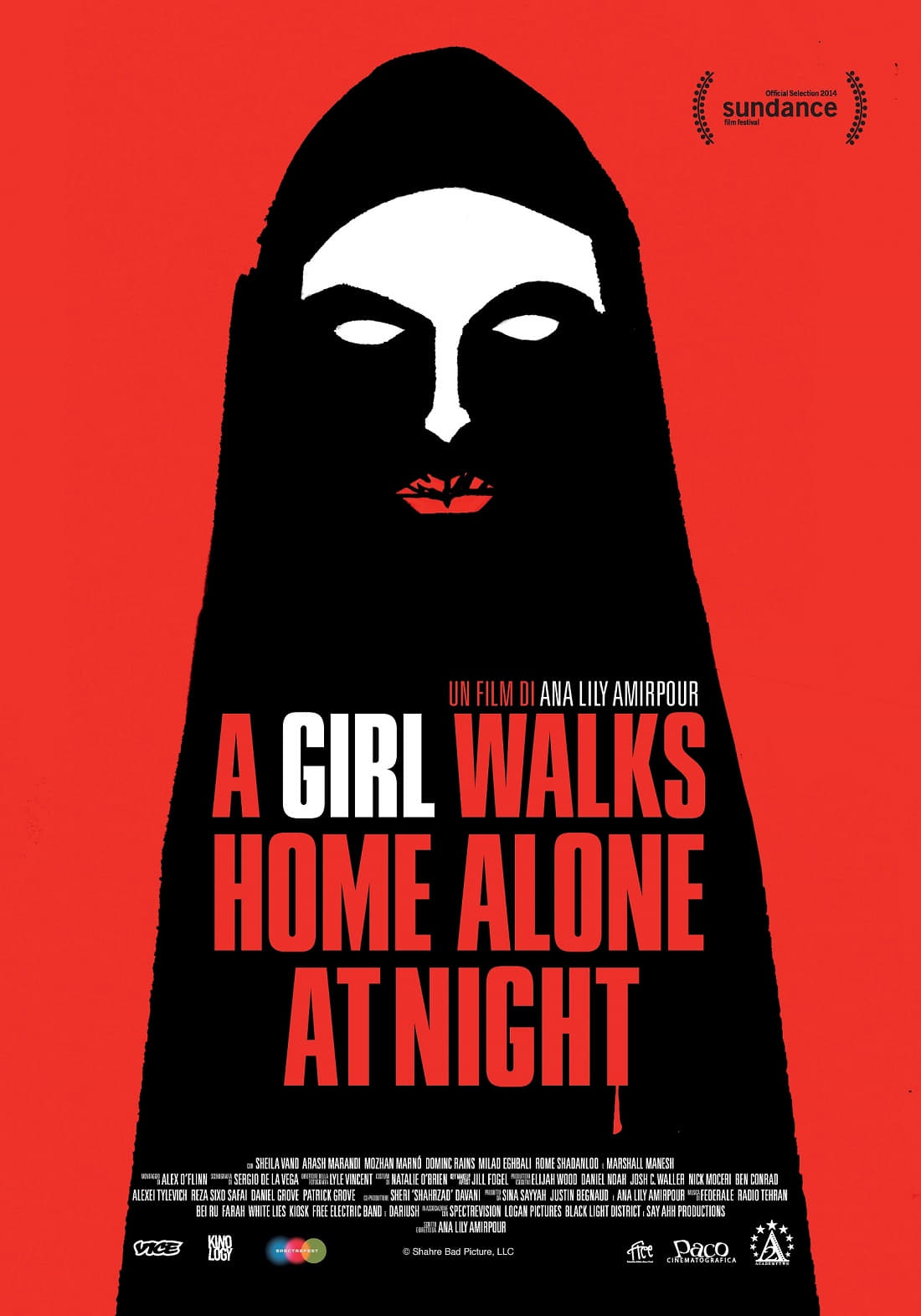
A Girl Walks Home Alone at Night (2014) - I'm bad. I've done bad things.


It's the fifth Letterboxd Season Challenge!  Theme eight, part two - a foreign horror film!

(Chosen by Jackie!)

(Well alright, A Girl Walks Home Alone at Night is an American production directed by a British-born Iranian-American, featuring Iranian-American actors, with dialogue in Farsi delivered in California locations.  It's not any more foreign in the traditional sense than would be any other film by a US citizen embracing their ancestry with others of a similar background.  Mistakes made, we press on regardless.)

In A Girl Walks Home Alone at Night, director Ana Lily Amirpour has crafted the ideal scene kid movie.  Though this is easily construed as a dismissive insult, I mean it as the most earnest compliment I can pay her film.  After all, we've a picture whose centerpiece revolves around two characters dressed in all black, both evoking vampiric motifs in their own way, one gently moving towards the other across an expansive widescreen with slowed-down disco ball lights rotating across the wall as the other turns into his embrace, contemplates his neck, and sinks into his arms to listen to his heartbeat instead.  All in beautiful black-and-white, all scored to "Death" by White Lies, grinding out across the screen over five whole minutes.  There's a weird techno-scored seduction scene that climaxes with a scummy drug-dealer getting his finger chomped off and throat ripped open, a cross-dresser dancing with a balloon, a quiet, awkward ear-piercing scene set against the backdrop of an empty trainyard, and, most importantly, a skateboarding vampire dressed in a black chador and striped long-sleeve.  This is a film purpose made to appeal to teens and college students who fuck with Bauhaus and Have a Nice Life and black out their windows to better appreciate the effects of poorly-strung atmospheric lighting on the posters of bands who'll never come to their town but inspire gobs of gif-based appreciation posts and self-insert fanfiction on tumblr dot gov in the year of our lord two-thousand and fourteen.  I'm deeply envious towards anyone who saw this right when it came out and felt the full sledgehammer-to-the-chest impact of finally seeing all their predilections thrown onscreen in a glorious act of stylistic exercise - those folks got exactly what they always wanted in their scant two-decades on this dying Earth.  All power to 'em, no sarcasm meant whatsoever.

The film lives and dies (and all states between) on how much appeal you can find in a slow-moving mood piece with minimal concessions to narrative.  To my mind, it takes the visual celebration pretty damned far, producing numerous memorable moments with little more than its two main characters stood before simple small-town backdrops and allowed to awkwardly interact as Farsi tunes play on the soundtrack.  There IS some character work going down, with Arash struggling under the pressure of his father's heroin addiction and eventually dealing himself when their dealer is sucked dry, while the nameless girl displays a streak for enacting justice and intimidation on the people of Bad City, pines for an immaterial long-lost something, and draws closer and closer to Arash through the force of what I (stealing from Connie) can only describe as his big dumbass energy.  Act delineations are primarily marked by the girl making a kill that impacts Arash's life in some manner, and their relationship takes a strange turn when she gives him what he always thought he wanted, without the film's taking time to explore what this will mean for them in the future.  Beyond these elements, A Girl Walks Home Alone at Night is far, far more about the sublimity of the girl rolling down an empty suburban street with her chador billowing in the wind, or Arash, blasted out of his mind on ecstasy and dressed in a Dracula cape, hobbling to a sitting position while the girl tries to steady him and bring him back to her place.  Time beyond these two is mostly dedicated to the small supporting cast, who exist to either more clearly define aspects of the girl's mysterious personality through bracing encounters, or do wrong so she can punctuate the moment with a swift bite to the neck, again through scenes better defined by their stark imagery than writing or acting.

Normally, I'm in favor beyond belief of works that presume the eyeline's slow journey from exposed neck to nestled beating heart are interesting in and of themselves, and turn out absolutely correct.  Here, however, I think Amirpour's decision to leave a skeleton narrative at the center results in... not exactly a poorer film, but rather one I can't help see as fallen short of its potential.  If it were exclusively a mood piece, following the camera's bliss and leaving interpretation of Arash and the girl's lives entirely to the audience, I'd find the film far more intriguing in a good way.  As filmed, there exist components like the girl savagely drinking from an unconscious homeless man, which indicates the presence of a basal need to feed beyond her active, motivated choice in targets, or the unmistakable contrast in how Saeed the dealer seductively dances towards the girl before his death and Arash's careful move to embrace her later on, which raises the question of, "Why him, exactly?" when coupled with the first point.  We see the girl express kinship with Atti the prostitute along the dimension of lost dreams and forgotten remembrances, and something in Sheila Vand's performance communicates a bottomless sadness, but there are no guideposts, no indications Amirpour means us to travel these lines of thought with intent or direction.  There's a potentially fascinating study about why Arash is the one to bring the girl beyond her situation, or how the girl's interactions with Arash liberate him whilst also crippling what seemed a potential future on his own two feet, or else some treatise on her vampiric nature reflecting or rejecting views of women in Iranian society, whether you choose to construe it as parasitic or liberating, and what that might mean for her as a person.

The film, essentially, has its toes dipped into the pool of conventional narrative just deep enough to intrigue me, and a few moments where it lowers a whole foot in and reveals great potential for these gorgeous images to become so much more in the ripples it creates; yet its dedication to being as much a visually-driven, story-free experience as possible means it never takes the full plunge and explores that which it teases to the fullest.  Perhaps I'm being a touch stupid here, asking a deliberately ambiguous film to flesh out what it only means to tease, to elaborate where silence is the intent.  In my defense, my own aesthetic concerns almost always lie with purity of form: while a work may eschew storytelling conventions and be for the sake of some ideal towards beauty or horror or coolness, if it chooses to keep a minimal story and even develop this story to some degree, I'm going to want either the story's removal or a greater cohesion between idea and image.  Blending the two often leads to feeling a weaker story, and images that would hit more potently entirely on their own or in active cooperation with an idea.  Applied here, I understand Amirpour's intent, I really do, but she has tantalized me with the possibility of seeing this picture play out with her thoughts and feelings guiding and interacting with my own, giving me insight into the specifics she's teased.  To not get these is consistent with her aims as director, and yet I cannot shake the notion of her film improving if I knew her perspective on some of these more interesting ideas beyond, "It's up to you."

That which is ambiguous about A Girl Walks Home Alone at Night would entice me to think on it as a vagary all the more if it were purely sound and vision instead of neglected narrative, basically.  Flipwise, sacrificing some of the ambiguity for specificity would work wonders in my assessment.  Again, I'm probably being stupid and unappreciative here, but I like what I like for the reasons I like it, and find it hard to stop thinking this film better if aesthetically pushed further one way or the other.  Those scenes that work still work like all hell regardless of my artistic preferences towards storytelling - I've been replaying the "Death" scene in my head all day, it's so powerful a moment.  Watch beyond the form-based hang-ups of someone who thinks Danger! Diabolik the ideal comic book movie, and you've nevertheless a splendent post-punk vampiric impression upon the brain, something unique and dark and beautiful, well-worth a watch and however many hours of debate it inspires, internal and external alike.  Shred on, you funky little vampire you.

3.5/5

Thursday, February 20, 2020

Ring (1998) - You better get some rest; I have a deadline.


It's the fifth Letterboxd Season Challenge!  Theme eight, part one - a foreign horror film!

(Chosen by me!)

I think it only fair to begin by noting how a proper discussion of Ring inevitably clashes against spoilers, spoilers everyone knows about though they be.  Ever since Hideo Nakata's adaptation of Kōji Suzuki's 1991 horror novel literalized the "frightened to death" aspect of the Ring Virus by transforming the moment of death from a simple hallucination-induced heart attack to vengeful ghost Sadako crawling from the well that served as her grave and out the victim's television to enact an abstracted killing blow, a pale, stringy-haired girl in white has been the franchise's defining image. Appropriately so, given it's an incredibly striking sight no matter the execution, an extension of the book's technology-as-conduit-for-supernatural-curse concept in a way friendly to continuous reinvention across the American remakes and numerous sequels in both Japan and the US during a time of rapid technological evolution, in a manner the original restriction to video tapes and phone calls couldn't hope to make interesting beyond changing the cursed tape's medium.  Thanks to Nakata's not-quite original and Gore Verbinski's The Ring making such an enormous splash in their respective markets, Sadako crawling from YOUR TV has become fodder for nightmares and jokes aplenty in the last twenty years.  You talk about Ring, you talk about the TV thing.

As such, talking about Ring by focusing on the film's bulk concerns across its runtime makes the lack of televised emergence conspicuous by its absence.  The journey undertaken by journalist and single mother Reiko Asakawa and her videographer ex-husband Ryūji Takayama across the second and third acts involves a great deal of level-headed investigative work into the origins of the cursed tape, with a mind towards breaking the curse by laying the ghost to rest.  There's absolutely no paranormal activity beyond the tape's evil aura until an hour's way in, which presents as psychic visions rather than hauntings, and Sadako's signature manifestation doesn't take place until the final ten minutes as a twist about how the protagonists were dead wrong as to her nature.  If I were to play coy with this and try to preserve the twist for everyone, it wouldn't work, because you all know what made Sadako iconic, and you'd figure out all my talk about plain Jane research and agonizing over retrieving the body of a wrongfully murdered woman was all mere prelude to a twist, simply by way of my not mentioning someone coming out a TV screen.  So we're just gonna note how the film's big famous moment can't function as a legit surprise anymore if you've extremely basic working knowledge of the culture, and move on to more fertile discussion.

Like I mention, Reiko's response to the cursed tape and her seven day deadline is more rational and intelligent than one might expect from a supernatural curse story.  There's an element of dogged pursual to her early movements, an undefined, restless need to see the cause behind her niece's sudden, inexplicable death days earlier, the kind've unknowing march towards doom you'd conjure when thinking of the paranormal intersecting with the mundane.  Once she's viewed the brief, surreal tape and been warned of her fate (no "Seven days..." whisper over the phone in this version, just the same eerie metallic scraping sounds from the tape), though, her next moves are all very sensible - contact someone she knows and can trust who has relevant experience studying and dissecting taped media, exercise her skills as a journalist, and start looking for a solution based on slowed-down viewings and cross-referencing.  A good chunk of the film passes with Reiko and Ryūji studying the tape frame-by-frame, seeking out clues and dissecting hidden meanings from the seemingly disconnected imagery, which gives the film this strange yet appealing atmosphere of extended repetition making the sights and sounds yet more disconcerting mixed with the reassurance of discovery and understanding.  Ring plays in large part like a serious-minded murder mystery, with the curse hanging overhead as a vague, barely-comprehended threat.

The horror, therefore, comes about through the increasing inadequacies of their method.  No matter how much Reiko extracts from the tape or how close she comes to understanding its origins and breaking the curse, it's not enough to prevent her young son from watching the tape late at night in a mid-movie twist, condemning him to the same fate without him ever knowing what he's done.  The work necessary to to unravel clues and discover new angles takes time, and on-screen captions remind us how quickly Reiko's clock is running down; it seems like no time at all between the roomy seven day starting point and our arrival at an all-too-close two.  Despite a rather blase attitude towards confirmation of psychic phenomena on both leads' part (one I suspect worked better in the book, where the protagonist's journalistic background had an element of past failed paranormal exposés), contact with various psychically burnt objects and persons as they get closer and closer to Sadako produces more overtly freaked-out reactions, and marks the characters' potential inability to handle the situation before them.  It gets a little bit clunky when the film uses overt flashes of the tape's imagery and sound to remind us how certain places, objects, and persons relate back to the clues rather than subtler interlacing, or when negative turns are accompanied by the otherwise quiet score going utterly manic on  the screechy strings, but in total effect the build rests on a solid foundation of exposing the limitations inherent to rational thinking when faced against the beyond.

When it comes time for the movie to climax, the twist enables it to do so twice in a row, with distinct approaches to the payoff.   In the first, Reiko and Ryūji's toilsome efforts to empty the abandoned well and retrieve Sadako's body may not entirely parse as to why the characters believe doing so will save their skins, but it turns on the great image of Reiko hauling heavy buckets over the course of many hours as her body grows weary and the sight of honeycombed crawlspace barriers facing the outside takes on a distinct menace, even knowing nothing's coming.  When she and Ryūji swap places and she's rooting around in the stagnant wellwater for the corpse, the shift to a damper, more claustrophobic environment continues the film's sense of undefined paranoia, and brings it to the head with the discovery of the corpse, oozing slime from its sockets like grateful tears as the seventh day fully passes and Reiko is saved... only for it all to come to bunk.  Just as the fake-out climax trades on an intensified version of the vaguely menacing feel of the preceding story with the payoff seemingly reward for such diligence under pressure, Sadako's sudden emergence stomps all over any sense of fairness or meaning to the film's events, killing Ryūji for reasons we cannot understand.  Once Reiko puts two and two together, and realizes it was not their hard work towards discovering Sadako's origins and laying her bones to rest that broke the curse, but rather the most innocuous, natural step she took that transferred it instead, the story attains  a wonderfully nasty bent.  There's a demand for cruelty from anyone who views the tape, a need to intentionally expose others and expect them to do the same in a never-ending cycle, and that's just that.  The relief of thinking those tested investigative convictions finally paid off, followed immediately by proof positive they're useless against real evil.

For its strengths, Ring does seem a touch lacking in a few places.  The gender-flipping of the protagonist from the book's Kazuyuki Asakawa to Reiko and the subsequent change of Ryūji from friend to divorced husband introduces the possibility for a more meaningful relationship dynamic between the two, one the film does not adequately explore outside a few brief moments.  It's more focused on the process of understanding and halting the curse than exploring the characters doing so in great depth, and so leaves them in a bit of an emotional limbo regarding one  another.  Something similar effects Reiko's relationship with her son, who's obviously very important to her yet drops from the film once he views the tape, to serve as little more than another reason to break the curse beyond Reiko dies.  These noted, the picture still goes plenty far on the journey to test how much a rational series of questions are worth under unusual and demanding circumstances, and the sheer meanness of its twist lands with a satisfactory thwack even when you know it's coming and spend the whole film waiting to see someone scramble out've an analogue set.  Much as later entries and online culture have diluted the special, unique fear of Sadako's emergence (coming out of a Jumbotron at scale is a natural evolution, but it is also extremely silly), Ring's dedication to earning that sigh of relief before gutpunching the wind from your lungs ensures its USP continues to demonstrate value as a scare worthy of the construction around it.

(I rather like how every other element of the tape has a concrete explanation, including the audio playing over the crawling figures, yet the crawling figures themselves remain unexplored and open to interpretation.  Adds to the creepiness and the sense of the investigation coming to naught.)

3.5/5

Wednesday, February 12, 2020

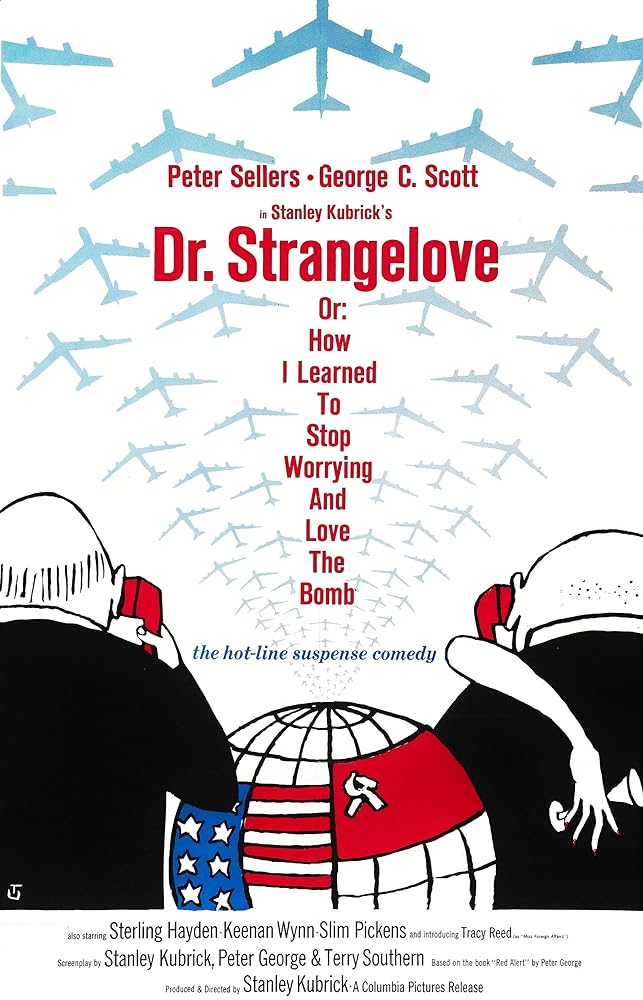
Dr Strangelove or: How I Learned to Stop Worrying and Love the Bomb - Nuclear Warhead. Handle With Care.


It's the fifth Letterboxd Season Challenge! Theme seven, part three- one of Spike Lee's essential films for aspiring directors!

(Chosen by John!)

Nothing written herein will be new or insightful. Without proper academic training into the act of film analysis, I cannot provide you a single word about Dr. Strangelove or: How I Learned to Stop Worrying and Love the Bomb any different than what a multitude of thousands have already said over these last fifty-five years. Not because Stanley Kubrick was some kind of inherent genius whose works are far too intricate for mere mortals to tackle, requiring a deftness of wordsmithery and cinematic insight beyond the ninety-ninth percentile before any decent work can take place - bout a year ago I watched and reviewed his Eyes Wide Shut during a different challenge, and managed a detailed piece I find satisfactory. Difference is, I watched Eyes Wide Shut for the first time then, without any preconceived notions or general knowledge of its general reception or common interpretations, a benefit of the film sitting outside the core Kubrick classics. Dr. Strangelove, by contrast, is a film I've watched in full multiple times since high school, regularly use as idle YouTube clip entertainment, read about from any new critic I discover who's covered it in any substantial detail, and love for all the reasons everyone else on the planet loves Dr. Strangelove. I know, you know, everyone knows the best lines, the ins and outs of what makes the performances tick and what Kubrick did to make George C Scott act Like That, all the little sexual innuendos, the Thing about how Kubrick insisted the table in the War Room be pool felt green despite the film's being shot in black and white. "You can't fight in here, this is the War Room!", "Precious bodily fluids," "He'll see the big board!", "Mutiny of preverts," Major Kong riding the bomb, "MEIN FUHRER, I CAN WALK!", all of it.

Still, I write, and write quite substantially on every film I watch for these challenges, so a lack of fresh insight shan't serve as any deterrent. In the name of maintaining forward momentum, let me simply state the observation I mean to work and expound upon in the bulk of this review: Dr. Strangelove is as cacklingly funny as it is because Stanley Kubrick did not make a comedy.

To clarify, he certainly conceived the scenario and directed his actors in the manner of a comedy. One can hardly look at George C Scott masticating on hunks of snack food between flustered, easily-excited outbursts and think his General Turgidson anything other than an immensely funny figure. Same goes for all three of Peter Sellers' characters, be they Group Captain Mandrake fighting back an emotional breakdown as he tries to calm his commanding officer's psychosis, President Muffkin ineffectually managing his staff and generals with ill-projected strength, or Doctor Strangelove gleefully describing a eugenics program to survive the end of the world while his Nazi hand flies into salutations. Beyond this core group, other characters aren't quite so wacky of immediately humorous, but Sterling Hayden's Jack D. Ripper and Keenan Wynn's Colonel Bat Guano are both such tightly-wound, deathly serious military men that their self-important speeches can't be anything save giggle-worthy, in isolation or in contrast to Mandrake's flustered replies. Clowns in positions of power all, even Slim Pickins, whose Major Kong is perhaps the mildest of the bunch despite his natural and entirely out-of-place Texas drawl, and still gets the film's bleakest, best punchline all to his lonesome.

Through Major Kong and his crew aboard the 843rd Bomb Wing, we can understand what I mean by Kubrick not making a comedy. Their scenes contain jokes same as the rest of the film, primarily quick lines from Slim and absurd background details, which render the plane a locker room hangout much as a militaristic instrument of death, but their composition and placement in the film do everything in their power to dissuade any impression you're watching a comedy. The majority of production design choices reflect Kubrick's typical eye for detail in a set based on then-top secret military hardware, the camera prefers views which emphasize the cramped space and the movements of dials and switches and blinking lights, the cutting shows us every man engaged in his obscure function as the crew flies onward to their final destination. Any time we jump to join the 843rd, the soundtrack strikes up a drum-based rendition of When Johnny Comes Marching Home, and the action plays out like any other military movie wherein a contingent of our good ol' boys are out on a mission to save Democracy and Freedom, and nothin's gonna stop 'em. They'll follow orders to a T, endure heavy enemy fire, face setbacks that mean their inability to return home safely, and still they fly on, fearless and undaunted! That they are flying a mission whose success means an end to all living things, one which sees every other character is tying themselves into hysterical knots in a desperate attempt to halt it, matters not one whit to how things play out.

Cross your eyes and ignore Slim Pickins and the pin-up girls on the safe containing classified orders, and there's really nothing funny about this stretch of Dr. Strangelove. Even once Mandrake and Ripper's side of affairs has concluded, and Muffkin and Turgidson and Strangelove are approaching their peak, the 843rd is still playing out its war game completely stonefaced, still emphasizing the technical work necessary to pull a last-ditch bombing run, still marching to its heroic tune. Right up until the bomb drops with Major Kong astride its girth, and the film corpses hard as it possibly can with him yippin' and hootin' and waving his hat all the way down to smack dab in the middle of Mother Russia with the world's biggest atomic penis between his legs... and then silence.

Such an effect applies across the entirety of Dr. Strangelove. Across every technical aspect, across set design, lighting, camerawork, sound editing, shot-to-shot cuts, Kubrick composes like he did and would any other film across his career, as a director driven to get everything just so and generate an atmosphere of cold, carefully manipulated sterility. The War Room is this monstrously huge, mostly empty space, with dozens of men all cramped around a comparatively little table with hot lights creating massive dark spaces all around and an imposing map of the world flashing ominous updates overhead. Ripper's office is laid out and decorated according to the sensibilities of a respectable military man, and gradually gets completely trashed by gunfire until it's an almost impressionistic space with slatted lights and obscure destruction strewn all around. Spaces we glimpse with comparative briefness still communicate a fussy, uncomfortable environment, such as the too open operating centers and offices Mandrake calls his own until he's stuffed into a cramped telephone booth, or the confusing mess of mirrors in General Turgidson's bedroom, which make it impossible to tell how he'll enter the frame until he does. Our view into these spaces consists of extremely long takes of two characters in close conversation, low close-up angles to emphasize projected strength, and more heavily cut sequences designed to show how stressed and uncertain all parties involved feel at any given moment. It looks and feels for all the world like the kind of military thriller that gets your teeth clenched til they feel like shattering, scootching forward to the edge of your seat desperate to know if they'll make it or not.

Except the subjects in the midst of this clockwork contraption of a tension machine are a group of sexually stunted, immature, undisciplined men who boggle for the camera and say patently ridiculous things in patently ridiculous ways, and make it beyond clear their petulance and desire to feel just a little bigger rules above anything else. I can only think of two instances in which the film is shot to explicitly laugh alongside the audience - when Kong rides the bomb, of course, and when Bat Guano gets a nice close-up of the Coca-Cola company squirting their product in his face. Beyond these two moneyshots, Kubrick does not once deviate from his thriller sensibilities. The script takes the plot seriously and makes damned well sure we know its every mechanism, the camera glares on like we can gleam some greater meaning from seeing these very important men in crisis, the editing holds and holds and holds til we can bear it no more, and then holds off the next cut just a bit longer for good measure... and George C Scott is in center frame, imitating an airplane and getting hopping excited about his boys dropping a nuke on the Ruskies to trigger a doomsday device. Or Sterling Hayden speechifying about how the commies are gonna fluoridate children's ice cream to an extremely uncomfortable Peter Sellers, or Sellers arguing with an unseen Russian premier like an old married couple, or any number of other silly things that completely destroy your faith in the chain of command. Completely unoriginal, argued to death argument here, but the contrast of the most handsomely mounted political thriller you ever done seen, and Peter Sellers talking up breeding caverns and wrestling an evil hand while Scott muses about megadeaths like a little boy in an old lech's body leaves you only the choice to either cry and commit suicide at the state of the world, or laugh at the same.

Even moreso than concerned Terrence Malick and Days of Heaven, I cannot recommend aspiring filmmakers try and emulate Stanley Kubrick's actual techniques. Genius and detail-oriented though he was, his work and writings about it clearly evidence a man who frequently demanded excellence beyond reasonable expectations from all around him, obsessed over things that didn't matter, and actively manipulated his actors instead of working with them if it suited the film. His methods produced some of the greatest films of all time, but I'd not think anyone who wants to work beyond a single project should try and do as he did. Rather, for the purpose of this challenge theme, I say we take Dr. Strangelove as a lesson in the power of contrasts - how complete and total dedication to a contrary tone with your actual, intended vibe peeking through juuuuuuust enough to recolor everything around it can pay massive dividends. The moments when the film breaks down and laughs alongside its audience are exceedingly rare, but its big break represents one of the most iconic images of Kubrick's notably iconographic career, and certainly the funniest of the bunch, so, y'know. Probably worth a study there.

(I meant to put my personal favorite moment from the film as a final tag here. I'm not doing so because I just can't choose one. It's either "HAS HE GOT A CHANCE? HELL YEAH HE....!", "Well, he went and did a silly thing..." or, "Our source was the New York Times.")

5/5