Thursday, November 7, 2019

Day One of the Loft Film Festival - Temblores (2019) and I Was At Home, But... (2019)

The story of Pablo, a middle-aged Guatemalan man who returns to his wealthy family after being outed as gay, Temblores is a story all-too familiar to millions the world over.  His family as a whole cuts him off and casts him out, his wife takes the kids and uses her money and influence to screw with him legally out of anger, his children have little comprehension of what's happened to their father beyond a general sense he's "bad" now, his lover tries to encourage him to leave it all behind and live with their newfound happiness, despite how much life Pablo left behind.  He is introduced as a man robbed of all agency, hiding beneath a blanket and fleeing the camera's eye for significant stretches of the introductory sequence, and when he finally does take action to ensure his wife and children are OK in the wake of a minor earthquake, his perfectly routine, loving actions are construed as sinister.  There's adherence to all the standard forced gay outing stories here, flavored by the particulars of its Central American setting and Pablo's several decades and greater life experience over most protagonists of his stripe.  Were I to simply describe its events, you might think it unremarkable.

The structure and framing, however, make it so.  Director Jayro Bustamante takes a broad look at Pablo's family and social circle, showing us how every member has their own concerns about some idea of Pablo they've built in their head since learning of his sexuality, and taking us through the intensification of their misguided worldviews as we see Pablo making little to no progress at all.  He is frustrated at every turn by someone deciding his fate for him, people he loves and expects to love him back unconditionally, people who instead get him fired and place restraining orders on his head and speak to him like a monster wearing the skin of their son.  That ineffectuality from the start wanes as he tries to assert himself over the world, yet it never leaves as each new effort is met by higher and higher barriers.  The really damning thing is in how spending so much time with his family in segmented little chunks throughout the film, and contrasting it against Pablo's inability to make is voice heard, is seeing how his consistent inability to meet any of their standards of the demon they see leads to strife into family.  Individuals begin drawing factions consisting of them and them alone, and turning on the other family members for being the REAL reason Pablo turned into this monster.  YOU didn't raise him right.  YOU weren't adequate in bed.  YOU didn't keep a close enough watch.  And all this over a man who loves another man.

It is not a happy piece in the slightest.  I feel compelled to warn anyone checking it for themselves in the future, Pablo succumbs.  Quite contrary to the bright spots throughout where it seems he may finally raise his voice loud enough to make a difference in his own life, the collective battering from those he loves eventually breaks him to the point where he acquiesses to the local church's care, and goes through conversion therapy.  Some of the images early on in this late sequence feel a little detached from Temblores' otherwise somber tone, hitting at "They're trying to make them not gay, but it's actually SUPER gay" visual jokes straight from the But I'm A Cheerleader playbook, but the breakneck descent into destroying their self-identity, physically exhausting, and even sterilizing the men like mere animals really underscores how the behaviors exhibited by Pablo's family are encouraged and reinforced and brought to logical conclusion by a powerful religious entity in the community.  Images of the family as a cohesive unit recur at the end, but we've seen far too much to think it natural.  This is unity by way of harassment, denial, and hatred masquerading as love.  The final look Juan Pablo Olyslager gives the camera, and what he finds behind that last cut, is a real gutpunch of broken eyes locking your own, and simply questioning, "Why?"

Regardless of how familiar Temblores feels at times, it is full of long, withering moments like this, and as a whole they serve as excellent reminder of how even works lesser than this, works that embrace every tired, worn-out cliche of tragic queer narratives, are worth telling as a reminder of this all-too-common story.  The real damage done the world over is too great  to stop regaling just because so many others have done so.

4.5/5
***
Ich war zuhause, aber (2019)
You go by the press copies for Angela Schanelec's new release I Was At Home, But..., you get the impression that the reappearance of Astrid's son Phillip after a week-long absence is an event of grand importance.  The framing of the film's opening flatters such an impression: he is preceded by an opening of a fox hunting a rabbit while an indifferent donkey watches, his arrival establishes the film's tendency towards exceptionally long, lingering shots, and Maren Eggert acts the moment of reunion with expected shock and motherly tears of relief.  The full text of the film, however, does not quite support the notion.  Aside from an early sequence of Astrid trying to dryclean his jacket, her son's vanishing does not play into proceedings again.  Astrid's main stressors come from a new bicycle she isn't fully satisfied with, an unnamed worry over how her children are treated at school/the hospital, the comings and goings of a suitor to replace her absent husband, and how goddamned annoying her kids can be on top of it all.  The thought that this week-long period in which her son was missing was more slightly out of routine but still expected, rather than remarkable starts to worm its way into your head.

After all, Astrid's actions and perspective reflect perfectly onto the film's style: hollow and listless, and unwilling to remain with a single topic long even as she has to spend ages at a time with any one subject.  She's over-eager to ditch her new bike after badly modifying it and potentially introducing an error herself, even if the old man with a synthetic voice box who sold it to her is more than happy to make the necessary repairs for no extra cost.  She wanders through the routine of her daily life, speaking in little circles and accomplishing nothing before retiring for the night to lay in the local graveyard.  When she gets a free ear from a director friend, she spends a solid ten minutes rambling and ranting about her thoughts on the inherent dishonesty of the sick meeting the artist and how his whole film was a colossal failure in her eyes, because someone with so clear a view of reality meeting a liar to the bone is cruel beyond belief.  By the time we understand all this about her and see how she really treats her children when they're alone with her, screaming bloody murder over tiny accidents and leaving them by themselves so she can enjoy some Astrid time, it's not much of a shock.  Something obviously wounded her very, VERY deeply before the film's beginning, and hit has left her alternately aimless and lifeless, and full of cynical disdain for any and all inconveniences, of which her definition comprises everything.

Looking at the film's open, it's more the indifferent donkey staring out a barn window than the rabbit killed off-camera or the lively hunting dog that reflects the core character of I Was At Home, But...  Persons standing amidst a world full of possibility, and looking on it with a rotting mindset, thinking it all so terribly staid.  The film itself loses interest in Astrid towards the ending, shifting its focus near entirely to the group of schoolchildren who've been flatly reading snatches of Hamlet during in-between scenes as they act out Ophelia's death and the final battle without interruption.  Though I'm not sure this gels with the film's overall feel as well as it resonates with the themes on display, it makes, on retrospect, a powerful illustration of what Astrid's worldview does when left unchallenged, leaving words and lives of great passion and import reduced to mere robotic script for the children under her, because how else can they know the world?  The final shot of human characters underscores this, with her children in a vibrant wooded setting for once, with Phillip, crippled by the incident at the start, trudges through a stream with his sister on his back at an agonizingly slow pace.  One never does quite learn what happened or why Astrid is the way she is (though there are hints towards an absent father and denied opportunities due to the challenges of raising a family), but it doesn't quite matter.  Once such a perspective develops and grows to this extent, its origins cease to function as a motivator on its continued development, and you grow resigned and cold and bitter for its own sake.

I Was Home, But... makes a compelling depiction of depression and its resultant ennui onscreen, though I must admit the strong possibility I only think this way because I am inclined to think of any slow-moving, emotionally dead piece of media I like a reflection of depression.  There's likely something I'm missing from the growing focus on Shakespeare, and the animals at the start are vague enough that a dozen perspectives beyond my own could hold water.  I AM fairly confident on reading the bicycle scenes as a stand-in for Astrid trying to express frustration with her children that she cannot so plainly verbalize otherwise through a stand-in, though, and think they alongside the extended walk-and-talk with the film director worth the price of entry.

4/5

Wednesday, November 6, 2019

It's Film Fest Season in Southern Arizona! Borderland Film Fest and The Loft Film Festival!

So hey, guess who's got an opportunity to check out some film festivals in their area?  Lots and lots and lots of people all round the world, but also me!  Over the next week, I'll bring y'all coverage of Tucson's own Loft Cinema as they run their tenth annual film festival, featuring specially curated films from all across the festival circuit!  In specific, I'll be running reviews of the eight films in competition CICAE Award, and offering my take on which one seems best suited for a win.  If there's time left over between the communte, the watching of eight competing films across a week-long period, and providing the write-ups, I'll try to block out a little whiles to watch one or two other films featured.  Can't promise any coverage of Parasite, the Phantasm remaster, The Two Popes, or Son of the White Mare due to the lateness of the hour, or Varda By Agnes or White Snake due to scheduling conflicts, but The Chambermaid, The Cave, Words From a Bear, Cunningham, and And Then We Danced are all definite possibilities!

(And, y'know, anything I can't catch is going into my letterboxd watchlist, so who knows if they'll crop up on this space in the future or not.  S'possible!)

So, for full scheduling of the CICAE competitors, that's:

  • Thursday the 7th: Temblores and I Was Home, But
  • Friday the 8th: The Heart and Always In Season
  • Monday the 11th: The Condor and the Eagle
  • Tuesday the 12th: Advocate and Aga
  • Wednesday the 13th: Falls Around Her
Now, you may wonder, hey, that link up there shows plenty showings for stuff Saturday and Sunday.  Why aren't you doing any coverage then?  Well, hypothetical reader who missed the full title, Saturday and Sunday are the main events for the Nogales Borderland Film fest!  Simultaneously held in Nogales, Arizona and Nogales, Sonora, the events are currently a little sketchy in terms of timing, but I have every intention of showing up for the selections of films about and filmed in the county border area, and Saturday night's Film at the Fence, 2004's A Day Without A Mexican.  Incidentally, I attended last year's Film at the Fence, 1983's El Norte, and provided a brief write-up on the experience here.

It's gonna be quite a lot to take in, and I intend to run some semblance of my regular programming both her and on letterboxd in the meanwhile, so here's to hoping the whole endeavor doesn't kill me!  I'll see y'all on the flip-side with plenty of southwestern, Arizona-based film coverage!

Sunday, November 3, 2019

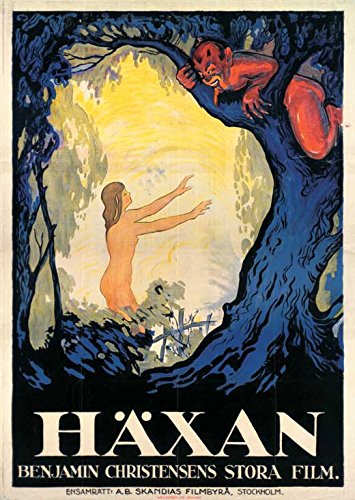
Häxan (1922) - We no longer sit in churches staring terrified at frescoes of devils.

Letterboxd Season Challenge 2019-2020!  Theme four, part one - a silent horror film!

(Chosen by me!)

There's some debate to be had over whether traditionally-defined progenitor of the documentary film, Nanook of the North, fully deserves the title.  After all, director Robert J Flaherty did not strive to capture the Inuit people as they lived at the time of production, but rather hired several actors of Inuit descent to play out the customs of their past like they constituted the entirety of Inuit culture.  Realities were ignored, narratives invented, details blurred, and overall the production is thought of as presenting a false impression of what "Eskimo" life was really like, based on American cultural assumptions of the day.  One does not come here to bury Flaherty and his entire historic footprint, though, regardless of how backwards his views and methods were, to the point of falsifying his star's name and cause of death two years after release to make his work seem more "authentic."  Much as Nanook of the North lacks true authenticity, one can still find the shape of things to come over the next century in its restagings - many of the practices on-screen were real Inuit traditions and skillsets, and in retrospect there's a certain truth to the falsehoods, if one useful for documenting the director's biases rather than the lives of those in frame.  It's far more docufiction than pure documentary, and its usefulness has shifted radically with the times, but a documentary it is all the same.

We encounter a similar issue of classification when discussing Benjamin Christensen's 1922 experiment, Häxan, retroactively subtitled Witchcraft Through the Ages for a 1968 American release.  On first blush, it seems very much in what we'd call the documentary mold, though perhaps closer to recorded lecture than anything traditionally filmic, what with the ongoing discussion of sources to be found in your playbill and the presence of a pointer guiding the eye through woodcarvings and mechanical depictions of hell.  The tone is academic, the focus on understanding how medieval scholars and priests understood the world to function.  Even when the camera shifts to presenting a filmed scene of a witch's hut in centuries past, the setting seems plausible, and the witch more an old, knowledgeable woman trusted by her younger fellows in the village as a source for miracle remedies with appropriately magical-sounding ingredients.  Shortly after this, however, Christensen's intertitle narration asserts that belief in the devil reached such heights as to make Satan a physical reality, and he pops up as Lucifer himself from behind a monk's bookstand.  We're off to the races, and won't make contact with more sensible reality for a good hour.

If Christensen's film veered into the fantastical and never returned, I'd feel no qualms about its classification.  The introduction is academic and informative, yes, but once you start watching witches fly through the night and kiss the devil's ass and eat stews of toads and unchristened children with the same eye of scholarly interest, you're more than likely exploiting safety and comfort communicated by the opening tone to scare the audience.  Let's all watch as Satan brings his faithful to a palace in the sky of wealth and delights they can never touch, tempts young maidens to wander nude through the night air from their window, and drive a convent of nuns to madness with the merest hint of his presence.  It's all realized with sets and costumes reminiscent of 15th century woodcarvings and manuscript doodles, and it's transgressive as hell for the time of release.  Just hunker on down for a bit of witchcraft-based horrors from the best a Swedish film studio's money could buy in the early 1920s.  Should be keen, yeah?

The issue becomes muddied when we consider how Häxan ends.  We return to reality for a brief consideration of torture devices and how we as a modern audience might react if forced to endure their infernal pains, dive back in for the aforementioned mad nuns passage, and then catch our heads for a final segment interrogating possible explanations for witchcraft in the past.  To Christensen's mind, much of the abnormal behavior cited as proof of allegiance to Satan can be explained as symptoms of hysteria in its various forms (or somatic symptom disorder, in the more up-to-date scientific vernacular).  Coupled with prejudiced and fearful attitudes towards anyone deemed a social outsider, or too temptuous to the faithful, or just plain not liked by a strong authority figure, a mental disorder could handily explain the vast majority of witch trials conducted by inquisitions across Europe over the centuries.  Witches, Christensen asserts, were never real, yet despite advancements in medical understanding of the mind and greater societal tolerance towards those with potentially frightening differences, the attitudes which fueled a fear of witches persist today.  After all, only the wealthy are afforded the full care of a fully-staffed clinic - the poor must endure and suffer in over-packed madhouses, and when you get down to it, what is forced, indefinite incarceration in an asylum but a more drawn-out form of burning at the stake?

Strong argument.  Resonant mindset.  Surprisingly comprehensive call for tolerance from something made nearly a whole century ago.  Applicable to discussions about how to handle mental illness in the modern day.  Damned strange case to make after indulging in images that treat witchcraft as real and immediate and vicarious as anything else in the picture.

It is here we encounter a difficulty in classifying Häxan, for it is possessed of a dual mindset.  In the one, witchcraft is as fake and ludicrous a notion as Earth at the center of a cosmos presided over by a physically tangible God, and has no place in modern times save as a specter of ills past; in the other, witchcraft is decidedly more solid and effective a cinematic reality than the unmoving images from manuscripts centuries old, and the very director calling magic and the supernatural a sham is free to run about in full devil costume, churning his butter and waggling his tongue into the camera all the way.  Christensen never acknowledges the disparity, casually showing an old woman driven to false confession by continued torture before presenting her wild inventions in a manner that suggests genuine vicarity.  From the way the film moves across subject to subject, witchcraft's existence only really depends on the needs of the moment.  The film is open to presenting beliefs born of ignorance and prejudice as just that, or presenting them like Flaherty would his Inuit subjects hunting with handheld harpoons, as the only conceivable reality.  There exists contradiction between these two modes, and it would seem to strain even the definition of docufiction to include Häxan amongst its ranks.

To solve this, I suggest we consider the film's roughly middle portion, the only passage to last across more than one of its seven segmented Parts.  The depiction of a witch trial from initial accusation to death of the last far-flung victim is as much fiction merely informed by historical research as anything else in the film, and its characters more indebted to the traditions of theatrical melodrama than a modern understanding of historical reenactment (or at least good historical reenactment - looking your way A&E), but it also makes the strongest argument for treating Häxan as a documentary of its own sort.  Amidst scenes chronicling false confessions as if they were undeniable truths, we find the inquisitors engaged in psychological torment of their charges better suited to chilling the blood than any naked moonlit dance or newborn sacrifice, or even the suggestions of instruments at torture in later sections.  They play false friend to trick a woman into confessing she may have heard of how to perform one tiny, inconsequential piece of magic at some point in her life; they drag a woman's family before her to guilt her over how they'll suffer when she's gone; they find inconsistencies in the stories as told and feel a tiny pang of empathy for those they torment, and go to their leader for an explanation of how this is REALLY the result of some magic spell or bewitchment upon their hearts.  We find, in short, the true monsters of the movie, the men who must hold directly contradictory views in their minds to assuage their guilt and carry out the destruction of several entire families to burn out witches they know probably do not exist, and yet must exist, because why else are they bringing about such suffering in the name of God?

Consider again how Christensen asserts these attitudes persist to the modern day.  We, like the priests and scholars of 15th century Europe, consider ourselves learned, better informed about the mysteries of the universe and the depths of the human mind than any before our time.  And like the priests, he posits our advancements do not preclude cruelty towards the disadvantaged, the oppressed, and the othered.  In order for this to be so, a similar form of doublethink must occur in our time, be it willful ignorance of the world's sufferings, or a distant self-justification that those who suffer in such a manner must deserve it in some way, or a personal self-justification of our own righteousness when we engage in such.  Per Christensen, a belief in witchcraft and the devil must persist to the present, in its own insidious way.  No longer in the literalized form of thinking suspicious persons as literally in league with the devil (for most of us), but in attitudes that say we are enlightened to the ways of the world and the plight of our fellows, yet allows them to burn by no fault of their own all the same.  This film is, in effect, a documentary of a mindset.

For Christensen's film to reflect this doublethink in its construction is, I should think, for Christensen to acknowledge his own shortcomings as an academic and documentarian addressing this issue.  On one level, to discuss witchcraft and the inquisitions directed at witches, one must treat the fantastical and real as matters of equal interest, particularly in a visual medium like film, where simply saying "This is what they believed witches did" is not the most effective means of communicating the idea.  On another, talking about the intellectual and moral inferiority of persons past invites one to derision by future viewers and critics, as Christensen's use of the medical term hysteria does in a time when said word has passed into common vernacular as a derogatory phrase.  Playing into the necessarily contradictory views in this manner insulates Häxan to an extent, ensures its ideas can remain evergreen.  After all, my notions about what constitutes a progressive, informed viewpoint will one day too seem hopelessly ignorant and backwards.  There are doubtlessly areas in my life where I turn a blind eye to suffering and justify it as necessary and right, as there are for all.  I, too, believe in witches after a fashion - it's just the way these things go.

We'd all do well to try and remove the bewitching of our own doing, treat those in our own lives better, and call for our governments to do the same, especially where the mentally ill are concerned.

4.5/5

Wednesday, October 30, 2019

Over the Garden Wall (2014) - If dreams can't come true, then why not pretend?


Full offense meant towards every other special we watched for this marathon, but Over the Garden Wall captures the spirit of Halloween far better than any of them.  There's a tendency to look on the holiday as merely its surface-level elements, with the candy and the dressing up and the pumpkins and the gentle attempts at spookery.  In fairness to them and many other Halloween specials, there's nothing inherently wrong with celebrating Halloween as a time of haunts and creeps at play and little else - it's wonderful we still reserve any amount of time for reveling in mischief and fear, and some truly great art has come from fully embracing the modern aesthetic, like The Nightmare Before Christmas.  Halloween isn't just the modern practices and signifiers, though.  There's a salient connection to an older way of life, an older system of beliefs, a link to times when it was believed certain nights blurred the line between this world and the other.  Viewed through a modern context, you've not only a blurring between reality and supernatural, but also modern customs and bygone means of celebration.  We've gone through quite a few iterations of how to observe Halloween and the sense of controlled fear in general, and this holiday marks a good time to revive them more than most.

Amongst its multitude of virtues, Over the Garden Wall's greatest strength as a piece of Halloween media rests on just how many autumnal and horror-adjacent ideas it evokes to pitched-perfection across a mere ten quarter-hour installments.  Episodes can vary in focus from exploring the confines of a seemingly infinite manor seeking out a ghost in the spirit of old dark house movies, gentle schoolhouse dramas mixed with Scooby-Doo and Benny Hill sensibilities, harvest festivals directly informed by the aesthetic of gay nineties fall-themed postcards, or 80s teen dramedies.  Quite a few episodes even make room for direct homages to Fleischer's creepier Betty Boop/Cab Calloway cartoons  There's dozens of artistic influences on display throughout the series, all unified by a gentle modernized take on the classic fairy tale set-up of children wandering the woods seeking a way home.  As all-encompassing revelry in imagery and tropes of Halloweens and harvests past as you could want, it ensures there's a special, particularly resonant moment for all audiences without sacrificing its own particular feel.  Chasing a predesignated, boxed-in style to slap over everything simply can't achieve the same warm, cozy effect of merging multiple sources to create a vibe all your own.

It's good the series' artistic style is so dedicated to forging its own path whilst wearing its influences on its sleeve, for doing so is ideally reflective of the show's overall storytelling goals.  I don't speak casually when I call this a modernized fairy tale; it's way more than just the sense of light whimsy meant by that evocation.  The Unknown as a setting is reflective of both Wirt's self-serious teenaged poetic mythologizing and Greg's younger freeform train of thought approach to the world, a dark, never-ending wood where practically anything can and will happen, and children must watch where they step at every turn lest they stumble into a strange inhabitant.  It's every bit the perfect stretch of land in which to abandon a Hansel and Gretel or Little Red Riding Hood, and leave them to learn a harsh lesson about never straying from the path, or always listening to their elders, or never trusting strangers.  Over the Garden Wall avoids such overt moralizing - while dangers do lurk betwixt the edelwoods and deceptive forces do crouch in the dark, the vast majority of residents and travelers are merely people living their lives, and trusting supposedly obvious warning signs based on initial appearances often leads to more trouble than being kind and adaptive would otherwise.  There's little need for Wirt and Greg to listen to a powerful authority figure or suffer greatly for their transgressions to learn their lessons.  What they bring into the woods is enough to see them through, if they know how to use it.

A firm rejection of regressive, conservative views on childrearing will always earn applause from me, but what makes this show so special is how beautifully structured it is towards the goal of communicating that idea.  How it will dedicate entire episodes to the old "you meet in an inn" set-up to explore the pros and cons of identifying oneself by a societal role, or sly repeat concepts from previous episodes in a new context to throw the viewer off-guard and foreshadow the characters' descent into despair when the same outcome produces vastly different results.  How dedicated it is to finding a minute or two for development and honest conversation amidst whatever ten-minute slice of fun we're currently engaged in, often with direct relation to the game's unfolding.  How gentle and consistent it is in revealing non-hostility of frightening entities in order to reinforce the sense of confidently conducting yourself and looking beyond first impressions for kindness rather than deception.  How when it does reveal the genuine, immediate danger in the forest, it takes the form of unilateral, unflexible thinking patterns, mixes that with the original conception of a fairy for a fresh take on Der Erlkönig, and then simultaneously freshens it further and ties it closer to healthier old sensibilities by making the secret to victory acceptance of a different, adaptable worldview.  On all levels I can conceive, Over the Garden Wall tries and succeeds at evoking the old to create and enliven the new, and it does all this with the added benefit of gorgeous art, charming characters, and alternately humorous and genuinely frightening moments.

This is what the children need.  Fairy tales for the new age.  Decidedly modern sensibilities used to explore and understand and grow beyond past attitudes.  Something crafted with the total spirit of Halloween in mind, something that can understand the original impulses behind its celebration and find ways of thematically educating them about its nature and assuaging their own self-doubts, and finding room for new forms of surface-level fun besides.  Over the Garden Wall is the kind of program which can play with a cat in a great big jack-o-lantern themed maypole raising the dead to new life in pumpkin costumes for a grand harvest dance amidst pastoral New English fields of wheat, and still make time for incorporating candy and costumes into its aesthetic.  It's the complete package for Halloween viewing, and a lovely watch with friends.  Odds are you've already seen it and don't need my glowing praise atop the thousands of other write-ups online, but I'm still thankful for the chance to watch it as the capper to this series.

Hey, thanks!  It works for the November holiday too!

5/5

Saturday, October 26, 2019

Van Gogh (1991) - He was my friend.


Letterboxd Season Challenge 2019-2020!  Theme three, part three - a film chosen by Cahiers du Cinéma as one of the 100 essential to an ideal library!

(Chosen by John!)

A part of me is screaming there's no way I can do this film justice.  It's a biopic about Vincent Van Gogh, one of the great European masters, a figure whose work and legacy are a tangled intersection of mental illness, impressionism, romanticism, and the nature of art itself.  It's a film by Maurice Pialat, one of France's most challenging directors, a man whose preference for simplicity and a sense of the real betrays an eye for complex beauty, inner turmoil, and a kind of fantastical attitude towards reality.  It has been hailed as a masterwork both in the context of art about Van Gogh (of which I have seen very little), and Pialat's filmography (of which I have seen none.)  "You've been fraying with all these reviews you've been writing lately," I say to myself.  "You've taken on far too much to do even a simple film justice, much less something with mountains of required reading attached like this picture.  You should just shut up and admit you won't get anything good out of this, because anything you say will be shallow and ill-informed and of no use to anyone who wants to read about Van Gogh."

Perhaps.  I confess to struggling with sitting still during the two hour, forty minute runtime of Van Gogh, and to great difficulty focusing when trying to read up on relevant materials to spruce my knowledgebase and say something a little more interesting.  I certainly won't match the insight in a Sense of Cinema article with this write-up.  However, if ever there were a film where my lack of insight seemed a good match to its contents, it would be Van Gogh.  Even with as little as I know, I can tell at a glance how Pialat chose a fundamentally different approach to Van Gogh from the popular conception, and how this approach is one friendly to simpler perspectives, much as it also invites deeper digging.

You and I know the image of Vincent Van Gogh.  Lust for Life draws on the popular conception of a mad artist wracked by fits of insanity amidst landscapes inspired by his vibrant paintings.  Don McLean eulogized him as a misunderstood lover who saw beauty where others found none.  Doctor Who posited there was something inherently different and special about the way he saw the world, which drove both his unique painterly style and the mental problems that led to his early suicide.  Most recently, Dorota Kobiela and Hugh Welchman spent nine years painstakingly replicating Van Gogh's brushstrokes to animate a biopic about his life in the direct form of his paintings in Loving Vincent.  In a generalized sense, he's shorthand for a misunderstood genius, someone given to wild displays of poor physical and mental health, a longer never recognized until after he was gone too soon, a man completely defined by his highest highs and lowest lows.  Art seriously reckoning with his life and legacy will speculate, venerate, celebrate, agitate, and overall canonize the image of Vincent Van Gogh, Special Artist Who Saw The World Differently.  It seems to be practically the only way most folks know to discuss his life.

Pialat takes a different tact with Van Gogh.  Following Jacquest Dutronc as the artist during his final two months in Auvers-sur-Oise under the dubious care of Doctor Gachet, Van Gogh has gained note for how it eschews the paintings and the madness almost entirely.  Vincent paints plenty throughout the film, and his difficulties with gaining notice under his younger brother and only dealer Theo, but the works are always framed as the products of labor, afforded little more prominence in the frame or note as something special than anything else in his life.  Several of Vincent's most famous works are entirely absent, and others are glimpsed in the corner of but one single shot.  As to his struggles with mental illness, we see more than our share as the film pushes through its second and third acts, yet any impression that Vincent has severe troubles of the mind is confined to discussions of vague past difficulties and a repeating headache throughout the first.  Otherwise, he seems a personable enough man, one who has a tough time connecting with women and seems moodier than those around him, but hardly a tortured artist whose experiences here are ultimately prelude to a suicide in sixty days' time.  Some brief fiddling with a gun while discussing the topic and a reassurance to his brother that he's not suicidal are about all we get, and those two events are separated by a solid hour.

The most prominent facts about Vincent Van Gogh thus relegated to the margins, the central narrative and visual focus of Van Gogh thus becomes what other works might consider the margins.  Vincent taking idle walks amidst fields of wheat and olive trees, Vincent struggling with how sincere his brother and doctor are about their relationships, Vincent trying to romance Gachet's young daughter or else conversing with prostitutes, Vincent acting lively as can be at an outdoors party.  Whether any of this is remarkable on its own or not, I couldn't tell you - the images are certainly beautiful, the performances certainly painful, the conversations certainly intriguing, but we are talking about work in an anti-melodramatic mode, which I typically blanch at and find incredibly difficult to read.  The structure is admirable for the way it gradually introduces more of Van Gogh's unhealthy behavior until Dutronc is an emotionally unstable mess, hopping from peak to valley in the middle of otherwise ordinary conversation.  The imagery is all beautiful, drawing on motifs from Van Gogh's work without tackily trying to duplicate his famous paintings.  The silence between moments of revelry or conversation rings with power, and the tendency to compress important events to their beginning and ending with a quick cut tells us everything we need to know about how present the man himself is despite our own lengthy time at his side.

But again, I have little proper frame of reference for Pialat or Van Gogh's respective catalogs, and do not think myself capable of fully communicating this film's import or quality.  What I DO possess, is a long-running streak of adoring works of art that emphasize the simple fact of our existence, and while for most of Van Gogh I find its commitment to the margins of Vincent's life an intriguing if difficult to sit through experience in my current headspace, its conclusion and method of presenting his suicide grabs me most of all.  The way Pialat avoids implying any of the negative, draining events from the previous hour are THE central influence on Vincent's decision to shoot himself is a lovely touch on its own - there's a montage of people around town preparing for their day like nothing's wrong, Vincent included, which gets across how there's no poetry or grandiosity to a suicide, just a spur of the moment decision we don't get to see - but the drag through his prolonged death really makes it.  As was the case for much of the film, Vincent isn't on-camera for long stretches of his own dying, the camera instead following supporting cast and background characters as they concern themselves with the preparations and busywork of housing a dying man.  His actual passing takes place behind a cut, and we're afforded a single shot of people mourning before the film transitions to an extended sequence of life returning to normal.  The proprietor's wife gets more cameratime after busting her foot on an opening door than Vincent does as he slips away from a self-inflicted bullet wound.

This may seem cruel, and I could see how it could become undoubtedly so with a shorter, less personal film behind it.  With so much of Van Gogh focused on the living of daily life in an unremarkable way, though, I find this approach entirely appropriate.  In the grand scheme of things, there was nothing remarkable or important about Vincent Van Gogh if you follow him as a man like any other.  He rose, he worked, he spoke, he ate somewhat less than he should have, he fought, he loved, he dreamed, he died.  Never minding all the sensational, myth-ready forms his illness manifested and the incredible, universally-valued paintings, we find over this lengthy picture a man whose most vital, important facet was that he lived at all.  When he passes, others live on, touched by his presence depending on how close they were to him in life, but not defined by it as if they knew some great, immortal artist was gone too soon.  It seems small, and yet it is two-and-a-half hours plus of simply observing he was here, same as you or I.  There's kindness and empathy in not treating him as a great or a master or an all-time tragedy - his death as lowkey and personal as his life, and then the lives of others take over and the world moves on, as it would and will for all others.

I find it good and right to do this.  To afford the simplicity of following the day to day free from the constraints of legacy until their presence and influence over Van Gogh's life are impossible to ignore, and even then only affording them as much importance as necessary to communicate the idea before returning to form.  One becomes so concerned with understanding and communicating the grandiosity of what The Great Vincent Van Gogh or The Great Maurice Pialat DID, what they MEANT, what they LEFT US TO AGONIZE OVER LEST WE MISS SOME COSMIC MEANING, that one risks missing how they were just people in the end.  And in the beginning, and the middle, and all the parts in between.  The small stuff matters, even if so much of the small stuff over so much movie is difficult to watch through if you're not in the right mind for it, and while I know there's so much more complex analysis to perform with respect to Van Gogh and all it embodies, much as I wish I could engage in it right off the top of my head amidst this overstuffed schedule in a stressful time in my life, I think it satisfactory enough to note all this.  To say Van Gogh is a beautiful film about the need to appreciate the greats as average, unremarkable people under the right circumstances, how there's nothing wrong with understanding a life through its most ordinary moments, leaves me feeling fulfilled by the watching.

For the time, others can write nuanced essays about Van Gogh and Pialat.  I'm happy to say what I've said, think what I've thought, and put a pin here to return when I have better resources and a clearer head to do more.  If I never return, what I've mined from this source is still good enough for my money.

4/5

Friday, October 25, 2019

Halloweentown (1998) - See you in the afterlife!


Depending on how you contextualize the matter, the Disney Channel film Halloweentown is either a standard tween drama about asserting your independence with a thin layer of watered-down spooky imagery slathered on top, or a standard kitchen sink fantasy family romp with a thin layer of watered-down tween drama sprinkled about.  Neither characterization does the production any favors, implying nothing particularly special about the base story while making the flavoring sound unappealing and insufficient.  Although you'd have to press me fairly hard to get me confessing I feel any different than this, I think it about as fair to have a go at Halloweentown for what it is as I do for all the films highlighted in this marathon - which is to say, not fair in the slightest.  Why take the movie to task for trying to give kids a safe, enjoyable entrypoint into spoopy material and SLIGHTLY more complicated family dynamics than they'd be otherwise used to when its legacy as a nostalgic classic indicates it landed just right with its target audience?  There's more than plenty failures inherent to the film's construction to use as fuel for a nice coal-raking beyond its conception, after all!

I more than understand the limitations imposed on a project of this nature.  Child labor laws dictate children can't work outside certain hours, so location shoots need to take place during the day and night scenes can't take advantage of natural dark.  Filming permits are expensive, as are props and costumes, and the challenges of set dressing grow exponentially when trying to transform a real location.  Interiors, though less logistically challenging, still constitute a real expense, and the overall company bottom line will come out healthier if old sets are recycled with minimal changes.  Costumes and special effects eat into a budget like nobody's business; cheaper alternatives to the cutting edge and a lack of make-up or prosthetics on the leads make an acceptable cost cutting measure.  And we mustn't forget how all of this is done on a TV budget, with a TV production cycle, and a particular target date to hit due to the holiday theming of the picture.  Movies are stupid hard to make, and the people behind them deserve no grief for the multiple reasonable compromises necessary to turn in a project on time and in budget.

From an end-viewer's experience, though, it's still hard to lose the feeling of Halloweentown as a disappointing setting.  A magical world full of all the monsters and creatures and beings you associate with All Hallow's Eve, realized as a tiny town square with minimal set dressing beyond the big stone jack-o-lantern prop.  The interiors we visit could readily double for homes and ice cream parlors and saunas (???) in any Disney Channel production save the inhabitants, who wander about in costuming ranging from passable to obviously inflexible latex.  Exterior shots not only rarely leave the tight confines of the town square, they rarely leave one side of the street.  Everything about this wondrous fantasy land wherein main character Marnie Cromwell's dreams of becoming a witch feels tiny, dingy, and uninspired, hardly what you want from a children's film trying to sell the magic of a town where it's Halloween every day.  I put no blame on the crew or schedule masters for doing their best under doubtlessly cramped, underfunded circumstances, but I do put blame on director Duwayne Dunham for not allocating screen resources better.  When compared against the potential of the setting to capture the eye through the whole runtime, I hardly think the puppetry needed to animate a skeleton taxi driver for a handful of scenes a worthwhile choice.

Mark you, for much Halloweentown, I can only tell what the town looks like by squinting at the frame's margins.  For reasons I cannot comprehend, practically every dialogue sequence is shot in extreme close-up, with characters' faces completely dominating the picture.  Not a medium or wide in sight any time people are talking, regardless of whether the location or action around them would benefit from a slightly pulled-back lens.  It's as if the whole movie was shot with the camera parked inches from the actors' faces, which makes for quite the miracle when considering how even the youngest child actor only occasionally acknowledges its presence.  Staying so needlessly, uncomfortably close makes the already fairly charmless town feel even more drab and uninviting, because the unexciting image of not-so-great child actors badly emoting as they half-scream through their lines lingers in the brain far more readily than that of a supposedly wondrous setting.  At the very least, it's preferable to be pressed up against the kid characters' faces, seeing as they're not half so creepy as Robing Thomas' damn-near pedophilic Kalabar getting up in our business.  He's thankfully not in this much, though his scenery chewing delivery towards the end is also afforded no flattery by the overly close camera.

With regards to those kids, I could certainly do with less of them.  Not regarding the snarky, self-satisfied dialogue, something endemic to practically all family friendly children's media in the 90s.  Not regarding Kimberly J Brown's Marnie, who's only bland and uninteresting in the mold of pretty much all protagonists of this nature.  Certainly not with regards to Emily Roeske's Sophie, an actually endearing presence in the film and one I wish had more to do than repeat the same three lines of dialogue over and over again when the scene's not totally focused on her, even if it's just doing some more unique cute things.  With regards to Joey Zimmerman as Dylan, the smug, brainy, "rational" brat brother of the bunch.  Him being eight years my senior and fully grown nowadays, I feel no qualms in stating I absolutely cannot stand the kid - not the way he's written, not the way he's dressed, not the way he delivers his lines, not the immaturity he inspires in anyone who responds to him, not the basic conception of his character as a skeptic who has to actively call out everything around him as fake before adopting a forced cheery "everything's obviously a dream so I'll roll with it, you freak dream people" attitude, none of it.  He's a prominent presence throughout the whole film, getting at least one grating line per scene, and the screenplay's idea of allowing him development is to grant him magic powers and then immediately slide back into the same viewpoint as always.  The whole "believe in yourself and love your family and you can do anything" message is fair and fine for a film of this nature, but it stands on shaky ground when the person two inches to the left of the main character going through all this self-improvement journey stuff is talking smack at it every step of the way and seemingly learns nothing by the time the last frame fades.  He's awful, and I actively wish he wasn't in the movie, particularly because he reminds me of myself at his age, and I don't think any child needs exposure to that blither.

Halloweentown probably ain't worth all this, as I mentioned up top, much as it's plainly a cheapie attempt to cash in on Tim Burton providing Disney a marketable name and concept in The Nightmare Before Christmas.  It's a Disney Channel movie from two decades ago, fer chrissake.  All the stuff I've mentioned is bad, but not "all those paragraphs what I wrote up there" bad, and on the whole it's an inoffensive runaround without anything special to its name.  Fact of the matter is, there's Homestuck nonsense going today, I get nice and riled up by the thought of Andre Hustle continuing to desecrate the corpse of something that WAS special and meaningful to me, I need a punching bag which doesn't come with painful memories of past fights and undue emotional turmoil, and Halloweentown makes the perfect target.  So take that, you nothing of a Disney Channel movie.  Bear the brunt of my negative energy, so I might feel better while watching and analyzing Van Gogh tonight.

There are multiple elements at play here to indicate the separate dimension Halloweentown exists within is actually hell, and I don't feel kind enough to the film to think of alternate interpretations for any of them.  Benny the skeleton cab driver is slowly roasting for the sins he committed in life, and he probably deserves it.

2.5/5

Sunday, October 20, 2019

The Worst Witch (1986) - HAS ANYBODY SEEN MY TAMBOURINE?


(Warning: I have never read any of The Worst Witch books.  Everything I claim about them comes from a two-hour dive across wikis, fan communities, and Goodreads reviews after watching last night.  Please excuse any inaccuracies.)

I shan't categorically claim a book so simple and episodic as The Worst Witch has natural difficulties making the jump from page to screen - to my understanding, both later TV series based on the series have found greater success, which indicates Jill Murphy's tale of Mildred Hubble struggling through her first term at Miss Cackle's Academy for Young Witches has greater potential for live-action translation.  It is probably more accurate to claim a mixture of hewing so closely to the structure of a book with perhaps half-a-dozen major incidents and bringing the same to life on a fairly low budget does nobody any favors.  1986's The Worst Witch has to fill a scant seventy minutes (less counting opening and closing credits) with an even scanter handful of notable events, and call it a day.  You can handily do this in the pages of a book with barely 100 pages, large-print, and multiple full-page illustrations aimed for the sensibilities of first or second graders.  Imagination and empathy for the main character takes over quickly to fill in any gaps, and a "and then this happened, and then this, and then this, and then that," structure fits either the child who only reads one chapter at a time or the child who tears through the whole book in a single sitting.  A low-stakes, high-fun spin through the life of a girl who can't do anything right in a fantastical setting is a great idea for a young reader's book.

For a film... well, you can see the director and crew straining for ways to make it all work.  Some choices meet their mark by inventing clever little new incidents to serve as glue between the major incidents, such as the game of Terror Tag or a brief bit of comedy with the Headmistress' (I assume) Chicago-dwelling niece.  Nice, kid-friendly expansions on what you'd expect from the setting and story, as are the moments of conversation between the children during lull-periods.  At other, more crucial turns, though, the film opts to take major incidents like Mildred accidentally turning her rival into a pig, and draws them out with guff-laden dialogue for quite a long while, longer than I could imagine myself standing at an age more appropriate for relating to this story.  Elsewhere, attempts to appeal to an older audience fall completely flat, whether they be the multiple segments showing the evil witches plotting their dastardly scheme to little more effect than their sudden appearance towards the book's end, or recasting the stuffy, elderly Chief Magician as a vamping Tim Curry, whom literally every other member of the cast is in love with for some reason.  Anything with these two threads is padding of the highest order - and speaking of their padding...

At least one of the songs is tolerable.  I think it's more a problem with delivery on Growing Up Isn't Easy and Agatha's Song, as the singers are pretty shrill and off-pitch, and I could see myself going with their bouncy rhythm if they featured a better performer.  They still irritate the ears a touch, unfortunately.  As to Tim Curry, his song features some awful non-sequitur lines even for something aiming at silly, very basic rhymes, an awkward halting rhythm backed by badly tuned synths, and Tim Curry wavering back and forth with no indication he knows what he's doing.  And it is probably the best part of the special thanks to how hard Tim Curry goes for it on the vocals, coupled with Craig Price's off-the-wall editing and effects.  If there were an award for Most Editing, Price deserves it for his work on Anything Can Happen On Halloween every year all years.  It's a neck and neck battle between Tim Curry and Charlotte Rae for whose musical number is the most transparent time waster, but much as I love Tim Curry's and have the entire thing imprinted on my brain after discovering it on YouTube years ago, I have to hand him the title.  His goes on way longer and completely warps the film's tone to cram itself in there.

Much as decisions to expand the story with wheel-spinning and weird underaged Tim Curry-crushes and long musical numbers harm The Worst Witch's potential, I think the biggest problem introduced in bringing it from page to screen involves the tone of how Mildred is treated.  Watching this without the implicit understanding that as a young reader invited to think of myself in Mildred's place thanks to the degree of non-specificity the written word affords, working through all the times when Mildred is called out, teased, put upon, straight-up bullied, and badgered by her fellow students and teachers alike for what look like terribly minor infractions just makes one feel bad.  The adults in her life engage in the exact same name-calling and positive punishment as the other children, to the point where the one adult in the school who's supposed to be on her side, the headmistress, out and out calls her the worst witch to her face multiple times.  It's a miserable thing to see, compounded by hints that this magical society otherwise operates on "Do things how you please just so long as you're witchy about it!" I GET Mildred being punished for messing up a potion, but let her ride her broom and carry her kitten however she damn well pleases, you monsters.  Carrying a cat in a satchel is just as witchy as having it sit on the tail.  With how pointed and direct these baseless attacks on her  person play, and how little the excessive lengthening and padding blunt the effect, the story still feels more joyless than I suspect it should, even for one about a little girl who feels like she can't do anything right.  I more want to hug Mildred and tell her it'll be OK than watch her continue on through this battery.

So, important thing to note again as we finish up: While I can't sit down and point to my own experiences with Murphy's books as a means of illustrating my points, I am somewhat inclined to treat the series with a softer hand.  This film reportedly disappointed Murphy on release, and while I could handily join thousands of others in digging through the Harry Potter similarities, I also understand how, with eyes clear from the nostalgia in my own, the first film in that franchise suffers from much the same issues as I identify here, just with a stronger throughline and a FAR higher budget.  If I can apply "this thing works far better on ink and paper, where a child reader can engage in self-protagonist-replacement easier" in a film I identify as a childhood favorite, I can say this weaker effort shouldn't cast any bad light on its source material.  Besides, in much the same way I adore Sorcerer's Stone in spite of the problems, I know there's plenty people who love this special for the same reason I love the first filmic entry in MY magical school series - they saw it as kids, have strong memories associated with its iconography, and no real reason to be bothered by the padding or strange means of depicting conflict as a result.  I wouldn't want them to besmirch my love for the film, so I won't besmirch anyone else's here.  There's issues issues aplenty, but I can understand why others like it, and don't think it much right to call this bad beyond its failure to engage me as an adult.

Besides.  Just... lookit this.  It's incredible.


3/5